
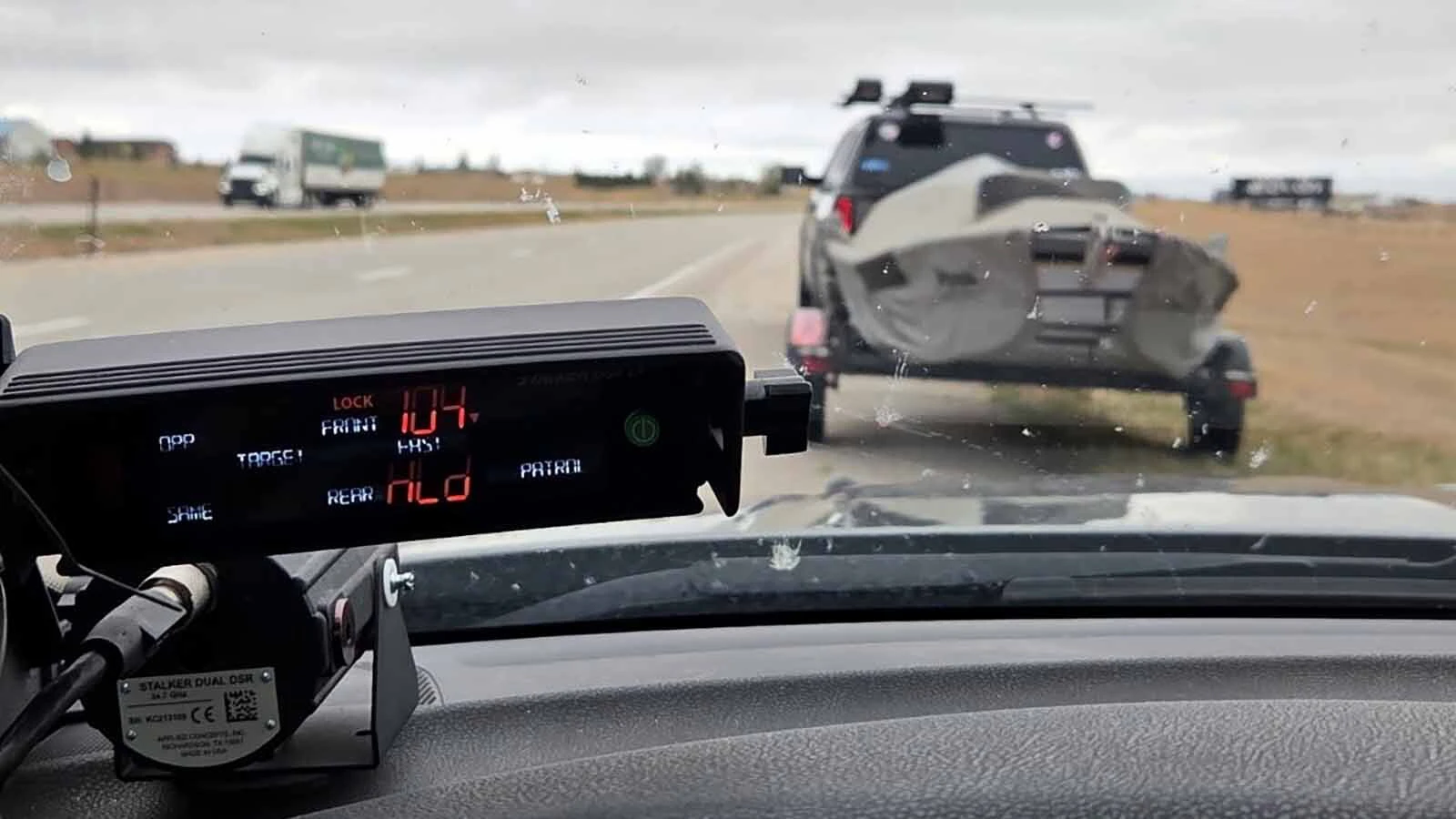
A driver eager to get to the water was clocked at triple-digit speeds while towing a boat on Interstate 25 — a decision Wyoming Highway Patrol troopers say could have ended far worse than a speeding ticket.
The driver swas topped traveling 104 mph in an 80-mph zone while pulling a boat on I-25 just south of Wheatland on Friday, according to the Wyoming Highway Patrol.
The agency reported that the traffic stop likely added about 20 minutes to the trip and resulted in a $180 fine.
But some observers said the driver got off easy, wondering why a situation that risky didn’t automatically lead to jail for the person hauling a boat that fast.
Troopers say the answer is simple: speed alone doesn’t decide criminal charges or trigger an arrest.
Speed Multiplies Problems
For people who haul boats regularly, the risks of high-speed towing aren’t theoretical. They’re real, and they show up fast.
Steve Stadelmaier, sales manager at Bellwood Boats in Glendo, Wyoming, recently hauled a new boat and trailer more than 1,200 miles from Texas back to Wyoming.
Even with new equipment, he said, caution is non-negotiable.
“Our boat was brand-new, we had a brand-new trailer, everything was good, so we drove 80 mph with no issues,” Stadelmaier said, adding he would never go as fast over the speed limit as the driver the WHP busted.
Many trailers on Wyoming roads aren’t fresh off the lot. They often sit for months — and sometimes years — exposed to sun, cold, and weather that slowly weakens critical components, he said.
Pushing the limits of a trailer at 104 mph is asking for trouble.
“A lot of times, boat trailers don’t get pulled a long way,” he said. “Let’s say a guy lives in Wheatland and his tires might be 10 years old. Your rubber is going to be compromised if they’ve been sitting out in the sun.”
At highway speeds, those hidden weaknesses can turn into emergencies in seconds.
“The faster you go, the bigger the problem,” Stadelmaier said. “If it [a tire] blows out at 108, you’re going to have a major issue.”
Even at legal speeds, the added weight of a trailer changes how a vehicle behaves, he said. Stopping distances get longer. Brakes work harder. Tires heat up faster. Bearings can fail.
“The first thing you need to do is make sure your bearings are in good condition,” Stadelmaier said. “Do an inspection — even if you’re only going 20 miles down the road.”
If a bearing overheats and locks, a wheel can seize or detach entirely, a scenario that can send a trailer swerving across lanes.
The danger isn’t limited to the wheels.
Inside the boat, a loose gear can shift or launch during travel, he said, adding that coolers, life jackets, and equipment can become projectiles. Outboard motors can be damaged while maneuvering through tight turns or steep ramps.
“We’ve seen it all,” Stadelmaier said. “Once a week in the season, we’ll have people come in — countless times — where a guy may be running a tandem trailer with four tires. One is blown out, bearings are shot.”
His advice is straightforward: don’t assume your trailer is ready for the road just because it worked last year.
“Make sure your lights work, make sure your tires are in good shape, and pay attention to the lifespan of the tires,” he said. “Nobody’s going to recommend that you speed, but even if you’re a responsible driver going the speed limit, bad things can happen if your equipment is not ready to be on the road.”
Once speeds climb far beyond the limit, he said, the margin for error disappears quickly.
“If you go from 80 to 108, a lot of bad stuff can happen,” Stadelmaier said.
No Magic Jail Speed
Some commenters online questioned why a driver clocked at more than 100 mph while towing a boat didn’t automatically face jail time.
Wyoming Highway Patrol Public Information Officer Aaron Brown said there is no specific speed in Wyoming that triggers jail on its own.
“There is not a speed at which you automatically go to jail in Wyoming,” Brown said. “That’s not how the laws are set up.”
That includes situations involving trailers or boats.
“It makes it more dangerous, but not how we are going to ticket it, because of how the laws are set up,” he said. “When it comes to ticketing, there are things that are up to the trooper.”
Instead, charges escalate when behavior crosses into reckless driving, legally defined as operating a vehicle in willful or wanton disregard for safety, he sais. That decision depends on the total circumstances, including traffic, road conditions and risk to others.
From a safety standpoint, Brown said towing at high speeds introduces a long list of variables that can quickly stack up.
“There’s issues like sway, the stopping distance, tire failure — it always depends on the situation,” he said. “There’s probably not a single situation that is going to be the same as the next.”
In this case, he said one potential danger that many drivers overlook is tire speed ratings.
“With the small wheels, he probably exceeded the speed that the tires were rated for,” Brown said. “He could have blown out a tire in this case. You can wear out the bearings.”
Improper loading is another common risk, Brown said.
"That’s a pet peeve for troopers — folks not properly balancing the load on their trailer,” he said.
Others include speeding, skipping inspections, overloading trailers, and ignoring wind warnings.
“Ignoring wind closures is one of the most dangerous things you can do in Wyoming,” Brown said.
While crashes involving boat trailers aren’t the most frequent incidents on Wyoming highways, speed remains one of the deadliest factors.
Troopers say the lesson from this stop isn’t complicated. Getting to the lake a few minutes faster isn’t worth the risk of turning a weekend trip into an emergency.
Kolby Fedore can be reached at kolby@cowboystatedaily.com.