
CHEYENNE — A bill to crack down on people who defy legislative subpoenas sparked a pointed debate on the Wyoming Senate floor Tuesday, with one senator warning that lawmakers were handing themselves "authoritarian power" without basic safeguards to prevent its abuse.
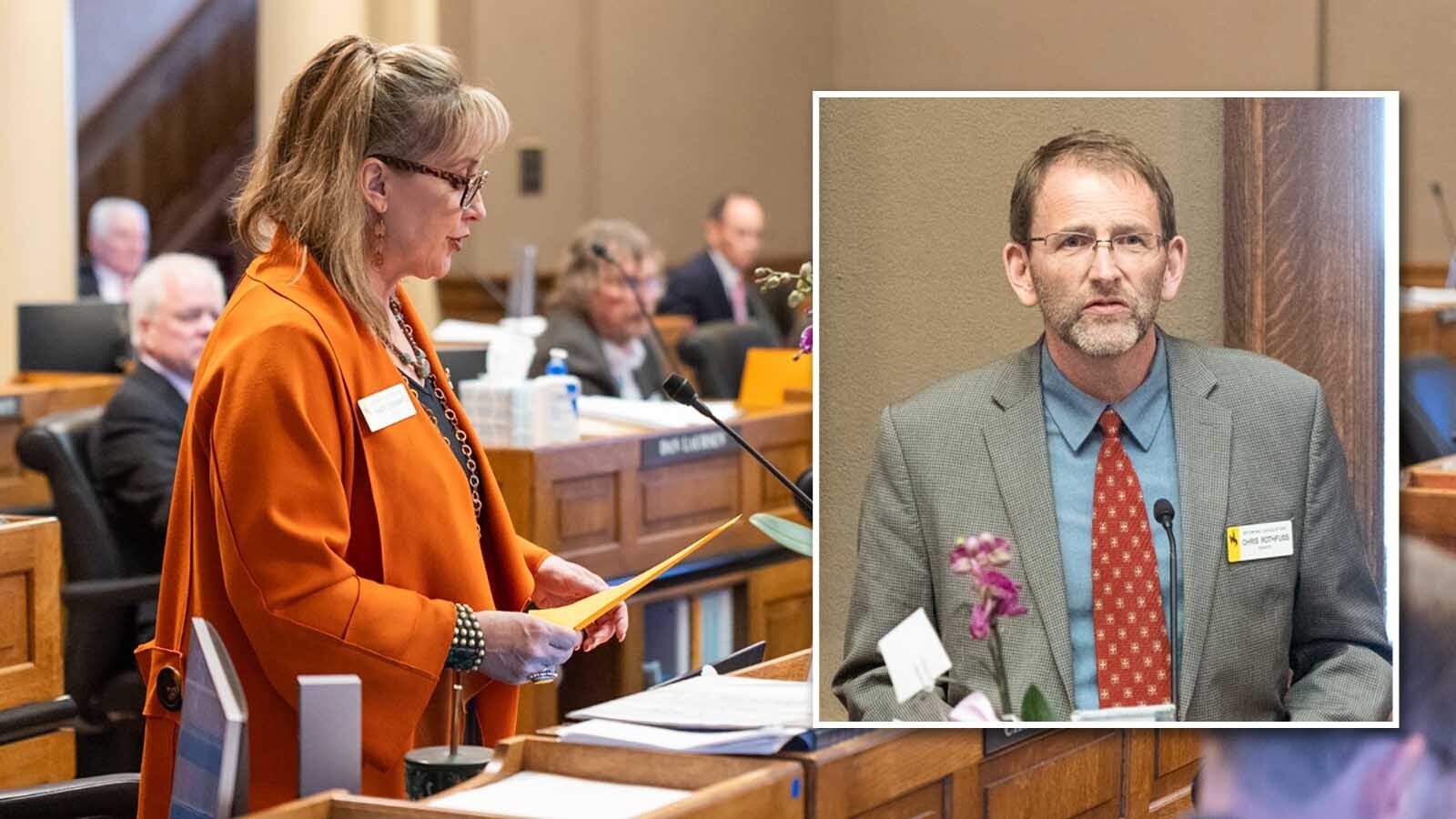
Sen. Tara Nethercott, R-Cheyenne, told colleagues that in the case that prompted House Bill 83 — the subpoena of Weston County Clerk Becky Hadlock during an investigation into her handling of the 2024 election — Hadlock responded and offered to appear on alternative dates, only to be rejected.
Nethercott estimated Hadlock received roughly a week's notice before being ordered to appear.
"We're not going to give you any notification. We're not going to ask you, and we're not going to give you any alternative options," Nethercott said. "You will show up when we command you to because we are the Management Audit Committee of the Wyoming Legislature and we have given ourselves this authoritarian power.
"Is that what we want? Is that the policy decision we're going to make here? Is that how we treat our citizens?"
Nethercott questioned whether any procedural steps — such as a prior request to appear or a minimum notice period — should be required before a committee can compel someone to testify under threat of criminal penalty.
HB 83 was indeed a product of the Management Audit Committee. Hadlock did not appear to answer her subpoena last year. She was subsequently charged with failure to appear, a misdemeanor carrying a maximum penalty of $100 and six months in jail.
As introduced, HB 83 would have raised the fine to $750 while keeping the six-month jail term. But the Senate Judiciary Committee adopted an amendment elevating the penalty to a $1,000 fine and up to one year in prison — crossing the threshold into felony territory.
Sen. Jared Olsen, R-Cheyenne, told colleagues the increase was modeled on federal law.
"The federal contempt of Congress penalty … is up to a $100,000 or one year in prison," Olsen said. "We are not asking for a $100,000 fine. We're asking for a $1,000 fine, but we're asking for a year in prison, which is exactly what the federal law asks for."
Heated Exchange
The debate turned contentious when Sen. Chris Rothfuss, D-Laramie, rose to oppose the amendment, arguing the Management Audit Committee had acted vindictively in the Hadlock case.
He told his fellow senators the committee voted to subpoena Hadlock without first calling to ask whether she could attend, and that when she responded saying she was unavailable and offered alternatives, the committee rejected her request.
"This was a political vote by a Management Audit Committee," Rothfuss said. "It wasn't an interim topic. They had an axe to grind, they got mad at somebody, they subpoenaed them, again — for the first time in my knowledge or understanding — and what we would do if we moved forward this amendment would be to say, 'Wow, you're not just committing a misdemeanor because you've made a few politicians mad, you're a felon because you've made a few politicians mad.'"
That drew a point of order from Sen. Cheri Steinmetz, R-Torrington.
"I feel this line of speaking is inflammatory to the committee that had these hearings," Steinmetz said. "And being from a county that I represent that is an affected county, I think it's wrong to impugn the committee, their intentions, their motivations."
Committee of the Whole Chairman Sen. Cale Case, R-Lander, overruled the point of order, saying it was "a really good point on debate, but I'm not sure that it rises to a point of order to interrupt the speaker.”
Rothfuss continued, saying as a member of the Management Audit Committee himself, the decision to subpoena Hadlock without first simply asking her to attend was "absurd."
"The idea that we would make that individual a felon, based on the level of judgment that I saw going into that decision is exactly, Mr. Chairman, why I'm on and against this amendment," he said.
Middle Ground
Sen. Charlie Scott, R-Casper, offered a more measured take, saying the current $100 penalty was clearly insufficient but expressing doubt about going as far as it being a felony-level offense.
He noted the Legislature's authority to hear impeachments could someday require an enforceable subpoena in a hurry.
"I do think that some raise in the penalty is appropriate," Scott said.
Sen. Jim Anderson, R-Casper, was among those voting against the amendment, calling a one-year prison term "way too long for this violation … way too long.”
Sen. Bob Ide, R-Casper, reminded colleagues the subpoena power already existed in statute, and the bill was simply adjusting the penalties “making them a little stronger.”
Past Precedent
The Weston County case was not the Legislature's first brush with the subpoena question.
Sen. Brian Boner, R-Douglas, recalled Tuesday that he had served on a joint standing committee that issued a subpoena several years earlier — a case involving the state lands office.
Boner said the committee had hoped to question the attorney general at the time, who had previously served as director of the Office of State Lands and Investments.
Not only did the attorney general decline to appear, Boner said, but she also "advised that members of the board of land commissioners to not show up to the committee meeting as well.”
That was a reference to former Attorney General Bridget Hill, who in 2022 told the Legislature's Agriculture Committee she "wasn't interested" in testifying about a state land leasing decision she made while serving as OSLI director.
The Agriculture Committee voted 10-4 to subpoena Hill, but the committee's term expired before the Management Council could approve an additional meeting to enforce it.
“It just kind of fizzled out,” said Boner.
Sen. Jeff Crago, R-Buffalo, raised a separate statutory question about which legislative bodies actually have independent subpoena authority, noting the word "body" in the governing statute could be interpreted to limit the power to the full Senate or House rather than individual committees — except for the Management Audit Committee, which has a specific statutory carve-out.
Final Vote
The standing committee amendment elevating the penalty to a felony passed on a standing vote with at least 16 senators in favor.
HB 83 subsequently passed the full Senate and both chambers of the Legislature, and could take effect July 1.
The bill had drawn no opposition and no public testimony when the House Corporations Committee heard it on Feb. 11. It passed that committee 9-0.
Committee Chairman Rep. Christopher Knapp, R-Gillette — who also chairs the Management Audit Committee, under whose authority the Hadlock subpoena was issued — told his colleagues at the hearing that the bill grew directly from the Weston County investigation.
"We did have four subpoenas this year in management audit and I think it's important … I did call them in advance and let them know what the subpoena was for and why," Knapp said. "Gave them the opportunity to appear both by in person and by Zoom to make it convenient for them."
Only one of the four refused to appear, Knapp told the committee, "which kind of led us to this bill of increasing the penalty on subpoenas."
Knapp said the ability to compel testimony is critical when the Legislature exercises its oversight function.
"When we're fact-finding information, it is important especially in an oversight committee to have the entity in front of us to be able to ask questions and find those answers," Knapp said.
The Roll Call Vote
HB 83 passed the Wyoming House unanimously on Feb. 21.
The Legislative Services Office had not posted the exact vote tally in the Wyoming Senate by deadline, but Sen. Case, the presiding chair, noted that at least 20 senators voted aye.
David Madison can be reached at david@cowboystatedaily.com.


