
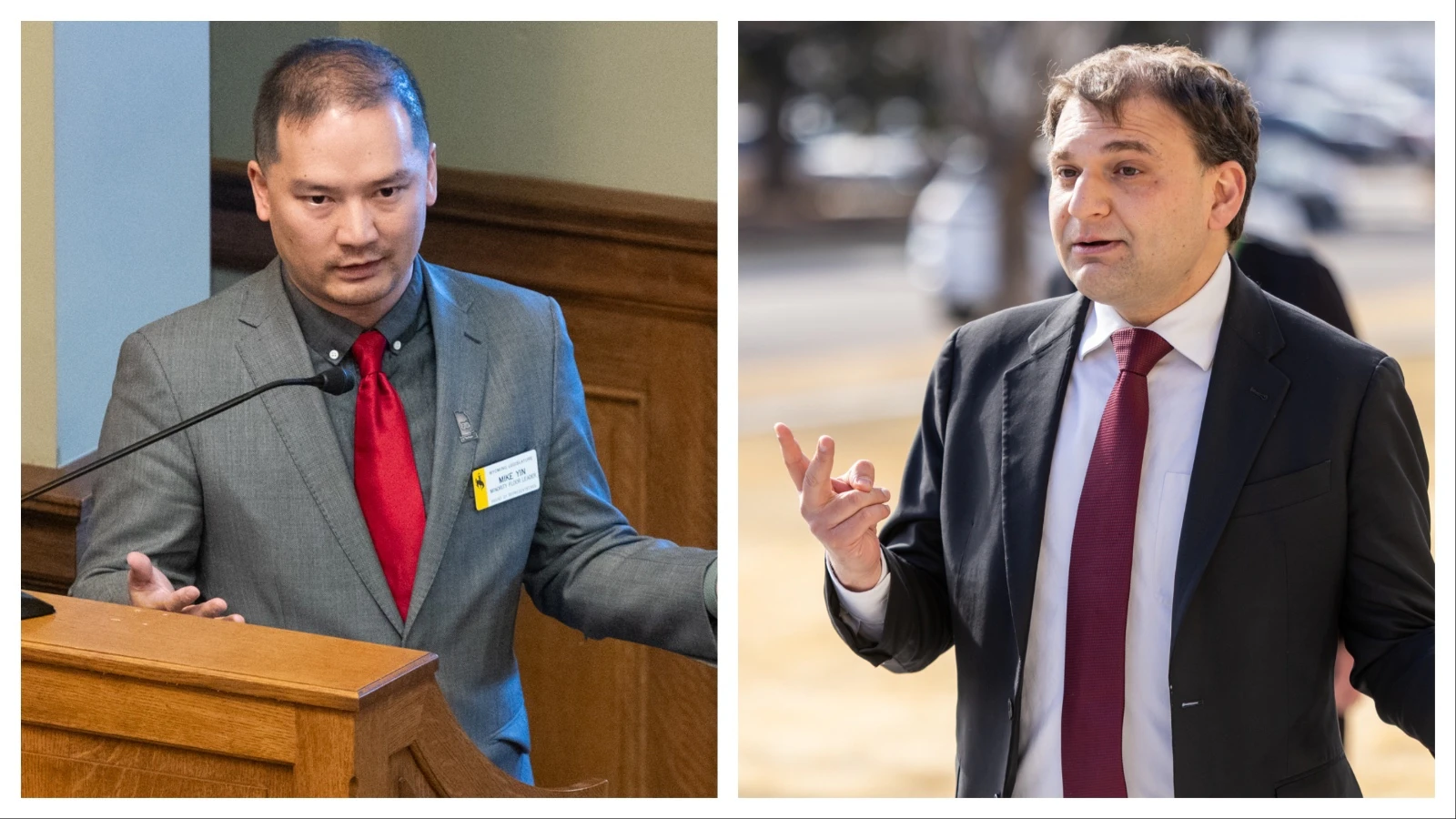
Now Wyoming lawmakers are pushing to ban voters from changing party affiliation for seven months of the election year beginning, instead of three months as the law now reads.
The conceptual bill draft directive came Friday during the legislative Joint Corporations, Elections and Political Subdivisions Committee meeting in Lander. It sets the committee up to consider the proposal in greater detail at its September meeting.
The maneuver follows years of controversy about a practice — called crossover voting — by some Democratic voters of registering to vote as Republicans to influence the GOP primary, which is Wyoming’s most decisive election across its top offices.
The Legislature in 2023 passed a bill banning voters from switching parties between about mid-May and the primary election in mid-August of each election year.
Before then, people could change parties at any time, including at their polling places on the day of the primary.
Secretary of State Chuck Gray on Friday urged legislators to expand the party-switching ban, which he called a “lockout,” to start Jan. 1 of each election year instead.
“One of my asks of this committee is for us to strengthen that lockout to Jan. 1 of the election year,” said Gray.
Rep. Joe Webb, R-Lyman, asked the Legislative Service Office to turn the idea into a bill draft. The committee majority approved that motion via voice vote.
What About Teton County?
But first, Rep. Mike Yin, D-Jackson, bristled.
“Mr. Secretary, when I hear you say ‘strengthen this lockout,’ that speaks to me as restricting people’s freedom to affiliate however they want,” said Yin.
Many people in the audience applauded.
Yin called for silence, saying it’s not appropriate for people to clap at committee meetings.
Yin referenced a presentation Gray had given earlier that meeting showing that “crossover voting” numbers are down from both 2018 and 2022 — and since the 2023 passage of the ban on changing party affiliation between the months of May and August.
“What I think you’ve seen in the reduction of affiliation changes is that people are just staying Republican,” began Yin. “It’s causing a problem in my county.”
Yin’s home of Teton County is Wyoming’s only consistently blue county, where Albany County is more of a mix of Democratic and Republican regions, and all other Wyoming counties are strongly Republican.
But Teton County voters have to choose between influencing who sits on the county commission and who sits in other offices when they pick a party and vote in primary elections, Yin lamented.
Though Teton County votes consistently for Democratic candidates for major offices, its registration numbers say a majority of voters have registered as Republican.
Registered Democrats can sway Teton County’s often-Democratic-leaning county commission races, but they can’t sway the hotly-contested GOP primary elections featuring prominent gubernatorial, congressional, and other statewide office races.
Wyoming has not elected a Democratic governor since 2006. It hasn’t elected a Democratic U.S. House representative since 1976.
“It creates an issue now across the board, where voters can’t always choose the candidates they want to,” Yin said. “I guess, why are you interested in making it harder for people to decide what races they want to participate in?”
Gray countered.
“I view it as an election integrity issue,” said the secretary, adding that the Legislature has made clear that in Wyoming, partisan primary elections unfold, “with the qualified electors choosing who is going to represent the party they’re affiliated with.”
Gray said he understood Yin’s points about Teton County voters.
“My answer would be, those individuals that are truly Democrats should remain in their party if they so choose to,” he said.
Ultimately, the committee directed staffers to draft the “lockout” bill, and to re-draft 12 more election and party-related bills that died in past legislative sessions.
Gray had called for 15 election and party-related bills altogether, but two of those did not galvanize Friday into re-draft directives.
Single-Party State
Gray said extending the party switching lockout would align Wyoming more with Kentucky, which he called the “strongest” in this area of policy since it bans party changes starting Dec. 31 before an election year.
Sen. Bill Landen, R-Casper, countered.
Kentucky has just had its primary election, while Wyoming’s isn’t until mid-August.
“I didn’t realize we’re not comparing apples to apples here. We’re comparing with Kentucky,” said Landen.
Gray emphasized that the Jan. 1 date in the conceptual draft is “just a starting point,” and that truly aligning with Kentucky would put Wyoming’s new party-change deadline at about April 1.
It was May 13 this year.
Senate Corporations Chair Cale Case, R-Lander, cast it as a bad policy idea to expand the party-change freeze.
“A lot of people in two thirds of the year change their minds,” said case. “That’s a long time to think about something, or to have events happen in the country or in your state and be able to respond to those events.”
Earlier in the meeting, Case had raised another concern — that limiting people’s ability to affiliate would clash with First Amendment issues.
“It would seem to me the most significant way we petition our government and drive the direction is through the voting process,” said Case. “And when you lock people out of choosing a party to effectuate their representation, you’re frustrating their ability to assemble and petition their government.
“So, it’s a First Amendment issue.”
The U.S. Constitution promises the general election date.
But in Wyoming, most contenders reach that general election by winning the primary election.
“The winner of the (GOP) primary — because we’ve become a single-party state — will be the winner in November most of the time,” said Case. “The reason that the (crossover) numbers have dropped is because they don’t have a choice.
"They’ve moved to the Republican party so they can have a choice.”
Case said he’d fight any effort to move the crossover deadline to Jan. 1. But even if that bill succeeds, he said, people would just switch before that deadline.
The ‘Blue’ County
Teton County voters numbered 6,434 Democratic and 5,773 Republican on the general election date of 2020.
By the general election of 2022, registered Republicans more than doubled registered Democrats in the county, at 9,050 Republican-registered voters to 4,222 Democratic.
That was the year a fiery contest unfolded between then-U.S. Rep. Liz Cheney, who’d pushed for President Donald Trump’s impeachment, and now-Rep. Harriet Hageman, whom Trump has repeatedly endorsed.
Hageman won Wyoming’s vote in a landslide that year. But in Teton County, Cheney voters more than tripled Hageman voters.
As of May 1 this year, registered GOP voters in Teton County still outnumber Democrats by about 2,500.
Crossover Voting Down
Statewide, crossover voting numbers have “declined a great deal since the passage in 2023 of the 90-day lockout, which I supported,” Gray told the committee.
In 2018, about 6,000 Democrats switched to Republican, 4,000 unaffiliated voters switched to Republican and “smaller numbers” of voters switched the other direction, Gray had told the committee.
The numbers plumed in 2022.
But around 20,000 people switched parties, Gray noted.
This year, 1,732 Democrats have switched from Democratic to Republican, and 1,017 have switched from unaffiliated to Republican, he said. Voters switching the other way are in “a lot smaller” quantities, he added.
Clair McFarland can be reached at clair@cowboystatedaily.com.


