
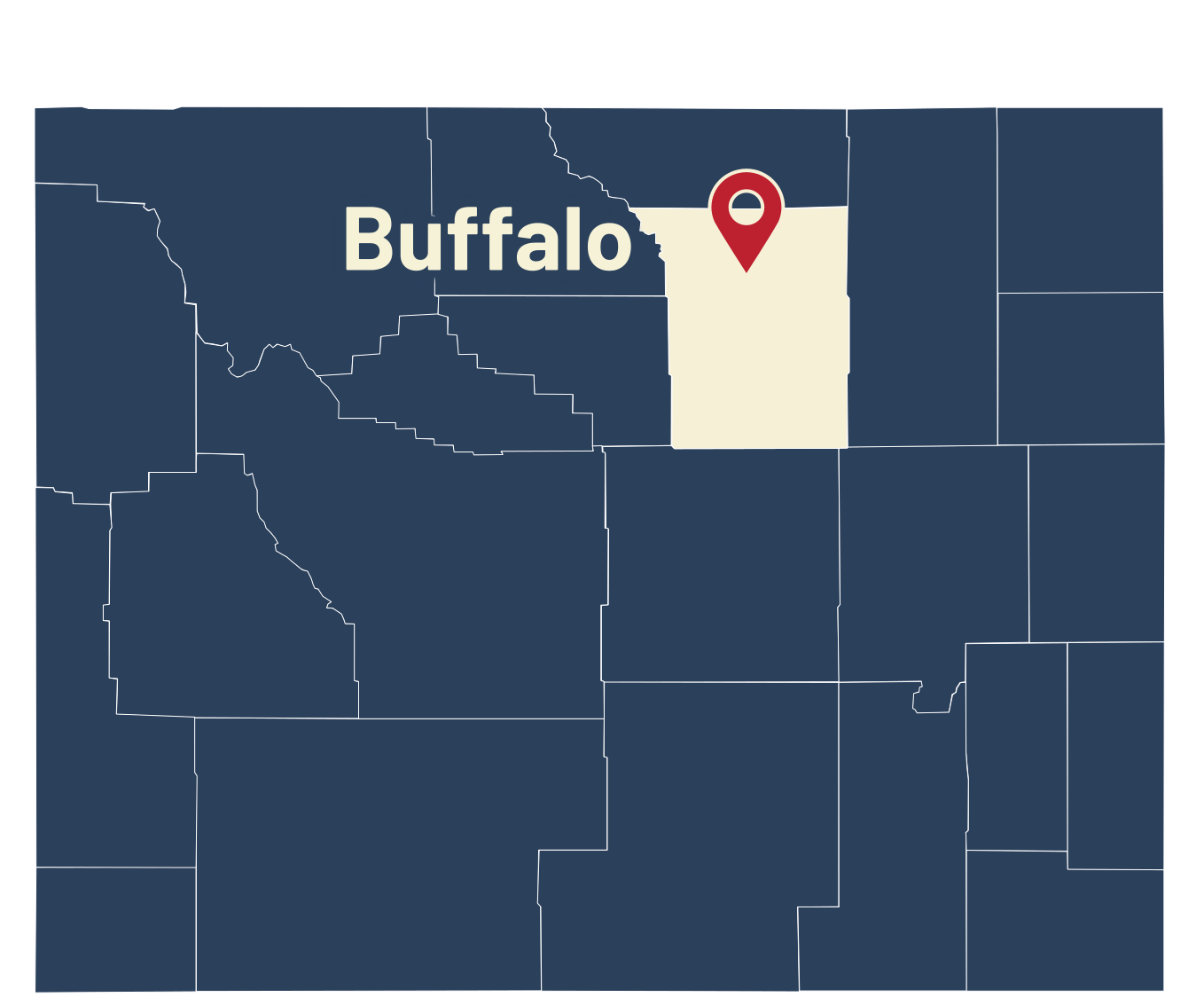

Wyomingites can encounter many strangely beautiful things in the Bighorn Mountains. The abandoned castle among the cottonwoods near Buffalo might be one of the strangest.
The medieval-style structure, still standing near Clear Creek, west of Buffalo, was once a vital piece of infrastructure for the community.
It was designed to bring European beauty to an unromantic necessity at the end of the 19th Century. Like the great castles of Europe, it still stands as a historical relic, despite outliving its intended purpose.
Beck And The Brewery
Buffalo was founded in 1879 as a popular hangout spot for travelers heading to the nearby Fort McKinney, a U.S. Army post built to protect the Rock Creek Stage Line from attacks by the Cheyenne and Lakota Sioux.
As Buffalo grew, so did the need for public infrastructure. When Wyoming became a state, more industrious individuals wanted to build businesses in its small communities.
One of those businesses was the Buffalo Mill Company, incorporated in 1887. Buffalo resident Charles Vance Lucas provided a detailed account of its history in 1970, which is preserved at the Johnson County Library.
“I’m quite certain that it was typical of pioneers (that) if they thought they needed a flour mill, to go and build a flour mill,” he said.
Clean water is a necessity for a flour mill. George Beck, a prominent Buffalo settler, decided to pull water from Clear Creek and build the mill where another entrepreneur, John Fischer, built a brewery in 1882.
From the beginning, Beck was planning and thinking ahead. He knew, eventually, that he wanted more than a water-powered flour mill.
Thomas Edison patented the incandescent electric lamp (which he did not figure out while fishing near Encampment) in 1880. Beck intended to implement that exciting new technology as soon as practicable.
“In the beginning, the equipment in this flour mill was operated with water power,” he said. “Beck and the other men who were associated in this venture had in the back of their minds that one of these days, they would expand and develop electric energy for this area, (so) they also applied to be permitted to hold land for mill and other purposes.”
The original flour mill was built of locally produced brick just outside Buffalo’s city limits.
Pipes carried water from Clear Creek to an open ditch, where it was funneled into an enclosed conduit, called the dynamo, and carried down into the mill building to run the water turbine, generating power to process wheat into flour.
“The headgate was 117 chains from the flagpole at Fort Kearney, which probably was adequate in those days, but who knows today where the flagpole was,” Vance said. “Maybe if someone gets real curious sometime, they’ll try to find it.”
The U.S. Army abandoned Fort McKinney in 1894, 20 years before a castle would replace it.

The old hydroelectric plant along Clear Creek just outside Buffalo, Wyoming, now looks like a tiny abandoned medieval castle. It's actually one of the most important historic buildings from the city's early history. (ruthless raws via YouTube, screenshot from video) 
The old hydroelectric plant along Clear Creek just outside Buffalo, Wyoming, now looks like a tiny abandoned medieval castle. It's actually one of the most important historic buildings from the city's early history. (ruthless raws via YouTube, screenshot from video) 
The old hydroelectric plant along Clear Creek just outside Buffalo, Wyoming, now looks like a tiny abandoned medieval castle. It's actually one of the most important historic buildings from the city's early history. (ruthless raws via YouTube, screenshot from video) 
The old hydroelectric plant along Clear Creek just outside Buffalo, Wyoming, now looks like a tiny abandoned medieval castle. It's actually one of the most important historic buildings from the city's early history. (ruthless raws via YouTube, screenshot from video) 
The old hydroelectric plant along Clear Creek just outside Buffalo, Wyoming, now looks like a tiny abandoned medieval castle. It's actually one of the most important historic buildings from the city's early history. (ruthless raws via YouTube, screenshot from video) 
The old hydroelectric plant along Clear Creek just outside Buffalo, Wyoming, now looks like a tiny abandoned medieval castle. It's actually one of the most important historic buildings from the city's early history. (ruthless raws via YouTube, screenshot from video)
Flour Power
In 1899, Beck sold the Buffalo Flour Mill to H.P. Rothwell and Frederick Hesse. They incorporated it into the newly established Buffalo Manufacturing Company.
H. Rothwell was remembered as “an aggressive go-getter.” A German immigrant, Rothwell was invested in ranches, banks, and other industries in Buffalo and Thermopolis, hoping to accelerate and capitalize on the communities’ growth.
By then, the original flour mill had fallen into disrepair. Rothwell immediately began improving and expanding the three-story structure, starting by electrifying the mill in 1900 and capitalizing on Beck’s foresight.
Locally grown wheat was brought to the mill for distribution in bulk quantities. Two grades of flour, “Acme” and “Patent,” were sold in cotton sacks that customers could use to make everything from towels to underwear.
“This country was very productive in the early days, especially where they had water,” Vance said. “They raised a lot of wheat, oats, quantities of hay, and some barley, but because of transportation difficulties they couldn't move it too far in order to make a sale, so it was brought there and sold here.”
Buffalo’s flour was of such high quality that it won awards at the 1903 World’s Fair in St. Louis, Missouri, and the 1905 Lewis and Clark Centennial Exposition in Portland, Oregon.
Meanwhile, copper wires were extended from the mill to Buffalo’s city streets, providing electric lighting to the small town. Buffalo’s first hydroelectric power plant was built next to the mill soon after to meet the growing demand.
This made Buffalo one of Wyoming’s first communities, and one of the first west of the Mississippi River, with electricity.
The same year that the mill was electrified, Rothwell hired Marshall Bell to manage the electrical side of the enterprise. He became a long-term fixture at the plant, living adjacent to it with his wife and two daughters.
It was all well and good – until 1912, when Clear Creek flooded and destroyed $50,000 of flour stored on the mill’s elevators. It happened so fast that Bell had to climb through a window to save himself from being submerged inside.
After the flood, Rothwell wanted to protect his investment and infrastructure. What better way than with a castle?
Castle And Moat
Buffalo’s second hydroelectric plant was erected on the same site as the original in 1914. Rothwell commissioned a local contractor, Leonard Burger, to build it.
Information on the power plant's construction is scant, but Rothwell is credited with its unique design. He wanted it to reflect the grandeur of European architecture, specifically medieval castles, and as the financier, he got what he wanted.
To prevent future flooding, the new construction included a dam on Clear Creek and new pipes to carry water from the dam to the hydroelectric plant. Meanwhile, the City of Buffalo built a tall concrete retaining wall to fortify the plant, adding to its castle-like qualities.
The final addition to the new plant was a home for Bell and his family.
By 1914, flour mill operations were secondary to meeting Buffalo’s electricity needs. As Buffalo’s electricity demands grew, running the plant became a 24-hour operation.
“Mr. Bell used to let me pull the mill whistle sometimes, if I happened to be there at noon,” Vance said. “Mr. Bell got up at 6:00 in the morning and started this generating equipment. It ran all day, and then he had to be there at midnight to shut it off. One man took care of the whole thing all the way through for a long time.”
The new castle-like hydroelectric plant would continue supplying power to Buffalo, even though it quickly fell behind the growing demand.
“That, too, got inadequate,” Vance said. “The increasing demand for electrical energy outmoded these things pretty rapidly.”
Under Siege
Around 2 a.m. on March 31, 1920, a fire broke out in the flour mill. The Buffalo Bulletin described it as “the worst fire in 20 years.”
The structure was nearly engulfed by the time Buffalo firefighters arrived. Freezing temperatures hampered their efforts, quickly turning the water they sprayed onto the flames into ice.
The fire was severe, but the all-important dynamo was saved, preventing Buffalo from losing its electricity.
Rothwell got an insurance payment to rebuild what was left of the flour mill, but he had lost much of his go-getter spirit by then. An economic recession in 1919 cost him a fortune, and the mill only operated for a few more years before it was shut down for good.
“They had that wonderful flour,” Rothwell’s wife, Sophie, told The Buffalo Bulletin in 1974. “I thought I could never bake as well again after that.”
In 1927, Rothwell sold the hydroelectric plant and utility rights to Mountain State Power Company. They converted it to diesel power soon after, ending the original dynamo's 46-year run.
In 1933, Rothwell sold the mill and shuttered the Buffalo Manufacturing Company. He spent his retirement in Buffalo until his death on May 11, 1940.
What remained of the flour mill was demolished after the foundations collapsed in the 1970s. Bell’s home was burned in 1990 as a drill for the Buffalo Volunteer Fire Department.
Pioneers And Visionaries
Today, all that remains of the industrious enterprises along Clear Creek are Rothwell's castle and the cottonwood trees that grew alongside it.
It's the final bastion preserving an important place in Buffalo’s early industrious history.
"A lot of the beautiful old cottonwood shade trees we have here in Buffalo were watered with that 25-cent water from the plant," Vance said. "Norman Davis was referred to as a 'water man' because he went down there to the creek with a water tank, dipped water out of the creek, and sold it to the homes in Buffalo for 25 cents a barrel.
"Somebody’d go out and pay for that water so those trees would survive."
The historical irony is that the purely aesthetic castle-like structure also marks the spot of the actual military fortification, Fort McKinney.
Vance praised Beck, Rothwell, and Buffalo’s other pioneers as “visionaries.”
They anticipated the community's growth and designed the Buffalo Flour Mill and hydroelectric plant to meet their needs in the moment while building for Buffalo’s future.
“They weren’t living just for today,” he said. “They had a wide knowledge of many things, and they were thinking about what was coming in the future.
"The more you associate yourself with what went on in those days, the more convinced you are that the people who came out to this as pioneers were also visionaries.”
Andrew Rossi can be reached at arossi@cowboystatedaily.com.


