
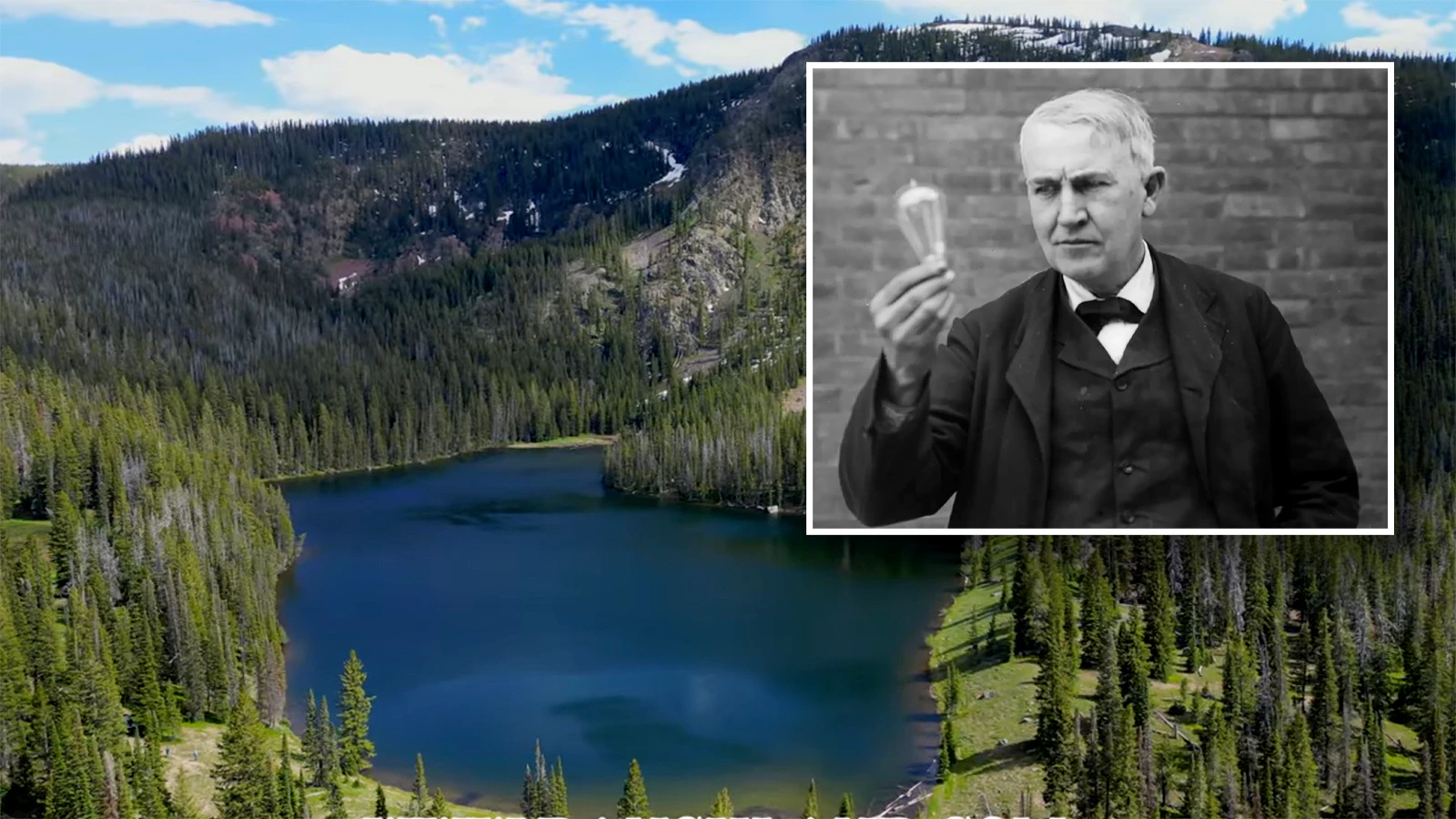
Thomas Edison, one of the most renowned inventors in history, was once asked about how much trial and error it took to make the phonograph, the light bulb, and hundreds of other revolutionary devices.
He famously said, “I have not failed 10,000 times — I’ve successfully found 10,000 ways that will not work.”
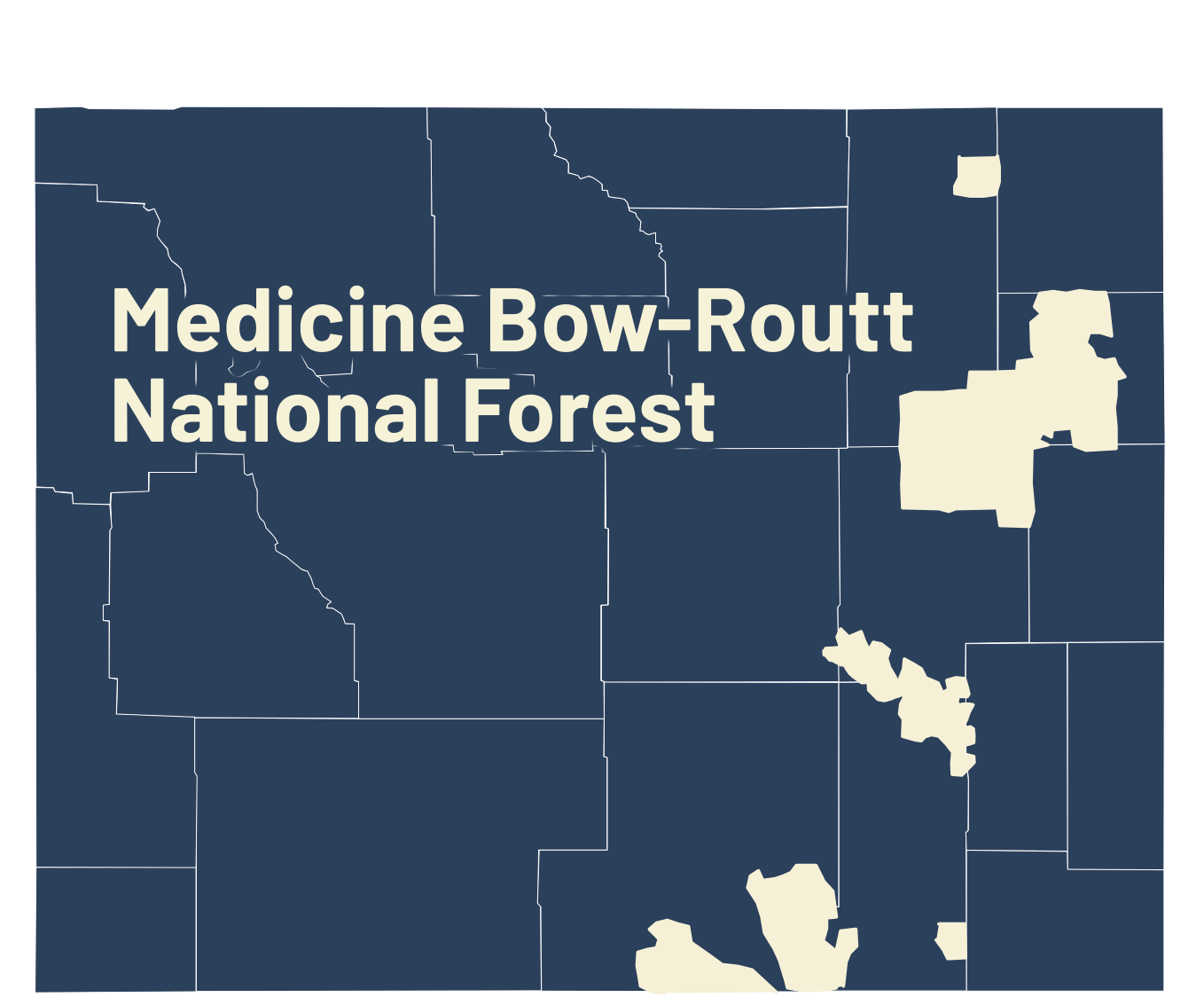
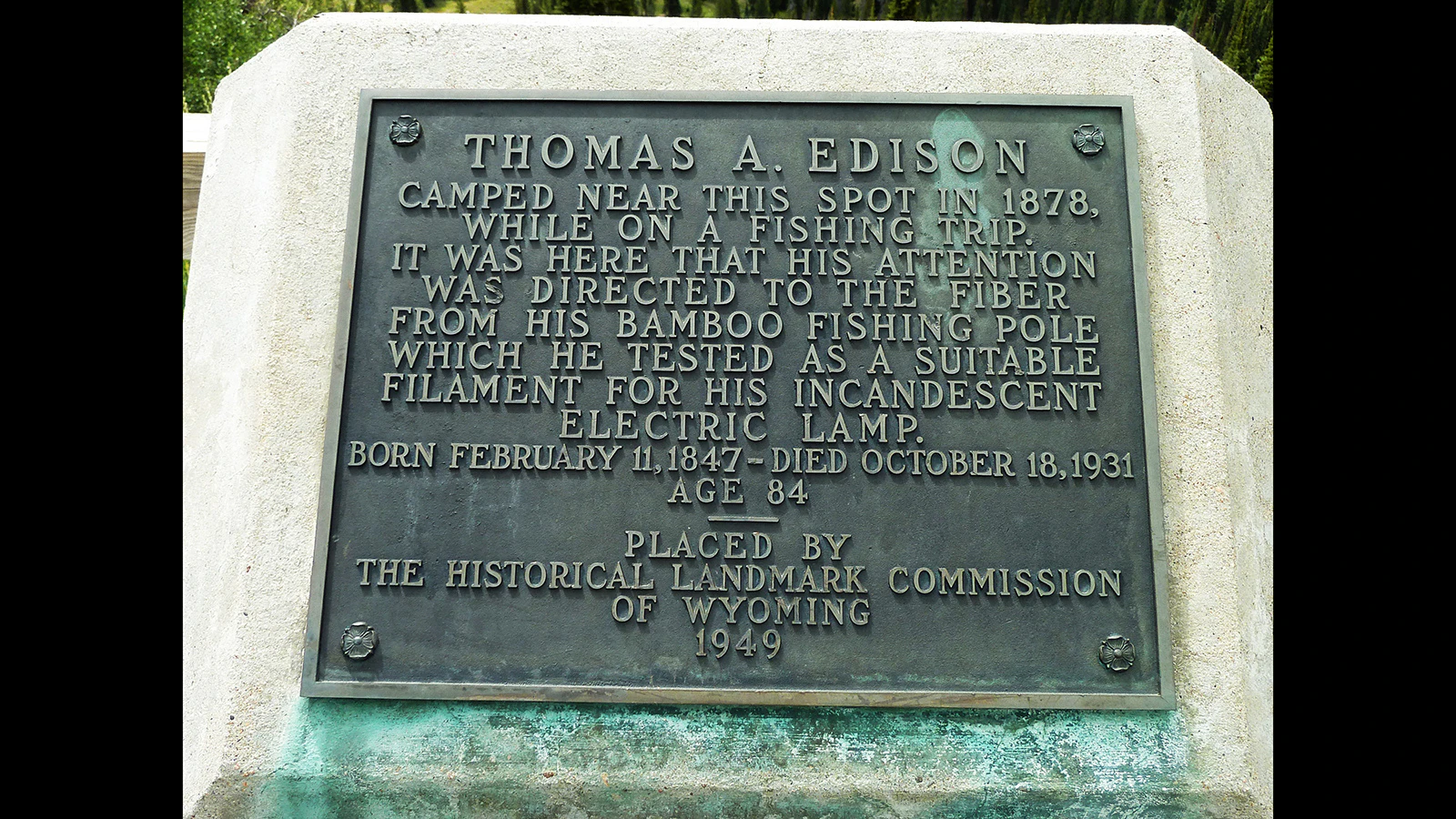
According to legend, Edison was enjoying a fishing trip on the shores of Battle Lake near Encampment on what is now the Medicine Bow-Routt National Forest in July 1878, when he found the 10,001st solution that led to the success of the incandescent electric lamp.
When his fishing pole fell into the campfire, Edison noticed how the ends of the bamboo fibers began to glow and kept glowing.
Later that night, Edison conveyed to his friend, George Barker, that he’d had a "eureka" moment.
“I wasn’t thinking about resting,” he told Barker. “I lay and looked up at the beautiful stars and clear sky light, and I invented an incandescent electric light.”
Soon after, Edison patented the incandescent electric lamp in 1880. His design used a filament made from carbonized Japanese bamboo, which lasted more than 1,200 hours before burning out.
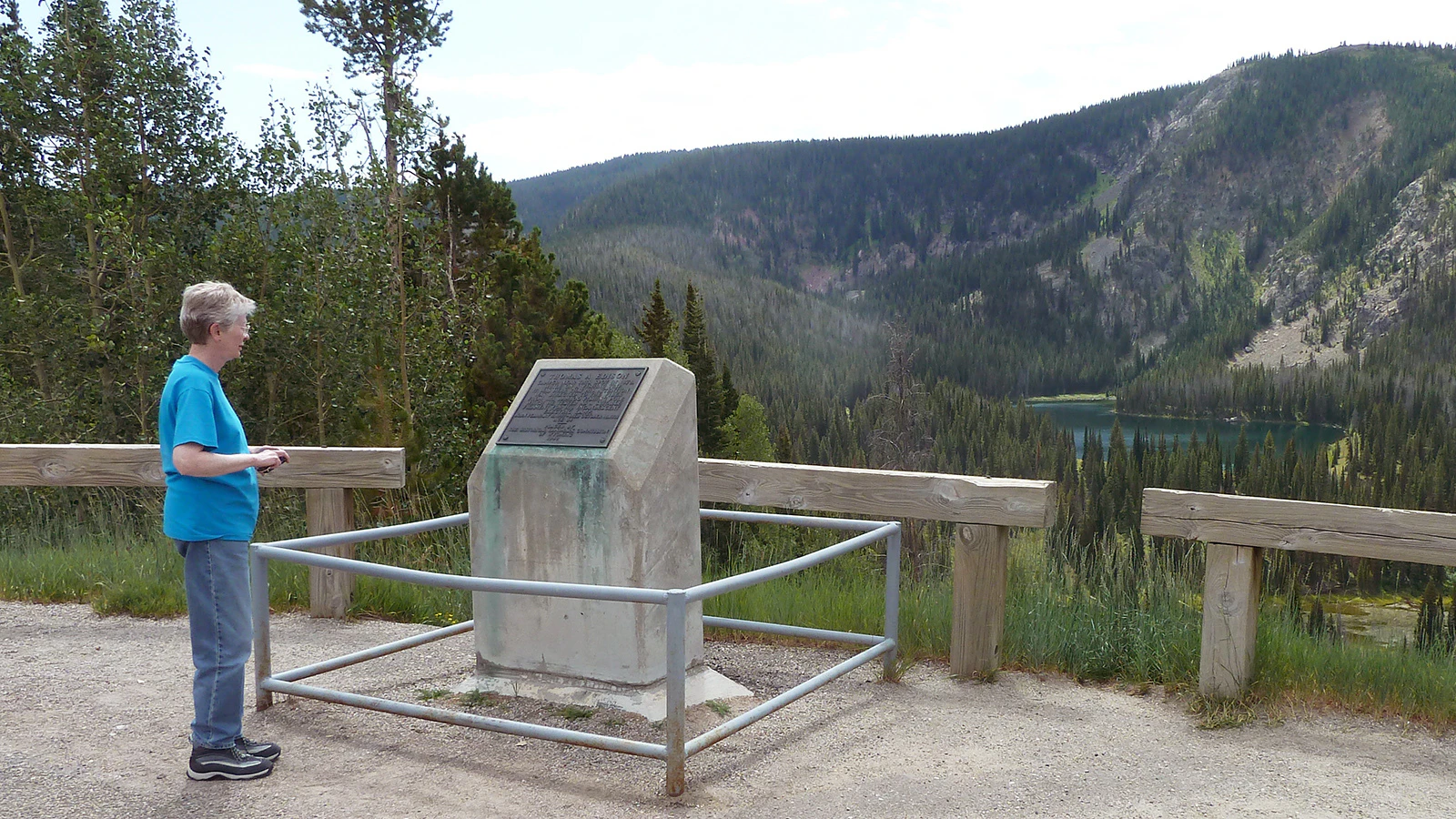
It was such a momentous moment in American history that the Historical Landmark Commission of Wyoming placed a plaque to commemorate this discovery overlooking Battle Lake in 1949.
It’d be an amazing story — if any of it were true.
“There are many stories regarding this incident, and while it is very interesting, it is a myth,” Kathleen Carlucci, museum director at the Thomas Edison Center at Menlo Park in New Jersey, told Cowboy State Daily.
Embellishing The 'Eureka!'
Like many historical figures in American history, much of what people know about Thomas Edison has been embellished or mythologized. The real man didn’t shine as brightly as his legacy would suggest - look up Topsy the elephant sometime and prepare to be horrified.
The Battle Lake story is one of those myths.
Wyoming historian Phil Roberts explored the origins of the story in “Edison, the Light Bulb and the Eclipse of 1878,” posted on wyohistory.org in 2014. Much like the successful filament used in the incandescent electric lamp, many threads have been woven together into something that works.
For one thing, the story's timeline doesn’t align with documented history. Edison didn’t “solve” electric lighting until a year after his trip to Wyoming.
“Arc lighting had been successfully demonstrated at the Paris exposition that summer of 1878,” Roberts wrote. “Edison knew of these experiments, but it was more than a year after his Wyoming visit and after the expenditure of $40,000 that he came up with the solution to incandescent lighting.”
The first successful filament, which was included in the 1880 patent, was woven out of “cotton and linen thread, wood splints, (and) papers coiled in various ways.” Edison and his team didn’t discover that carbonized Japanese bamboo was a much better material until later that year.
Edison didn’t try and fail 10,000 times to find the best filament, but he did try more than 6,000 materials before one of his inventors brought him wild-growing Hachiman bamboo from Japan.
If Edison was so inspired by his burning bamboo fishing rod in Wyoming, why did it take two years and 6,000 experiments before recognizing the potential of bamboo?
According to Roberts, the story of Edison's eureka moment while "looking at the stars" over Battle Creek came from an individual who claimed to have been with Edison and Barker during their Wyoming excursion, but it wasn't shared until 40 years later.
That individual got several easily proven historical facts wrong, which undercuts their credibility.
“(He) recalled years later that Major T. T. Thornburgh was with the group,” Roberts wrote. “He said a messenger called Thornburgh away to join the White River expedition against the Ute tribe in Colorado, where the major was killed.”
Thomas Tipton Thornburgh was killed during the Battle of Milk Creek on the White River Ute Reservation, but that was on Sept. 16, 1879, over a year after Edison’s fishing trip in Wyoming.
“Historical evidence indicates that the story is simply a myth,” Roberts wrote.
Edison In Wyoming
The fact behind the fiction is that Edison was in Wyoming to test a new invention during the summer of 1878.
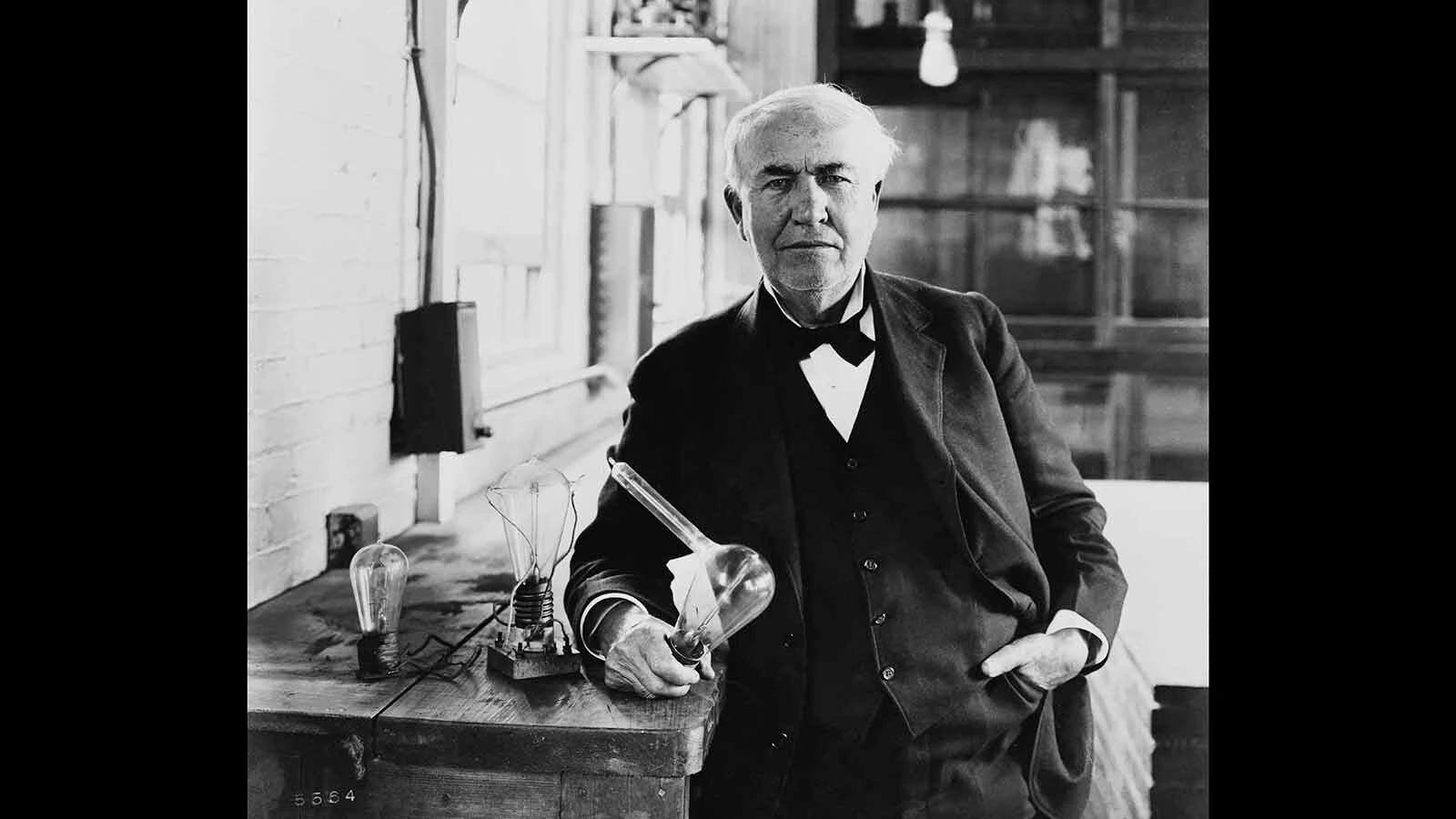
By July 1878, Edison, then 31, was already a national celebrity with more than 200 patents. His first famous invention, the phonograph, was created in 1877 and given a live demonstration at the National Academy of Sciences in Philadelphia in April 1878.
Through a clever public relations strategy, Edison used the press and live demonstrations to get the public excited about the phonograph. It was around this time that he began to be called “the Wizard of Menlo Park,” in reference to his New Jersey workshop.
In July, Edison traveled to Rawlins for a total solar eclipse with a group of astronomers. The local press covered his entire journey from New York City to Rawlins.
Edison intended to test his newly designed microtasimeter during the eclipse. It was a device for measuring infrared radiation, which would hopefully detect any temperature changes in the Sun’s corona during the eclipse.
Edison arrived in Rawlins on July 19. His first night in Wyoming was memorable, as Edison himself recalled many years later.
“After we retired and were asleep, a thundering knock on the door awakened us,” he said. “Upon opening the door, a tall, handsome man with flowing hair, dressed in Western style, entered the room. His eyes were bloodshot, and he was somewhat inebriated. He introduced himself as ‘Texas Jack’... and he said he wanted to see Edison, as he had read about me in the newspapers.”
“Texas Jack” proceeded to do his own live demonstration for Edison by shooting a weathervane off the top of a building with his revolver.
The total solar eclipse occurred on July 29. Edison’s microtasimeter confirmed there were temperature changes in the sun’s corona during the eclipse, but couldn’t measure the extremes.
Edison ultimately abandoned the microtasimeter and, in an unusual move for him, never patented it.
After the eclipse, Edison and George Baker left Wyoming for San Francisco. When they returned to Rawlins two weeks later, they spent some time hunting and fishing on Muddy Creek, near Encampment.
“Today Professor Edison … left Rawlins on a grand fishing tour on the Big Muddy, seventy miles south of (Rawlins),” the Laramie Daily Sentinel published on Aug. 12, 1878. Edison was accompanied by several people from the Union Pacific Railroad.
The Laramie Weekly Sentinel published an update on Edison’s trip on Aug. 24, 1878, saying they returned from their Big Muddy trip after “a very pleasant hunt and fish, killing many elk, deer, antelope, etc., and bagging about 3,000 trout.”
Edison had actually left Rawlins by train on Aug. 19. There were no other mentions of Edison until the Sept. 6, 1878, issue of the Daily Sentinel, where the paper said he had yet to invent “a lens through which other people’s children will look as angelic as their own.”
Aside from that burn, there were no mentions of fishing rods, bamboo, or incandescent electric lamps.
Light Of Reality
It’s true that Edison didn’t earnestly begin working on electric light, which would make him one of the most famous inventors in history, until after he returned from Wyoming. However, there’s nothing factual to indicate that experience had anything to do with it.
Edison’s actual eureka moment was reported by the New York Herald on Dec. 21, 1879. It described how Edison was fiddling with a filament, specifically compressed lampblack, until he had rolled it into a thin wire that he tested to “satisfactory” results.
That led to the first successful test of Edison’s incandescent electric lamp on Oct. 22, 1879. A filament of carbonized cotton thread in a bulb burned for 13.5 hours.
Edison’s hunch that carbon thread was the key to making electric light work paid off, scientifically and commercially. Light bulbs with carbonized bamboo filaments were sold by the millions until they were replaced by filaments made of rare-earth metals at the beginning of the 20th Century.
Perhaps Edison got the idea of using carbon thread from Carbon County. Based on historical records, it’s about as likely as the fishing pole in the fire story.
Nevertheless, the legend persists. The Carbon County Museum has a mural of Edison, Battle Creek, and the incandescent lamp, along with other artifacts associated with Edison, to commemorate the enlightening moment that never happened.
“The recollection was reported more than 40 years after the event supposedly occurred and is not substantiated by any other source,” Roberts wrote. “This statement probably was the basis for a tale that Edison invented the light bulb at Battle Lake.”
Andrew Rossi can be reached at arossi@cowboystatedaily.com.


