
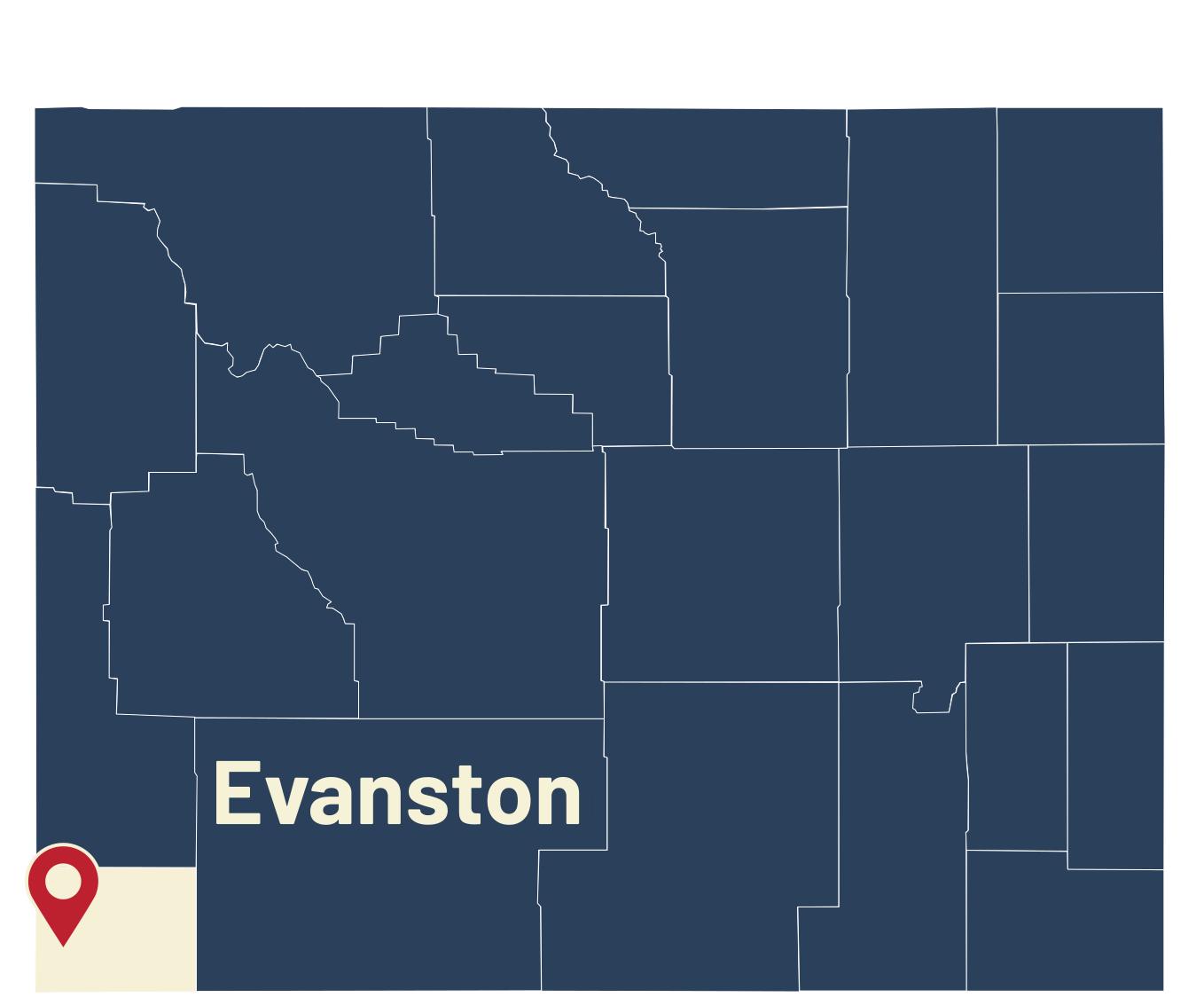

When a struggling brewery's plan to occupy the Evanston Roundhouse fell through, it threatened to leave the city in the lurch without a tenant after a decades-long nearly $30 million renovation saved the building from the wrecking ball.
Now the city has scored a new tenant for Section Four of the Roundhouse. Internationally acclaimed spirits maker Alpine Distilling is relocating its headquarters and the bulk of its production from Park City, Utah, to Evanston’s historic roundhouse.
A love for trains helped seal the deal, Alpine Distilling’s Sara Sergent, who owns the company with her husband Rob, told Cowboy State Daily.
“Basically, Rob and I walked into the roundhouse and fell in love,” she said. “We walked into the space and just those beautiful windows and saw the way the light was hitting certain segments of the floor.
“I could see the distillery growing and expanding there. And about the same time there are trains going by outside. It was pretty magical.”
Sergent, who is Alpine’s master distiller, is among the most decorated botanical distillers in the world. Her company has won Gin of the Year in London, double gold at Top50 in New York, Best in Class at the TAG Global Spirits Awards in Vegas and more.
Alpine Distilling’s spirits are distributed in 44 states and, as the company’s new headquarters, Evanston will be home to the bulk of that production.
Sergent said the company will keep a tasting lounge and a microdistillery in Park City, but the rest was packed up and moved to Wyoming. She expects the five-person setup team in Evanston to grow to about 12 employees by mid-2027.

A Higher-Proof Turnaround
The turnaround for the city began around May or June, Evanston Community Development Director Rocco O’Neill told Cowboy State Daily.
Shades Brewing, which had agreed to occupy Section Four, was experiencing business difficulties, O’Neill said, but was still paying the agreed-upon rent and keeping the city informed.
“We sat down about May or June of this year and really sort of realized that maybe it wasn’t feasible for either party moving forward,” O’Neill said. “So, it was mutually agreed upon that we would terminate the lease, and that would allow the city to pursue another tenant for that space.”
Alpine was already shopping for a new location to expand its distilling operation at the time. Evanston was at the top of its short list.
“We’ve had an eye open for expansion for a couple of years,” Sergent said. “And our whole family, we’re huge fans of Wyoming and Evanston. We do a lot of outdoor activities here. We love winter yurt camping and things of that nature.”
As it was a frequent destination over the years, it was natural to look around Evanston for places that might be a good new home. Discussions with city leaders eventually led the Sergents to the Roundhouse.
“The Roundhouse is the best sales tool in the history of the world,” O’Neill said. “Once you walk in there, you’re just googly-eyed because it’s just an amazing space.”
After the first visit, serious negotiations began and a long-term lease was hammered out.
“Our Evanston home is an exciting next chapter as we begin our next 10 years,” she said. “We’re here for the long haul and we’re very excited.”

Why The Roundhouse Is Special
Evanston’s Roundhouse is the last fully intact roundhouse on the Union Pacific main line, O’Neill said, and one of relatively few intact examples left in the country.
As Cowboy State Daily reported in May, Megan Stanfill, executive director of the Alliance for Historic Wyoming, estimated that about 200 of the roughly 3,000 roundhouses built in America remain, with perhaps a dozen fully intact.
Saving the building took decades of work by city and community leaders, preservation advocates, donors and volunteers. Former Urban Renewal Agency director Jim Davis estimated the restoration investment had reached about $28 million by his retirement in 2014.
But saving a building and finding sustainable uses for it are separate challenges.
The city has used Section One as a conference and convention space for the past 20 or so years. That left much of the 60,000-square-foot building awaiting a new purpose.
A 2016 feasibility study identified food and beverage production as a practical alternative, particularly for Sections Three and Four. In 2023, the sale of a city-owned industrial building to Clean Energy Fuels added just over $2 million to an economic development investment fund that already had about $1 million.
With that funding backing it up, the city decided it would get Section Four tenant-ready. That included utilities, seismic and structural improvements, fire suppression, electrical and mechanical systems, and parking and loading facilities.
O’Neill estimated the resulting space was about 80% built out, leaving the tenant to supply finishes and business-specific improvements.
Those improvements remained useful even after the brewery deal ended, and the city didn’t have to wait long to fill the space.
The public investment will take time to recover, O’Neill acknowledged.
“It’s probably a 20-plus year return on investment,” he said.
Alpine is paying a near-market lease rate, he added, and that money will return to the city’s economic reinvestment fund to help support future development.

Alpine Distilling is moving its headquarters to Evanston, Wyoming. (Sara and Rob Sergent, Alpine Distilling) 
An elevated gin & tonic. (Sara and Rob Sergent, Alpine Distilling) 
An espresso martini made with Alpine Distilling liquor. (Sara and Rob Sergent, Alpine Distilling) 
Alpine Distilling is moving its headquarters to Evanston, Wyoming. (Sara and Rob Sergent, Alpine Distilling)
The Spirit Behind The Spirits
Sergent is bringing an international reputation with her to Evanston. She’s studied gin in Scotland and done botanical work at Cornell.
Her private gin-making clients include St. Regis, Rolls-Royce, and the Auberge Collection, along with collaborations with roughly two-dozen top-level chefs.
The James Beard Foundation named her a 2026 semifinalist for Outstanding Professional in Beverage Service for her work at Alpine Distilling Social Aid & Pleasure Club in Park City.
She was also inducted as a Warden Rectifier in the London Gin Guild in 2024. This is a rare honor granted only to select members.
Sergent said she’s the 504th since 1497 to earn the honor.
Her beginnings were significantly less formal — and a lot more fun.
Her grandmother Lois loved a gin and tonic and a good story.
As a teenager, Sara would sit with her grandparents on the back porch after dinner, sipping her grandmother’s botanically infused iced tea while they enjoyed their cocktails and she told her stories.
Her grandfather, for one, had helped develop the lunar module, while her grandmother had once ridden an ostrich.
“You talk about botanicals,” Sergent said. “My grandmother used to make this really great iced tea. She would pull the botanicals together and steep them in the sun all day. And so I just remember that was always a great glass of iced tea.”
Those experiences connected flavor and aroma with time spent learning about her grandparents — themes Sara and Rob have built into Alpine Distilling since opening 10 years ago.
“There’s all these fun things that are out there. The art of distilling really goes back to biblical times, so it’s really been part of history for a long time,” Sergent said. “In the beginning, they were trying to find an elixir for life, and then it would go into medicinal purposes.
"So at Alpine, we enjoy celebrating using alcohol as a vehicle to move flavor and aroma.”

What’s In Store At The Store
Most of Alpine’s Roundhouse space is devoted to manufacturing, but visitors won’t have to guess what is happening behind the scenes.
A glass-topped partial wall and a walkway around the production area will give people a view of the work.
“Everyone can see what’s happening in real time,” she said.
The company is planning open houses in November and December, with dates still being finalized. Those events will tie into a holiday “Kringle” market featuring local vendors and artisans. There will be no charge for participating artists or for attending visitors.
A kitchen and eatery are part of the 2027 plans.
No Evanston menu has been announced with specific items, but some of Sergent’s past culinary collaborations have included gin-soaked chicken skewers and Negroni macarons, as well as a chocolate collaboration involving barrel-aged cocoa nibs. Another project underway involves a blood-orange distillate that will become part of a marmalade.
Education is another element of Alpine’s approach. Its Park City lounge already offers custom gin-making experiences, and Sergent envisions similar opportunities in Evanston.
It’s not all about alcohol, she added. The company also makes nonalcoholic spirits. Whether a spirit has alcohol or not, the goal is always just enjoying flavor.
“We’re not a get-drunk company,” she said. “We’re not a 2 a.m. company.”
For the community, one of the best parts of the change is the establishment of regular hours when people can come enjoy the building without renting it or waiting for an invitation.
“It will have public operating hours where people can go in and enjoy Alpine Distilling’s products and really appreciate the history and architecture of the facility,” O’Neill said.
It’s also fitting that the building that once kept Wyoming trains moving and was a bedrock of Evanston’s economy will become a community gathering spot where family and friends can meet and toast the stories of their lives in Evanston.
Renée Jean can be reached at renee@cowboystatedaily.com.


