
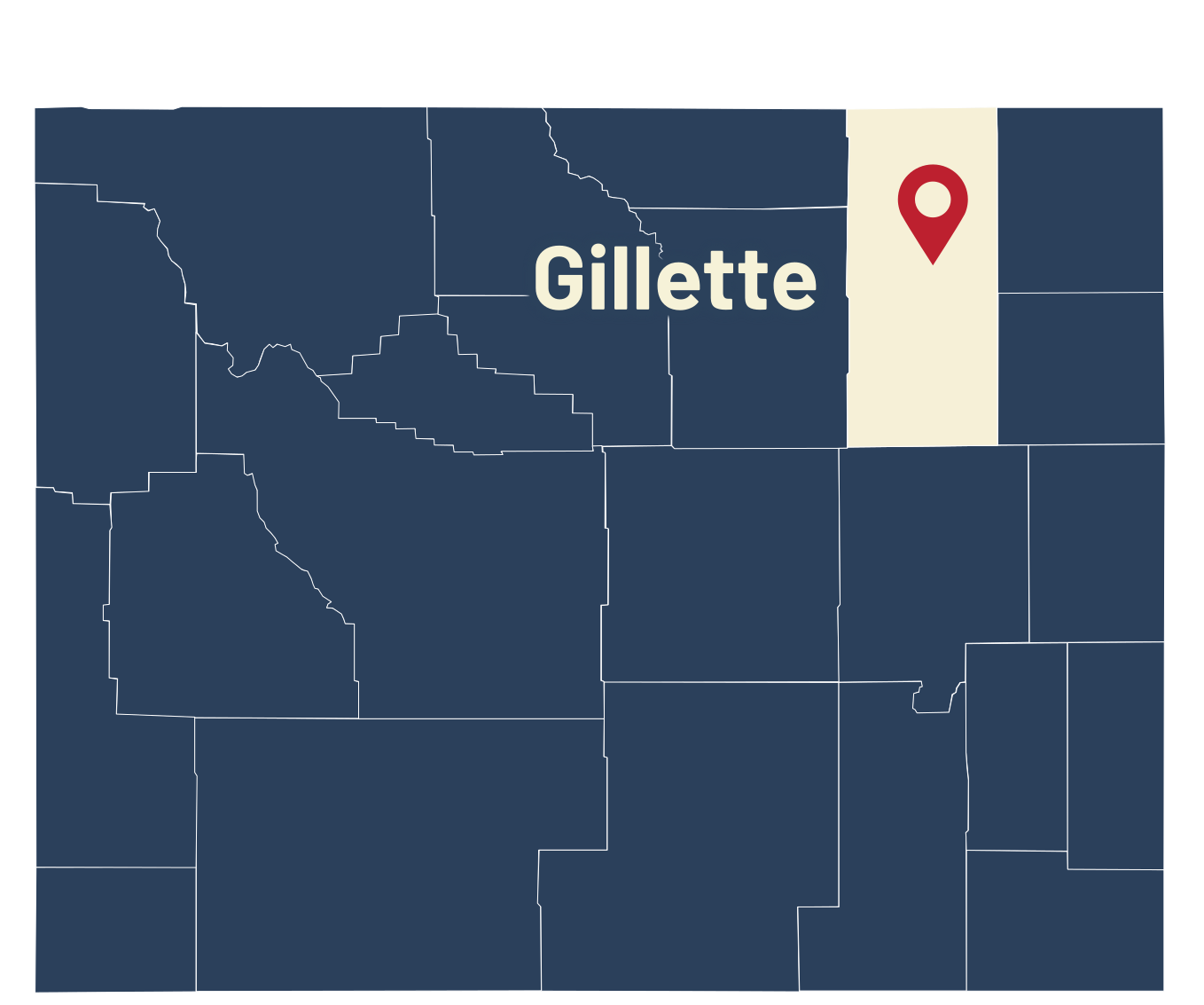

It’s been almost a year since Gillette flew the coop on the state’s minimum revenue guarantee, showing that a Wyoming airport can graduate from state-backed airline subsidies.
The question now is whether the four airports remaining in the program can follow suit.
The Wyoming Legislature recently approved $18.4 million for Wyoming’s Capacity Purchase Agreement (CPA), giving those communities a longer runway to get there. In short, money for airlines to guarantee service to airports.
About $12 million came from statewide lodging taxes, a nod to how important airport service is to the state’s tourism sector.
Wyoming’s minimum revenue guarantee for airlines was born amid Great Lakes Airlines’ collapse as well as a severe pilot shortage. Under the agreement, the state covers 60% of the revenue guarantee, while local communities pick up the remaining 40%.
In September, the National Association of State Aviation Officials honored Wyoming with an innovation award for the program.
Other states regularly call Wyoming Department of Transportation Aeronautics Administrator Shawn Burke to ask how to replicate the state’s program, he said.
Still, Burke cautions that Gillette’s Jan. 1 exit doesn’t mean all the airports in the CPA program are necessarily close to hitting the same milestone.
Cheyenne, Sheridan, Riverton and Rock Springs are all posting record or near-record passenger numbers. But fuller planes are just one aspect of the equation.
Those passengers still have to generate enough revenue to persuade airlines to shoulder the financial risk on their own.

What It Took To Graduate
Gillette’s success wasn’t just about filling seats, Burke told Cowboy State Daily.
“A lot of what airlines look for in smaller communities is the inelastic demands that are going to pay little bit higher fares,” he said. “So, we’re trying to get as close to market fares in some of these other markets as possible.”
Gillette has a strong energy sector that helped drive higher-than-average fares.
In the remaining communities, which have a different mix, it’s going to require more of a balancing act.
“Gillette is a blueprint in some regards, but each community is different,” Burke said. “It’s a blueprint in the sense that’s kind of where we’d like to see markets go.”
But those communities will need to strike the balance between keeping flights affordable and still covering the costs of providing them.
To walk away from subsidies, each community will also have to prove to United Airlines not just that they’ll break even, but that assigning a regional jet to them beats deploying that same aircraft somewhere else.
“I can take my airplane between Dulles (Washington, D.C.) and Albany, New York,” Burke said, explaining the airline’s calculus. “So what is the difference that makes it so it makes sense for me to fly between Denver and Rock Springs?”

Sheridan And Cheyenne Queuing Up
Right now, Sheridan and Cheyenne appear closest to making the business case for United to provide flights at their own risk.
Both markets have performed well enough that SkyWest, which operates the United Express flights, is adding four additional afternoon flights per week in mid-January. The airports are expected to have three daily round-trip flights by early June, with the expanded schedule continuing through the summer.
In Sheridan, passenger counts have climbed from just over 16,000 in 2019 to more than 60,000 in 2025, with planes flying near 90% capacity during peak summer months.
Thanks to that, rather than using up its $400,000 budget match this fiscal year, Sheridan actually received a $70,000 credit in July, when ticket revenue outpaced airline costs.
“We saw some very high fares in here last summer, which, like I said, I know is not popular locally, but that’s certainly a metric I think United’s going to look at,” Sheridan County Airport manager Robert Gill told Cowboy state Daily.
Limited seat capacity had been holding Sheridan back, he said.
He’s hoping the additional flight will help the community hold onto more of the passengers who have been traveling to either Billings or Denver for flights.

Denver Leakage Remains Huge
Sheridan’s not the only airport with high leakage to another airport. It’s a major problem in Cheyenne, where an estimated 94% to 97% of local air passengers choose to drive to Denver International Airport instead.
Cheyenne's flights are running at roughly 87% full, which Airport Director Doug Bullock said is a strong indicator that Cheyenne should be a strong enough market to for United at its own risk.
United has agreed to add a third flight, which Bullock hopes will underscore that idea.
“Give us a third flight, we’ll fill it up and we’ll demonstrate as a community that we can support that additional lift,” he said. He described the flight as the “culmination of several meetings with United, with SkyWest. It’s a big win for the community.”
Bullock, who just took the helm at Cheyenne’s airport about six months ago, hopes the airport can expand to destinations beyond Denver.
He sees incoming data centers and the relocation of the Professional Rodeo Cowboys Association as two factors that can help make that case.

Why ‘Butts In Seats’ Isn’t Enough
In central and southwest Wyoming, Riverton and Rock Springs have a steeper hill to climb.
Unlike Sheridan and Cheyenne, both markets were cut down to a single daily flight during the pandemic and have had to rebuild local flying habits once a second flight finally returned.
Southwest Wyoming Regional Airport Director Devon Brubaker said Rock Springs is seeing steady year-over-year growth in both passenger counts and average fares.
Still, United tracks more than just the number of seats filled on a 50-passenger jet.
“Obviously the butts in seats and buying the fares is important,” he said. “But how many are buying the premium seats, whether that’s economy plus, business class, first class, in each market? How many people in each market are MileagePlus members that have extensive loyalty to the airline? How many are using co-branded credit cards?”
Co-branded credit cards are playing an increasingly critical role in keeping airlines flying, Brubaker added.
“If you look at their financials, airlines today, the most successful airlines — United and Delta, specifically — they’re actually profitable because of their co-branded credit cards. If it wasn’t for their co-branded credit cards, they would actually be losing money as a company.”
The co-branded credit slice of the industry is continuing to grow, Brubaker said, and it’s part of an overall picture that airlines are considering when they decide where to deploy their jets.
“Butts in seats is the golden ticket,” Brubaker said. “But when you try to put together the complete package for an airline, they’re going to look at every one of those factors, especially as the profit side of flying becomes harder with higher fuel prices.”
Headwinds Are Real
Nationwide, jet fuel prices are averaging $4.80 a gallon, Brubaker said. That’s roughly double to triple what airlines were paying a year ago.
That’s squeezing margins across the industry — even as the collapse of Spirit Airlines earlier this year helped at least one metric: It eased an acute pilot shortage, Brubaker said.
Burke noted that planned job cuts at WE Soda could temporarily cool travel demand in Sweetwater County, stretching Rock Springs’ timeline.
At Central Wyoming Regional Airport in Riverton, meanwhile, passenger traffic reached 51,000 last year — a roughly 40% increase over five years, with flights roughly 75% full.
The community is working to fuel more growth by upgrading the airport to accommodate larger, 70-seat jets, Airport Director Bruce Ransom told Cowboy State Daily. Those larger jets will face fewer hot-weather weight restrictions near the mountains, helping boost flight consistency.
They’re also working to ensure consistent winter runway operations, as well as running a slate of television ads to promote the service. One of the television ads was so good, it actually won an Emmy, Ransom added.
Even so, United hasn’t given the community a single magic number that would guarantee them independence.
“I don’t think that the goalposts are set in one exact spot,” Ransom said. “Each community is going to be a little bit different.”
Beating Federal Subsidies
While Gillette is so far the only state-program graduate, Yellowstone Regional Airport in Cody offers a glimpse of both the promise and the limits of unsubsidized flying in Wyoming.
Cody isn’t part of the state Capacity Purchase Agreement. This year, United flew up to four daily Denver flights at its own risk from May through September and also offered a weekly flight to Chicago. The federal Essential Air Service (EAS) program subsidizes Cody’s flights from October through May.
That new Chicago flight was successful enough that United plans to keep flying it, Yellowstone Regional Airport Director Aaron Buck told Cowboy State Daily. In fact, it’s considering whether to add a mid-week flight to the existing end-of-week service.
“It’s all tentative right now,” Buck said. “But it’s in the works. There’s a chance to get that. I think it’s more than just a chance.”
To make the Chicago flight happen, Cody offered its own minimum revenue guarantee, with the state’s help, through WYDOT’s Air Service Enhancement Program.
Cody guaranteed United about $191,000 for the Chicago service, but the outcome was still promising enough that the airline is not only willing to continue the flight but is interested in adding another.
“There’s a lot of international travelers that want to get to Cody,” he said. “And Chicago allows that. So, there’s some demand there, and we saw a lot of growth in that with those travelers. Chicago is one of our fastest-growing markets with the (Yellowstone National) park.”
Thriving Airports Help Communities
For Buck and his counterparts across the state, the math behind the subsidies to airports comes down to what happens on the ground when commercial flights disappear.
Across Wyoming, aviation supports more than 21,000 jobs and more than $3.5 billion in annual economic activity — from $36 million in central Wyoming to more than $80 million around Cody — alongside medical flights, aerial firefighting, and time-critical cargo for mines and manufacturers.
“You show me a thriving airport, and I’ll show you a thriving community,” Buck said. “If we can get the airports thriving in all these locations, we’re going to get our communities thriving. So that’s the whole goal of the CPA. That’s the whole goal of being part of the EAS that I am in and doing MRGs is to grow the airport to be thriving so that our communities can thrive.”
Renée Jean can be reached at renee@cowboystatedaily.com.


