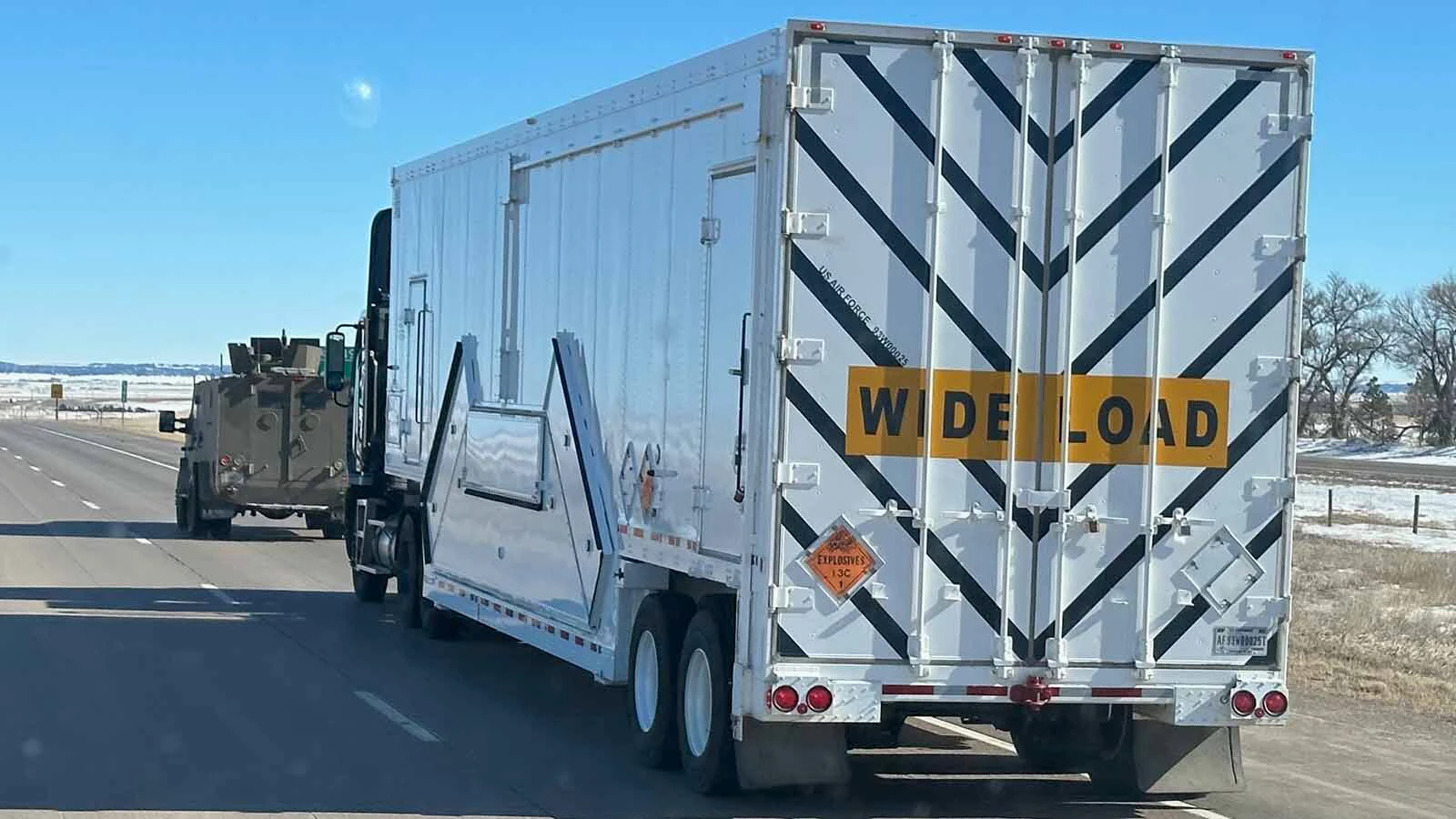
For those who’ve ever wondered what’s in those industrial-looking semitrailers with military escorts seen driving from time to time on Interstate 80 through Wyoming, it could’ve been a nuclear missile.
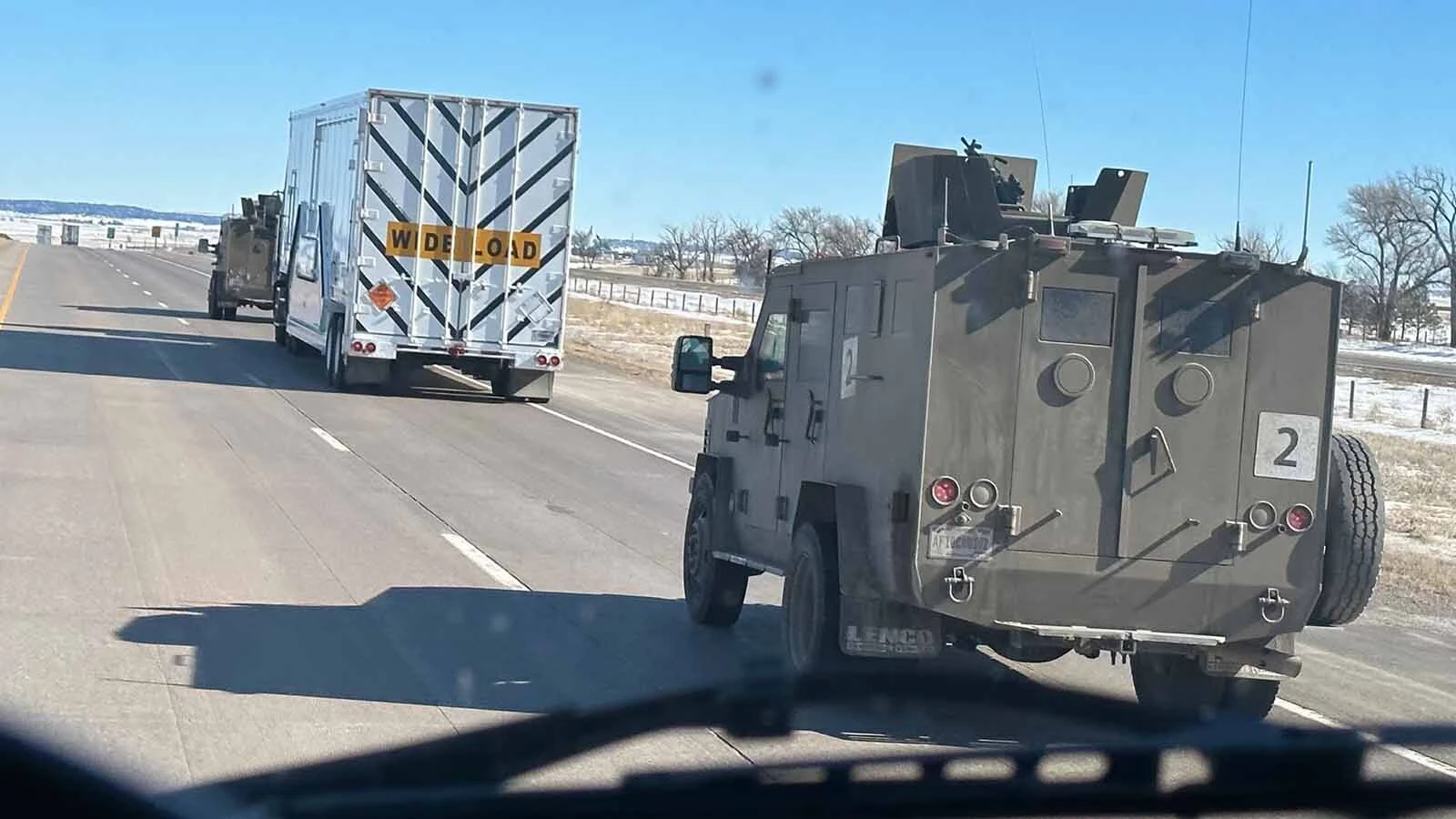
Semitrailer driver Roberto Figueroa wondered that while on I-80 near Burns one day. He saw a semi hauling a uniquely shaped tractor-trailer, escorted by several armored vehicles and helicopters overhead.
“I didn’t know what it was at the time,” he told Cowboy State Daily about the 2023 encounter. “They were heading east towards Pine Bluffs, Nebraska, with local police, state police, and a white pickup truck. It looked like a presidential escort.”
The convoy crawled along the right lane of I-80, but Figueroa and other drivers could freely pass it in the left lane, which Figueroa found surprising.
“I would imagine that they'd block the roads, but cars and trucks were passing like normal,” he said.
Only after he passed the convoy did he start to notice the unassuming patches of fenced-off land throughout Wyoming, Nebraska, Colorado, and Montana.
He realized those were the active missile silos for the Minuteman III nuclear missiles.
Figueroa said the whole encounter was “super-exciting” while wondering how much the driver was being paid to haul around the components of an intercontinental ballistic missile.
“These fuel haulers think they got a bomb in their back, while this guy had a nuclear warhead,” he said.
Payload Transporter
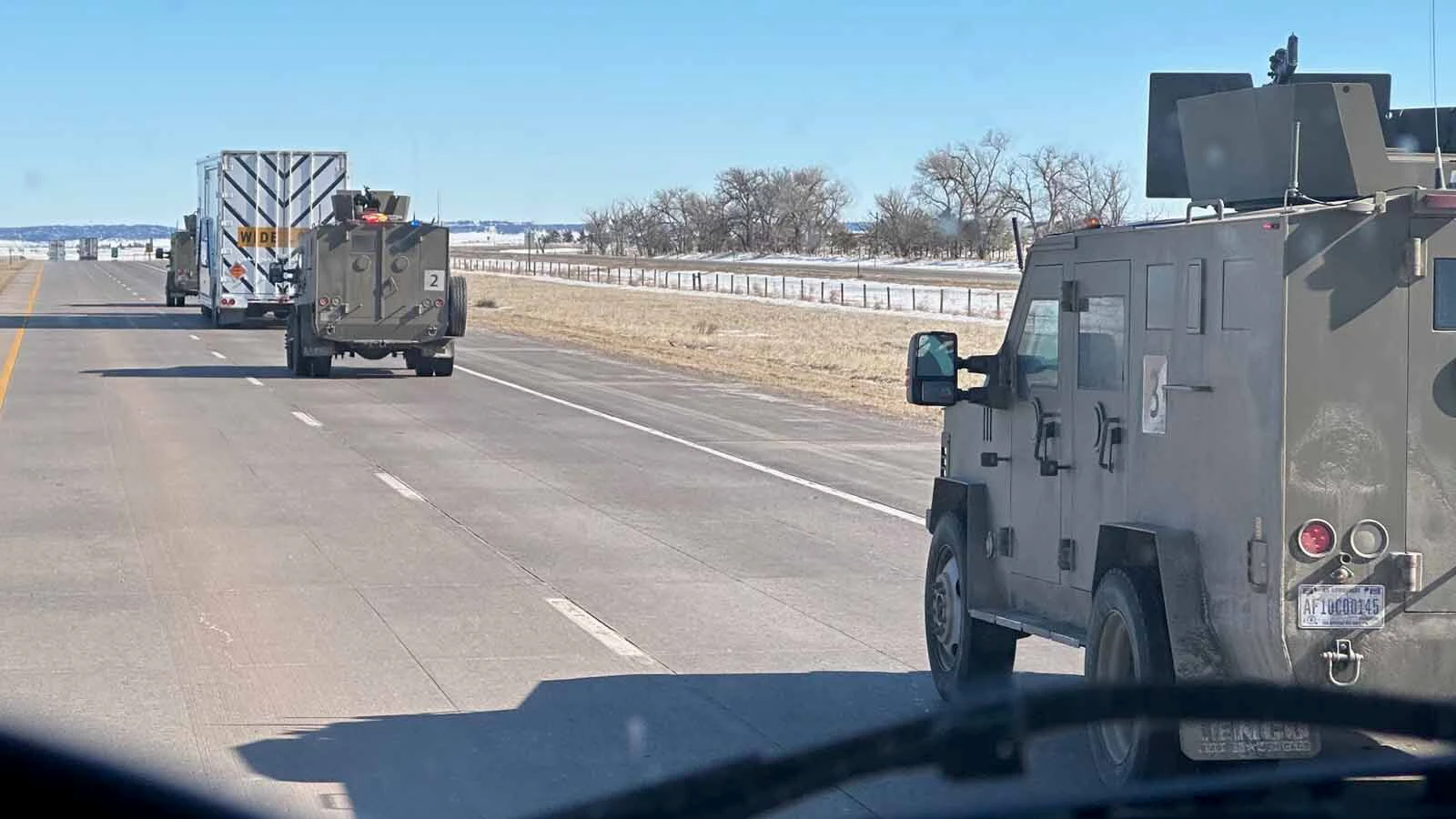
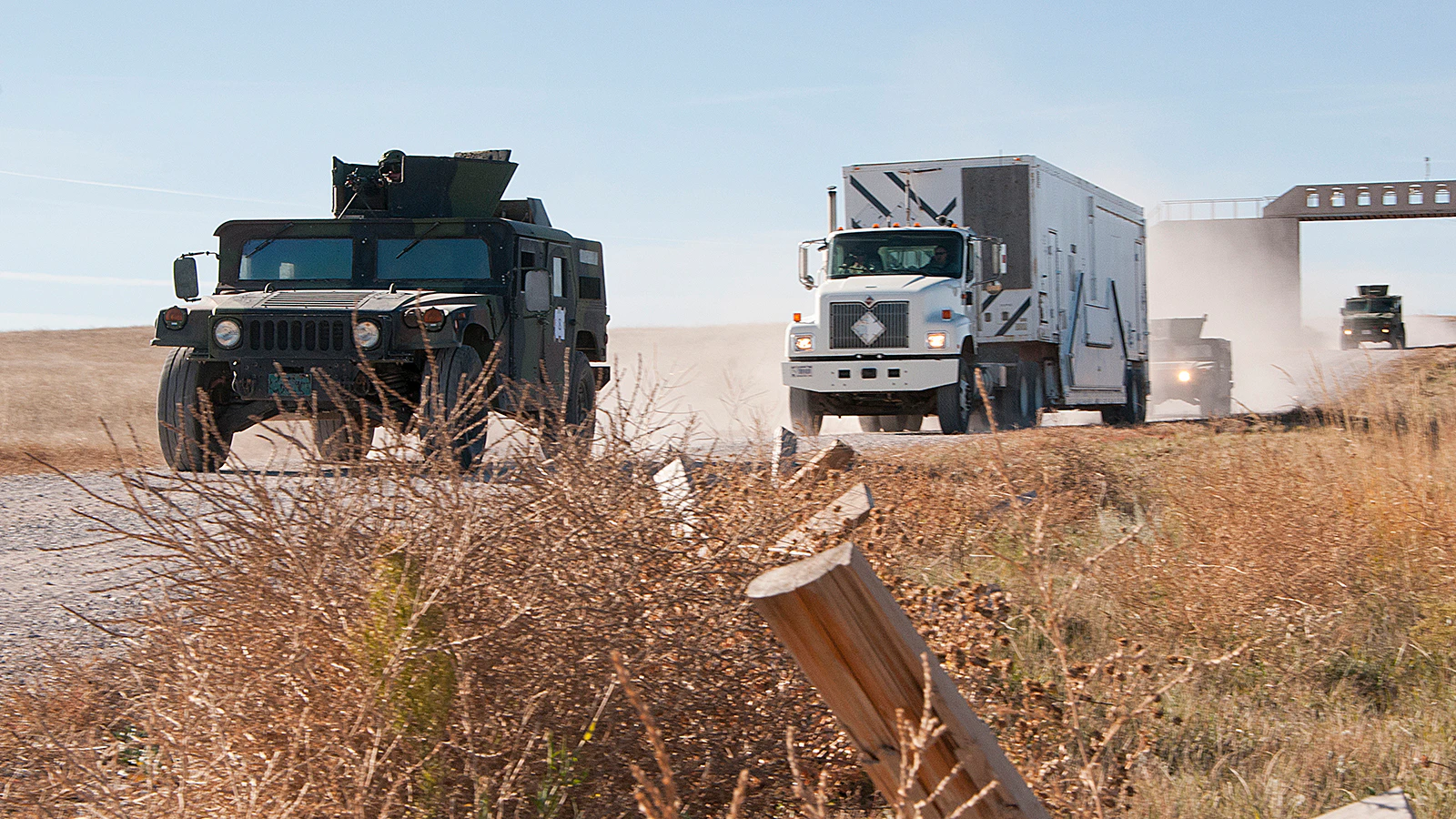
The vehicle Figueroa passed near Burns was a Payload Transporter III, a $1 million semitrailer built specifically for the U.S. Air Force.
According to the F.E. Warren Air Force Base website, the Payload Transporter III (PT III) has “the ability to load, unload, transport, emplace, or remove and replace Minuteman weapon system aerospace vehicle equipment (AVE) and supporting equipment in a controlled environment.”
These vehicles were designed to transport components of the LGM-30 Minuteman III, the latest generation of American intercontinental ballistic missiles (ICBMs) that entered service in 1970.
The PT III uses air-cushioned pallets to transport important AVE components between the launch facility and the Missile Support Base. Those components include guidance and control systems, propulsion system rocket engines, and reentry systems.
The vehicles escorting the Payload Transporter III appeared to be Lenco BearCats, an armored vehicle used by the military and many law enforcement agencies.
Figueroa said some of the BearCats he saw surrounding the PTIII seemed equipped with communication jammers rather than machine guns.
Anyone would have realized they were escorting something important, he said, even if they didn’t know specifically what that was.
“You’d never know if it was empty or loaded,” he said. “It could have been carrying parts, the guidance system, or the warhead itself to the nearest silo.”
‘Neither Confirm Nor Deny’
It’s no secret that Wyoming has nuclear missile silos, but you’d have a hard time getting anyone in military brass to acknowledge it.
“If you ask anyone on (the F.E. Warren Air Force Base), they’ll say, ‘I can neither confirm nor deny the presence of a nuclear weapon,’” said Tucker Fagan, former commander of F.E. Warren Air Force Base.
Fagan told Cowboy State Daily that there are many reasons anyone enlisted in the U.S. military would be cagey about anything regarding nuclear missiles.
For one thing, sharing details about them isn’t exactly advantageous for national defense.
However, there’s also the stigma against anything nuclear. In Fagan’s experience, even the concept gets people riled up.
“The American people are scared to death of anything nuclear,” he said. “That's why it’s been the policy of the United States government that you can’t either confirm or deny the presence of nuclear material.”
Nevertheless, it’s easy to spot the surface infrastructure supporting an underground ICBM silo if you know where to look. They’re hiding in plain sight.
“You just don’t call attention to it,” Fagan said. “You don't want to bring it up to somebody who can disrupt that whole mission.”
Payload On Pavement
When Fagan saw Figueroa’s photographs of the transport convoy, he immediately knew that this particular operation wasn’t escorting a nuclear payload. That isn’t what the PT III was designed to do.
“I'm not going to talk about what it was transporting because we don't want to call attention to it,” he said.
It’s not unusual to see convoys escorting PT IIIs, especially in Wyoming. That might seem shocking to many, but Fagan doesn’t think it should be.
“It's not like this is something new or crazy,” he said. “It’s been going on since 1960.”
While the Air Force oversees Minuteman missiles, the U.S. Department of Energy handles the transport of their payloads.
It’s entirely possible to pass a nuclear warhead on the highway. Many people might have done it already without even knowing it.
Nuclear payloads are also transported on highways via the highly secretive Safeguards Transporter.
Sandia National Laboratories designed the nuclear weapons transport vehicle for the National Nuclear Security Transporter in 2000 by combining Peterbilt trucks with a custom-built Safe Secure Trailer.
Outwardly, a Safeguards Transporter looks like a normal semitrailer, but it’s designed to withstand any assault, with 12-inch-thick sides, a wide array of high-tech defensive capabilities, and armed support in the sleeper cab.
Safeguard Transporters also have automatic sanders, run-flat tires, and special inclinometers to keep the payload level at all times.
If something jars it out of place, a special mechanism triggers that fills the entire Safe Secure Trailer with high-density foam.
The Safeguards Transport program is so secretive that only three photographs of the unknown number of vehicles have been publicly released.
Those show only the unassuming exterior, which looks like any run-of-the-mill semi.
That’s why Fagan was so confident that the PT III Figueroa saw wasn’t transporting a nuclear payload. A PT III is easy to identify, while a Safeguards Transporter would be almost invisible among regular highway traffic.
Still, the philosophy is the same. Whether it’s missile components or a nuclear warhead, trucks transport them on public highways.
The idea of passing a nuclear warhead in traffic might be unsettling, but Fagan doesn’t lose any sleep over it.
“When the Air Force has to do something like that, they just do it,” he said.
An Upgrade
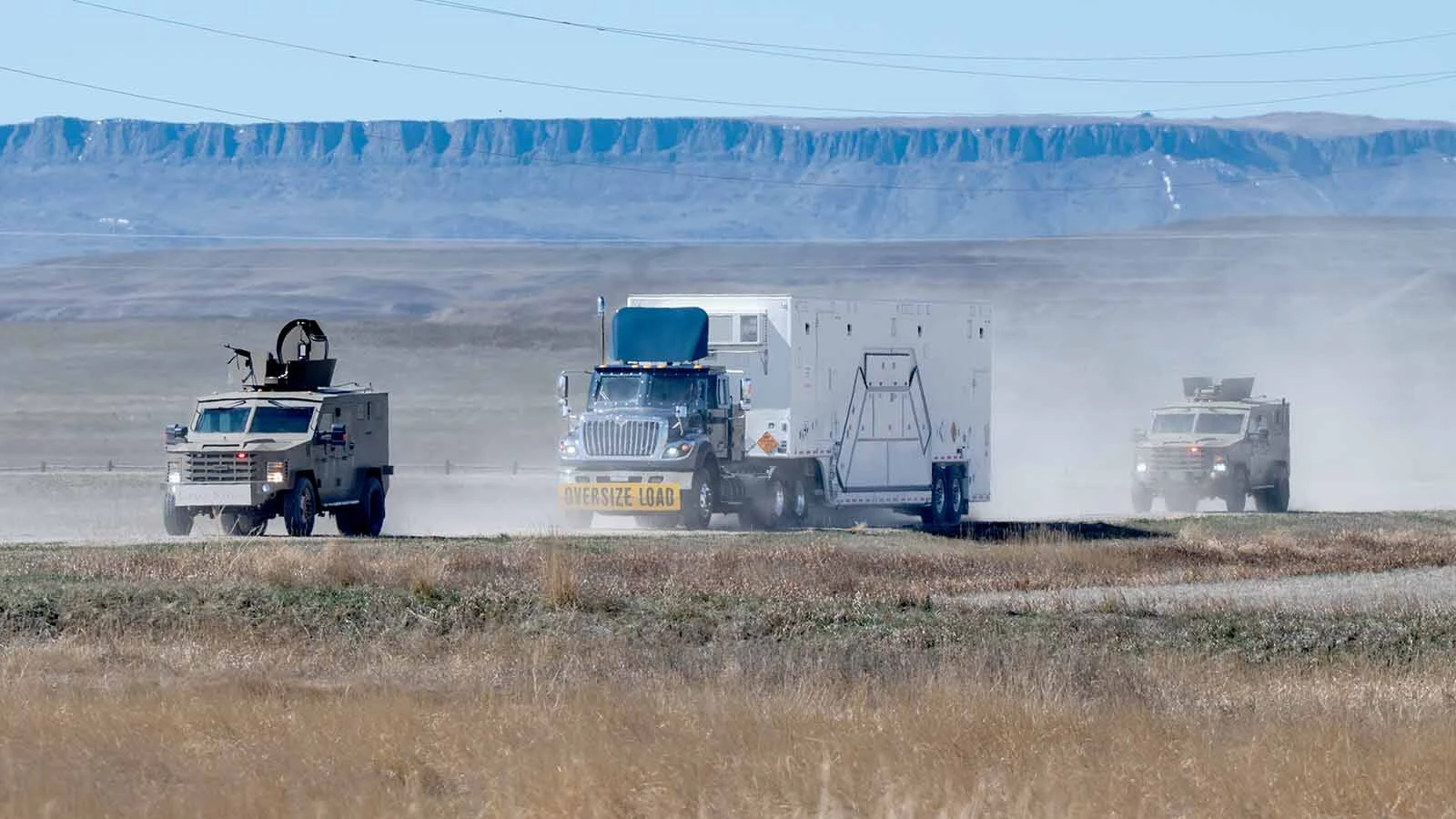
In April, U.S. Strategic Command announced that the 341st Maintenance Group executed the first operational mission for the Payload Transporter Replacement (PTR) at Malmstrom Air Force Base in Montana.
The new vehicle is intended to replace the Payload Transporter III, as several of its components are no longer being manufactured.
The upgrades include an armored cab, a more capable auxiliary power unit, and an enhanced trailer designed for improved functionality.
The Air Force has ordered 25 PTRs to modernize the Minuteman III transport fleet and replace the PT III, but doesn’t intend to use them for very long.
Any PTRs and PT IIIs will likely be decommissioned along with all 450 Minuteman IIIs when they’re replaced by LGM-35 Sentinels.
Northrop Grumman is manufacturing the United States' newest nuclear ICBMs, which will occupy the same silos, at a cost of $141 billion.
The Air Force is hosting town halls on the transition to the Sentinel Program for Wyoming residents in Cheyenne and Torrington on Nov. 30 and Dec. 1, respectively.
Fagan doesn’t think the public has warmed up to anything related to nuclear energy, which is why the Air Force will maintain its “neither confirm nor deny” policy regarding its missiles and the occasional PT III sighting.
“People were so upset about that Radiant Nuclear (microreactor manufacturing facility) they wanted to build near Bar Nunn, and that uranium is so depleted that it’s minuscule,” he said. “What do you think is in that missile silo that you just passed on the road?
"It doesn’t fit, but it manifests enough that it’s an indicator of how people feel.”
Figueroa didn’t feel that way when he passed the PT III on I-80. He definitely was sure it was sensitive nuclear missile equipment, and it’s an experience he’ll never forget.
“I was terrified as I slowed down to pass,” he said. “I was thinking, ‘Oh my god, I'm driving around the world's most dangerous weapon like nothing.’ It was super-exciting."
Andrew Rossi can be reached at arossi@cowboystatedaily.com.