The Wyoming Supreme Court on Tuesday affirmed the State Board of Land Commissioners’ decision to lease about 2,400 acres of state land in Converse County to a wind farm designed to power a hydrogen plant.
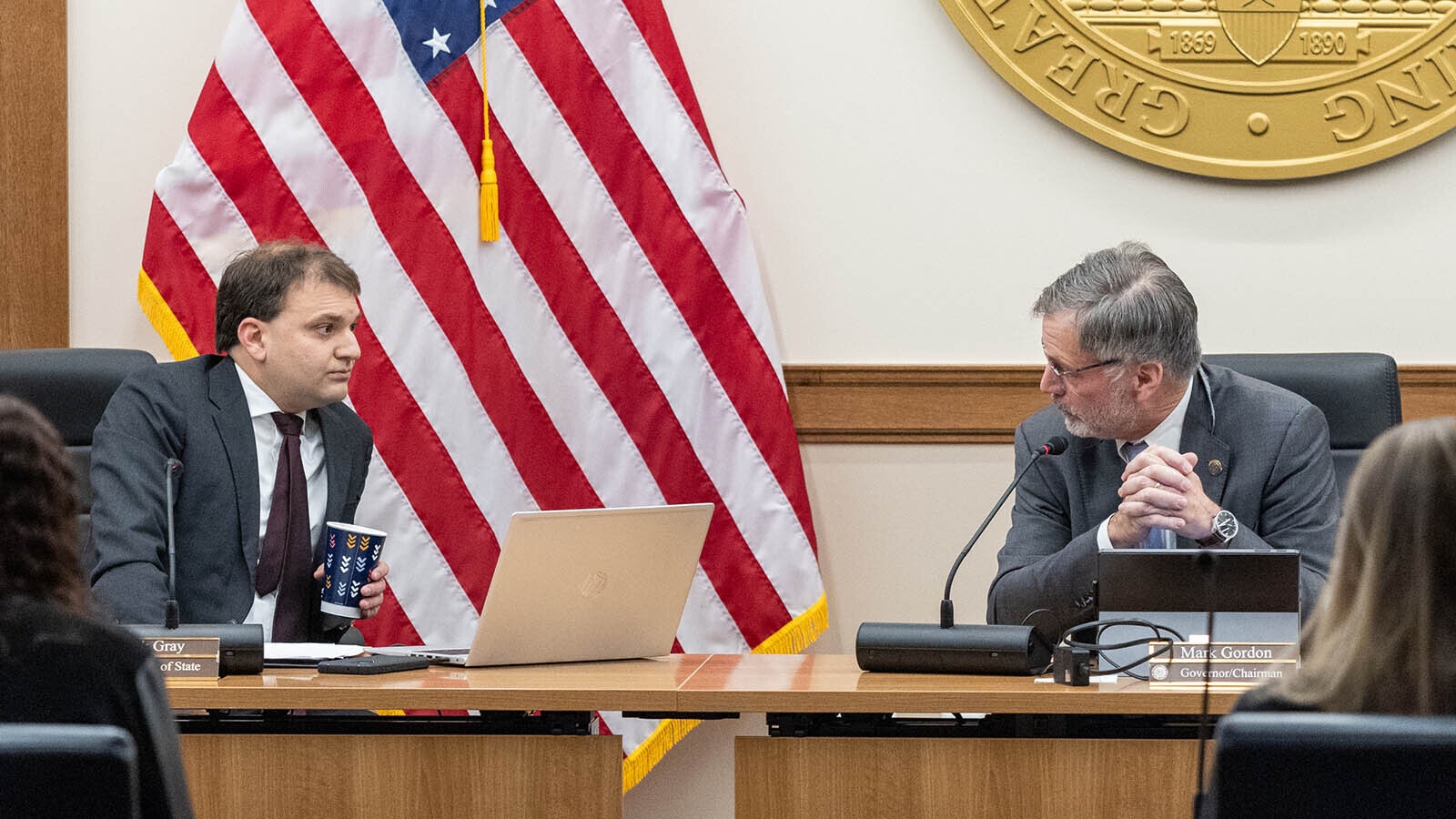
The Pronghorn H2 LLC lease and its counterpart in Natrona County have fueled months of debate, controversy and news headlines that culminated in a heated Jan. 8 meeting in Douglas with Gov. Mark Gordon asking Secretary of State Chuck Gray if he would like to “step outside.”
The crux of the case was whether the Wyoming Board of Land Commissioners' rules authorize the lease of a 267-turbine project planned for about 15,500 acres of state trust lands in the northern Laramie Range mountains.
The high court ruled unanimously that they do.
Gray had opposed authorizing the lease in April 2025, while the other four elected officials on the board — Gordon, Auditor Kristi Racines, Superintendent of Public Instruction Megan Degenfelder and Treasurer Curt Meier — voted in its favor.
After public outcry and Gray’s recurring critiques of Gordon, Degenfelder and Racines changed course, voting to start a process to reverse the lease approval.
Meanwhile, the project’s neighbor Mike Stephens challenged the board in court, saying it wasn’t following its own rules, hadn’t considered wildlife impacts, and was failing to reap the highest benefit from state lands.
The Wyoming Supreme Court disagreed with all those arguments Tuesday and upheld the lease.
It noted that Stephens had legal standing to challenge the lease. But the board acted within its own rules when it issued the lease.
"We also conclude the Board complied with its duty to create the greatest long term benefit for the state land trust as reflected in the Lease’s alternative operating fee provisions," says the Tuesday opinion, authored by Chief Justice Lynne Boomgaarden.
‘Never Political’
In a victorious statement Tuesday, Gordon pointed to the duty the state Constitution places on Wyoming’s top officials to fund public schools with state trust land projects.
“These decisions were never political, they were made to ensure the highest and best value for our state lands, buttressed by the legal, and contractual obligations made by the state,” he said.
The governor said the court upheld the officials’ duty Tuesday.
Worries about Wyoming’s contractual obligations surfaced when board members, under Gray’s urging, started to reverse course on their own leases.
A Pronghorn H2 representative initially vowed to sue if Wyoming broke faith, but later relented when the board took a more provisional approach.
“I want to thank the Treasurer for his fidelity to the Constitution,” said Gordon. “I also want to thank our legal counsel, the Attorney General, whose advice has been confirmed today as sound and prudent.”
Gray did not immediately respond to a Tuesday request for comment.
Meier issued a scathing quote via email, writing, "Secretary Gray knew (his opposition) was unconstitutional and just pandered to the environmental socialists for votes and support. At the expense of educational funding and private property rights."
The high court didn't go quite that far; it merely upheld the lease as falling within the board's rules, and honoring the mandate of reaping benefits for schools.
Gray said he feels Meier's comment "should be fact-checked."
Cowboy State Daily had fact-checked the comment (see above).
"Because," Gray continued, "Mike Stephens is a Wyomingite who was trying to stop a liberal corporation's wind farm."
The Pronghorn project is slated for 46,000 total acres, of which 13,838 acres (or 30%) is owned by the state.
The related Sidewinder project in Natrona County, which is not part of this case, is slated for 120,110 acres, of which 19.4%, or 23,290 acres is state land.
More Saga
The company first applied for the lease in 2022, on an area south of Glenrock spanning both state and private land with 25% to 30% of the total on state lands.
Commenters wrote to the board’s administrative arm, the Office of State Lands and Investments (OSLI), mostly opposing the project.
The board adjourned into executive session for legal advice, then approved the lease.
That same month, April 2025, Stephens filed his legal challenge.
“It’s right in my backyard. I border it,” Stephens told Cowboy State Daily at the time, describing an area outside Glenrock that his family first homesteaded in 1912. “It’s beautiful. It's like our Tetons and our Bighorn Mountains.”
The Ruling
District Court Judge Scott Peasley ruled Dec. 5, 2025, that the board’s lease had violated its own rules.
The rules say wind energy leasing applies for wind farms that produce electricity, “including collecting and transmitting the electrical energy … to the interconnection of the transmission grid.”
Peasley read the word “including” there to mean the project needed to include feeding the grid.
Since the Pronghorn project won’t necessarily feed the grid but a hydrogen plant, he struck down the lease.
Wyoming Attorney General Keith Kautz argued that the judge should not have read the word “including” that way.
In a separate interview, he worried that rendering the word exclusive rather than inclusive could affect entrenched legal interpretations statewide.
Kautz appealed the ruling.
And This Led To That Scene …
Gray spoke dourly of Kautz at a Jan. 8 meeting of the State Board of Land Commissioners, pressing Gordon to “please instruct the Attorney General not to undercut the will of the board over the next four weeks.”
Gordon bristled.
“To cast aspersions on the attorney general — former justice — is, I just don’t think that’s a good idea, Mr. Secretary,” said Gordon.
Kautz was a Wyoming Supreme Court Justice before he reached age 70, the state’s age cap for the position. Gordon selected him to serve as AG after that.
Gray said he took “deep umbrage” at Gordon’s assertion he’d casted aspersions.
Gordon tried to interrupt, and Gray interrupted back.
Gray said, “He stepped in and — “
“Step outside. Do you want to step outside?” parried Gordon.
“Are you threatening me?” asked Gray.
“No, I’m asking if you want to step outside,” answered Gordon.
“Are you threatening me?” asked Gray a second time. “I’ve never seen anything like that. That is astounding.”
Degenfelder tried to interject.
With a palm-down hand gesture toward her, Gray said, “please stop interrupting.”
Gordon’s office later said the “step outside” comment was an invitation to discuss things outside with more clarity, not an invitation to fight.
Clair McFarland can be reached at clair@cowboystatedaily.com.