

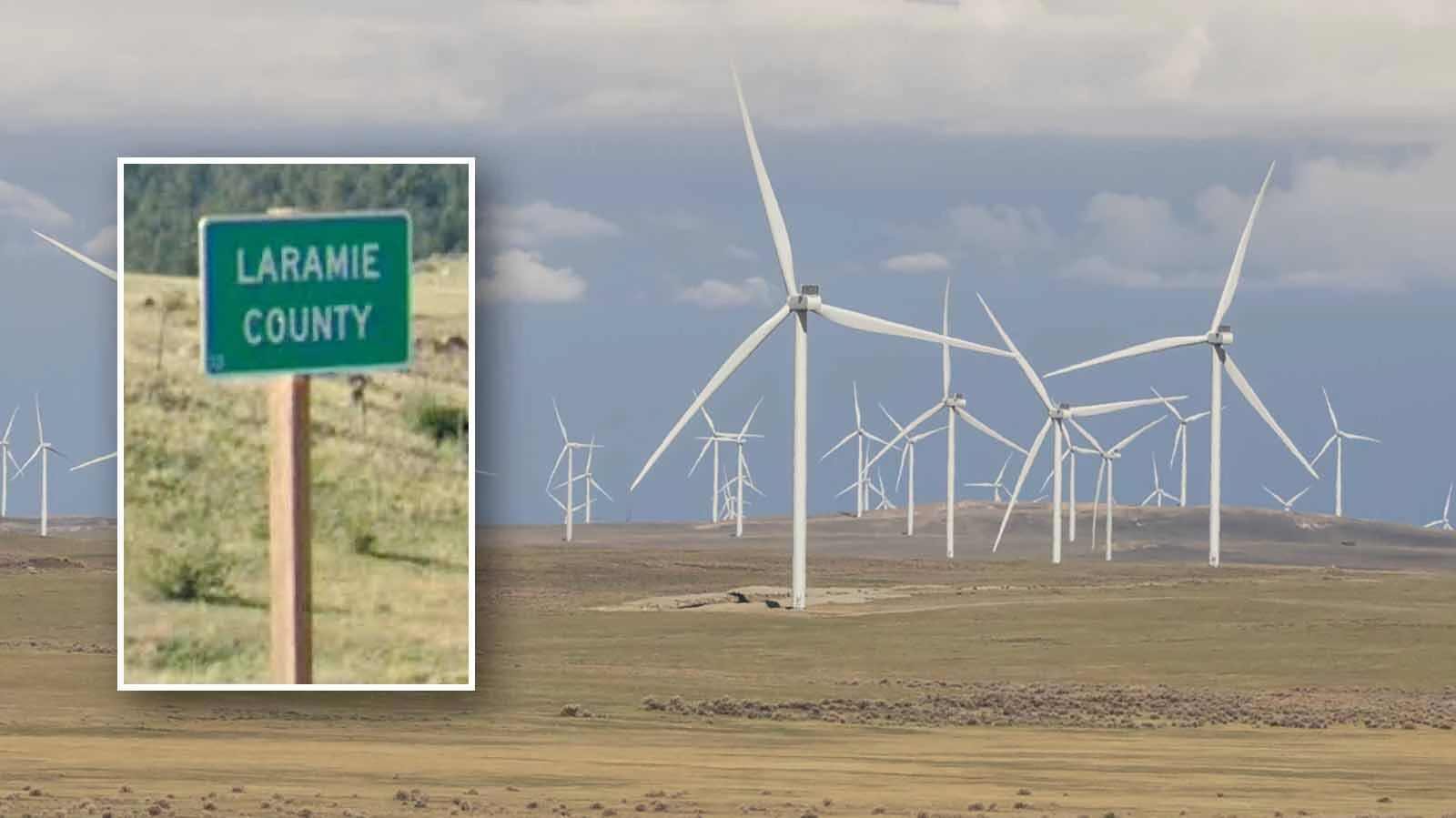
The Wyoming Industrial Siting Council officially signed off on the controversial Laramie Range Wind Project on Monday, issuing its final order to green-light the 650-megawatt wind farm.
To maintain its newly granted state permit, developer Repsol still must comply with 26 binding conditions established during a contentious two-day hearing in September.
Among the provisions, the order requires a 2.5-mile buffer between turbines and neighboring homes, restricts high-capacity well drilling near project boundaries, mandates bird-detection systems, and requires fully executed road agreements before construction can begin.
The council allocated up to $11.7 million to local governments, drawn from state sales and use taxes on construction materials, to offset local infrastructure and public-service costs during construction.
“These funds are to compensate counties, cities, and towns for unmitigated impacts which are directly or indirectly attributable to construction of the industrial facility,” the permit states.
The total impact assistance funds, designated for local governments, fire districts and other public entities in Laramie and Platte counties, fall below the state statutory cap of $14.97 million for projects of this size.
Repsol must also retain an independent engineer to determine what, if any, road modifications are needed to accommodate the project.
‘Unprecedented Times’
Earlier this month, developer ConnectGen Laramie County, a Repsol affiliate, temporarily withdrew its conditional use permit applications with Laramie County.
Repsol spokesperson Christi Schaefer told Cowboy State Daily that withdrawing the local permits gives the company time to “review and incorporate the final ISC requirements” into revised county permit applications, which it intends to file early next year.
Justin Arnold, head of the Laramie County Planning Commission, told Cowboy State Daily the state’s conditions changed the project so much that it no longer resembles what the company first submitted to the county.
He pointed to the additional mile of setback between turbines and surrounding property, saying that change is why the developer withdrew.
“It sounds to me from the information I’ve been provided that the conditions placed on their permit made the project, to some extent, unviable for the applicant,” Arnold said. “Their intent is to go back before the Industrial Siting Council for an amendment to their existing application.”
Schaefer said she didn't yet have details on what specific steps Repsol might take next with the Industrial Siting Council.
If the state application is amended, Arnold said Repsol will still need to bring its plans back before Laramie County commissioners, who will make the final county-level decision on whether to approve the project.
Their job, he said, will be to weigh whether the wind farm offers a net benefit to the local area.
“We’re in unprecedented times with the volume of proposals coming through at the same time,” Arnold said. “We’re having to not only look at this project but the cumulative impact.”
Arnold said those cumulative impacts cut both ways.
On the upside, he said, large projects bring tax revenue that benefits Laramie County residents through roads, school districts and other services, along with a construction workforce and added business for local shops and restaurants. On the downside, he said, they bring more traffic, strain on water and emergency services, decreased property values and changes to the landscape.
“There’s positives and negatives with everything,” Arnold said.
‘Meaningful Protections’
For Cheyenne real estate agent Wendy Volk, an outspoken opponent of the development whose family owns land in the area, that cumulative impact has been a primary concern from the start.
“Our family has six generations of roots in Horse Creek,” Volk told Cowboy State Daily. “We want to see meaningful protections, not simply promises of future coordination.”
Volk said she appreciates that state regulators attached 26 binding conditions to the approval. While many address key issues raised during the hearing, including road safety, wildlife protections, and site restoration, Volk said she remains hesitant about the project.
“I would not characterize the conditions as fully resolving our concerns,” Volk said. “Much depends on how they are interpreted, implemented, monitored, and enforced.”
Specifically, she questioned whether critical protections will actually be in place before breaking ground, pointing to a discrepancy in the order that cites a 2.5-mile setback in one section but references 1.5 miles in another.
While the Industrial Siting Council's final permit strictly reportedly mandates a 2.5-mile setback between turbines and neighboring homes or ranch headquarters, Volk pointed out that the developer originally pushed for less.
“That discrepancy needs clarification,” Volk said. “We also need to understand whether this condition contributed to Repsol’s decision to withdraw its county applications.”
For Volk, her main concerns haven't changed. She said she's still worried about the cumulative impact of the Laramie Range Wind Project on top of other developments nearby, and whether each project can actually protect the health, safety, and welfare of the people living and working in the area.
‘Preserve Their Land for Generations’
The permit is the latest turn in a fight that began more than a year ago, when Repsol first pitched the Laramie Range Wind Project for the Horse Creek area northwest of Cheyenne.
The original plan called for up to 170 turbines across roughly 56,000 acres, a footprint about three times the size of the city. Laramie County commissioners rejected it 3-1 after a marathon hearing in September 2025, citing unanswered questions about road access, fire mitigation and water well permits.
The company has since scaled back the plan to up to 139 turbines on about 41,000 acres of private and state land, still larger than Cheyenne itself.
Supporters like rancher Charlie Farthing, whose family has ranched near Iron Mountain since 1903, say turbine leases help steady a cyclical cattle business and keep land in the family. Opponents point to strain on narrow roads, scarce water and emergency services.
Schaefer emphasized that the project has been developed through “extensive studies and ongoing engagement with landowners, community members and agencies.”
“The company believes the Laramie Range Wind Project represents a meaningful long-term contribution to the local economy and an important opportunity for local families to preserve their land for generations to come,” Schaefer said.
For Farthing, a fourth-generation rancher who leased land for the project, that stability means an extra revenue stream that won't disrupt his cattle operations.
"We want to be able to continue on,” Farthing previously told Cowboy State Daily. “I've got grandkids, and I hope that they have the opportunity or want to come back. That’s a lot of the reason we're doing this.”
Beyond the state-mandated $11.7 million in impact assistance funds, Schaefer said the company has also sought to build goodwill locally through voluntary community contributions.
Outside of the formal permitting process, Repsol has backed several area nonprofits and events, including the Cheyenne Children's Museum, Comea House, Cheyenne Frontier Days, local agricultural events, and an ongoing scholarship at Laramie County Community College.
Emma Jane Jackson can be reached at emma@cowboystatedaily.com.


