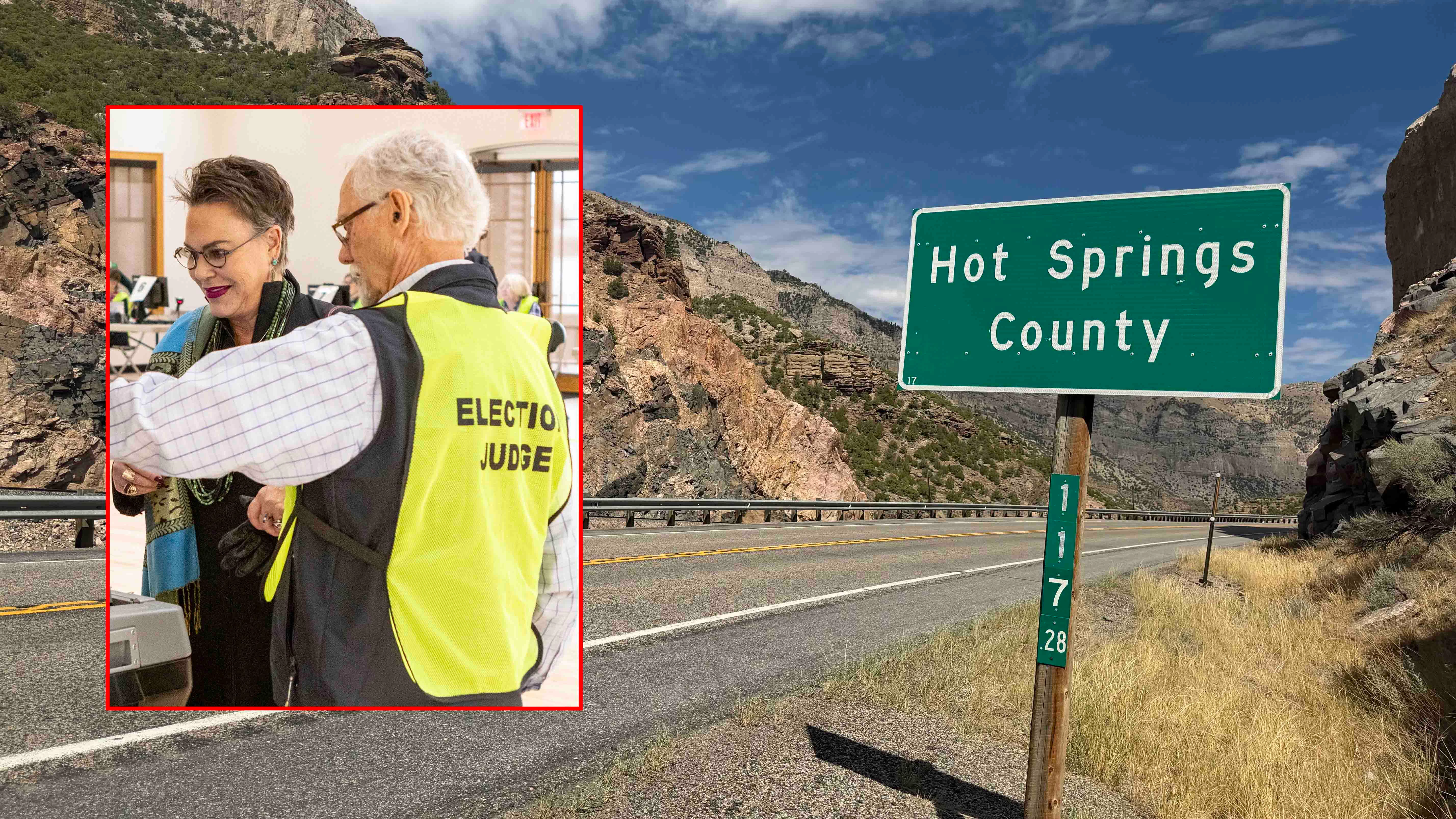
Hot Springs County had the highest voter turnout of Republicans and Democrats in the Aug. 18 primary election, totaling nearly 74% — compared to a statewide average nearly 20 points lower.
It’s a highly political county, Republican and Democratic leaders both told Cowboy State Daily.
“That’s great news,” said Dale Horkey, Hot Springs County Democratic Party Chair, in a Monday phone interview.
He asked for a copy of Cowboy State Daily’s calculations so he can show them to his members and tell them “Damn good job.”
The county’s Democrats voted in a higher concentration at the primary election than those in any other Wyoming county, with 59.5% of all registered Hot Springs County Democrats, as of election day, casting ballots.
Hot Springs County’s Republican voters also boasted higher turnout per registered voter than any other county, with 75.15% of them casting ballots.
When compared with the total number of registered voters in the county, that shakes out to 69.5% turnout – one percentage point lower than Niobrara County’s 69.6%.
But the greater presence of independent and third-party voters registered in Hot Springs County, versus Niobrara County, inflates the registered voter total to drive its turnout percentage down. Yet the structure of the partisan primary election discourages third-party participation.
When taking Hot Springs County’s turnout percentage from only registered Republicans and Democrats, compared against Republicans and Democrats who voted, it bests Niobrara County 73.8% to 72.9%.
“My Hot Springs County Democrats are a motivated group,” said Horkey, adding that the party distributed mailers urging people to vote ahead of election day.
For a Democrat in Hot Springs County, the down-ballot options are few. But the local Democrats still voiced preferences in statewide elections, noted Horkey.
Those Hot Springs County Republicans
Hot Springs County Republican Party state committeeman Phil Scheel said “yeah I believe it” of the local GOP’s intense motivation.
“We’re politically active here in Hot Springs County,” he said.
Scheel won his primary election bid for County Commission and advances to the general election.
Numerous political disputes have roiled the county in recent years.
Those include a land-use spat, a lawsuit over who should run the Hot Springs County GOP, and a failed attempt to have two-thirds of the County Commission removed by the Wyoming attorney general. Scheel was involved in all of those, always taking the side less aligned with the Wyoming Freedom Caucus movement.
He theorized Monday — nearly two weeks after the primary election saw numerous Freedom Caucus legislators and allies unseated in GOP races —that officials were “doing a lot of things the average voter did not agree with.”
As for the county’s all-around political force, per-registered voter, Scheel said both Republicans and Democrats worked actively to get people to the polls. He called the 27% turnout for the 2024 primary election “disappointing.”
This year’s turnout was much more robust, at 55% statewide. That includes 43.8% of registered Democrats and 62% of Republicans.
Hot Springs County Commissioner Bob Aguiar, who unseated Scheel in the 2024 election and often opposes Scheel in the local controversies, did not return a Tuesday-morning voicemail by publication.
Other Mentions
The Campbell County Democrats were the least motivated group of major-party voters this primary election, with 35.94% turnout. Lincoln County Democrats trailed shortly, at 35.96%.
Teton County’s registered Republicans were the least-motivated group within the GOP, at 53.9% turnout. Teton also had the most dismal turnout overall, at 41.5% taken from all registrants, and 49.4% when accounting for just major parties.
State Rep. Mike Yin, D-Jackson, has addressed the Teton County voter’s quandary previously. He did so again Monday.
“It’s a struggle, right?” said Yin. “You either choose between the statewide, Republican primaries or between the county-wide Democratic primaries, to participate in.”
Teton County’s registered Republican voters roughly double its Democratic voters. But the numbers flip in the general election, when Teton votes for Democrats in statewide races roughly double those cast for Republicans.
The average voter in Teton County, said Yin, has to decide between swaying his county commission and other county-office races, where Democrats often prevail, or the statewide races, where Republicans have universally prevailed in recent years.
“You get disenfranchised for half the ballot” either way, said Yin.
He suggested switching to a primary election where the top two contenders, regardless of party, advance to the general election.
Yin noted that Teton County yields high turnout for the general election, where voting options aren’t constrained by party. The numbers confirm that: Teton boasted around a 94% turnout in the 2024 general election.
Democratic turnout at the primary election is consistently less concentrated than GOP turnout, averaging 45% to Republicans’ 62.3%.
Just A Few More Numbers
Natrona County had the second-lowest turnout at 51.73% when taken from all registered voters.
Like Hot Springs County, Natrona’s third-party registrants not showing strongly for the primary election pushed that rate down.
When counting just Republicans and Democrats, Teton still had the lowest turnout and Carbon County the second lowest.
After Teton County, Carbon County had the least-motivated Republicans, at 54.8%.
Niobrara County had the second-most motivated group of Republicans after Hot Springs County, at 73.6%.
With just 35 registered Democrats (2.8% of its whole voter registry), Niobrara is arguably the reddest county in the nation.
Clair McFarland can be reached at clair@cowboystatedaily.com.