
Wyoming laws governing which state and local Republican Party officials can vote for leaders are constitutional, and the state Republican Party’s rights to dictate its own membership don’t trump those laws, a judge ruled Friday.
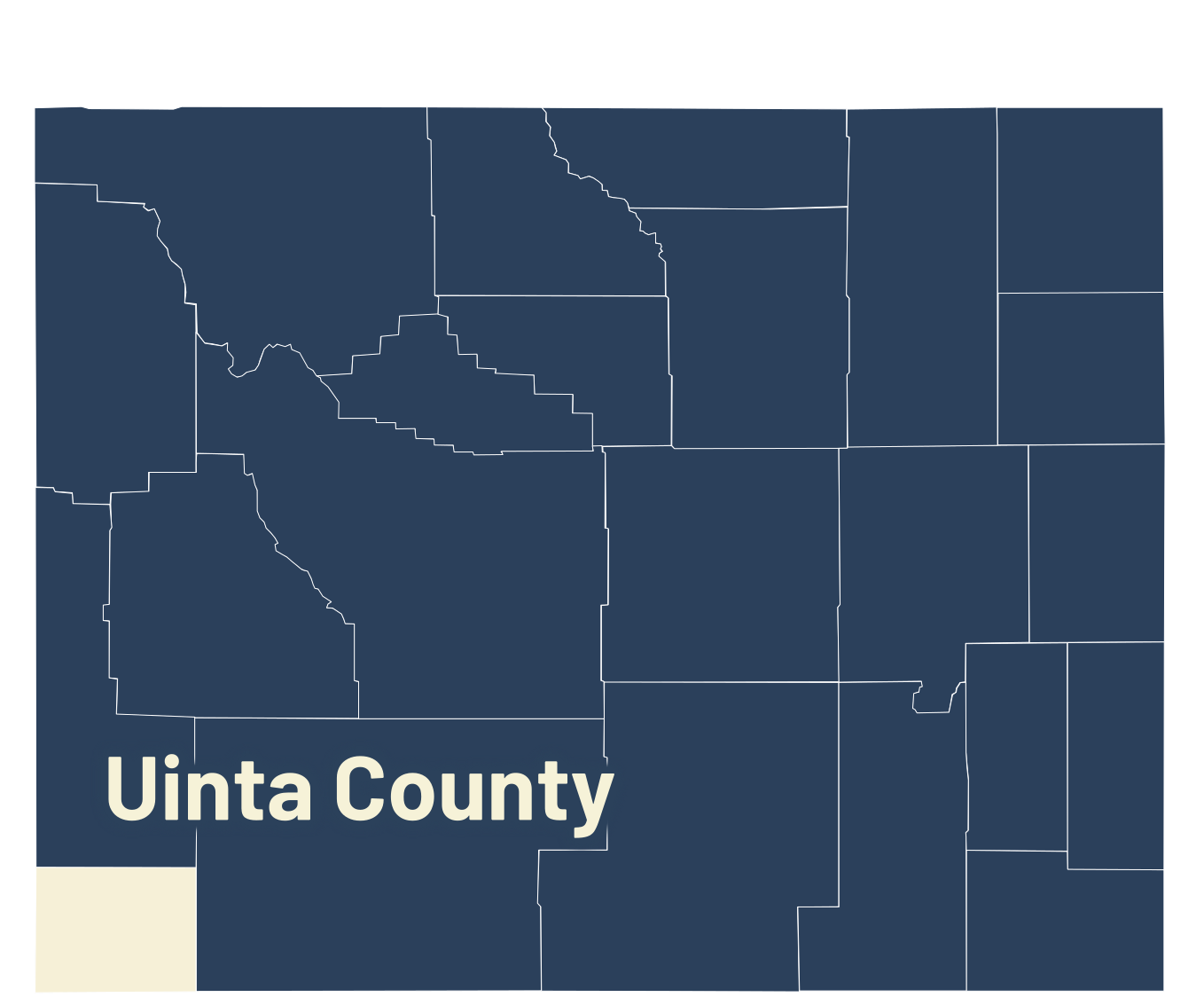
Uinta County District Court Judge James Kaste’s Friday ruling gives a concrete, though appealable, answer to the state GOP’s yearslong agenda to shrug off the restrictions Wyoming law places on it and behave as a private group.
The dispute in this case started in March of 2025 when Joe Martinez and Phillip Scheel won election to the seats of Hot Springs County Republican Party Chair and state committeeman, respectively.
But the state party’s Dispute Resolution Committee, after a controversial mediation process, then arbitration process, ruled that two “provisional” ballots of former Vice-Chair Brayden Harvey and former Secretary Mary Ann Jager should have counted in that election.
The ballots tipped the scale and made Harvey chair, and Russell Lewis state committeeman instead.
But Harvey and Jager weren’t precinct committee people, meaning, they weren’t elected to the county central committee by their Republican neighbors as of the most recent primary election.
State law says only people elected in that fashion can vote for the county party leaders.
The Wyoming and Hot Springs County GOP bylaws, conversely, say the officers can vote even if they’re not precinct committee people.
The state party asserted that because the First Amendment confers to private groups a right to dictate their own membership, the party’s bylaw should defeat state law.
Kaste disagreed.
The state GOP’s most-referenced case in this matter, Eu v. San Francisco County Democratic Party Central Committee doesn’t fit this case, the judge ruled.
That case, which the U.S. Supreme Court decided in 1989, conferred broad associational rights on political parties.
But it stems from a situation in which the state of California laid much heavier restrictions on the Democratic Party, Kaste noted.
He ruled that Harvey and Jager’s provisional ballots don’t count.
“Martinez and Scheel won the election and should have been installed in those offices,” wrote Kaste. “The Dispute Resolution Committee made a manifest mistake of law in concluding otherwise.”
Kaste ordered that Martinez and Scheel should be installed “immediately” into the offices of Hot Springs County Republican Party Chair and state committeeman, and the case dismissed.
Case Autopsy
Former state Rep. Clark Stith, who’s now a judge, filed this case last April on the Martinez group’s behalf.
Kate Mead, the mother of U.S. Senate candidate Sam Mead, took it over when Stith became a judge earlier this year.
“I think the judge made the right decision,” said Kate Mead in a Saturday phone interview. “He was super well-prepared, had gone through all the briefs with a fine-toothed comb, had researched the heck out of it.”
Mead noted that the party can still appeal, and that this time, it has raised its constitutional concerns and the attorney general has had a chance to defend those.
So the Wyoming Supreme Court can address those concerns.
The party can also file separate action asking a judge to declare that it’s above the state laws that restrict it.
“It was obvious that the Republican Party had screwed up by suggesting to the Hot Springs people that my clients weren’t elected, when they were validly elected,” said Mead.
This case cost people a lot of time, she said, adding, “I’m always kind of offended by that.”
Mead said that she had to read a lot of documents to enter this case in its final phase, but Stith had done 90% of the work - and the attorney general also defended the state law well.
Wyoming GOP Chair Bryan Miller told Cowboy State Daily the party is “highly disappointed” but unsurprised at the ruling.
“The Party is considering our options including an appeal to the Wyoming Supreme Court,” Miller said. “In the meantime, the Party will abide by the district court's order to seat the plaintiffs while we prepare for our next actions.”
Miller said the party, “in support of our 210,000+ registered Wyoming Republican voters, will continue to defend its freedoms of association under the First and Fourteenth Amendments, as confirmed by the United States Supreme Court."
He had announced to a bylaws committee at the party’s April convention that the party is planning to challenge state laws in federal court.
Mead emphasized in her interview that this case only addressed the state laws that came to bear on this conflict. The party can’t address some of its other angst with state laws, such as a ban on financially backing one Republican candidate over another before the primary election, through an appeal in this case should it choose to file one.
“I was very pleased with the amount of research (Kaste) put into this matter,” said Martinez in a Saturday phone interview. “I certainly appreciate his diligence in trying to ensure that he’s making the best decision possible based on all the information.”
Martinez said he looks forward to filling the county party role to which he won election, and performing party work at the state level as well.
“And just moving forward,” he added. “I think that’s the big thing, is it’s time to move forward and not look back.”
A Little More About That Spring
While the dispute over who won the chair and state committeeman position for Hot Springs County was still ongoing last spring, the state party had its Dispute Resolution Committee convene to address the question, April 8, 2025.
Vince Vanata, committee chairman, presided over the meeting.
The attorney representing Martinez, Scheel, Meri Ann Dorman and Clay van Antwerp at that meeting was excluded from the call because he wasn’t a member of the state central committee.
Van Antwerp was excluded too because he didn’t sign a confidentiality agreement within the timeframe the committee required.
After about two hours, says Kaste’s order, Vanata declared the committee’s mediation efforts unsuccessful and said the committee would switch to arbitration.
Martinez, Scheel, and Dorman were “terminated from the call” and excluded from that process, the judge wrote.
The Dispute Resolution Committee issued its arbitration order the next day, proclaiming the provisional ballots valid.
Meaning, the committee chose to go by the party bylaws rather than state law.
The Wyoming Supreme Court in 2023 had upheld that same state law over a similar bylaw in a Uinta County Party dispute. But the high court didn’t address the political group’s associational rights debate at that time because no one had invited the state Attorney General, then Bridget Hill, into the case to defend the state law
Wyoming Law
Wyoming election law imposes numerous tasks and restrictions on major parties - as well as benefits, like letting them help fill vacancies when their incumbent leaves an elected office.
County central committees consist of men and women, in this case registered Republicans, elected at the biennial primary election by their neighbors, or precincts.
The law tells the county central committee to elect its officers and state leadership delegates, called state committeeman and state committeewoman, during odd-numbered years.
The state central committee in turn calls conventions in even-numbered years.
County central committees help fill vacancies in county elected offices, and the state central committee or local portions of it in state-level elected offices.
The state party convention also nominates presidential electors, elects the party’s national committeeman and committeewoman, and adopts the party platform, among other duties.
The Judge’s Analysis
Kaste noted that the election code doesn’t dictate the state party’s membership directly.
Freedom of association is a right, and does give political parties some protection from state infringement, noted Kaste, from a 1986 case called Tashjian v. Republican Party of Connecticut.
But courts also use a balancing test called the Anderson-Burdick test when parties assert this right, and they consider how burdensome the state’s laws are on that right.
If the burden is severe, the court judges the state’s infringement under a rigorous constitutional standard that most laws do not survive, called strict scrutiny.
But if the state is only imposing a “lesser burden” on the party, then the state’s important regulatory interests are usually enough to justify “reasonable, nondiscriminatory restrictions,” Kaste noted from an earlier case.
State party leaders sued in this case claimed Wyoming violated the party’s rights.
“Defendants are incorrect,” wrote Kaste.
The state laws impose minimal burdens on the party’s associational rights, and the state’s important regulatory interests justify them “amply,” said the judge.
He added that the party relied on oblique cases while ignoring cases “that are more squarely on point.”
Wyoming law lays some tasks and formational requirements on the party, but the party’s role in filling vacancies is a privilege in which the state has an imnportant interest, he added.
Kaste rebutted a point the Wyoming Republican Party has made not just in this case, but repeatedly in public - especially while rewriting its bylaws in April to conflict with state law on purpose.
“Defendants assert that this case is more like Eu,” Kaste wrote, referencing the 1989 case. “The Court disagrees.”
In that case, the California election code dictated the party’s composition, terms, and leaders’ residence, among other restrictions.
The laws unduly burdened the party’s rights.
They’re not comparable to Wyoming’s major party laws, the judge wrote. He added:
“Eu is inapplicable.”
The Wyoming laws challenged in this case impose only a minimal burden on the party, says Kaste’s order.
The state has a legitimate interest in how office vacancies are filled, he wrote.
“It would be a real problem if a vacancy occurred in a public office and the State had no one to call,” Kaste said. He said the biennial election also ensures orderly election tasks, like nominating presidential electors before general elections.
Update: This story has been updated to include a comment by Wyoming Republican Party Chair Bryan Miller
Clair McFarland can be reached at clair@cowboystatedaily.com.


