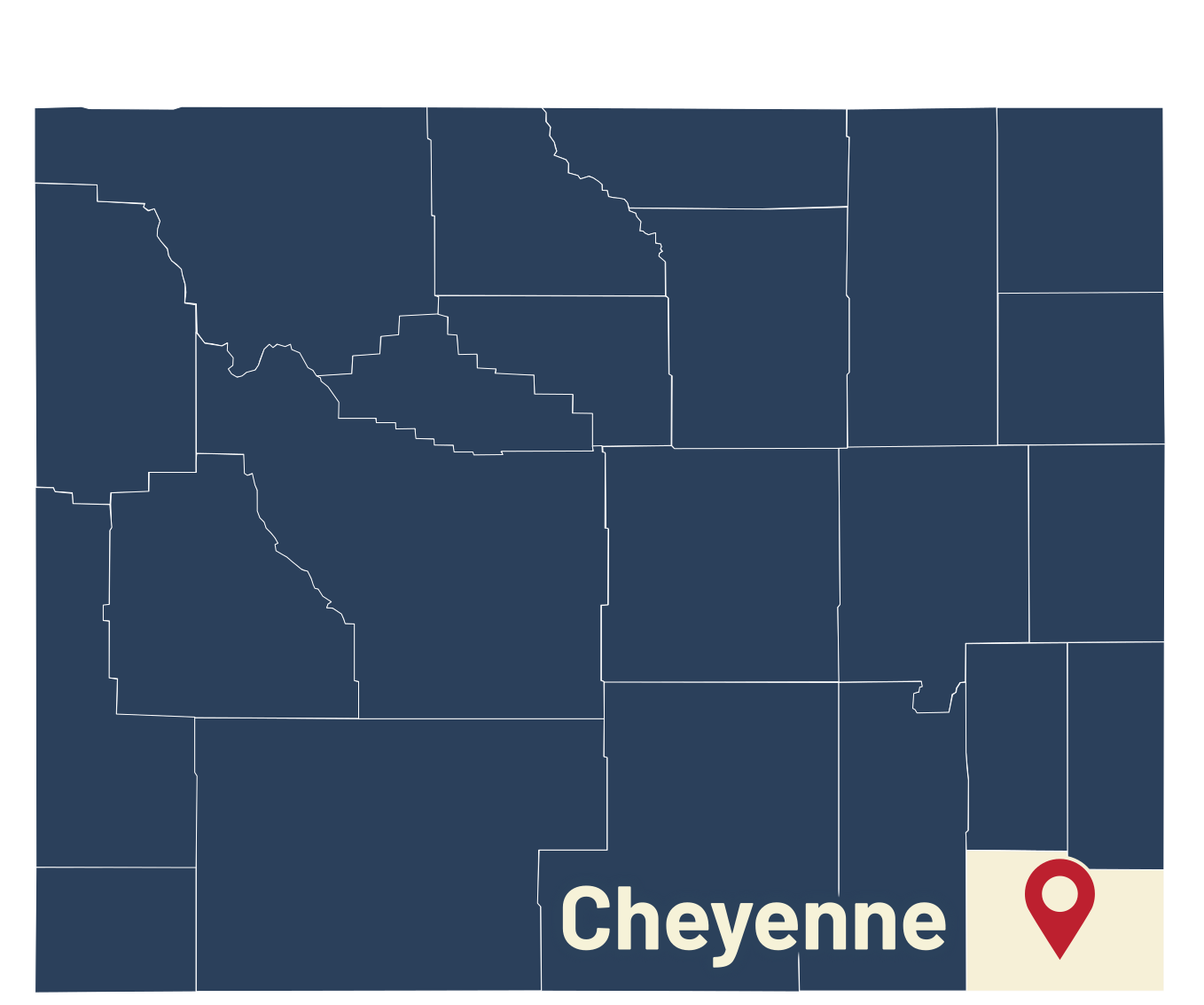
This is a cautionary tale about bad choices, including one I made on the night of Aug. 1, 1985, when the Cheyenne flood that killed 12 people became one of the worst natural disasters in Wyoming’s history.
My first bad choice: Ignoring an early afternoon forecast that declared a severe thunderstorm warning was in effect until 8 p.m.
It was undeniably risky behavior, but the reward seemed promising — a night away from Cheyenne and my job as editor of the Sunday Wyoming Tribune-Eagle, which was second only to the Casper Star-Tribune in state circulation.
I can’t recall why this particular Thursday was any rougher on my psyche than any other day, but 41 years later my only excuse was the feeling I had to escape for a few hours and visit one of my favorite pastimes.
Guilty Pleasure
That guilty pleasure was the one-hour trip to the Loveland, Colorado, dog track, where I could kick back, study that night’s racing form, eat some questionable food that was the biggest gamble of the entire experience, and be back home by midnight.
If I could end the night with a few more dollars in my pocket than I started, all the better. It was an addiction, to be sure, but one that didn’t seem to be an inherent risk to my health or wallet.
The later it got at work, the more nervous I became that this excursion just wasn’t going to happen.
It was raining hard when I headed west on Lincolnway to the Interstate 25 entrance, but I felt reassured that the nasty forecast was for Cheyenne and the immediate vicinity, and I would soon be miles away.
As I got closer to I-25, though, my blue Pontiac Sunbird seemed to be the epicenter of a storm that was outpacing the speed of my windshield wipers. About a mile away from where there would be no turning back, I turned back and headed toward downtown.
Maybe a movie would put me in a better mood.
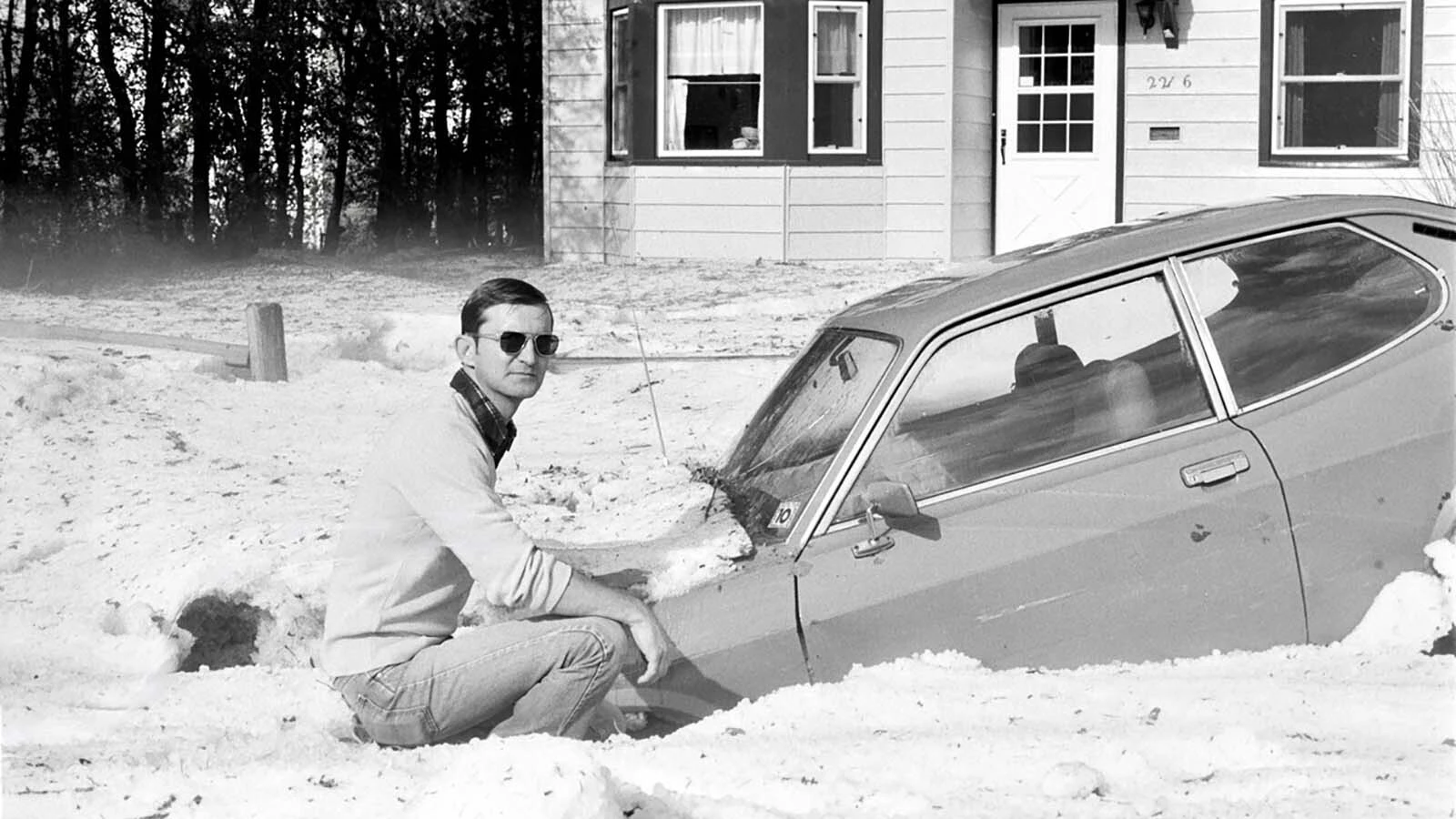
Cheyenne looked more like it had been hit by a snowstorm rather than a flash flood that caused huge banks of hail to cover vehicles. (Photo Courtesy Mark Junge) 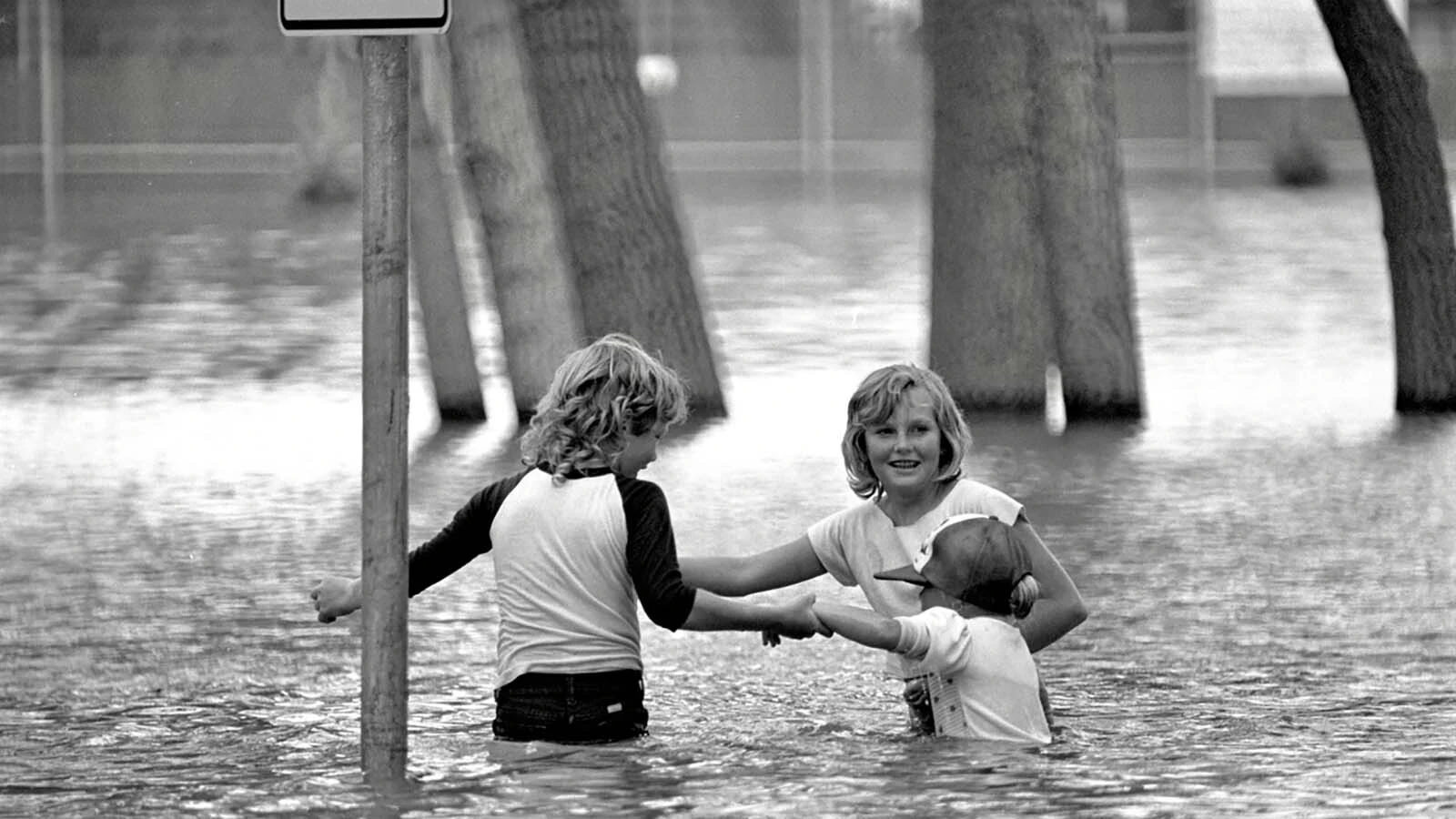
Children play in the floodwaters in downtown Cheyenne on Aug. 2, 1985, the day after more than half of the city’s annual rainfall fell in just a few hours. (Photo Courtesy Mark Junge) 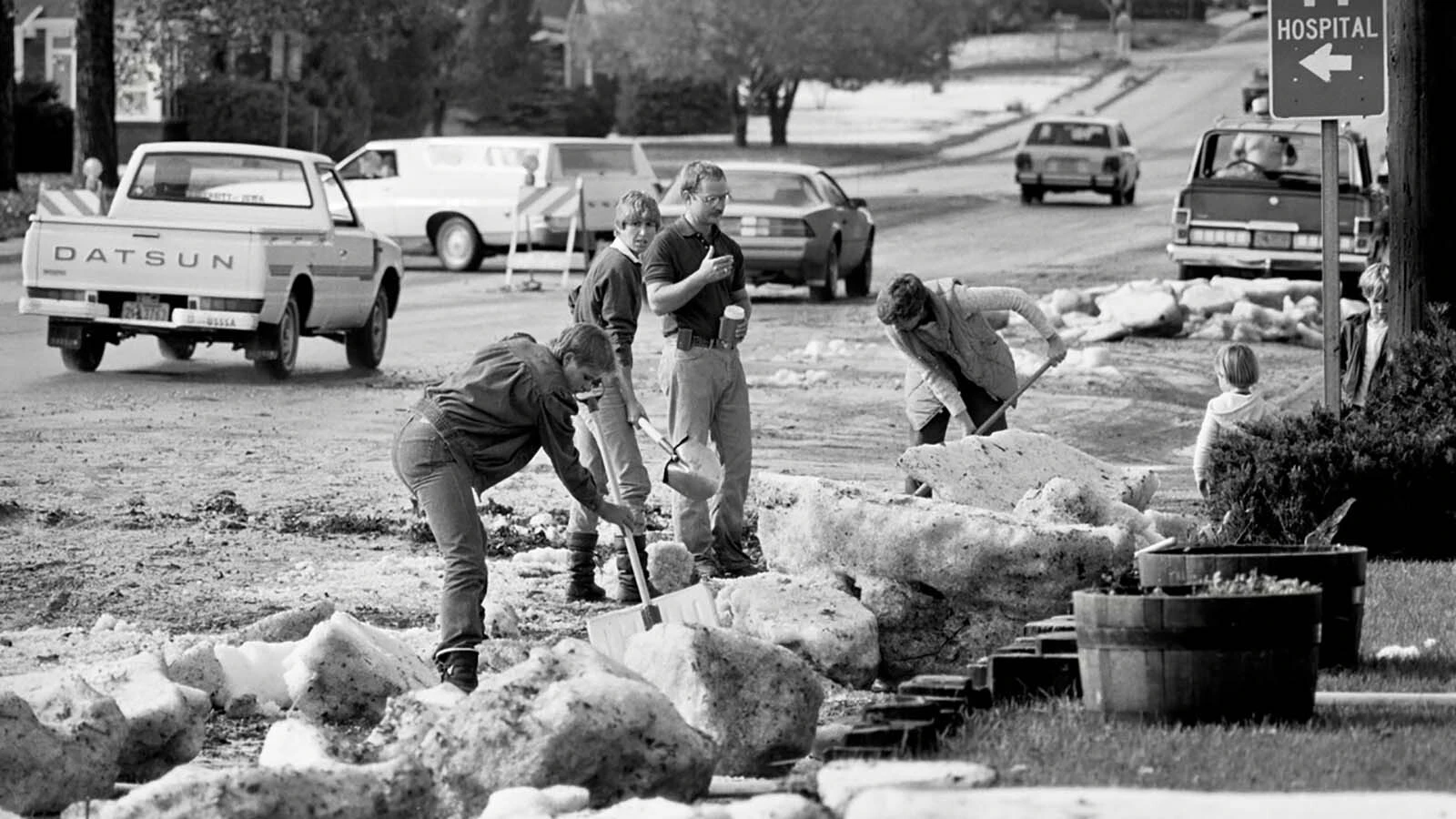
Crews get to work to clean up mounds of hail and debris that covered streets throughout the capital city. (Photo Courtesy Mark Junge) 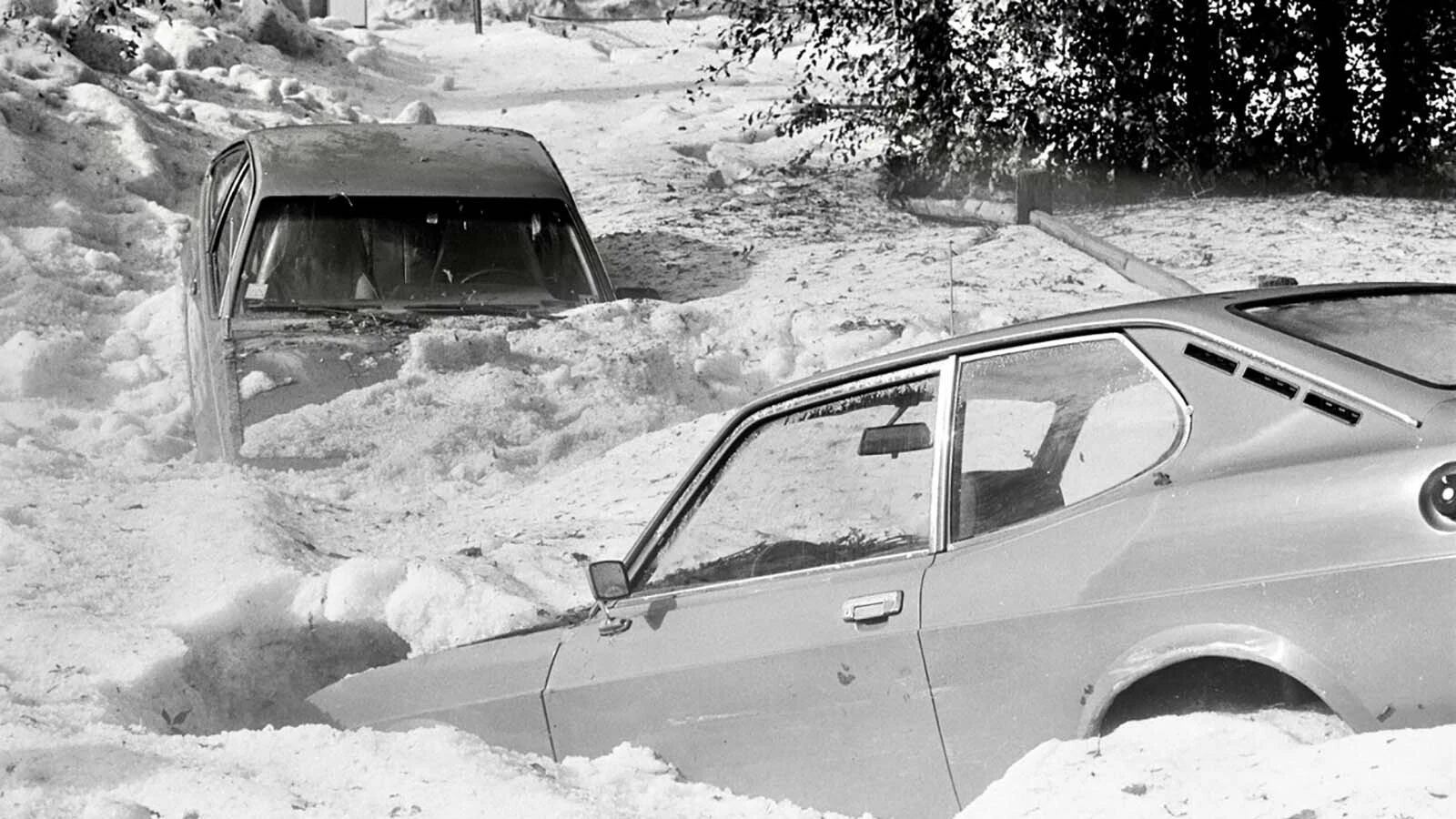
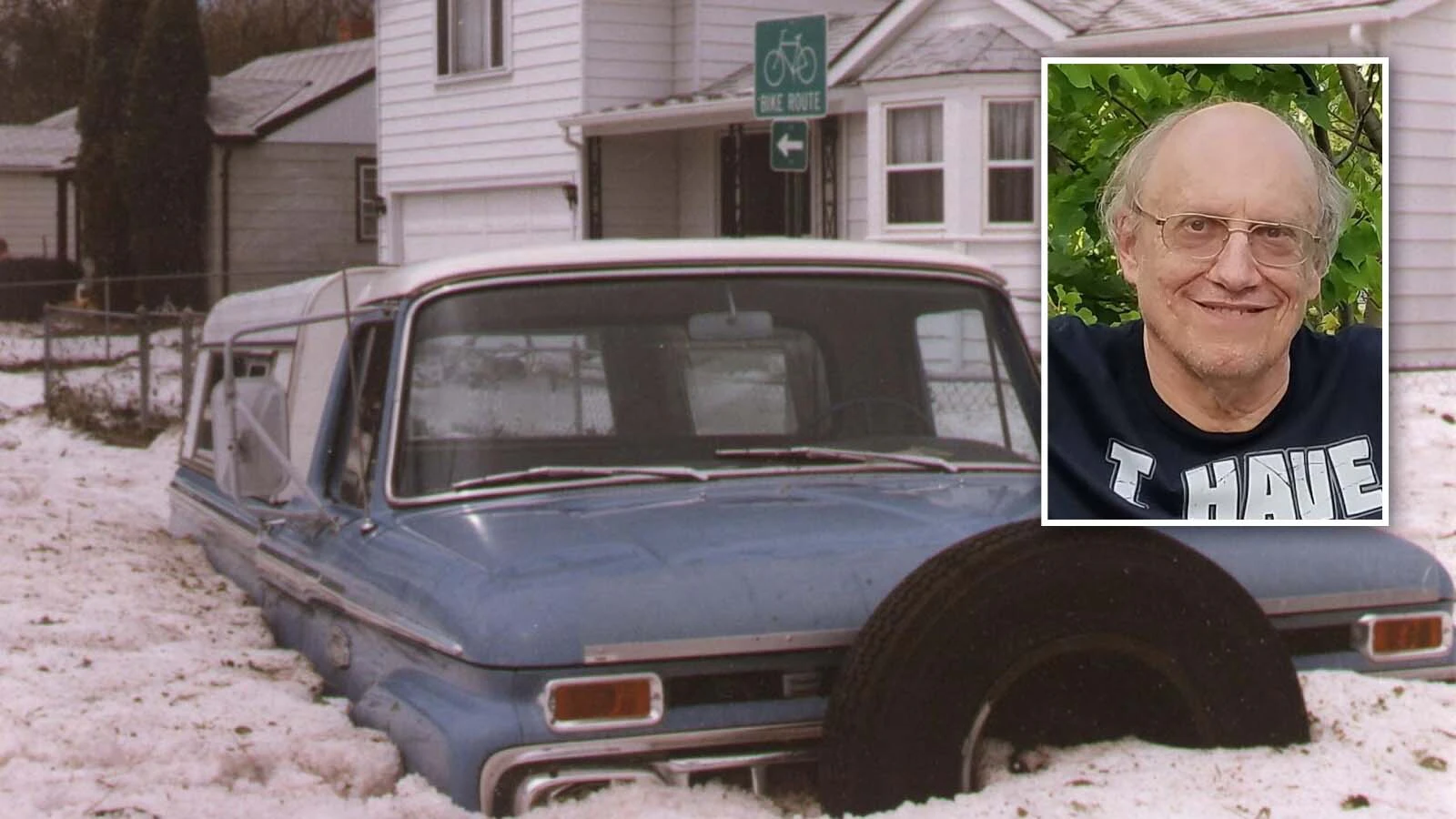
Cheyenne looked more like it had been hit by a snowstorm rather than a flash flood that caused huge banks of hail to cover vehicles. (Photo Courtesy Mark Junge)
Floating Down The Street
But a not-so-funny thing was happening right before my eyes: my car was literally floating down the street, and I had no control over its movement.
Fortunately, there wasn’t much traffic, which turned out to be natural when the entire city had been warned not to be doing exactly what I was doing.
The one thing I knew was that I did not want to be traveling further east, because the flood I would be running into looked more intense up ahead.
At this point I couldn’t actually steer, but I tried to will my car into a parking lot at the intersection of Lincolnway and Warren Avenue by hoping I could somehow stop this crazy thing.
The steady stream took me back west, but I missed the parking lot and wound up half on the street and the other half on the sidewalk in front of a record store I wished I was inside. It was one of my favorite places in Cheyenne but was closed, I realized, because no sane person would be on this block.
I wasn’t floating anymore, which was the most positive spin I could put on the experience. I wasn’t comforted by the fact that I had missed the first race, all because I hadn’t left work on time.
It was at this point I noticed water was filling the inside of my car.
The options seemed bleak: I could get out and get soaked trying to find nonexistent shelter, or I could stay inside and wait out the storm.
That was another bad decision.
The floorboards were soaked and water kept pouring in. I crouched on the driver’s seat, but as the water rose to the level of my radio and glove compartment, I realized that my electrical system was fried, and I would never be driving this car again.
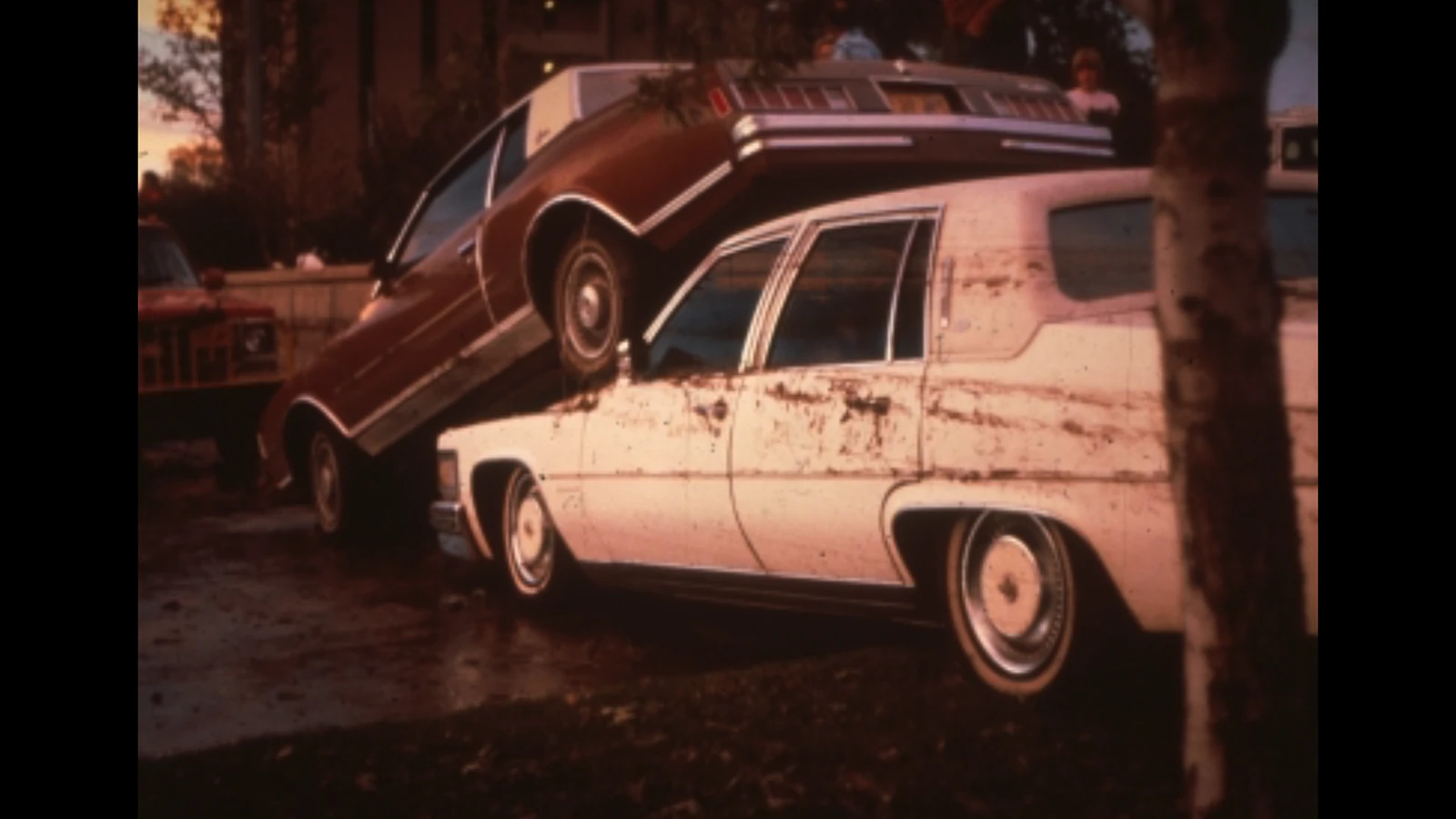
Cars left stacked after floodwaters receded. (USGS) 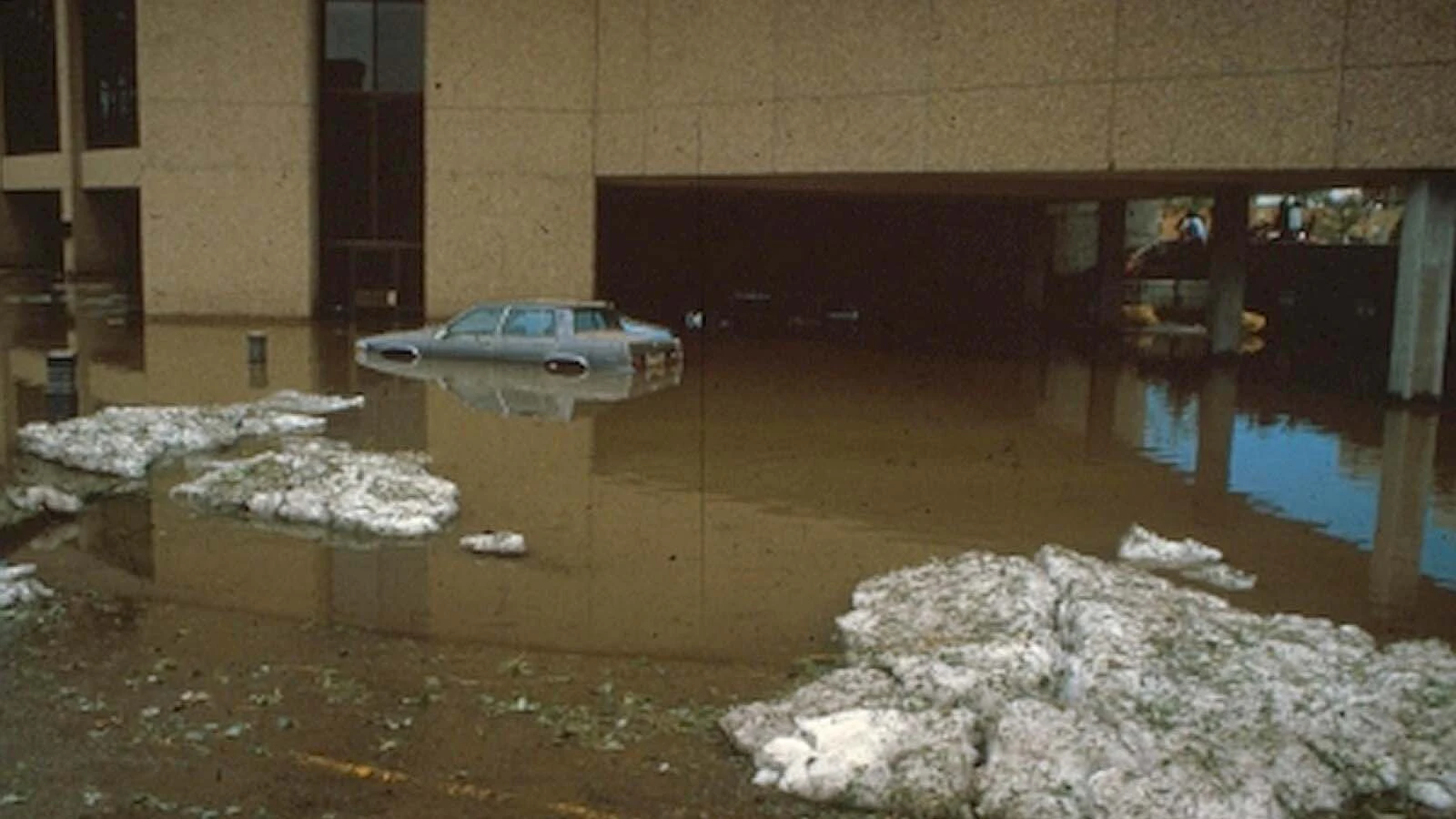
A car submerged in flood waters with drifts of hail in front of Cheyenne Bank on Aug. 1, 1985. (USGS via Wyohistory.org) 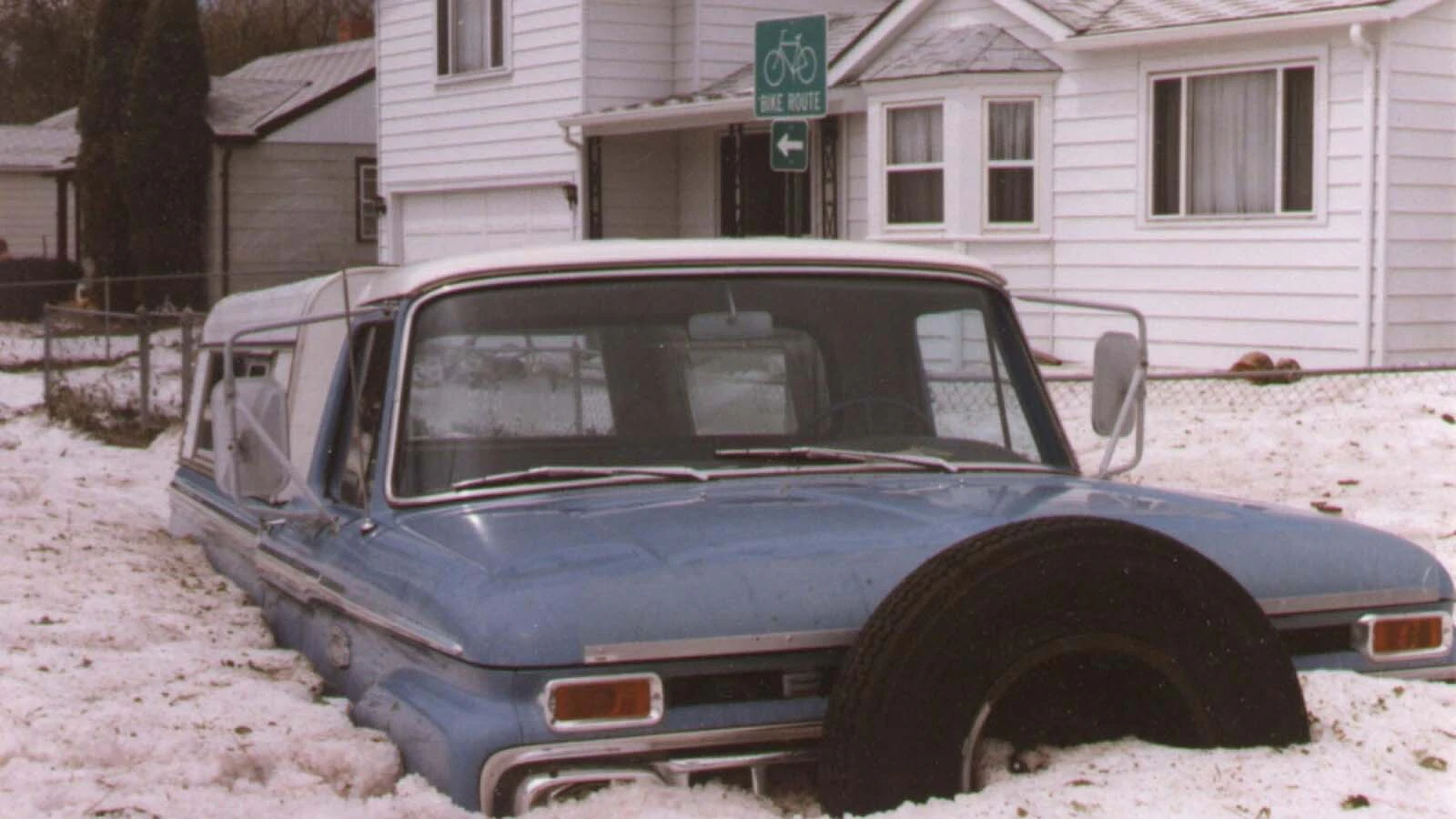
Hail accumulation following flooding in Cheyenne in 1985. (USGS via Wyohistory.org)
Abandon Ship
My only recourse was to abandon ship, so I tried to open my door, but the water pressure was too great and it wouldn’t budge.
I tried to frantically bang against the door with my shoulder, but nothing happened. With the car no longer running, there was no way to open a window and climb out.
It would have been bad idea No. 3 of the night, but I actually searched for something to smash the window, which would likely have left me wet and bleeding. Where was I going to find this mystery tool to free myself anyway?
At this point, I had what I can only describe as my mortality moment.
All I could think about was that I didn’t want to die in this car and how much I wanted out, even though what sounded like the biggest hailstones I’d ever heard were pummeling my Pontiac.
So, I kept trying to slam into the door until my mysterious force would suddenly meet head on with an unmovable object and get me untrapped. After a couple more tries, I was happy to discover it worked — until I got outside and felt the coldest water I had ever experienced, and I was slogging around wondering what to do next.
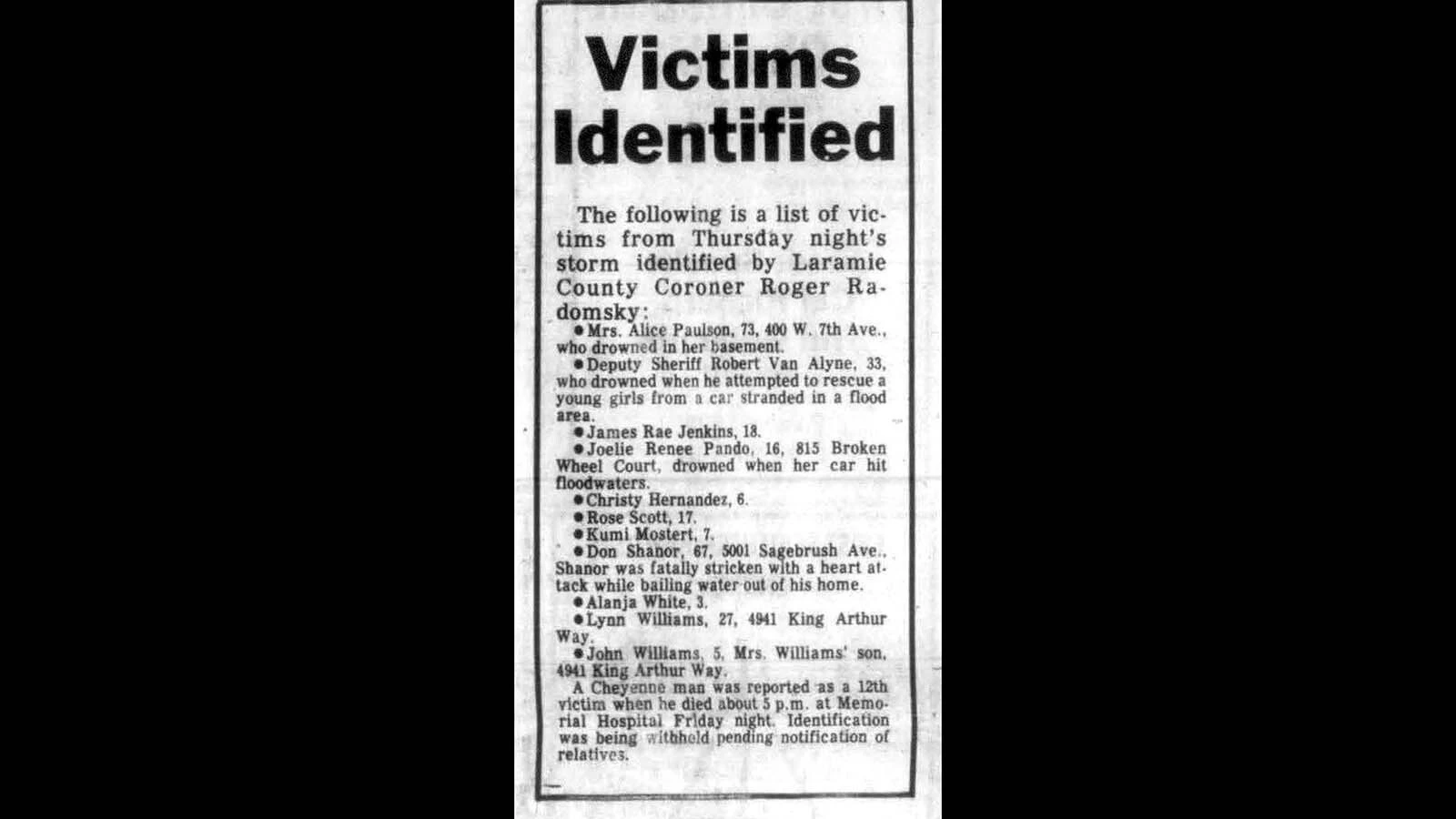
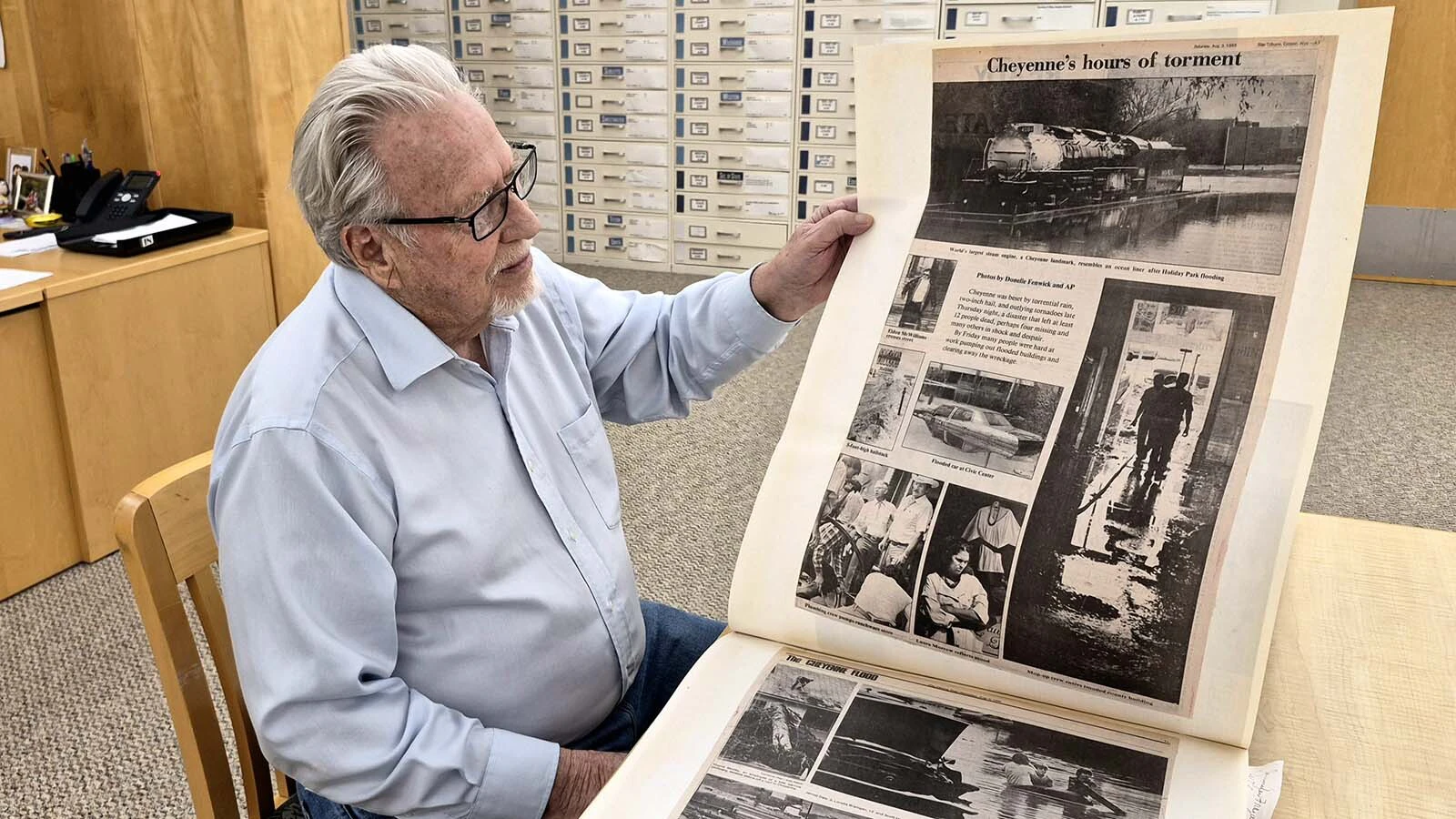
The Aug. 3, 1985, edition of The Wyoming Eagle printed a list of victims of the 1985 flood. 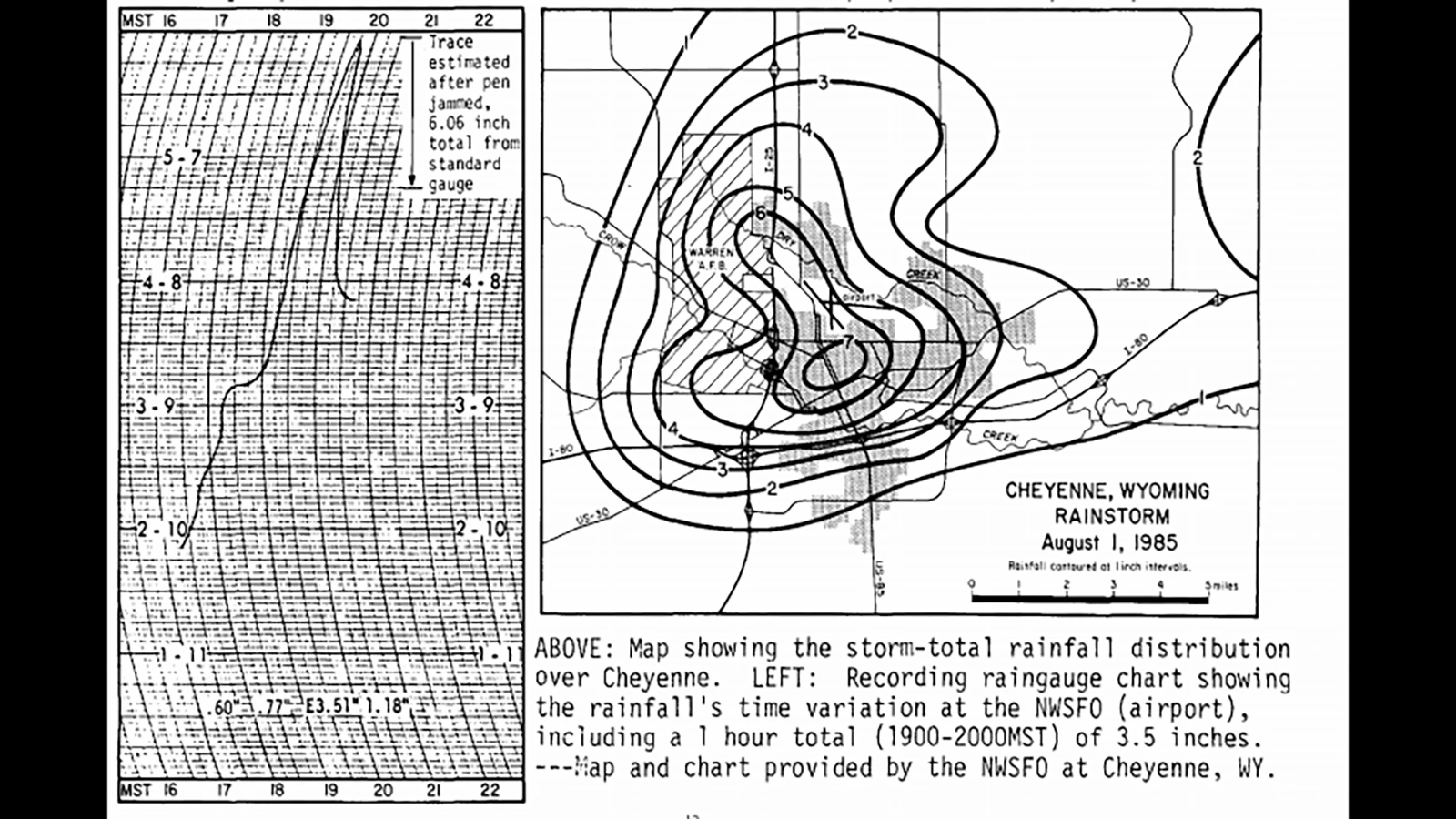
Flood Rainfall map and rain gauge chart from the Cheyenne National Weather Service Office.
Open The Door, Mister!
A quick glance around was not reassuring.
At the other end of the parking lot was a brand-new white truck, and though I couldn’t tell from that angle if anybody was inside, it was high enough off the ground that I trusted it wasn’t taking on much water, if any.
Eould someone open the door? That seemed iffy at best.
If you lived in Cheyenne in 1985 and had the good sense not to be outside in a flash flood, I doubt if you have ever felt the pain accompanied by baseball-size hail striking every part of your body while desperately trying to get from point A to point B.
I read news accounts later that put the size of the hail at 2 inches in diameter, but I swear it was actually bigger than a baseball, and there was a kind of inverse hope that took over my brain and body. Every step was painful and chilly, but I promised myself that if I could just get into that truck, my life would improve 1,000%.
I reached the truck and pounded on the door as hard as I could, and the startled man behind the wheel reached over and let me in. I seem to recall he gave me a jacket because I was still shivering like crazy.
We spent the next hour waiting for the storm to stop, trading life stories as only two survivors of a totally miserable night are wont to do.
He told me he was the owner of a construction company, and seeing how nice his truck was, I believed he was probably good at his job.
I told him that if I’d only been able to get on the road a bit quicker, none of this would have happened to me. The dog track had called its siren song, and instead of hitting a healthy exacta bet for a decent payday the only thing that kept me from feeling like a total loser was getting out of my damned car by myself.
When someone saves your life from baseball-size hail, it’s only natural to show some gratitude and at least remember his name. I can’t do that. In fact, I think it was gone from my memory bank by the flood’s first anniversary.
Still, as crappy as the day was, it was an experience I’ve used to judge how everything is relative. What was a terrible day and night by every criteria one might judge it, it was also a life-affirming one.
I’m mixing gambling metaphors, but I had dealt myself a bad hand and lived to tell about it.
The driver graciously drove the two blocks to the newspaper, and I sought refuge in the fact that my co-workers at The Wyoming Eagle had survived the flood, too.
I was half-expecting they would be putting out an extra edition — all six of them, by themselves — until they recounted how 911 had gone down and the only communication was listening to the police scanner.
What the editor and his staff knew was that there were at least several deaths, but no one knew exactly how bad things were or that the banks of Dry Creek had overflowed and trapped people inside their cars with no possible escape.
No Extra Edition
The word had come down fairly early in the evening to the newsroom: there would be no late press run or extra edition because the paper they had just printed wasn’t likely to be delivered for a few days as the city tried to pick up the pieces and move on.
I knew that I’d be busy for the next two days, getting copy and photos for the Sunday edition so we could try to make sense of this community disaster.
My photographer and friend Fred Yates and I decided to drive around downtown so he could shoot pictures of some of the broken windows at stores. The receding flood waters still glowed from the blinking lights at intersections.
But there weren’t any people walking the streets. Our last stop was at the Mayflower Bar on 17th Street, which was my second-favorite place to be that wasn’t a dog track or poker game.
The place was having a flood party, and there were about 50 souls gathered to wet their whistles and recount their evenings.
Fred and I ordered beers — they were free! — and listened to one of the managers talk about how even though part of the bar was flooded shin-deep and the patrons were drenched to the bone, everyone was indeed in pretty good spirits.
Fred drove me the six blocks to my third-story apartment, where there was no flooding. I turned on a Denver TV station that was broadcasting a special live report, even though it was after midnight.
I stared at the screen and saw something so surreal I had to laugh. There was my Pontiac, nearly by itself on Lincolnway, tilted on the sidewalk, right where I abandoned it to flee to safety and live to tell this tale.