
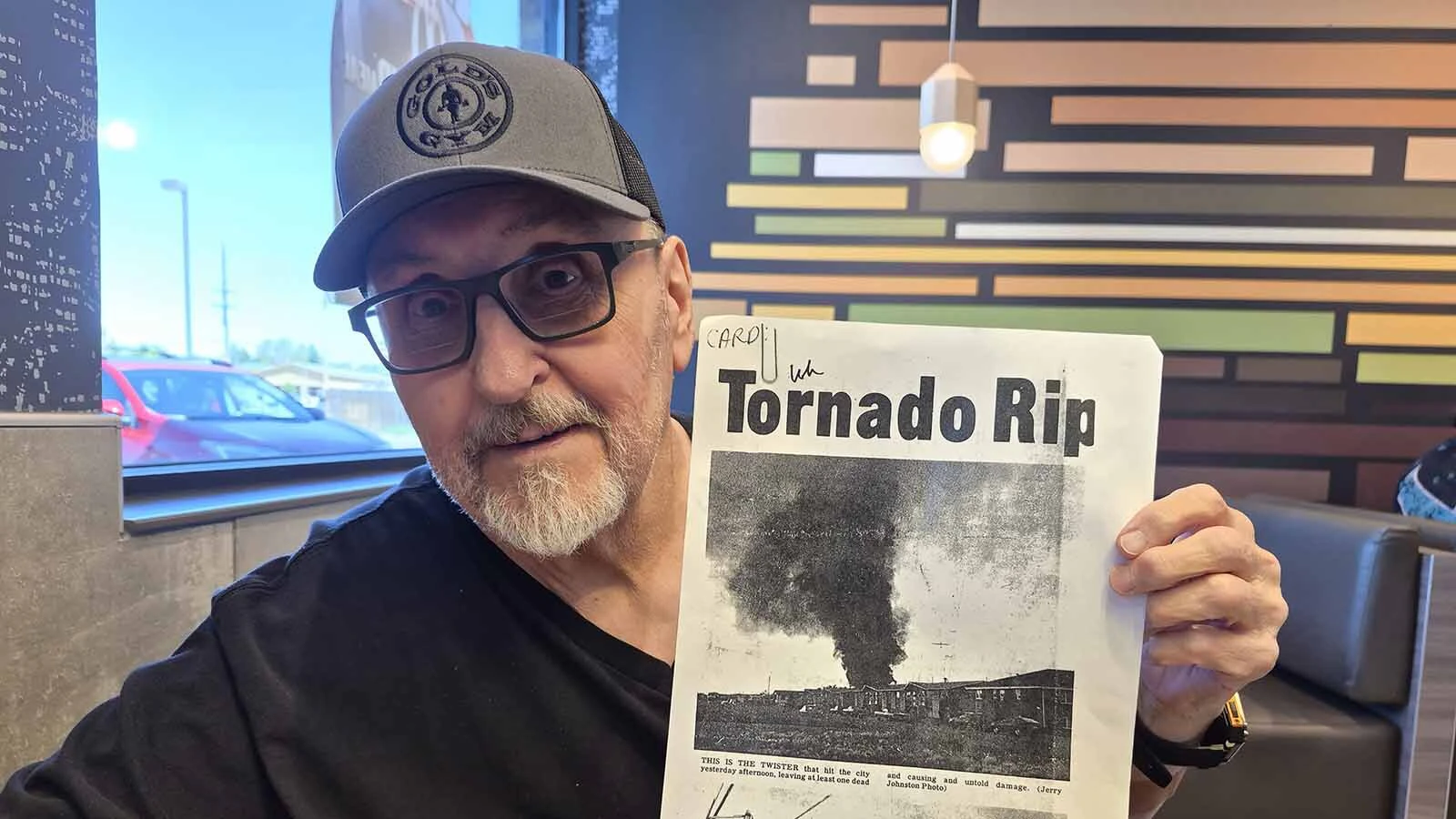
This is a story about old-school journalism when photographers used what is now considered ancient equipment to capture dramatic images of incredible events, like following a tornado as it tore across north Cheyenne on July 16, 1979, destroying everything directly in its path.
It’s also the tale of two guys who found themselves in the right place at the right time, journalistically speaking, though we did nothing to put ourselves there.
Let’s call it what it was: dumb luck.
I was half of this team; my friend Jerry Johnston was the better half.
Jerry wasn’t a news photographer, but he was a great one that day because he accomplished what all of us in the business want: a front-page photo in newspapers across the country.
I was a reporter/photographer for the Wyoming State Tribune, Cheyenne’s afternoon daily newspaper. Our paper went to press at about 1 p.m., so anything I did after that would have to wait until the next day’s edition.
There wasn’t much on my plate as I drove to my volunteer job at the American Cancer Society-Wyoming for a meeting of its public relations committee, which I chaired.
The weather was what everyone in Cheyenne expects on a typical mid-afternoon about a week before Cheyenne Frontier Days — a dark, foreboding sky that promised to soon dump a healthy amount of rain.
Almost Everyone Fled
As I arrived at the ACS office in the Melton Shopping Center, the meeting was already breaking up.
A secretary informed us that it was looking dangerous outside, and that it was probably a good time to leave. Everyone rushed to their cars except Jerry, who was a staff member, and me.
We went outside to see if it was really that bad.
I got together with Jerry this week to talk about what happened that day, like I knew I would when I was assigned to write a retrospective on the most destructive tornado in Wyoming’s history.
Although we hadn’t seen each other in many years, there’s no one I’d rather reminisce about a day 47 years ago that, as Jerry said, is etched in both of our memories.
I had forgotten a few details that Jerry recalled, but our accounts were virtually the same for most of the events.
I remember seeing a large, black mass off in the distance west of us. I wondered what could be on fire — maybe the National Guard headquarters? — until I noticed in horror that it was slowly moving east.
And at that moment, even though I had never seen a tornado live, I knew what it was.
I believe my response was, “Holy shit!” If I didn’t say it outloud, it’s what I was thinking.
A Shocking Discovery
I went to my car to grab my camera, which I took with me everywhere, because it was essential to my job.
It wasn’t there.
My heart sank when I realized I had likely left it on my desk in the newsroom, and that's exactly where I found it about an hour later.
The funnel cloud kept moving, and though it wasn’t on top of us, it was getting much too close for comfort.
My first concern, though, wasn’t about safety, even though the ACS office didn’t have a basement, so there was nowhere to immediately go if it veered in our direction.
No, my first freak-out was that the most dangerous weather phenomena I’d ever seen was smack-dab in front of us, and I was powerless to document it.
But Jerry, thank God, had a 35 mm Pentax camera he retrieved, so we were in business after all. I remembered he’d taken photography classes when we were at Laramie County Community College, so I felt things were in control. Except perhaps me.
“You kept yelling at me to ‘shoot, shoot, shoot!'” Jerry recalled.
Yes I did, because there was nothing else I could say to convey how important it was to keep clicking the damn shutter. Jerry assured me that he had just loaded a huge roll of film, so things were cool.
But what was happening in front of us was terrifying.
There were houses in the twister’s path, and I could see what looked like doors, maybe pieces of roofs and tons of debris being whisked up into the funnel cloud, then slammed to the ground.
“It didn’t have a classic tornado look. It looked like that,” Jerry said, jabbing his finger at the copy of his photo that I brought to help stimulate our conversation and, hopefully, to illustrate this notebook.
This time I remembered to bring my camera, which is actually a phone, which is all I use in this modern world.
‘We Were Idiots’
The photo depicts the closest we ever were to the tornado, and it was the one we eventually used.
I chalked that up to great timing, but Jerry had a different description.
“We were idiots,” he said. "We didn’t know if that thing was going to come over the hill and right at us. But what it did was ride that ridge line all the way down, and we got lucky.”
Jerry’s right, we were idiots, but being lucky idiots wasn’t a bad thing.
When push comes to shove, sometimes the thing that separates a run-of-the-mill photo from a great one is having luck on your side as something extraordinary passes right in front of you.
So, Jerry got his shot and it was time to rush back to my office so we could literally scoop every other media outlet with the first photos of this tragedy. Right?
Nope. That would have been too sensible. Or lackluster. Or wimpy. There was only one thing to do.
“We got in your car and we drove up and around Mylar Park and up to Powderhouse Road, and then we just kind of started following it,” Jerry recalled.
I think our adrenaline mutually kicked into gear, because this wasn’t an idiotic move at all. We were quite a distance behind the twister, and we could see what kind of damage it was doing.
“As we drove on Powderhouse there was junk all over because it had thrown prairie all over, and it was getting worse,” Jerry said. “And that’s where we stopped.
"We talked to some people who were in extreme shellshock. A woman showed us that half of the roof on the back side of her house was gone.”
That was the end of our journey.
“You were like, ‘I don’t think I want to drive in there any further,’ and at that point it was wise because that’s when all of the emergency crews were trying to get there,” he added. “Powderhouse became a big route, and we were pretty much stuck.”
‘Give Me That Film’
Jerry remembers shooting some pictures from a distance over toward Buffalo Ridge, which was the most heavily damaged.
“And then we booked it back,” he said. “And you immediately said, ‘Give me that roll of film, I don’t have time, I’ve got to get this out.’ And you took off.”
Now, if this catastrophic event happened today, I wouldn’t have had to speed back, develop the film, wait for it to dry and then run it through our photo processor to get an image.
Since our cheap, unreliable photo processor typically jammed a few times, it was a long process.
Today, we would have had a digital camera — well, I probably would’ve forgotten mine, but Jerry would have one — and it would be click away, select the best shot, send it electronically, then leave to chase the tornado.
I knew the wire services would want what Jerry shot, and I quickly found what looked like the best photo to tell the story.
United Press International (UPI) was the wire service my paper used, and was conveniently next to our newsroom.
The Associated Press was located downtown, so I dropped a copy of a slightly different shot there.
Both services said they’d send it out with a mandatory credit, so at least Jerry would have some reward for his hard work and putting up with my insistent order to shoot, shoot, shoot.
The Morning After
The next morning, Jerry started getting calls from friends and family all over, including Iowa, Nebraska and Minnesota.
“A former college roommate living in Wisconsin told me, ‘You’re on my front page!’ Jerry said. “It was kind of spooky.”
Jerry and I both laughed when he told me his son asked if he got rich from his historic photo that was seen throughout the country, and perhaps much of the world.
“About a year later, AP sent me a check for $53,” Jerry said, shaking his head. “And UP sent me about $60. My son said, ‘How much money do you think they made?’ And I said, ‘A hell of a lot more than what I did.'
“In today’s media, it might have made some money,” he added. “But honest to God, that was such a small part of it.”
What does he remember most about that day?
“How dark it was,” Jerry said. “The photo, which is really dark, doesn’t even do it justice. I’ll never forget that, it’s etched in my memory.”
Mine too.
It was indeed a dark day, both in the eerie sky above and for all of the people whose homes were destroyed and lives overturned.
That’s what I think we should commemorate on this 47th anniversary. Cheyenne was filled with brave and caring people to help their neighbors get through the tragedy.
Personally, I also think about what it was like to be part of an unlikely team that managed to work together and get the first photo of the major news event of the day on both wire services — quite a mean feat.
It hasn’t happened to me in the 47 years since, and it won’t ever again because, as Jerry remind me, “We’re ancient.”
And at times that day, we were too reckless for our own good.
But we got the job done, in a far different — and I would say more challenging to navigate — media environment.
People relied on local newspapers to inform them, not 24-hour cable news channels, talking heads, high-tech websites, apps and artificial intelligence.
I didn’t know it then, but those were some of journalism’s best days. I was glad to be a part of it.
Kerry Drake can be reached at: Kerry@CowboyStateDaily.com


