
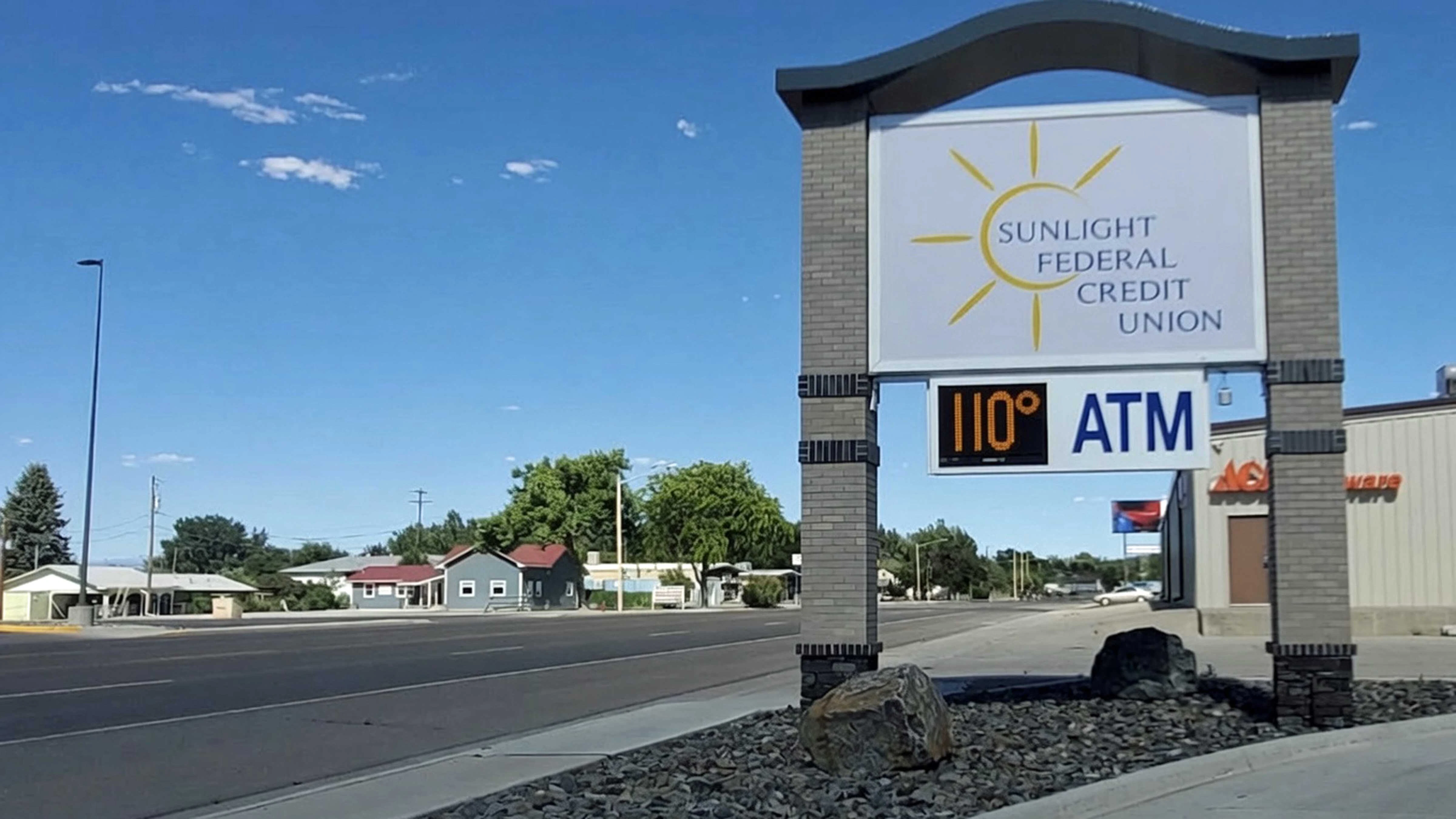
For many Wyoming cities and towns, July was the hottest month on record, going as far back as 1891. It really was that hot.
With another month of record-breaking temperatures, day after day, 2026 is on track to be the hottest year in Wyoming’s recorded history as well. And, at this point, there’s no end in sight as we move into August.
“The consistency and intensity of the heat, especially for northern and northeastern Wyoming, was really remarkable,” said Cowboy State Daily meteorologist Don Day. “I fully expect that if it's not the hottest July in many areas, since records have been kept, it will certainly be in the top three.”
In Record Heat
Throughout July, Wyoming was under a stubborn heat wave that refused to let up.
Jason Straub, a meteorologist with the National Weather Service (NWS) in Riverton, said seven communities either set records or tied for the hottest July on record.
“Big Piney, Buffalo, Casper, Lander, Riverton, Rock Springs, and Worland have set year-to-date records,” Straub said. “We're well into first-place all-time rank for those sites.”
Historically, Riverton has a day with temperatures over 100 degrees three times every five years.
There were six days with highs at or over 100 during July. That’s around 10 times the five-year average in a single month.
Lander, which has the oldest climate records in Wyoming, usually has one 100-degree high every six years. It had two 100-degree days in July, which is 12 times the average going back to 1891.
Meanwhile, Cheyenne set its own record in July: the longest streak of days where temperatures stayed above 60 degrees, even overnight.
“Temperatures didn’t drop below 60 degrees for 13 days, between July 18 and July 30,” said meteorologist Shelby Fuller with NWS Cheyenne. “Our previous streak was eight days. That’s very unusual for Cheyenne and Wyoming as a whole.”
Average temperatures in July ranged from 3.9 degrees to 6.3 degrees above normal across Wyoming. Between 69% and 77% of the days in July had above-average temperatures.
Even places prone to heat during the summer, such as Worland, set record highs in July. Worland's 110-degree high on July 12 broke the town's record for that day by 3 degrees and was the hottest in Wyoming last month.
It also ranks among the hottest days ever recorded in Wyoming.
For the record, the hottest temperature ever recorded in Wyoming is 115 degrees at the Wind River Diversion Dam on July 15, 1988.
It’s all really hot, but Day noted that some historical records are longer than others.
“Nobody’s saying this is the hottest July since the dawn of time,” he said. “
Heat Under Pressure
The primary source of July’s record-setting heat was a high-pressure ridge with a “bull’s-eye” over northeast Wyoming, according to Day.
However, Wyoming’s humidity was also high throughout July. That typically means more moisture, but that didn’t happen.
“What we were fighting for the month of July was moisture being drawn into Wyoming, but the high-pressure ridge over the Northern Plains was so strong, it was making it harder to rain, even though we had that moisture.”
Straub added that another high-pressure ridge set up over the Four Corners region. That means Wyoming spent July sandwiched between two ridges that kept everything hot and dry.
“That ridge stretched well into Wyoming for most of the month,” he said. “That blocked moisture and let the heat dominate and repeat, day after day.”
High-pressure ridges, and the heat domes they create, are expected to set up somewhere in North America during the summer. In July, Wyoming got the short end of the stick.
“When these ridges set up, there's not a whole lot to push them around,” Straub said. “It needs the jet stream to push them around, but the jet stream's well into Canada at this time of year, so it's not influencing any heat domes that set up.”
Monsoon Too Soon
The unrelenting heat of July also meant the monsoonal moisture many people were hoping for never showed. The moisture-rich air from the Pacific Ocean arrived, but it couldn’t beat the heat.
“That's the thing with the monsoon,” Fuller said. “Even when there are increased chances for heavy rainfall across the area, that doesn't mean every single place is going to see and/or benefit from it.”
For the few places that got some monsoonal moisture, it was a decent month for precipitation.
According to Day, thunderstorms were much more active in western Wyoming in July, explaining the mudslides near Cody and flash floods in Thermopolis. The disparity between western and eastern Wyoming, due to the high-pressure ridge, was “quite remarkable.”
“Any time a thunderstorm really wanted to build up, or it looked like there could be multiple days of thunderstorms, they were running into that high pressure east of the Continental Divide,” he said. “That’s how much it influenced the eastern side of the state.”
High humidity is also what kept overnight temperatures high.
“High humidity keeps those temperatures warmer at night, and makes it more uncomfortable in the heat,” said Day. “That’s one thing that sticks out to me, and a lot of people probably noticed that nighttime temperatures stayed elevated all month.”
Stuck In The Middle Of It
Straub said the NWS Riverton office was still compiling data from stations that malfunctioned in July. He expects that data would only add more confirmation to what’s already known.
“If it wasn’t the hottest July on record for those places, it’ll be pretty close,” he said. “They had the same heat as everybody else.”
No relief is expected anytime soon. Monday and Tuesday were to be significantly cooler, with daytime highs in the 70s, but the heat will be back.
“Once this cold front is through, we're back into hotter temperatures, upper 80s and 90s, by the end of the week,” Fuller said. “Unfortunately, it looks like August is probably going to be another hot one.”
Day expected the first half of August to feel like July, with above-average temperatures and stubborn heat. After that, he’s “cautiously optimistic” that Wyoming will get cooler.
“For the first 10 days of August, don't expect too much different,” he said. “When you go through the second half of August, we normally start to see things subtly change. Days are getting shorter, nights are longer, and it gets harder to get prolonged periods of that kind of heat.”
Those subtle changes could give monsoonal moisture a chance to manifest and fall as precipitation across Wyoming.
The critical thing to remember, even if August eventually gets cooler, Straub said, is that it’s still the peak of summer. Wyoming’s summers are always hot, but this record-breaking streak seems poised to continue, keeping 2026 on track to be the hottest year in Wyoming’s recorded history.
“We're still in the middle of summer,” Straub said. “That area of high pressure can reestablish itself pretty quickly, so we're not out of the heat quite yet. Hopefully, everyone can stay cool until then."
Andrew Rossi can be reached at arossi@cowboystatedaily.com.


