
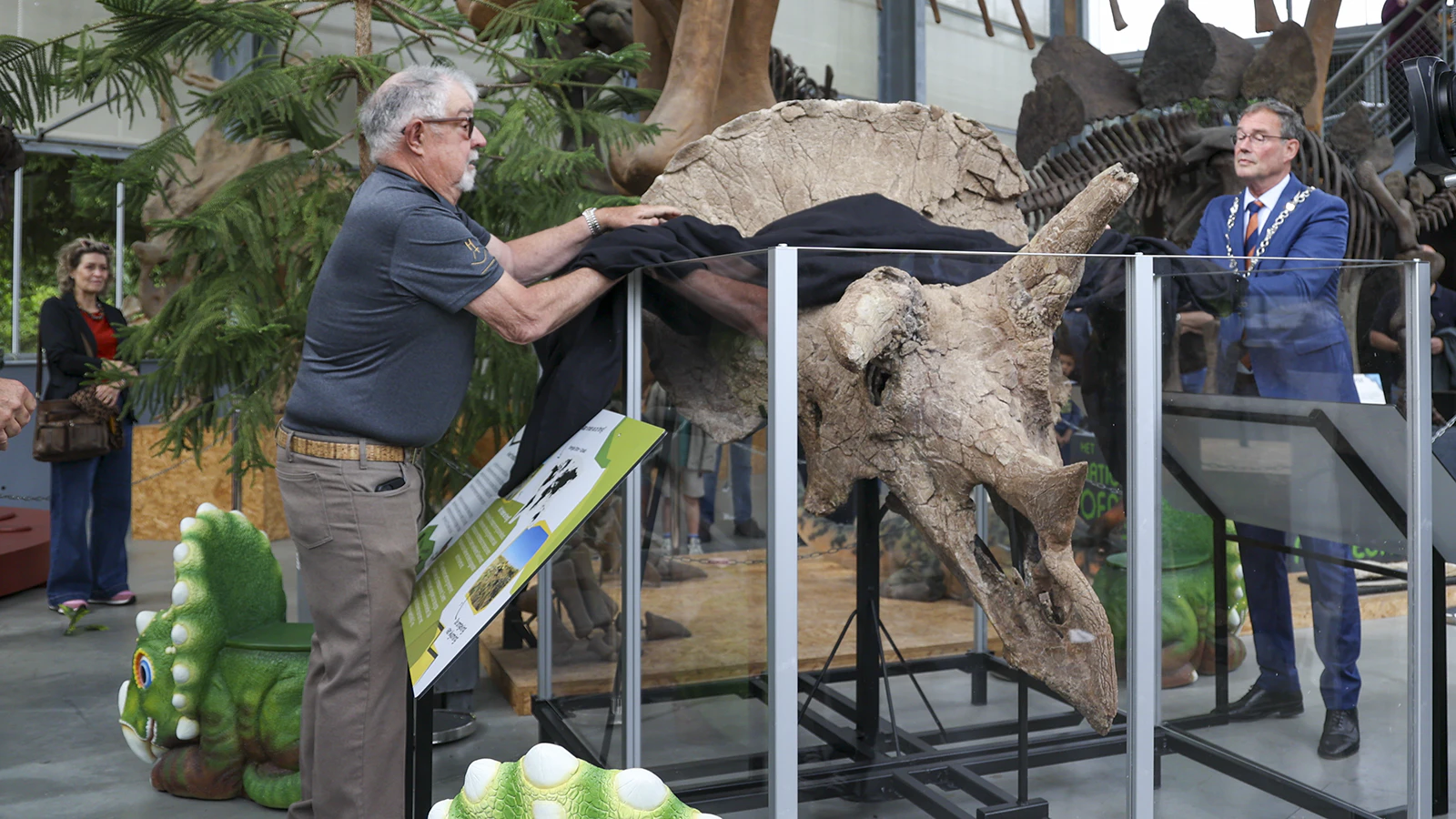
A museum in the Netherlands has unveiled “Veronika,” an extremely rare near-perfect Triceratops skull from eastern Wyoming.
Veronika made her official debut in the dinosaur gallery of the Oertijdmuseum two weeks ago, the culmination of more than two years of work to extract the skull from the hard rock in Wyoming that preserved it for 67 million years.
“The skull is almost completely there, with only a small part being deformed,” Jonathan Wallaard, senior curator of the museum, told Cowboy State Daily, adding that, “95% of the skull is there.”
Nose To Nose
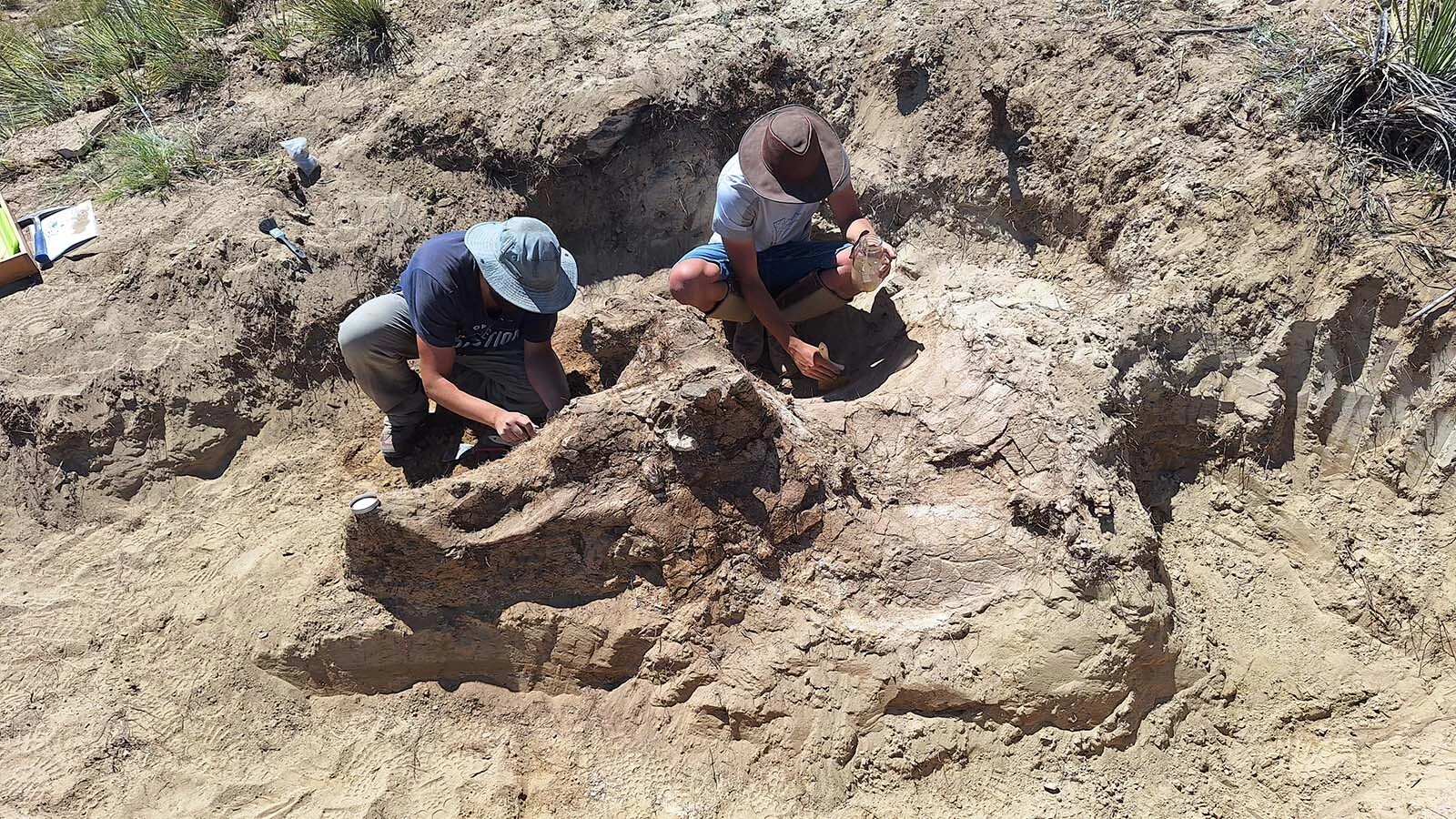
Wallaard said Veronika was found during the Oertijdmuseum’s 2024 excavation in the Lance Formation of eastern Wyoming. It was discovered due to a minor medical issue.
“It was the first field day of the season, and we were walking towards a microsite where we wanted to dig, he said. “During that walk, one of our crew got a nosebleed. We sat him down on a rock and walked around it a little bit when we discovered some bits and pieces of bone on the surface of that hill.”
When the team started digging around the area, they realized they were looking at brow horns. Further digging confirmed that they’d found a Triceratops skull, and a very complete one, at that.
“Only parts of the brow horns, the nose horn, and part of the nose itself were missing,” Wallaard said. “We got it out of the ground in 10 days.”
After being encased in a 660-pound plaster jacket for protection and transport, the skull sailed across the Atlantic Ocean to the Oertijdmuseum. The meticulous process of fossil preparation began when it arrived in August 2024.
“The preparation, mounting, and remodeling of the missing pieces took 1,500 hours,” Wallaard said.
Ronald van Meygaarden, the mayor of the town of Boxel where the museum is located, helped unveil the finished skull. It joins another Wyoming dinosaur, the 74-foot-long Ardetosaurus, in the museum’s dinosaur gallery.
Bitten And Battered
In the process of excavating and preparing Veronika, Wallaard and other scientists studied the Triceratops skull closely. They have many intriguing ideas about how this dinosaur lived.
There are two species of Triceratops, which is Wyoming’s state dinosaur.
Veronika is a Triceratops prorsus. According to paleontologists, T. prorsus has a longer nose horn and is slightly smaller than the other species of Triceratops, T. horridus.
Wallaard hinted that Veronika's name might be a misnomer.
“The skull itself is of a fully grown adult, although relatively small at 5 feet long,” he said. “It is most likely a male, although we need some more proof on that.”
Wallaard said these insights come from the excessive amount of scar tissue on the skull.
The sides of the skull are covered with healed bone. Wallaard believes that was the result of Veronika sparring with other Triceratops.
“Based on the scar tissue on the frill and the cheeks, (Veronika) had been fighting other Triceratops a lot during its life,” he said.
That's why they believe the skull is possibly from a male Triceratops. It's more likely that males would be scarring each other with their horns, just like Wyoming's modern-day bison and elk.
There are other, much larger scars on the frill that don’t look like wounds from Triceratops horns. According to Wallaard, these gouges probably came from Tyrannosaurus teeth.
None of these claims are extraordinary. Many Triceratops skulls show evidence of intraspecific combat and post-mortem scavenging by Tyrannosaurus.
In fact, a 2012 theory postulated that a hungry T. rex would tear the heads off Triceratops carcasses to feast on the neck muscles that would have attached the massive head to the rest of the body. That would partially explain why Triceratops skulls are so common, while their bodies are comparatively rare.
“We are investigating the scar tissue to get more knowledge on them, but the marks on the frill look like very big bite marks, most likely caused by T.rex,” Wallaard said.
Uncrushed
One of the Oertijdmuseum’s goals in their ongoing Wyoming excavations is to understand the paleoenvironment of the Late Cretaceous Lance Formation. The discovery and preparation of Veronika provided some insights into this prehistoric world.
“We have a site where we found fossils of 15 species of dinosaur, nine species of mammal, crocodiles, fish, birds, salamanders, frogs, lizards, snakes, turtles, and much more, and all in an area of 20 square feet,” Wallaard said. “This gives a near complete overview of animals all living at the same time in the same area.”
When preparing their Triceratops skull, Wallaard and his team found several small balls of clay in the rock encasing the fossil.
That indicates that the dinosaur lived, died, and was buried in a river ecosystem, which could explain how it was so spectacularly preserved.
“Veronika died and ended up in a river, and the animal was in there for quite some time,” he said. “When the river flooded, all the bones except for the skull were flushed away. In the meantime, the skull filled up with clay.”
Fossils are often crushed by the overlying weight of accumulating rock and sediment over millions of years. Fortunately, this Triceratops skull was preserved intact with no crushing, thanks to the environment where the animal dropped dead.
“The skull was not flattened due to the pressure, because it was completely filled with sand and clay,” Wallaard said. “Only a small part was missing or deformed.”
The result is a perfectly preserved Triceratops skull. Even for a dinosaur as common as Triceratops, it’s an ideal discovery for any paleontologist.
Ongoing Excavation
Wallaard and other paleontologists with the Oertijdmuseum will be returning to eastern Wyoming this summer. They’ll continue excavating at their existing sites in the Lance Formation while prospecting for new dinosaur discoveries.
“We are currently focusing on finding new spots, new areas to dig, and new things to discover,” he said.
Among their discoveries was a small eggshell fragment from a large egg, presumably laid by a large dinosaur. After comparing it with other fossilized dinosaur eggs, Wallaard believes their ancient egg was laid and hatched into a T. rex.
“This type of eggshell has not previously been found in the USA,” he said. “It’s only known from Asia, where a lot of eggs of this type have been found and assigned to Tarbosaurus.”
Because the eggshell fragment was squared, not rounded, Wallaard believes it didn’t tumble far from the nest where it would have been laid. His hope is that he’ll be able to find and follow a path that will lead to the discovery of a lifetime: a Tyrannosaurus nest with intact eggs and embryos.
“So far, no luck, but we are still looking,” he said.
Even in the unlikely scenario that their future excavations are a bust, it’d be hard to be disappointed by a specimen as spectacular as Veronika. It has a very pretty face, by human and Triceratops standards.
Andrew Rossi can be reached at arossi@cowboystatedaily.com.


