
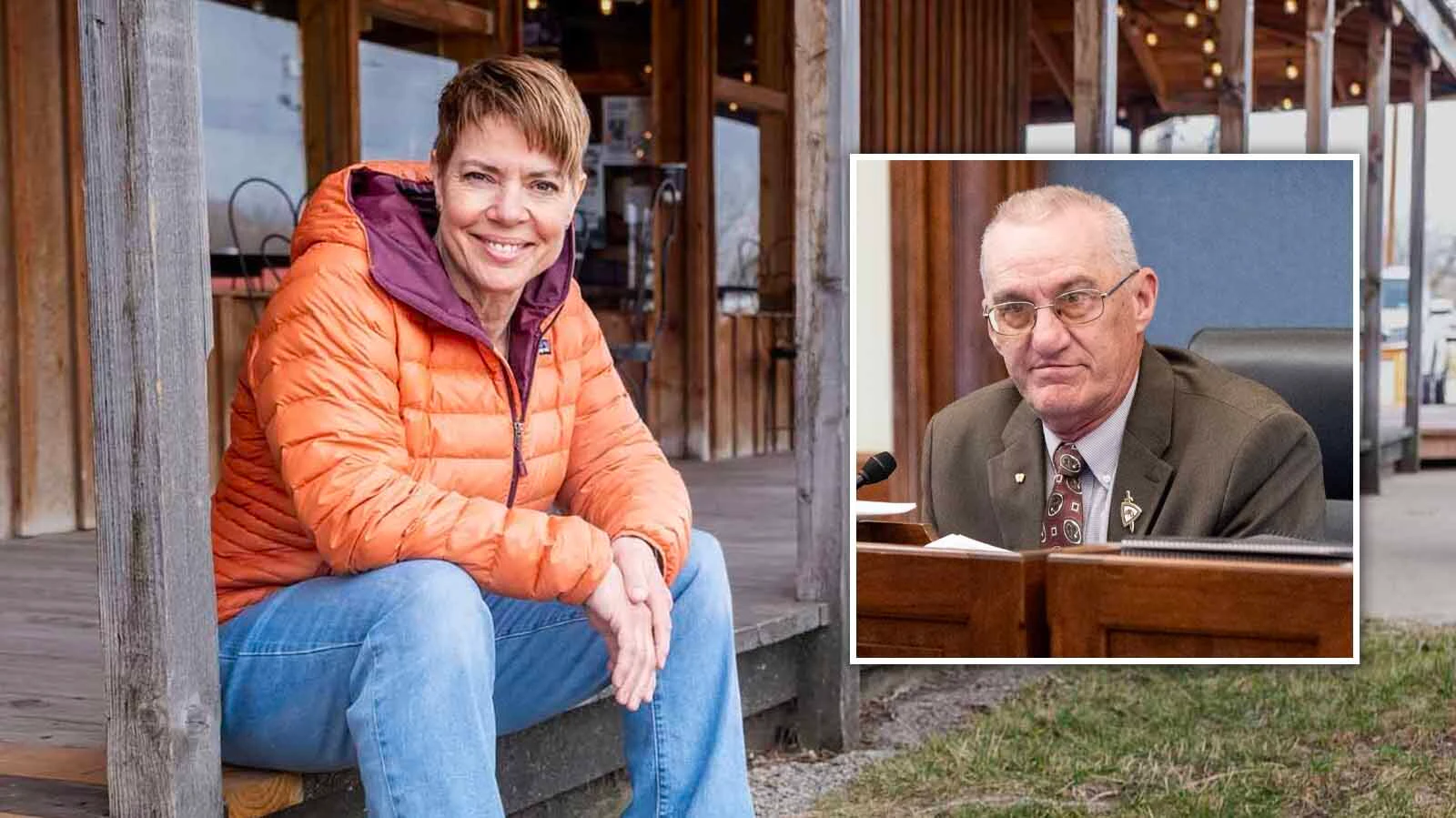
Dayton resident Melissa Butcher has claimed Sheridan County’s Senate District 21, beating opponent Ken Pendergraft by nearly 1,000 votes.
Tuesday’s primary election capped a race that saw voters choosing between an emphasis on pragmatic policy and a fiscal-conservative, Freedom Caucus-aligned approach.
Pendergraft, who made fiscal restraint and limited government central to his legislative career, sought to move from the Wyoming House to the Senate after serving two terms in the House. He is finishing a term as the representative for House District 29.
Butcher, 58, owns businesses in Ranchester and Sheridan. She ran on a platform advocating for Wyoming moving beyond ideological battles and focusing on policies that work.
Butcher claimed the seat currently held by Sen. Bo Biteman, R-Ranchester, who is running for the Republican nomination for Wyoming’s lone U.S. House seat. Biteman was showing a close second to Chuck Gray in Sheridan County polling Tuesday.
The race came as Pendergraft and House Speaker Chip Neiman, R-Hulett, sought to strengthen their numbers in the Senate for the Wyoming Freedom Caucus, which has pushed for lower spending, smaller government and other conservative priorities.
According to unofficial results, Butcher garnerd 3,361 votes to Pendergraft's 2,391.
Butcher’s Emphasis: Practical Solutions
Butcher approached the race from a business background and has said she wants to bring a more pragmatic perspective to the Legislature.
Rather than viewing policy primarily through an ideological lens, Butcher has argued that lawmakers should focus on whether a policy actually works.
Her professional work is in public process facilitation, helping businesses and other organizations navigate government, permitting and regulatory processes.
Among the projects she has worked on was a uranium mine north of Moorcroft, where she helped the operation navigate Environmental Protection Act regulations and other public processes.
Among other issues, she and Pendergraft clashed in how they viewed the efficacy of the Wyoming Business Council.
Pendergraft has made the Wyoming Business Council one example of what he sees as excessive government spending.
Last year, he pushed an effort to defund the agency. That effort ultimately failed, but the Legislature approved only one year of funding for the Business Council rather than its customary two-year appropriation. Lawmakers also called for reforms to the agency.
Butchr said she believed the agency can be improved and does not support simply eliminating it.
She has said “burning it down” is not the answer and has advocated finding a compromise over how the agency should be funded and operated.
Property Taxes A Key Issue
Property taxes are another issue where Butcher has advocated for a targeted approach rather than broad measures.
Residential property taxes rose sharply in many parts of Wyoming following the COVID-19 pandemic as buyers from outside the state entered Wyoming’s housing market and drove up home values.
The Legislature responded by approving a 25% property tax reduction for Wyoming homeowners, applying the reduction to the first $1 million of a home’s value.
But reductions in property tax revenue have also created concerns for local governments and other entities that depend on those revenues to provide services.
Property taxes help fund local law enforcement, fire and ambulance services and school districts, among other services. Some counties have reported budget shortfalls since the cuts took effect.
Butcher has said the Legislature should concentrate on helping homeowners who are struggling most rather than adopting sweeping property tax measures.
She has said the issue hinges on finding a solution that “genuinely helps homeowners, especially those who need the most help, but on the other side of that, what is sustainable for our communities in the long-term.”
That puts her at odds with the idea that a single, broad tax policy can solve Wyoming’s property tax problems.
Pendergraft Focuses On Spending
Pendergraft was elected to the House in 2022 and in 2025 was appointed to one of seven seats on the powerful House Appropriations Committee.
The committee gets the first opportunity to review and amend the governor’s proposed two-year state budget before it moves to the full Legislature and later budget negotiations. It also oversees other spending measures.
Pendergraft said he had been waiting for Biteman to vacate the Senate seat rather than challenge him directly.
He also saw the smaller Senate as an opportunity to have a greater impact. The Senate has half as many members as the House, meaning individual senators can have more influence over legislation and negotiations.
He named his top priority if elected to get the Senate to exercise greater financial restraint.
“We need to cultivate that true Republican spirit of low taxes, small government in the Senate; and it’s not there right now,” Pendergraft previously told Cowboy State Daily.
Pendergraft has argued that government should be more disciplined with taxpayer dollars and has made fiscal restraint a central theme of his campaign.
Two Visions For The Senate
Pendergraft entered the Senate with legislative experience, a seat on the House Appropriations Committee and a record of pushing for lower government spending and greater fiscal restraint.
Butcher brings experience as a business owner and public process facilitator.
Butcher and her husband own a bakery and café in Ranchester, with a pastry outlet in Sheridan, as well as a campground in Ranchester.
She grew up in Wyoming and is married with one stepdaughter.
Pendergraft was born in Casper and raised in Sheridan. He served 10 years in the U.S. Army and is a combat veteran. He later worked in construction before retiring.
Pendergraft is married and has three children and 11 grandchildren.
Kate Meadows can be reached at kate@cowboystatedaily.com.


