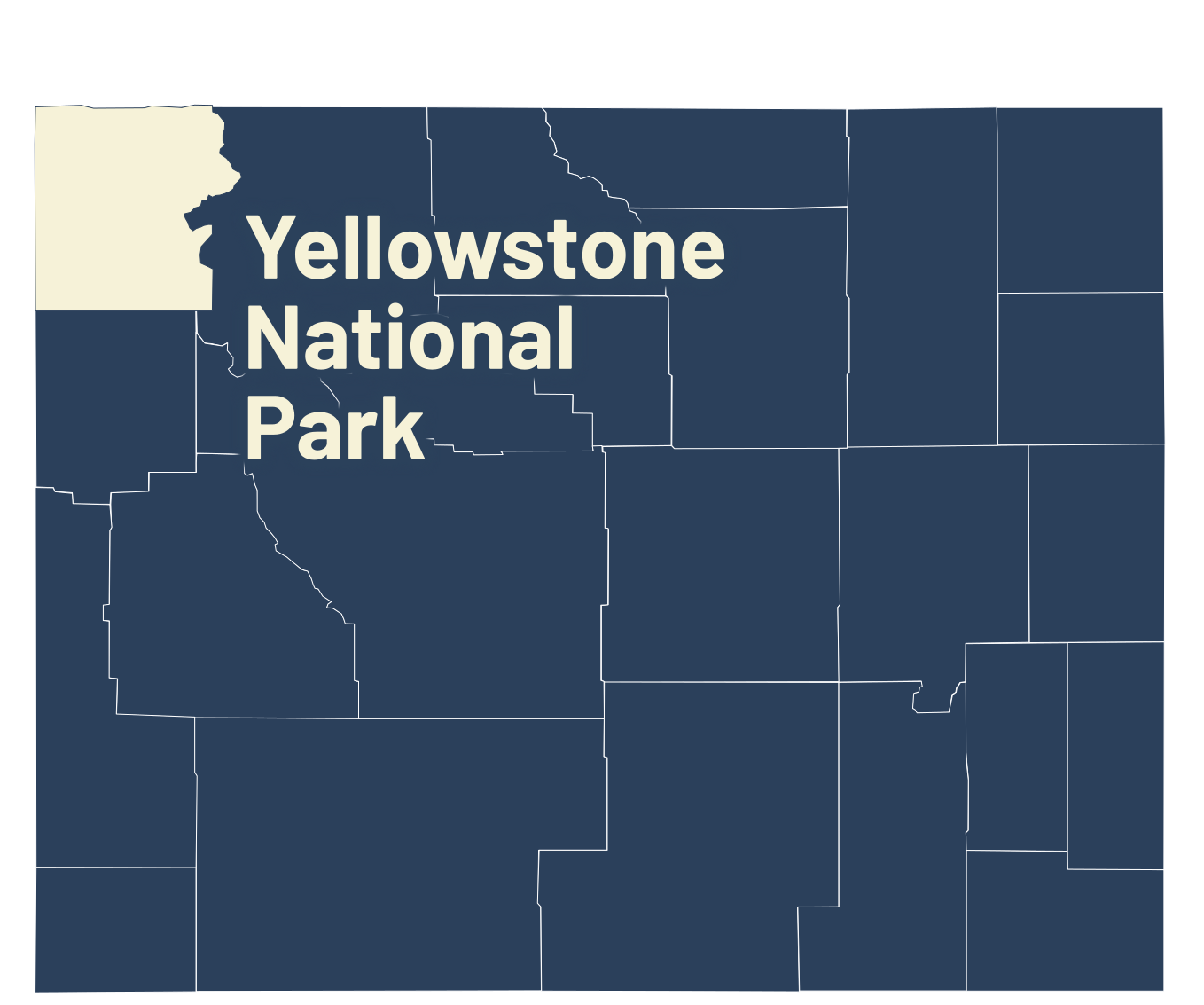
There's a big bee emergency in Yellowstone National Park after a semi-truck carrying dozens of beehives crashed Tuesday.
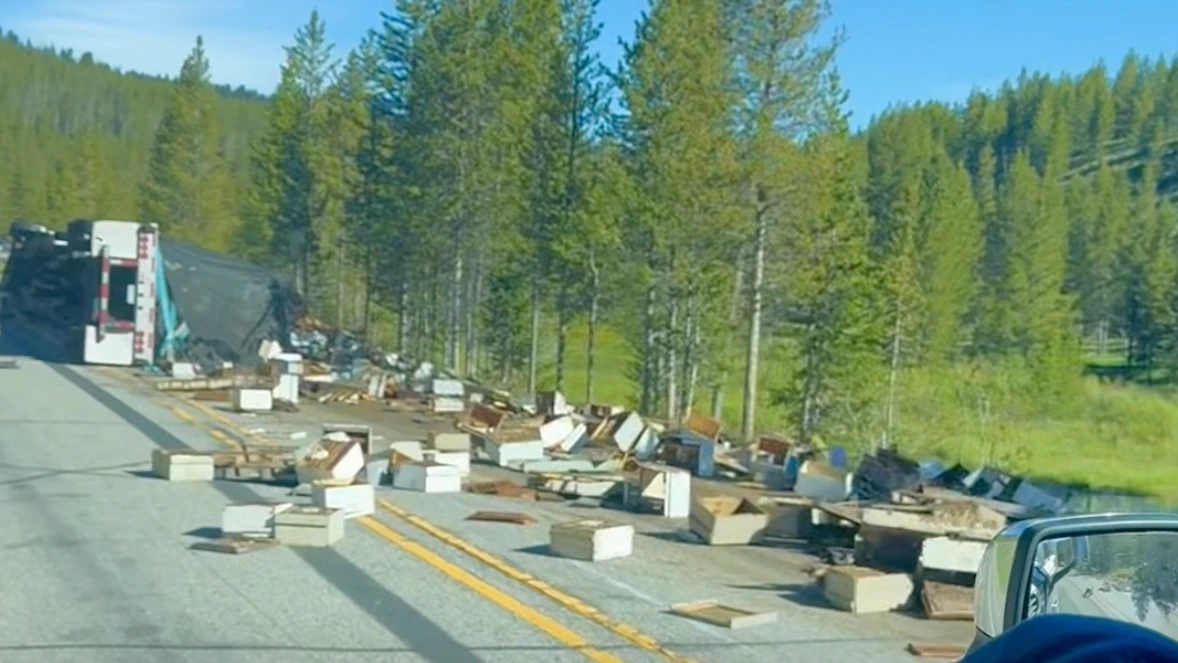
Dalton Broadus of West Yellowstone, Montana, was driving north along U.S. Highway 191 around 9 a.m. Tuesday when he drove past the scene.
Damaged and destroyed beehives were scattered across a quarter-mile stretch of road. Bees were swarming his vehicle, several tow trucks and a Yellowstone ambulance were at the scene, and someone in a beekeeping suit was already assessing the area.
“It happened about an hour before I got there, I believe,” Broadus said.
The Gallatin County Sheriff’s Office, Hebgen Basin Fire/EMS, the Montana Department of Transportation, and the Montana Department of Agriculture responded to the scene.
James Peterson, dispatch manager for Eaton Road Solutions, told Cowboy State Daily his company received a call from the National Park Service to recover the flipped semi-truck. He wasn’t sure what caused the accident.
“We brought three recovery trucks and two traffic-control trucks from Idaho Falls,” he said. “It took us about three hours to get it back up.”
Peterson said Eaton’s crews were heading back to the scene Wednesday night to start recovering the damaged hives and, hopefully, the bees that had been residing inside.
“We’ve been working one-on-one with the company (that owns the hives), and they’re trying to save what they can,” he said.
The crews will require bee suits while on the scene. Fortunately, Eaton already had some at the ready.
“We haven’t dealt much with bees,” Peterson said. “This was our second bee call in 15 years, and we still have the beekeeping suits we got for the first call."
Bee Catastrophe
After viewing Broadus’s video, Cheyenne venture capitalist and beekeeper Michael Jordan said that, from what he could see, the incident was “a devastating loss” for all involved.
“From the way it looks. I’d think about 40 to 50 percent of what’s there is salvageable, maybe,” he said. “It’s a big dump across a long section, so I’d say they’ve got a three-day ordeal ahead of them.”
According to Jordan, an average honey box can hold between 75,000 and 125,000 bees. Each box costs around $500 and generates $2,000 in profit from honey production.
A semi-truck like the one that crashed can carry 250 to 500 honey boxes, and potentially double that if they’re trying to save space.
“There could be up to 1,000 of those boxes in one load,” he said.
That’s easily millions of bees and hundreds of thousands of dollars lost in Yellowstone.
Jordan has been involved in similar incidents. He helped coordinate a salvage effort after a beehive-carrying semi-truck was involved in an incident on I-80 near Arlington.
“The first four hours are critical,” he said. “The truck drivers, the insurance company, and the owners of the colonies have to work together and approve everything. Somebody on-site is going to be the manager, and they’ll figure out how to fix the problem, so there’s a lot of communication that needs to happen.”
In this incident, all parties will have to coordinate with the Park Service. They’ll need to have a lot of input, given the accident happened in Yellowstone, and fines could be assessed.
“When your boat sinks in Glendale Lake, they charge you for littering, not to mention salvage,” Jordan said. “It’s going to be a pretty big loss, and that’s just the property damage. The owners will need approval from the insurance companies, and then there’s whatever liability the trucking company will have with the NPS. If the mitigation takes too long, they could lose everything."
Bee Recovery
Jordan wasn’t sure how the NPS would manage a 500-hive bee recovery in Yellowstone.
In a high-traffic area, such as a highway through Yellowstone during the summer, the first step in a successful recovery might be to call the fire department, he said. That’s potentially the worst-case scenario for the bees and the beekeepers, but the quickest solution for the NPS.
“If the bees are deemed a hazard to traffic, the fire department might go ahead and foam the whole area,” Jordan said. “That kills everything in the area, but you can go in and clear everything out without having to close down the highway.”
As for the bees, Jordan said everyone involved in the salvage operation must make critical moves within 48 hours. That’s how long they have before the surviving bees move on.
“The queens are going to be looking for locations where they feel safe,” he said. “If you can’t get new hives set up in 48 hours, the queens will migrate and leave a pheromone trail that the bees accommodating her in that hive will follow.”
Tracking down and individually placing the queens in new or rebuilt honey boxes is the best strategy, assuming the surviving queens can be located. Otherwise, there might be a big bee population in northwest Yellowstone.
“If the queens are in Yellowstone, they’re going to migrate into Yellowstone’s forests,” he said. “You can prevent that if you find the queens and put them in individual hives, but you have 48 hours to do it.”
When Jordan helped salvage the scene near Arlington, they successfully recovered 70% of the bees that had been on the semi-truck. They accomplished this by quickly setting up new honey boxes in a safe spot near the scene.
“Bees are very communal,” he said. “They work on a swarm mentality, and they can migrate and integrate into a new colony pretty easily. Once the new housing is set up, they’ll typically migrate to those locations within 24 hours.”
Busy As Bees
Jordan imagines the companies that owned the damaged honey boxes are coordinating a large response and rushing new housing to the scene.
“I’d say salvaging those colonies and hives will be a three-day ordeal, working 18 hours a day,” he said. “It depends on who’s managing the cleanup. The owners will want to keep as much product as they can, and there are many factors that go into that.”
That already complicated and urgent effort will likely become even more complex, given that it all needs to happen within a national park. The NPS might implement its own strategy to ensure the safety of visitors, traffic and the Greater Yellowstone ecosystem.
In a statement to East Idaho News, a Yellowstone spokesperson said there were no reported injuries.
"Although the highway remains open, expect delays and traffic control measures as cleanup and mitigation work continue at the site of the accident,” the statement reads.
Broadus had the same takeaway from the incident as he’s had for years driving that 55-mph section of road in Yellowstone's northwest corner: slow down.
“I’m surprised there aren’t more accidents like this,” he said. “I drive from West Yellowstone every day during the summer. People speed quite a bit and pass within tight margins of oncoming traffic. They need to slow down.”
Any way you look at it, it’s not good.
“I feel bad for all the people involved,” Jordan said. “There could be two or three owners of those hives, and that’s a lot of money. That’s their livelihood. That’s at least one whole company that has to rebuild.”
Andrew Rossi can be reached at arossi@cowboystatedaily.com.