

Microsoft, Black Hills Energy, and other local officials said data centers, handled the “Wyoming way,” are already helping hold down power bills and could unlock new land for affordable housing.
The additional water sales, they added during a panel Saturday, are something Cheyenne’s Board of Public Utilities said it actually needs to keep rates stable.
Cheyenne rate payers, panelists further suggested, might one day pay less for electricity than they do now, even as the city chips away at a housing shortfall that’s been estimated at roughly 5,000 units.
The claims came as Cheyenne finds itself on the front lines of a national race to build out digital infrastructure — a race the Trump administration has framed as critical to national security.
Cheyenne has 10 data centers already operating, five under construction, and nine more announced or in planning stages, according to Cheyenne LEADS Executive Director Betsey Hale.
Another 36 data center companies or site selectors have expressed some level of interest in Cheyenne or Laramie County, and about 30 more “tire kickers” have made at least one exploratory call, she said.
The sheer volume — about 90 potential data centers in all — has unnerved many Cheyenne and Laramie County citizens, prompting a petition drive calling for a moratorium on new data centers.
At recent public meetings, citizens have raised alarms about scarce water, spiking energy demand, and whether the boom will price ordinary people out of housing and other services like plumbers or electricians.
On Saturday, city and industrial officials didn’t just push back on those narratives. They argued the opposite. So far, they said Cheyenne’s data center buildout has kept electric rates lower than they otherwise would be and could eventually push them down.
At the same time, they said the projects are helping open new ground for housing and plugging financing gaps in affordable-housing deals — all while giving the Board of Public Utilities more water customers to spread fixed costs around and keep rates low.
How Server Farms Underwrite Grid
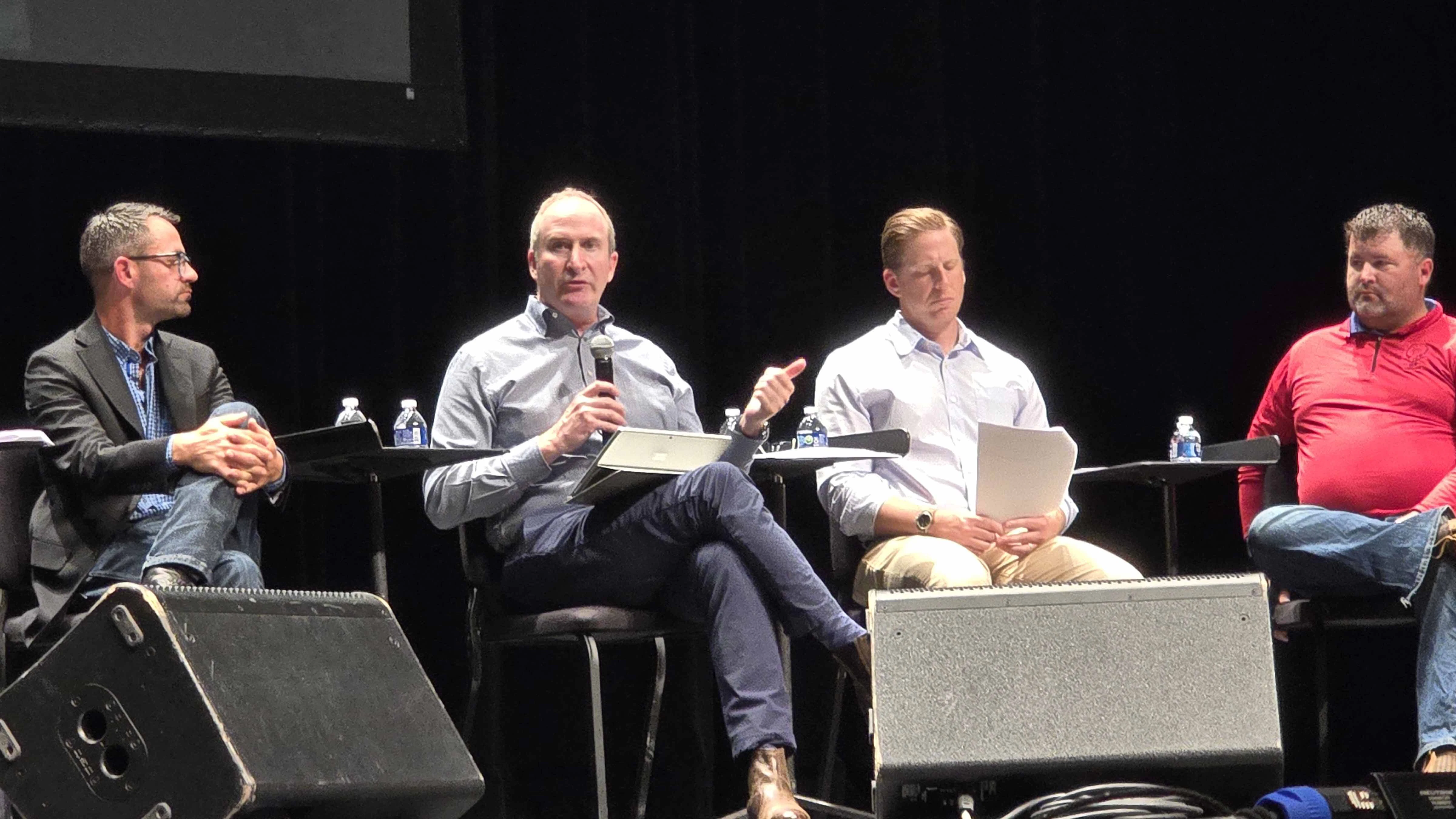
Black Hills Energy Data Center Development Director Austin Allen said Cheyenne residents are already seeing benefits when it comes to electricity.
“In the last decade, Cheyenne Light has had one rate case,” he said. “What we see is that data centers actually stabilize rates. They provide far more benefits into the system from a cost perspective than they take out, and they actually work to lower rates.”
The key to that, Allen added, is the large-load tariff that Cheyenne Light, Fuel & Power (now Black Hills Energy) developed back when Microsoft first came knocking on Cheyenne’s door in 2012.
“Our tariff requires that any cost that data centers cause, they must pay for,” he said. “And they must pay for it correctly. That tariff is actually codified in state statute as well. So it is a requirement. The tariff that we perform this way as a utility is also a requirement under the service mechanisms that we use to serve large data centers. That’s written into state law as well.”
Because of those rules, Allen said, Cheyenne's wave of data center projects has not only held rates steady, it’s also helped make Cheyenne’s grid one of the most reliable in the country.
“Cheyenne for the last several, several years, is consistently rated as one of the most reliable utilities in the country,” he said. “By and large, that’s significantly due to the partnerships that we have with data centers, because as we’re adding these loads of the system, data centers are paying for significant investments themselves, which therefore also benefit the reliability, the grid reliability of our local system here in Cheyenne.”
Dan Diorio, vice president of state policy for the Data Center Coalition, said Cheyenne’s experience matches what he’s seen in other markets.
“What we see throughout the country is that large loads like data centers put downward pressure on the rates for others,” he said. “Indiana Michigan Power is a really strong, growing market. We’re going to lower our rates for residential ratepayers because we have data center revenue coming in.”
Indiana Michigan Power has already implemented a 3.6% rate reduction, which is roughly $6 per month for average users.
Georgia Power, meanwhile, is lowering rates after a three-year rate freeze, due to large loads coming in, the most significant of which are data centers. The company has projected annual savings of about $102 for typical residential customers, once the rate freeze ends in 2028.
“DTE Energy, Detroit, Michigan, we don’t need a rate increase because we have two data center projects coming in,” Diorio said. “And that’s our commitment to you is that these projects come in, they’re not raising your rates.”
PG & E is another unlikely example, Diorio said.
"PG & E (is) not a place known for cheap energy or commitment to anything,” he said. “We’ve kept rates as much as 11% lower because of data centers.”
Done right, Diorio said, data centers can mean a step-change in affordability for future rates, instead of the out-sized rate hikes so many fear.
“We have a tremendous opportunity here to help address those affordability questions and keep rates low,” he said. “Data centers are playing a key part of that, and you have the right type of system set up to ensure that data centers pay their own way and pay their full cost of service and no other rate payers are affected. You are affected in one possible way that means your rates go down, because data centers are bearing the burden of this cost.”
Turning Server Farms Into Housing Cost Relief
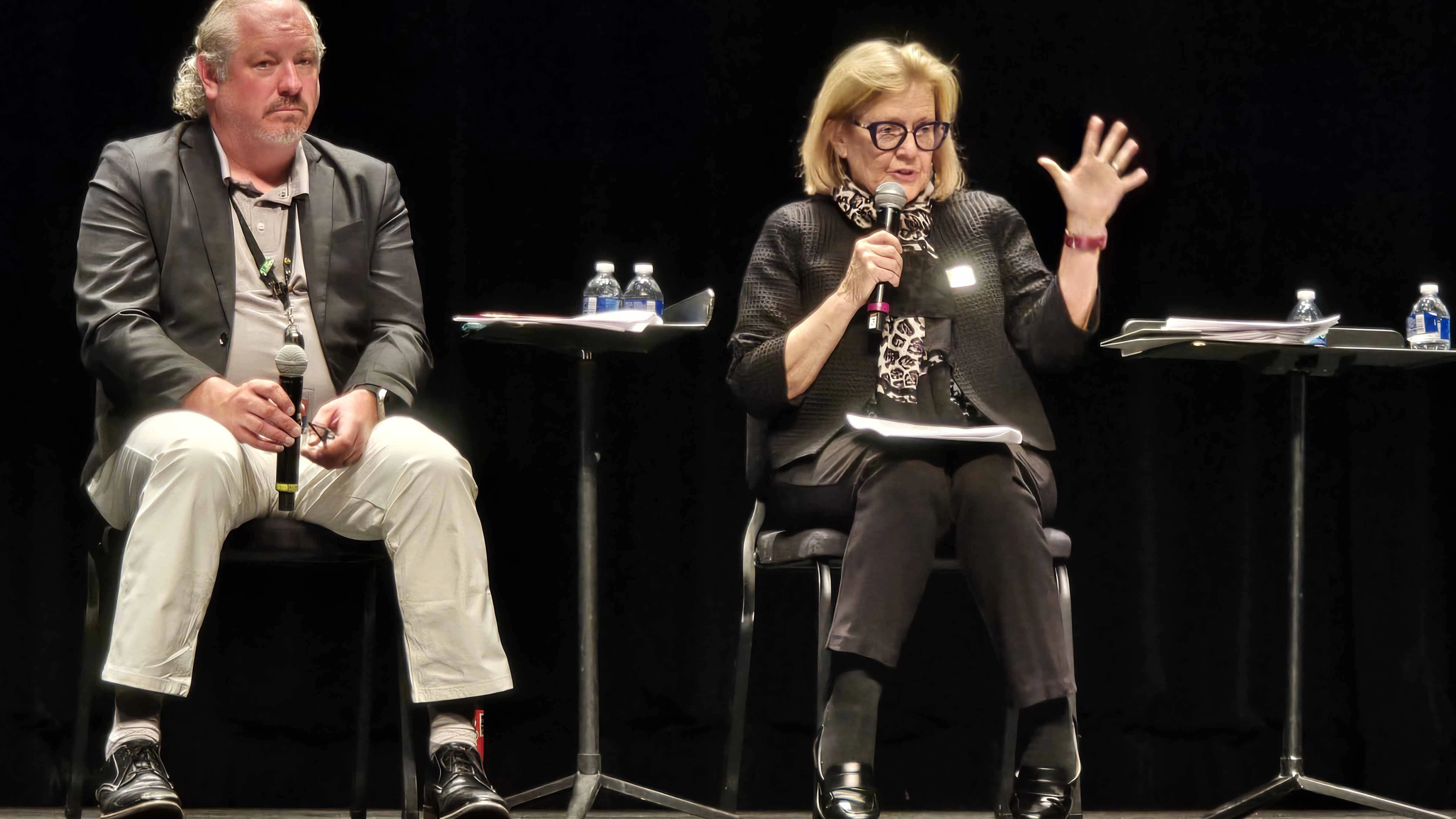
Housing is another question Hale said she’s heard constantly.
“Boyd Wiggam (Planning and Zoning Commissioner) is always worried about affordable housing,” she said. “He’s always asking me, ‘Where are we going to build houses?’”
Data center development, she argued, is helping to answer that question.
When Meta agreed to help pay for and complete the High Plains Road from Highway 85, it did more than just build a driveway for its own “Project Cosmo” campus, Hale said.
“That’s the biggest structure for a traffic signal in the state of Wyoming,” she said. “But they were able to help us pay for that. That has now opened up 2,100 acres.”
The property owner isn’t interested in more data centers, fireworks stands, wind turbines, or solar panels. Instead, Hale said, LEADS is working with them on a mixed-use development that will eventually include future housing, retail stores, restaurants and hotels.
“That road isn’t open yet,” Hale said. “But it will eventually be open once the Cosmo Meta project is complete.”
Mayor Collins added that the same buildout is bringing 3 miles of water and sewer lines into play — infrastructure that would have cost a million dollars to do, which would not have been feasible but for that project.
Each time a project like that pushes utilities into previously uneconomic areas, it’s creating a new jumping-off point that can make more housing projects pencil out in areas where they never have before.
Housing has benefitted in more direct ways as well, Collins added, pointing to a $3.5 million gift from Related Digital. That was the last piece of funding needed for a 184-unit affordable housing complex that’s expected to break ground in June or July.
Taken together, panelists argued that server farms are not just paying their own freight when it comes to water and power, but they’re creating generational infrastructure that’s making new developments, including affordable housing, feasible again.
Cheyenne Needs To Sell More Water
Water use in Cheyenne, meanwhile, has been falling, even as the city grows — a trend that is putting the Board of Public Utilities into a financial squeeze.
When Collins was elected to the city council in November 2000, Cheyenne was using about 14,500 acre-feet of water.
“Today, we use around 12,000,” he said. “That’s 650 million gallons of water that we use less today than we did back then.”
From a conservation standpoint, that’s a success. But economically, it’s tougher. The cost of maintaining hundreds of miles of aging water and sewer lines keeps rising, even as BOPU’s sales base has shrunk.
“The truth is, the Board of Public Utilities needs to sell more water,” Collins said. “But they’re saying no to people who don’t want to use closed-loop systems because that’s the right thing to do.
Collins estimated Cheyenne needs to sell another 1,000 to 2,000 acre-feet of water to stay on solid footing without a rate hike.
“Otherwise, they’re going to end up like, and I don’t want to pick on a community like Rawlins, but they had a major disaster where their water system completely failed,” Collins said. “And years later, they’re still struggling to get that thing back on track.”
The key, Collins said, is selling enough water to keep up with system maintenance.
The “Yes, But” From Skeptics
Not everyone is convinced that data centers will underwrite cheaper power and abundant housing, at least not at the scale city officials suggested.
Ward 1 Councilman Larry Wolfe, who attended the forum, told Cowboy State Daily afterward he is skeptical that data centers will meaningfully subsidize residential energy rates any time soon.
“That would require them to start contributing generation to the grid,” he said. “The only facility talking about that is Tallgrass.”
He can see some transmission improvements from data center projects, which might trim some costs at the margin, but he thinks those effects will be limited.
“As to opening land for housing of any type, that could happen to parcels that could get water and sewer access as a result of data centers paying for service expansion,” he said. But, he added, the effect will likely be “dwarfed by the amount of land that the centers are going to consume.”
Sen. Cale Case, R-Lander, meanwhile, agreed that some of that upside is real, but said the long-term energy and tax picture is still a bit fuzzy.
Case has spent years scrutinizing Wyoming’s utility law, and agrees that Cheyenne’s large-load tariff does force data centers to shoulder their own capital costs up front, adding that the Public Service Commission has to sign off on those contracts and wouldn’t do that if there were going to be negative impacts to rates from line extensions.
But he’s less certain about the long-run energy side of the ledger once regional capacity tightens to the point they’re “soaking up any electricity they can find.”
“If it comes down to where the entire market gets a little shorter, then utilities have to pay extra to get in the queue,” he said. “That part to me is not clear.”
Case, meanwhile, believes there could be many impacts that data centers have so far skirted.
“Are they paying for the roads or the sewers? How is that being held?” Case asked. “We’ve had the foresight to talk about large loads with that large load legislation, but we haven’t necessarily had the same foresight with everything else. I know Cheyenne LEADS says they pay a lot of taxes, but they don’t pay as much as everybody else.”
Wyoming, with no income tax, has to make sure the juice coming from data centers is worth the squeeze, Case said, and it’s something that lawmakers will discuss this summer during the interim session.
“We give them that manufacturing sales tax exemption and our overall property taxes are pretty low,” he said. “So I still maintain that they don’t really pay their impacts in terms of infrastructure, in terms of schools in terms of everything.”
“Do No Harm” Standard
On the economic development side, Hale said companies looking to locate in Cheyenne go through a thorough vetting process before any shovels hit dirt.
First, LEADS asks a basic, but crucial question. Is this a real business, and is it durable?
That’s easier to answer for publicly traded companies, with lots of financials on file. For privately held corporations, Hale said LEADS hires a a third-party CPA firm to look behind the curtain and verify that they’re bonafide.
Beyond that, LEADS also runs a detailed cost-benefit analysis on every project, weighing negative financial impacts against positive ones using a tool called the Site Stats Tool.
County, city and state budgets are loaded into the model annually, along with assumptions about where employees will live.
“We understand what the cost of government service delivery is,” Hale said. “When the company moves to your community they need services. We measure 50% of their employees living in the city, so that we can understand the cost of service delivery to those employees.”
The tool tallies impacts on city and county governments, school districts, and special districts.
“So when we look at a project, we’ll look to see is it a negative financial impact to the city county and the state versus a positive financial impact,” she said. “And our board takes that very seriously and Mayor Collins has participated in those presentations.”
Data centers are required to meet an explicit “do no harm” standard. That means paying 100% of their off-site impacts, including new roads and turn lanes, pump stations and trunk sewer lines, and substation and transmission upgrades for power.
They must also agree to noise and light mitigation, as well as closed-loop cooling systems. They’re also expected to contribute directly to community needs, which includes everything from tree-planting and stormwater projects to affordable housing projects.
Every two years, Cheyenne LEADS commissions a study with the University of Iowa to ensure that the forecasted positive benefits were in fact realized.
Actual taxes paid by data centers since 2012 is published on Cheyenne LEADS website, Hale added.
“Once Meta is up and running, those tax revenues will go up exponentially,” she said.
Renée Jean can be reached at renee@cowboystatedaily.com.


