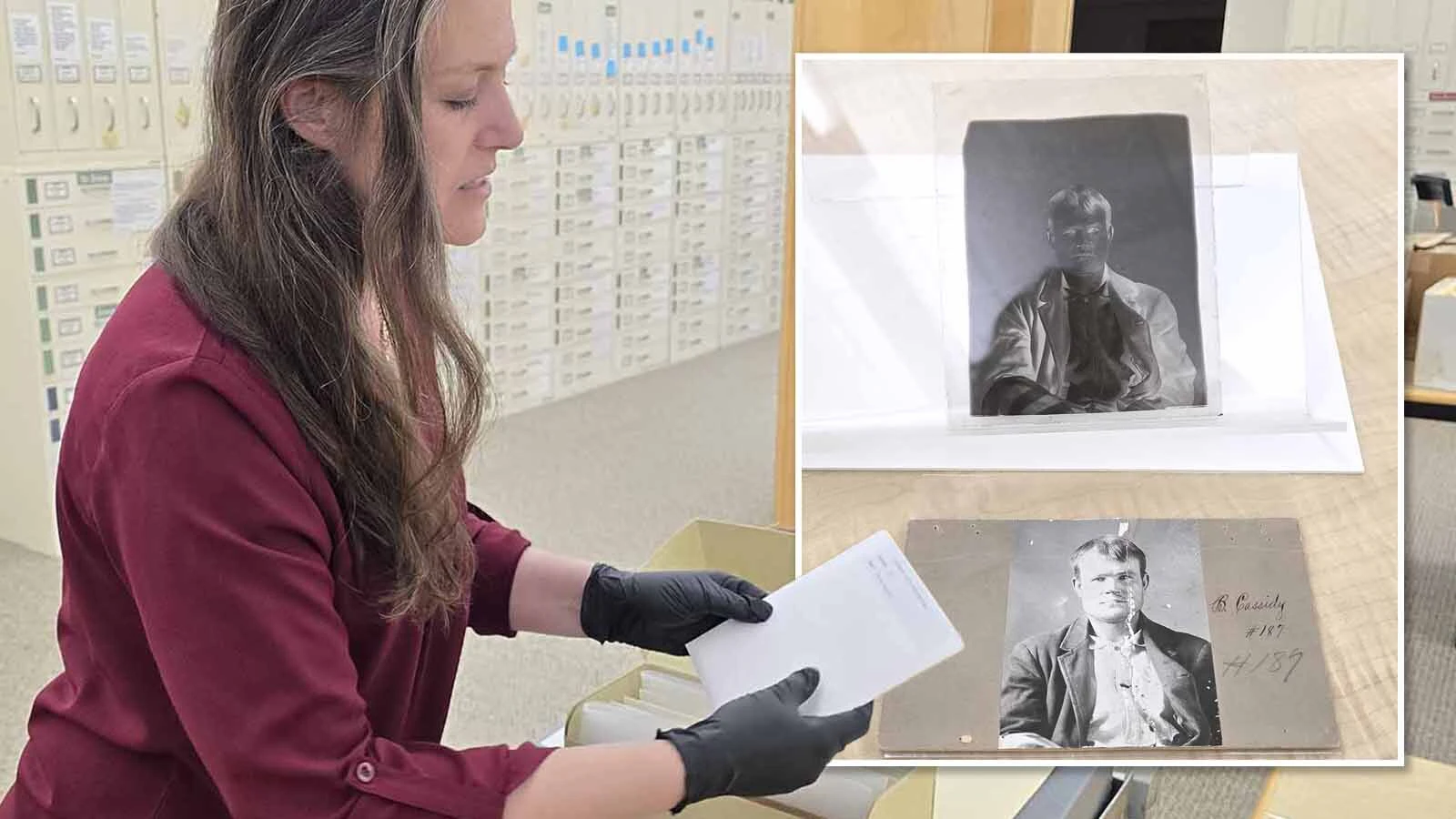
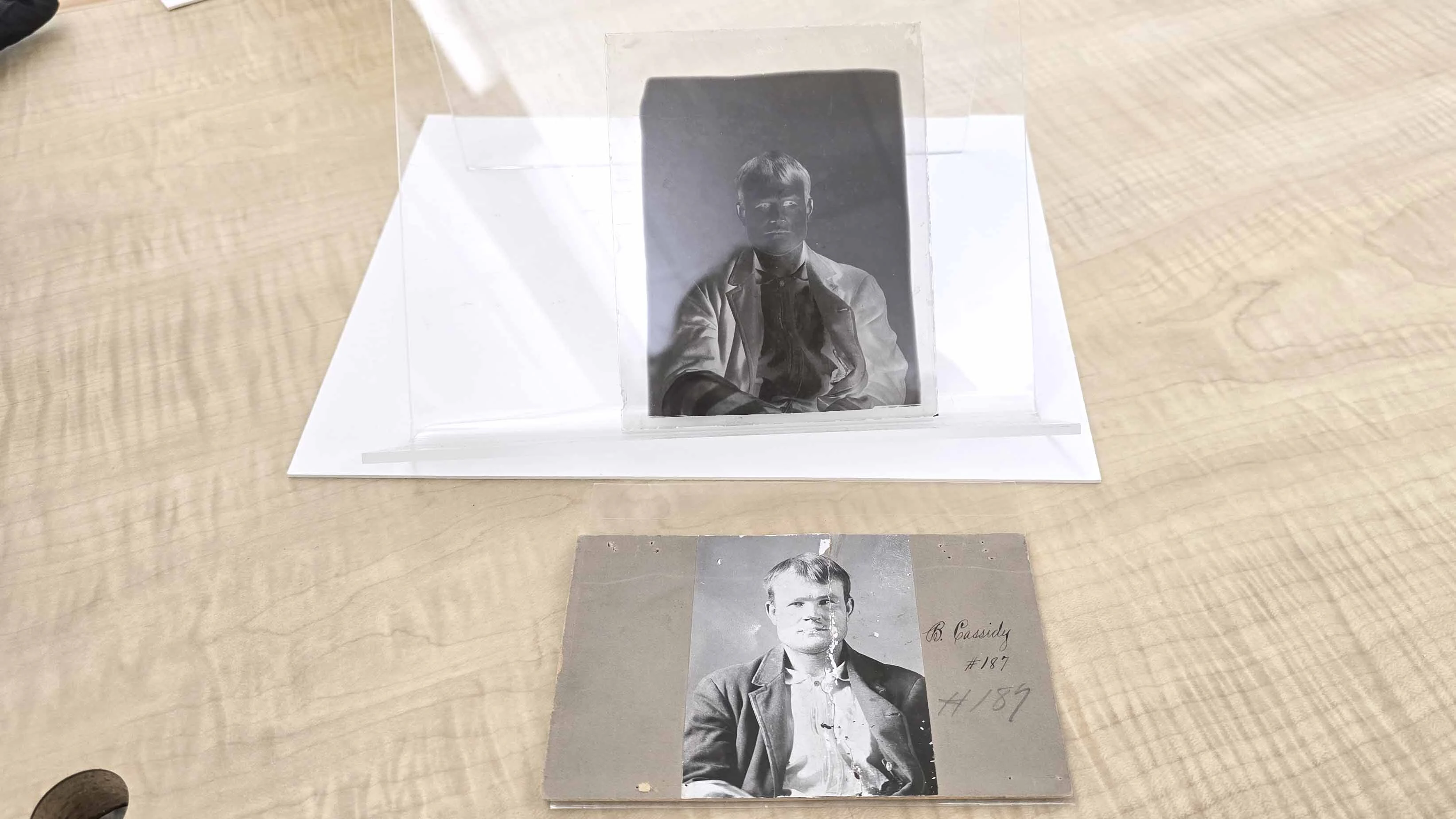
When Wyoming State Archives materials archivist Suzi Taylor first saw an auction listing for what was billed as the original glass plate negative for Butch Cassidy’s Territorial Prison mugshot in a forwarded email from Cowboy State Daily, she stopped everything she was doing and hustled upstairs to double-check the state's collection.
“I was fairly certain we still had it in our collection,” Taylor told Cowboy State Daily. “But I ran upstairs just to be sure. Sure enough, it was in the box, just where it’s supposed to be.”
That had her breathing a sigh of relief as she carefully put this treasured state item back into its acid-free sleeve and closed it back up in a reinforced box.
The mix-up highlights how questions of provenance can affect high-value Wild West auctions, but it also shows how Wyoming curators quietly document and safeguard key pieces of the state’s Western history behind the scenes.
The Cassidy glass mugshot negative offered by RR Auction failed to meet its reserve price and was ultimately not sold during a recent sale, the company told Cowboy State Daily.
Questions raised about the negative’s provenance — including the fact that Wyoming still holds the original glass plate — are being reviewed before the company decides whether and how to offer the item again.
Taylor, for her part, said the fact the auction house’s glass plate negative isn’t the original doesn’t necessarily mean it’s a fake.
She said contemporary copies were made from Cassidy’s print mugshot for wider distribution to law enforcement.
That means while not original, it’s still period to the time.
Since negatives of the time were made of breakable glass, authorities likely didn’t want to handle the original too often. Re-photographing a print was a much safer way to make additional copies for other law enforcement agencies.
Haunting Portrait Of An Outlaw
Cassidy’s mugshot is one of the most iconic of the few images ever taken of America’s last cowboy outlaw, made famous in the Robert Redford movie “Butch Cassidy and the Sundance Kid."
Taken during Cassidy’s only significant prison stint, the photo freeze-frames were taken of the young man before the notorious Wild Bunch appeared.
Cassidy never owned up to leading the Wild Bunch, though law enforcement officials of the day said he was — loudly and often.
Historians, meanwhile, have various opinions on that.
Some suggest there’s good evidence Cassidy would have scoffed at the idea anyone could lead such a loose confederation of misfits and malcontents as the Wild Bunch, while also pointing out he couldn’t possibly have been in as many places as law enforcement was claiming.
Others have suggested the Wild Bunch was probably Cassidy's way of getting even with Wyoming for the trumped-up horse thief charges that the cowboy outlaw always maintained were fabricated by his enemies.
Cassidy’s younger sister, Lula Betenson, meanwhile, once claimed her brother told her during a secret family reunion that if Wyoming wanted to treat him as an outlaw, then he’d show them what an outlaw really was.
The truth of that will never be known for certain. Instead, there’s this compelling photo that captures the mystery of it all in a glance.
In it, Cassidy looks less like an outlaw posing for a mugshot and more like a patron posing for a casual portrait on a relaxing Saturday or Sunday afternoon. He wears a dark, structured suit coat and a white shirt buttoned up to his neck.
It’s his enigmatic expression that captures and holds attention, though. He offers the viewer neither smile nor frown, but his eyes seem to know something his lips aren’t about to ever tell.
Rarely Sees Light Of Day
The original glass plate negative used to create Cassidy’s Territorial Prison mugshot is on a short list of treasured artifacts whose condition is frequently monitored at the Wyoming State Archives.
“I had laid my eyes on that one not too long ago, but I had to make sure it was exactly where I’d left it,” Taylor said. “I check it fairly regularly, just to make sure it’s where it’s supposed to be and hasn’t deteriorated.”
Glass is among the most non-reactive substances on the planet. But the chemicals used to create the image itself, which are laid down in a thin emulsion directly on the glass, are much more fragile.
“The image itself and the emulsion can, if the chemicals weren’t properly fixed, start to fade in odd ways,” she said. “So, we want to be able to catch that. And sometimes the emulsion gets really dry and starts flaking off the glass itself, because the image sits right on top of the glass.
"Over time, it can delaminate and separate, so we want to make sure we are extra careful and catch that before it becomes a problem.”
Taylor frequently spot-checks other mugshots in the Territorial and Wyoming State Penitentiary collections, which include thousands of negatives of outlaws.
Among the collection are mugshot negatives for other Cassidy contemporaries like Albert “Slick” Nard and Joseph Nutcher.
All of the glass plate negatives are kept in acid-free sleeves inside a rigid box with additional support. That ensures the glass plate won’t accidentally break.
Cassidy’s negative, in particular, is rarely handled.
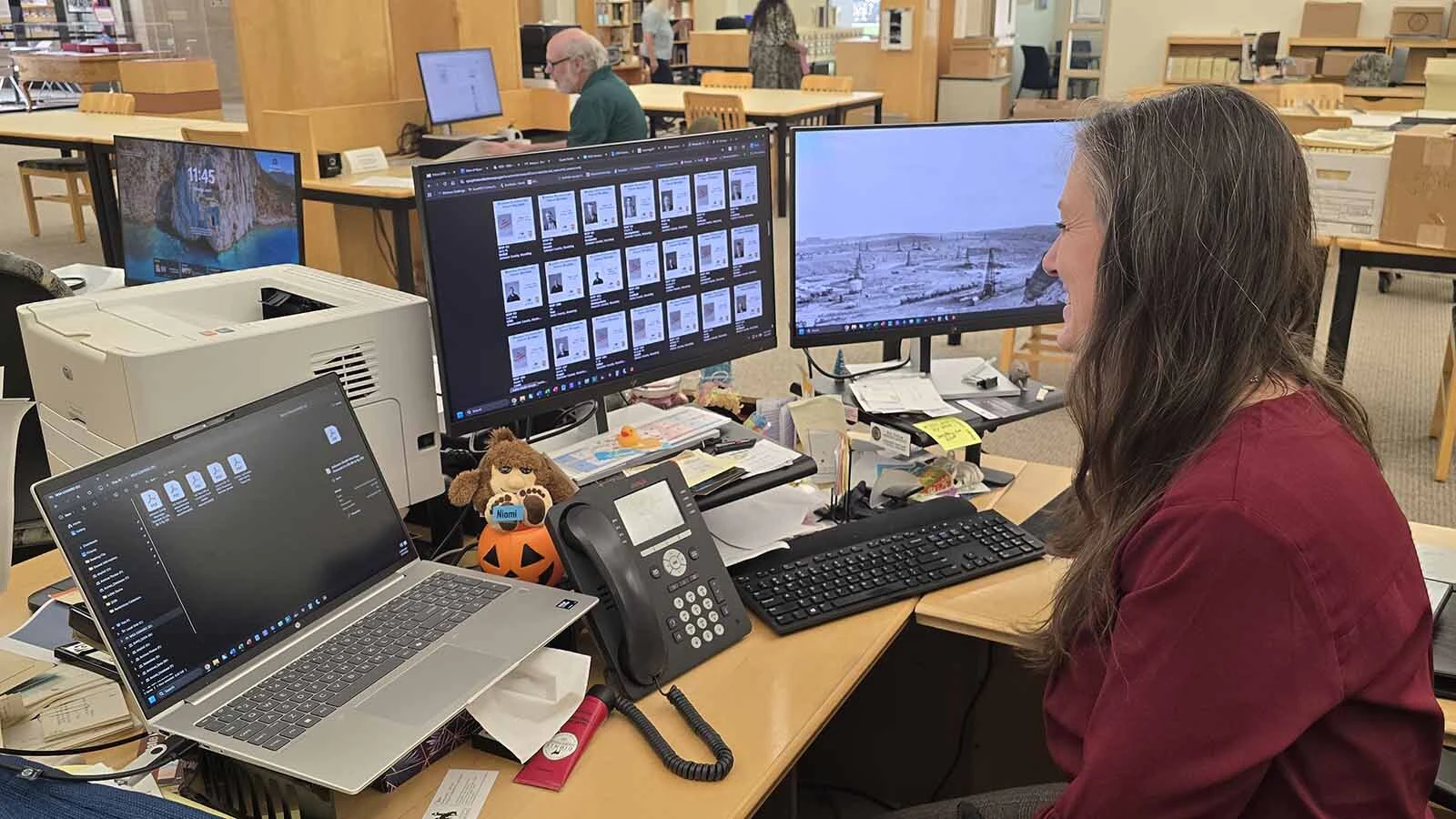
“We have a digital surrogate that we use instead of taking the negative out,” she said. “The less it’s handled, the less likely it is to break.”
Helps Tell Territorial Prison’s Story
Another place where Cassidy’s mugshot appears is the Wyoming Territorial Prison State Historic Site, where Superintendent Jessica Lira has made it a prominent part of the museum’s exhibits.
“We have a big portrait of his mugshot, his intake photo, right when you walk into the building,” she told Cowboy State Daily. “The exhibit talks about his life and how, even though he only spent 18 months and was let out early for good behavior, it was after that he starts blowing up trains and blowing up safes around Wyoming and Colorado.”
Cassidy, Lira said, is the most famous outlaw the territorial prison ever held, and his face is an instant hook into the larger story of crime and punishment on the frontier.
Lira uses high-quality prints and digital reproductions for her exhibits, keeping the originals at the Wyoming State Archives to protect them. That’s how the state balances public access with preservation.
Lira uses the mugshots to tell stories about real people, as well as to illustrate changing ideas about law enforcement in the West.
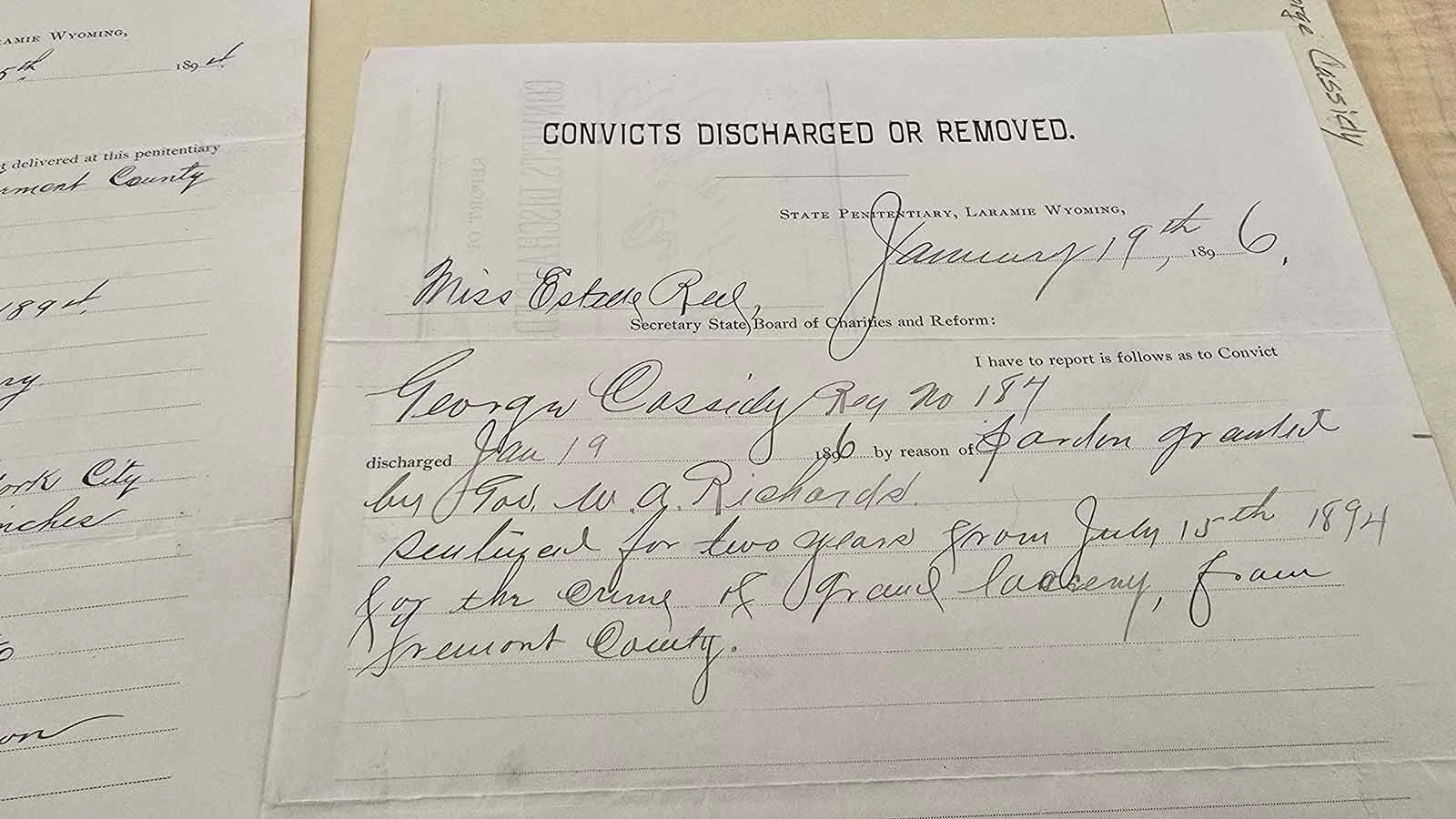
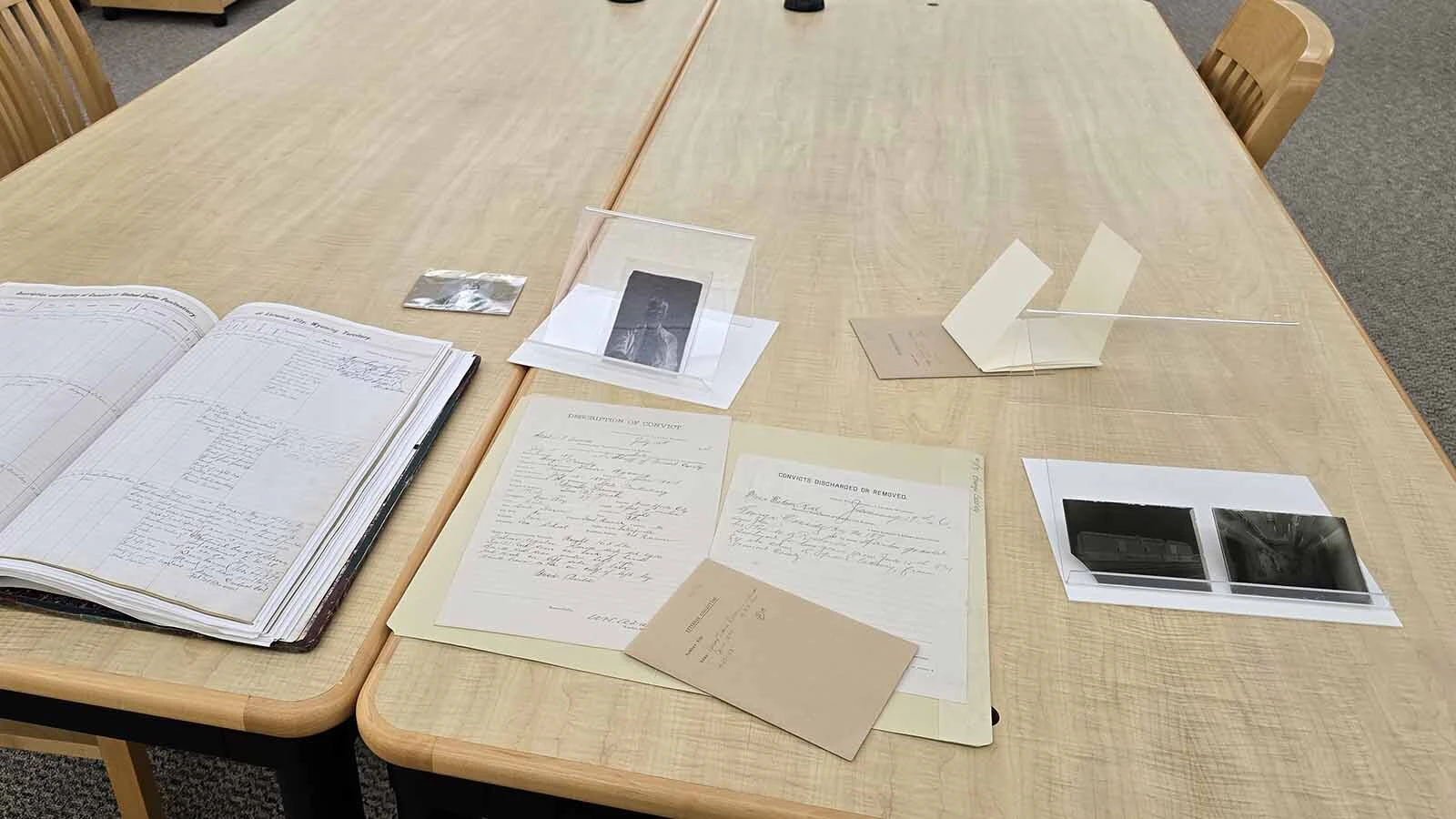
Butch Cassidy's discharge papers are kept at the Wyoming State Archives. (Renee Jean, Cowboy State Daily) 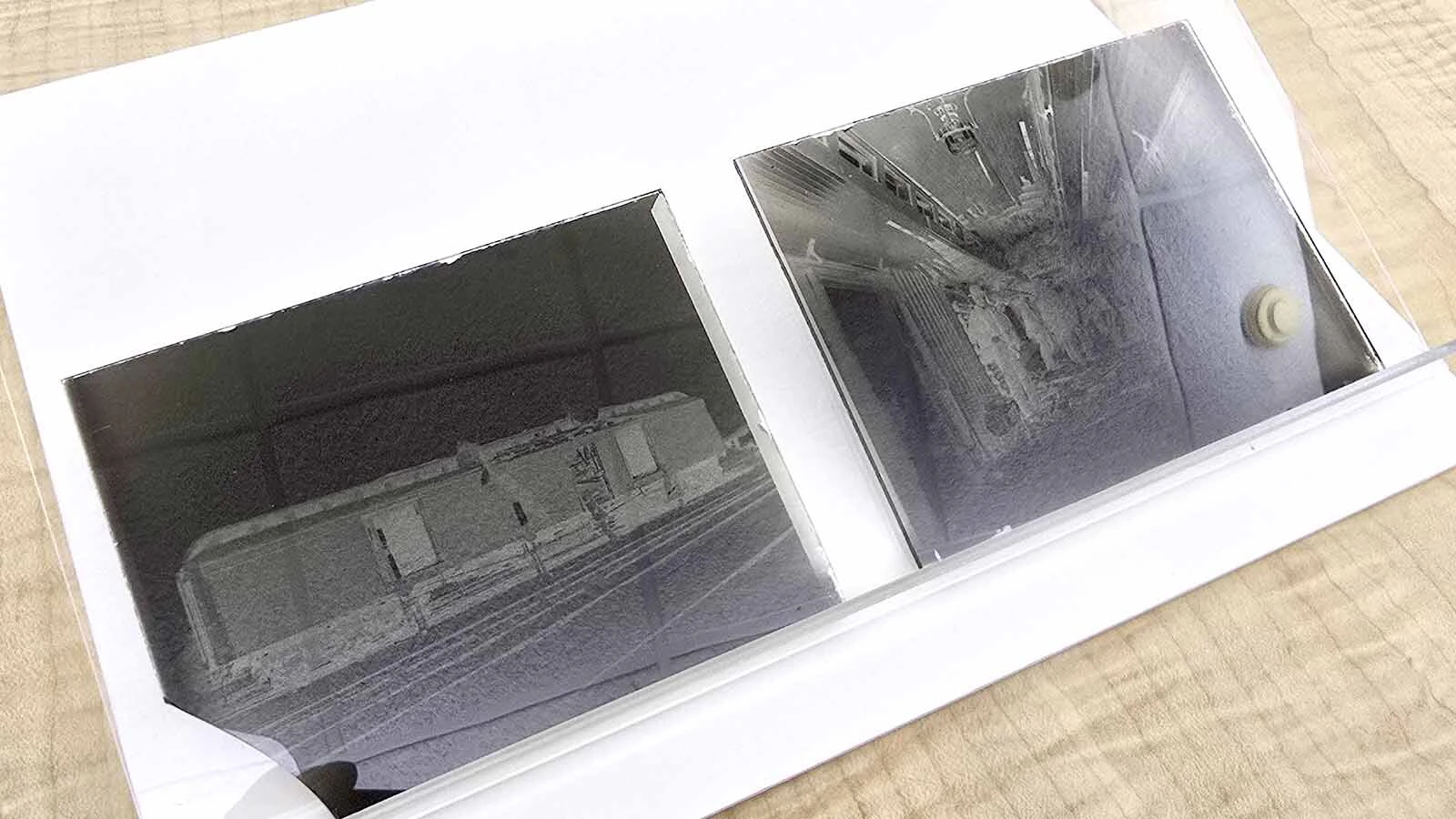
Wyoming State Archives also has the glass plate negatives for the infamous Wilson train robbery. (Renee Jean, Cowboy State Daily)
How Experts Know
There are several telling details that immediately distinguish Cassidy’s original Territorial Prison mugshot negative from the mugshot negative offered in RR Auction’s Western Americana sale of the Jochen Zeitz collection.
“The (prison) photograph of Cassidy was taken in May 1895 by Laramie photographer Louis Heyn,” historian and Cassidy expert Mike Bell has told Cowboy State Daily. “The original shows a wider view of Cassidy, including part of his leg in striped pants.
"The picture was then cropped to show the head and torso version, which is well-known and widely circulated.”
Bell, too, believes it is possible the auction house’s glass plate negative is a contemporary copy of the original photograph. Lots of police departments did have copies of Cassidy’s mugshot at the time.
“For example, Sheriff Louis Grant Davis of Sweetwater County got a copy,” Bell said. “He showed it to E.L. Carpenter, the manager of the Pleasant Valley Coal Company, which was held up by two men in 1897.”
Carpenter told Davis at the time that he recognized the photo of Cassidy as being one of the two men who had held him up.
Renée Jean can be reached at renee@cowboystatedaily.com.