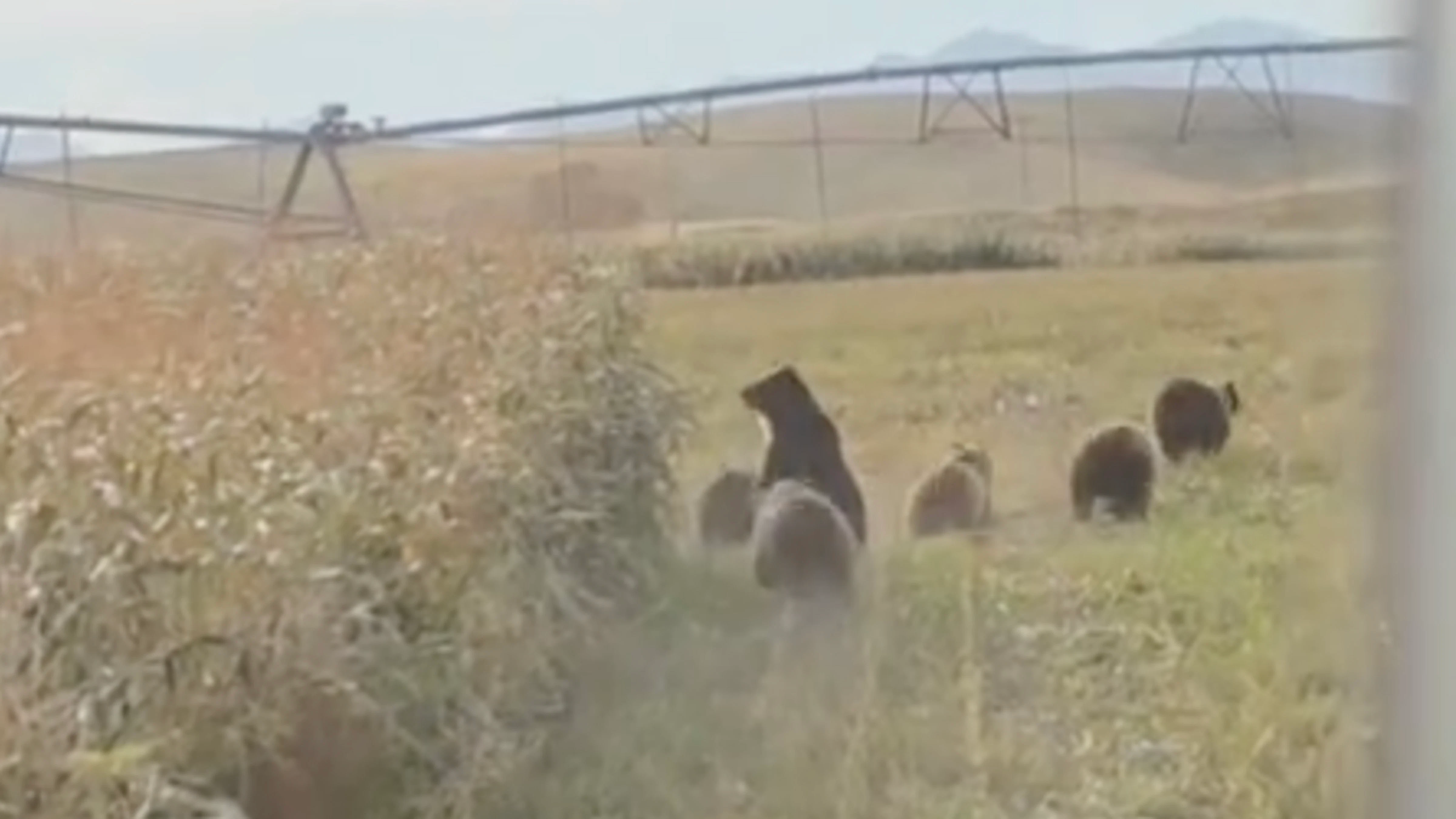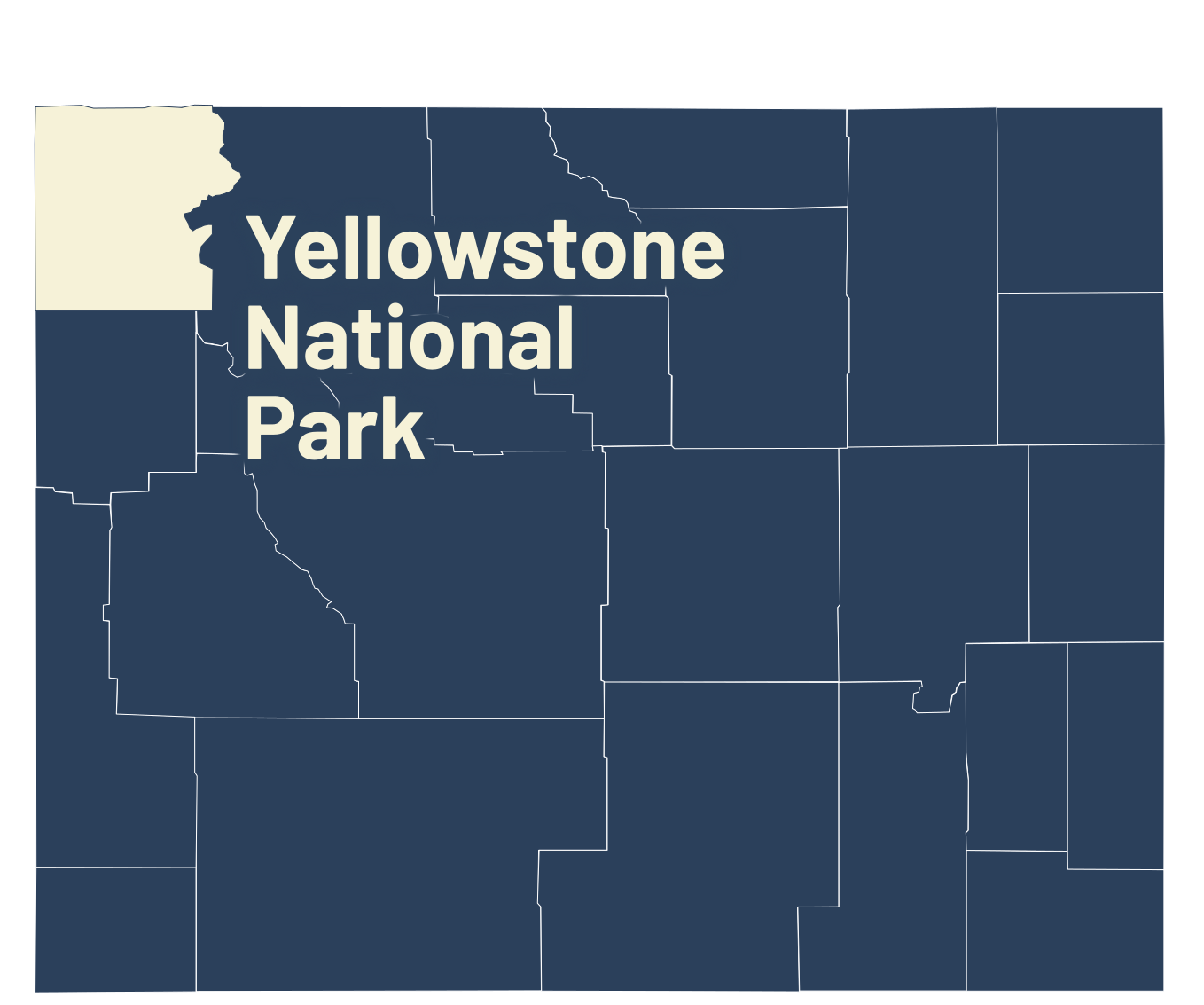
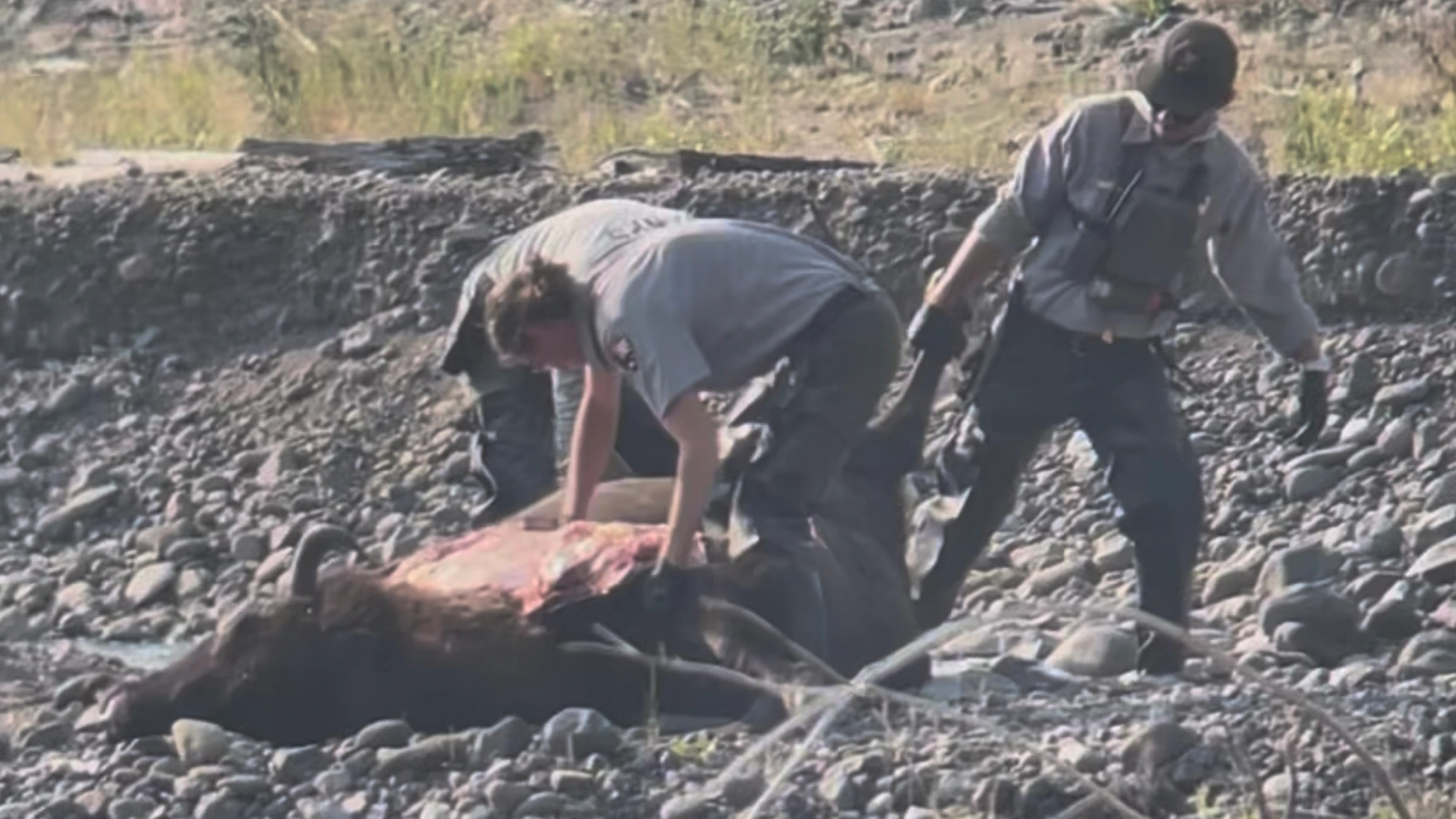
A bison carcass in Yellowstone National Park attracts the usual crowd of grizzlies, wolves, ravens, and tourists. One recently attracted a pack of bear management staff, who thoroughly dismembered it before carrying the pieces away.
Joseph “Jojo” Kaul, owner of Kaul of The Wild Yellowstone Tours, encountered the scene in the Lamar Valley near Soda Butte Creek on Monday. The female bison, which died of natural causes, was around 220 yards from the road.
“It wasn’t really close, but with the proximity of fly fishermen and hikers, it presented a situation that was possibly chaotic,” Kaul told Cowboy State Daily. “They wanted to know how to speed up the process of this bison being consumed.”
Using three sharp kitchen knives, three men from Yellowstone’s bear management started “quartering” the carcass, according to Kaul.
“They cut off all four of her legs at the joint, and dragged them to four different areas, probably about 100 to 150 yards away from the main carcass,” he said. “Then, they opened up her belly and backside to expose more flesh and blood for the predators to smell.”
Within 30 minutes, the bison had been butchered, and the three bear management men were back at their vehicles.
Kaul described it as “the best-case scenario” under the circumstances, which he explained to the crowd of people watching it unfold.
“There were around 30 people there, and I explained that they were doing everything they could to allow us to enjoy this,” he said. “Instead of completely removing the carcass, they left it so the wildlife watchers and enthusiasts of the park could enjoy it.”
Butchering Bison
Carcass management is a critical component of managing Yellowstone's natural landscape. Front-end loaders or multi-truck winches are the go-to tools, but sometimes rangers have to get their hands dirty.
Author and historian Jeff Henry is familiar with dismembering carcasses in Yellowstone. During his tenure as a Yellowstone ranger, he did it multiple times.
“Most people I worked with didn't like doing it, and I did, so I ended up doing a heck of a lot of it,” Henry told Cowboy State Daily. “I found the physiology and forensics interesting.”
One of Henry’s tasks was documenting winter kills. Every spring, he’d document every bison, elk, and other animals that died over the winter as they began to thaw out of the deep snow.
Usually, the carcasses were left for the grizzlies to devour as they emerged from hibernation. On occasion, Henry and his peers were asked to get hands-on and take carcasses apart.
One instance stands out: In December 1986, Henry single-handedly butchered a bison at Fishing Bridge Junction to an audience of television cameras and Yellowstone’s top staff.
“There was a grizzly bear, Bear 83, that refused to den that year,” he said. “She stayed around Lake Village late into the fall. She chased me when I was on my snowmobile once.”
After Grizzly 83 and her cub were captured and relocated, Henry was given a new assignment: shoot and dismember a bison and scatter the pieces across Pelican Bay.
“The powers that be sent me and another ranger out to shoot a bison,” he said. “We found and shot a bull near Indian Pond and dragged it back to Fishing Bridge.
By then, the grizzly relocation and bison butchering had become a national news story. Several news agencies traveled to Fishing Bridge to see it, as did “a lot of National Park Service big shots,” according to Henry.
“They came from Mammoth to be involved, but when it came time to cut up this bull bison, none of the so-called GS99s wanted to step forward and do the dismemberment. So, it all fell on me.”
Using nothing but his personal five-inch hunting knife, Henry cut up the entire bull. Because that part of the park was closed to traffic at the time, he did it right in the middle of the Fishing Bridge Junction while everyone watched.
After a lot of sweat and blood, Henry had butchered the bison into several smaller pieces. He boarded a helicopter to scatter them across Pelican Bay, so any active grizzlies would head that way rather than wander around Lake Village.
“I don't think anything like that would happen nowadays,” Henry said.
Fast Food
Yellowstone personnel try to maintain a “hands off” approach inside the park, letting things play out naturally. On the occasions when they do have to take an active role, there’s usually a good reason.
According to Herny, carcass dismemberment is employed when dead animals are close to tourist hot spots but not easily accessible for the preferred methods of disposal.
“Whenever an animal died in a developed area or on the roadside, we'd have to move it away,” he said. “Sometimes, maintenance people would come out with heavy equipment, pick up the whole carcass with a front-end loader, put it on a truck, and we'd haul it away.”
Front-end loaders and winches are easier and faster, but sometimes they aren’t viable depending on the terrain and location of the carcass. That’s when you cut it up into manageable pieces that you could load onto a pickup truck with muscle power.”
Kaul said the terrain where the female bison died wasn’t ideal for the easier, faster options to be viable. Dismembering the carcass was the only option.
“She died along Soda Butte Creek and Lamar River,” he said of an area commonly known as "The Confluence." “Dragging it out and removing it would be a very, very hard process. It was treacherous for the three gentlemen to walk out there just to get to the carcass. Trying to haul away the 1,000-pound carcass with a pulley system from a winch would be even harder.”
The bear management personnel told Kaul that by dismembering the carcass and scattering the pieces, Yellowstone’s wildlife could utilize the immense resource while speeding up its consumption. That further reduces the risk to visitors.
Usually, carcasses are transported to one of the “secret spots” where they can be safely left to be consumed far from visitors.
“They have certain spots, out of the way of the public, where they like to dump carcasses,” Henry said. “They like to continue dumping carcasses in the same spots so that bears and other scavengers get used to finding meat there.”
Still In Service
Henry wasn’t surprised to see Yellowstone rangers dismembering a carcass, but he was curious if they had any prior experience doing so.
“There aren’t many people (in the park) who are good at it anymore,” he said. “Most of today's rangers are more law enforcement–oriented, from urban and suburban backgrounds, than they were in my time. That's not being derogatory about anybody. It's just an observation.”
Kaul said the bear management staff he’s observed are “a well-oiled machine.” Their goal was to get in, get out, and move on as quickly as possible. ‘
“They're usually really efficient, working simultaneously, but it’s still a process,” he said. “Each of those legs weighed 100 to 150 pounds, so dragging those away wasn’t easy. For them.”
Henry enjoyed dismembering carcasses because it was akin to doing an in-field autopsy. By cutting into a dead animal, he could learn more about its life and death.
“I don't want to sound like I'm bragging, but I probably evaluated 1,500 or 2,000 winter kills in my career,” he said. “Cutting them up is a good way to analyze what it was exactly that killed them.”
He specifically mentioned the value of examining bone marrow, as the color of the marrow can reveal whether an animal died of malnutrition.
Kaul has seen multiple instances of on-site carcass dismemberment, which is why he took this opportunity to educate people on why it needed to happen.
“This is not ideal for the National Park Service,” he said. “If the bison was hit by a car and was close to the road, they might be more inclined to pull it. This bison died naturally in a difficult spot, and they wanted to let the wildlife consume it, so they created the best scenario. It’s better than having no access to it.”
Andrew Rossi can be reached at arossi@cowboystatedaily.com.