
For wolves in Yellowstone, it’s all about survival, and sometimes that doesn’t leave much room for niceness – pack members sometimes put the smack-down on each other, just to maintain order.
There can be a “constant rivalry among pack members” and only dominant breeding wolves are rarely, if ever challenged, biologist Robert Crabtree told Cowboy State Daily.
Discipline In The Wapiti Pack
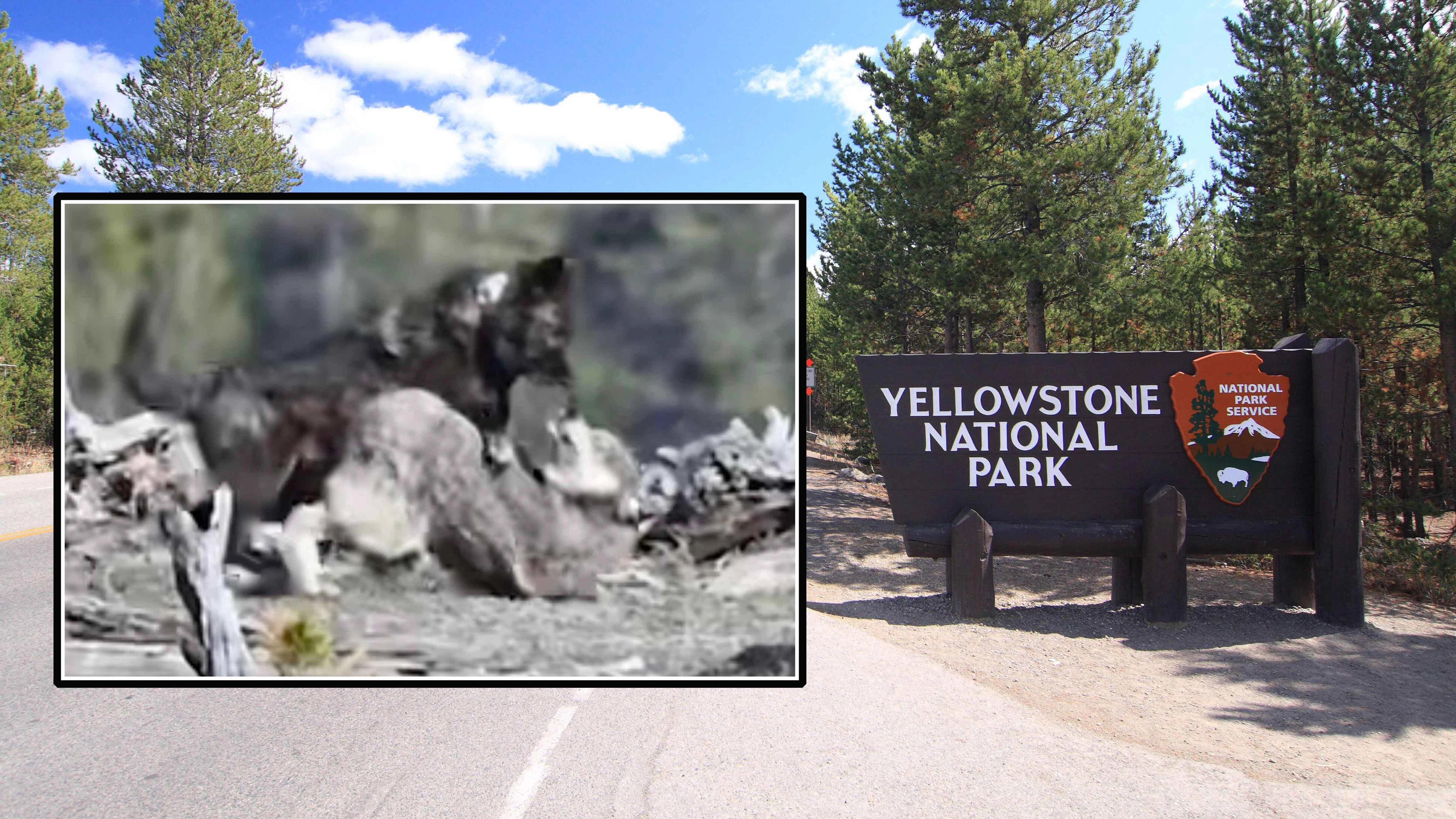
Willow Holm recently captured video of a member of the Wapiti wolf pack harshly correcting one of its packmates on the west side of Yellowstone National Park.
She’s not sure what prompted the episode, in which a black wolf bowls over and pins down a tail-tucking gray wolf.
“That had been all around us (for hours). This happened just as they were leaving,” said Holm, who frequently visits Yellowstone with her parents, April and Patrick Holm.
The pack had spent much of the day hunting bison, but didn’t have any success, she said.
Two top wolf biologists said the video shows the type of behavior wolves engage in to maintain discipline within the ranks, so to speak.
“I think the video is very interesting, but standard social interaction for wolf pack members. Classic straight tail for the dominant (wolf) and tucked tail for the subordinate,” said Crabtree, the founder, chief scientist and president of the Yellowstone Ecological Research Center.
Biologist Doug Smith said the gray wolf was “very submissive.”
The black wolf was clearly communicating, “I’m in charge here,” said Smith, who led Yellowstone wolf program in for nearly three decades.
‘Who Is Calling The Shots?’
Wolves aren’t always harsh with each other. Sometimes, they romp and play like giant puppies, which also help with pack cohesion and hunting skills.
But there’s a time and place for corrective measures between wolves as well.
Basic pack structure in Yellowstone hinges on a “dominance hierarchy,” Smith said.
The top dogs are usually a breeding male and female.
“They don’t fight each other and they don’t exhibit dominance with each other. But who is calling the shots? Usually the female,” he said.
When food is abundant, a second female might be allowed to breed, Smith said.
“The top positions are more fixed. The positions below the lead wolves are more fluid,” Smith said.
Competition Within The Ranks
The jostling for lower position is segregated by sex, he added. In other words, males compete with other males, females with females “and it doesn’t cross over.”
And as with humans, wolves’ personalities can play into their management styles.
“There’s some packs where the dominant wolf easygoing, and it’s difficult to tell who the leader is,” Smith said.
In other packs, the leaders are harsh.
The black wolf in the video “was quite aggressive” and might be the lead wolf,” he said.
It’s difficult to say whether the pack’s lack of success hunting that day played into the aggressive behavior, Smith said.
But hunger can be a factor.
“That type of behavior is personality-driven and food-driven,” he said.
‘A Dominance Fight’
An abundance of food helps keep things relatively peaceful within packs, Smith said.
A lack of food can cause “social tenson,” he said.
“When you’re having trouble making ends meet, everybody’s stressed,” he said.
Once in a while, there might be a “dominance fight” when one of the lower wolves challenges a leader, Smith said.
More often, the changing of the guard happens because of a death at the top.
When the dominant female dies, the formerly dominant male might get “evicted” by a new male joining the pack, he said.
The new dominant, breeding female might be the daughter of the past top pair and “wolves avoid inbreeding,” so that’s why the former dominant male, her father, has to go, Smith said.
Wolves in Yellowstone are protected and may not be hunted by humans.
In that setting, lower-ranking males are much more likely than females to disperse from the pack and try their luck at becoming a top, breeding leader elsewhere, Smith said.
Outside of the park, where wolf hunting is allowed, females and males disperse about equally, he said.
Wolf packs outside Yellowstone “are less stable” in their social order because of hunting, he said.
Mark Heinz can be reached at mark@cowboystatedaily.com.


