
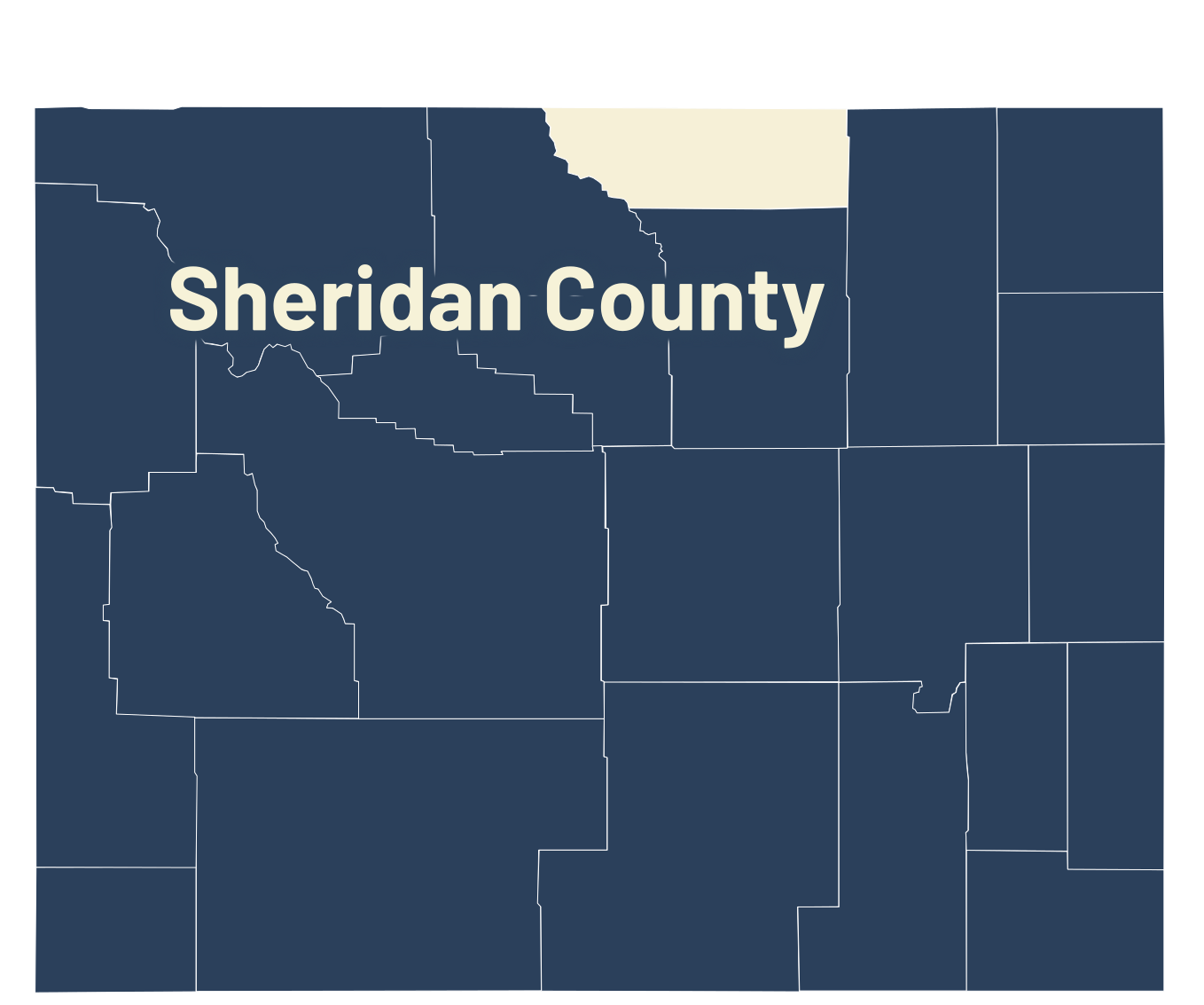
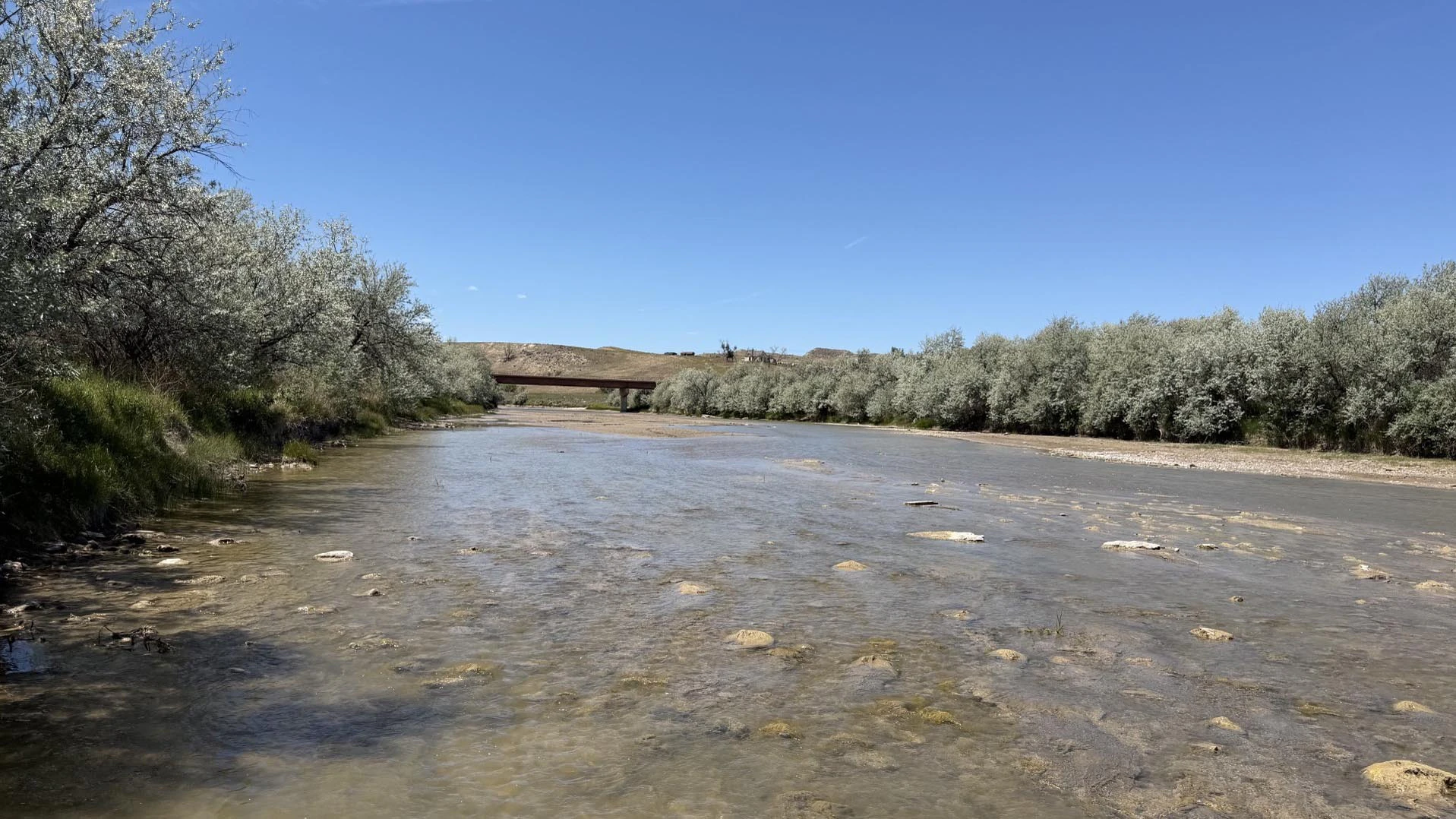
The Powder River at Arvada in Sheridan County has essentially stopped flowing for nearly a month, encapsulating severe drought conditions persisting across the West.
The river’s flow levels there have been sitting at zero to near-zero cubic feet per second (cfs) since mid-July, U.S. Geological Survey (USGS) communications specialist Cheryl Miller told Cowboy State Daily.
When the river hits 0 cfs, “there could be a little pool there, but it is not moving," Miller said. "There is no water going downstream from there.”
The Powder River's main steam flows for 375 miles from the Bighorn Mountains into the Yellowstone River near Terry, Montana. It is susceptible to wild fluctuations because it is one of the last free-flowing prairie river systems in the country.
During a typical year, the Powder at Arvada is flowing at 135 cfs, Miller said.
On June 16, it was at 17.5 cfs.
When the river reaches zero cubic feet per second, native fish such as sauger, channel catfish and sturgeon chub have evolved to survive in deeper pools.
“This is not unheard of for that site," Miller said of zero cfs, "but it is uncommon.”
Records dating to 1930 indicate the Powder River has hit a standstill at Arvada about a dozen times, though there are no records for length of time at zero flow. The Powder also reached 100,000 cubic feet per second in 1923.
Why So Low?
Unusually light snowpack coupled with a relative lack of rain during the spring and summer have contributed to the scarcity of water this summer, Miller said. Irrigation has also taken water from its tributaries, fishing guide Gene Pruett told Cowboy State Daily.
Dry ground along the upper stretches can absorb some of the river’s runoff.
The main Powder River’s tributaries include the North, Middle and South forks, which are still flowing.
The Middle Fork is typically fishable until late June or early July, when the water becomes too warm for responsible angling, said Pruett, owner of the Thermopolis-based Wyoming Trout Angler fishing guide service.
He guides anglers on the North Fork in Outlaw Canyon above Kaycee.
Wyoming State Engineer Brandon Gebhart recently told the Legislature’s Select Water Committee that this is one of the lowest water years on record across the West.
“Over 83% of the state is in severe or extreme drought,” he said. "Luckily, no parts of the state are under exceptional drought, as of right now.”
Time To Stop Fishing
Flows along the upstream forks of the Powder River is “generally low,” said Mike Cassidy, fishing guide with Rock Creek Anglers, based out of Saddlestring in Johnson County.
It is probably weakest on the South Fork, he told Cowboy State Daily.
“We shut down our fishing on the Middle Fork because of high water temperatures,” he said.
Stretches of the North Fork on private property remain “fishable” because cold water from tributary springs has kept water temperatures lower, he said.
As a general rule, it’s best to stop even catch-and-release trout fishing once the water temperature hits 68 to 70 degrees because of stress to the fish, Pruett said.
In addition to shutting down his operations on the Middle Fork, Pruett said he’s limited trips to early mornings only on other rivers because of rising water temperatures.
The Wyoming Game and Fish Department hasn’t mandated catch-and-release fishing shutdowns but is asking anglers and guides to suspend their fishing on numerous waters.
On the Bighorn, the Green, the Salt, the Snake, and the New Fork rivers, there are voluntary closure signs everywhere,” Pruett said.
“I think it’s the guides’ and the anglers’ responsibility to preserve the resource” and refrain from catch-and-release fishing when the water is too hot, he said.
As for the Powder, it was still near zero cubic feet per second at Locate, Montana, but picked up some water by the time it reaches Moorhead, where the flow was 10-12 cubic feet per second Thursday.
Mark Heinz can be reached at mark@cowboystatedaily.com.


