
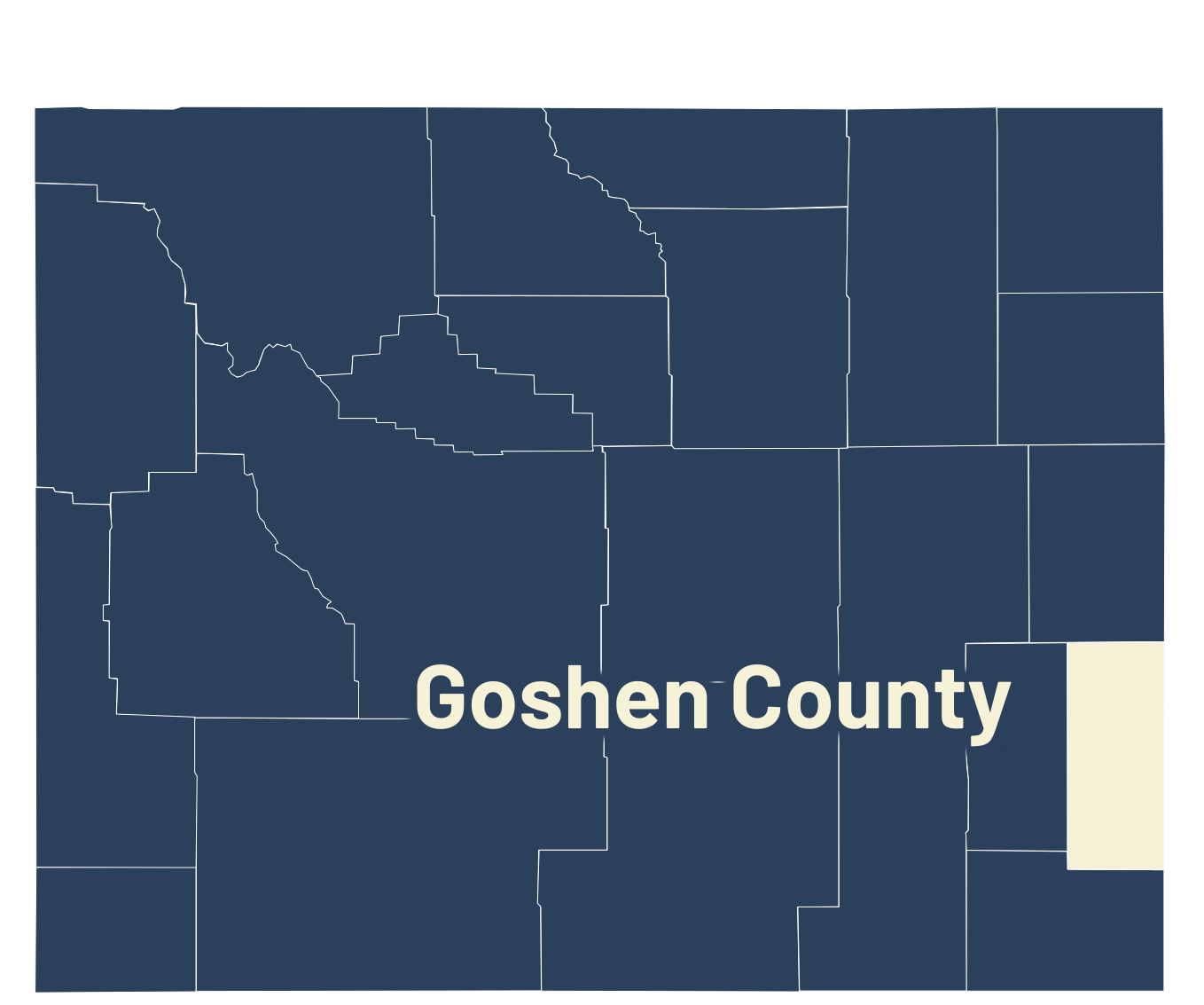
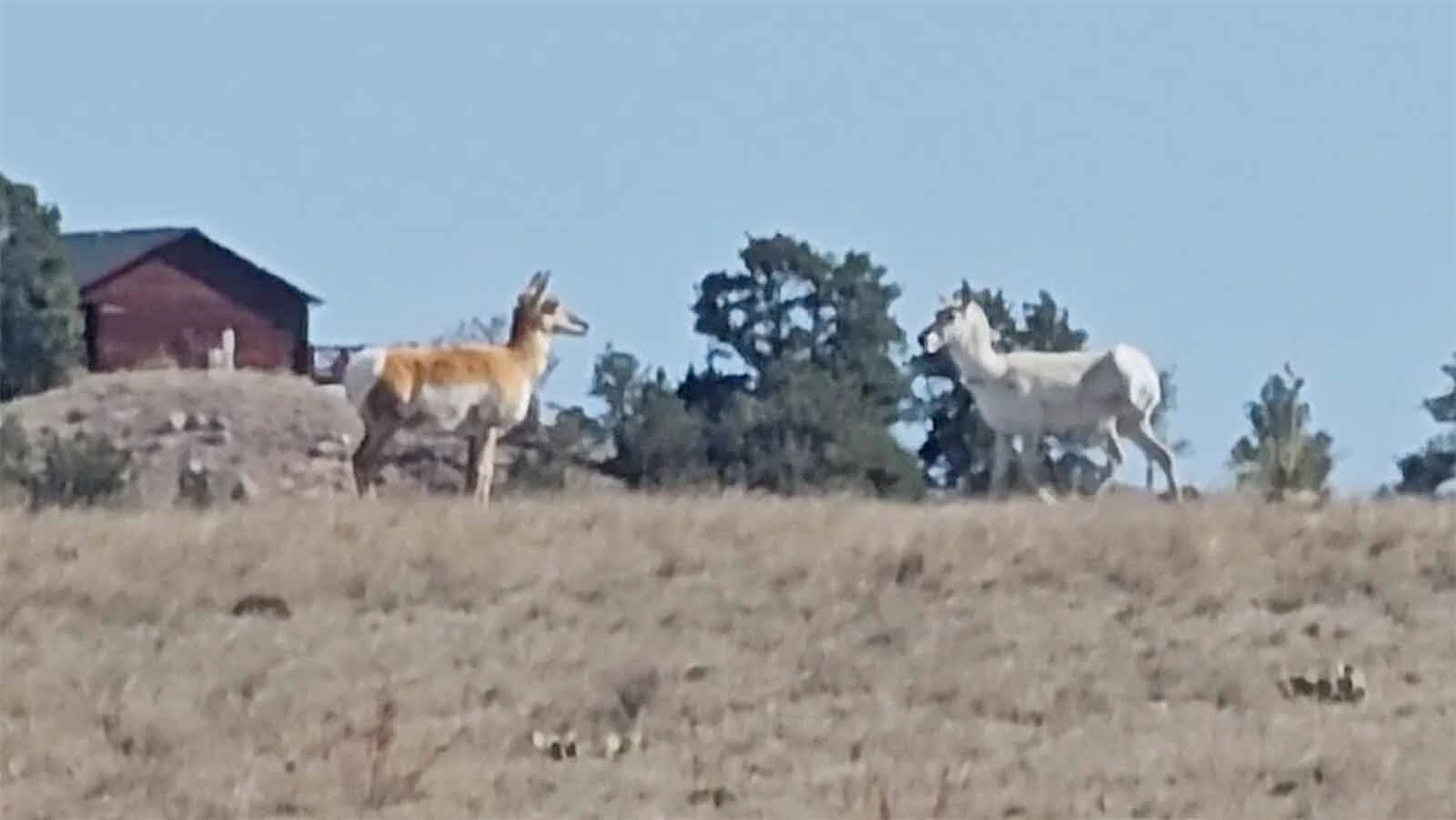
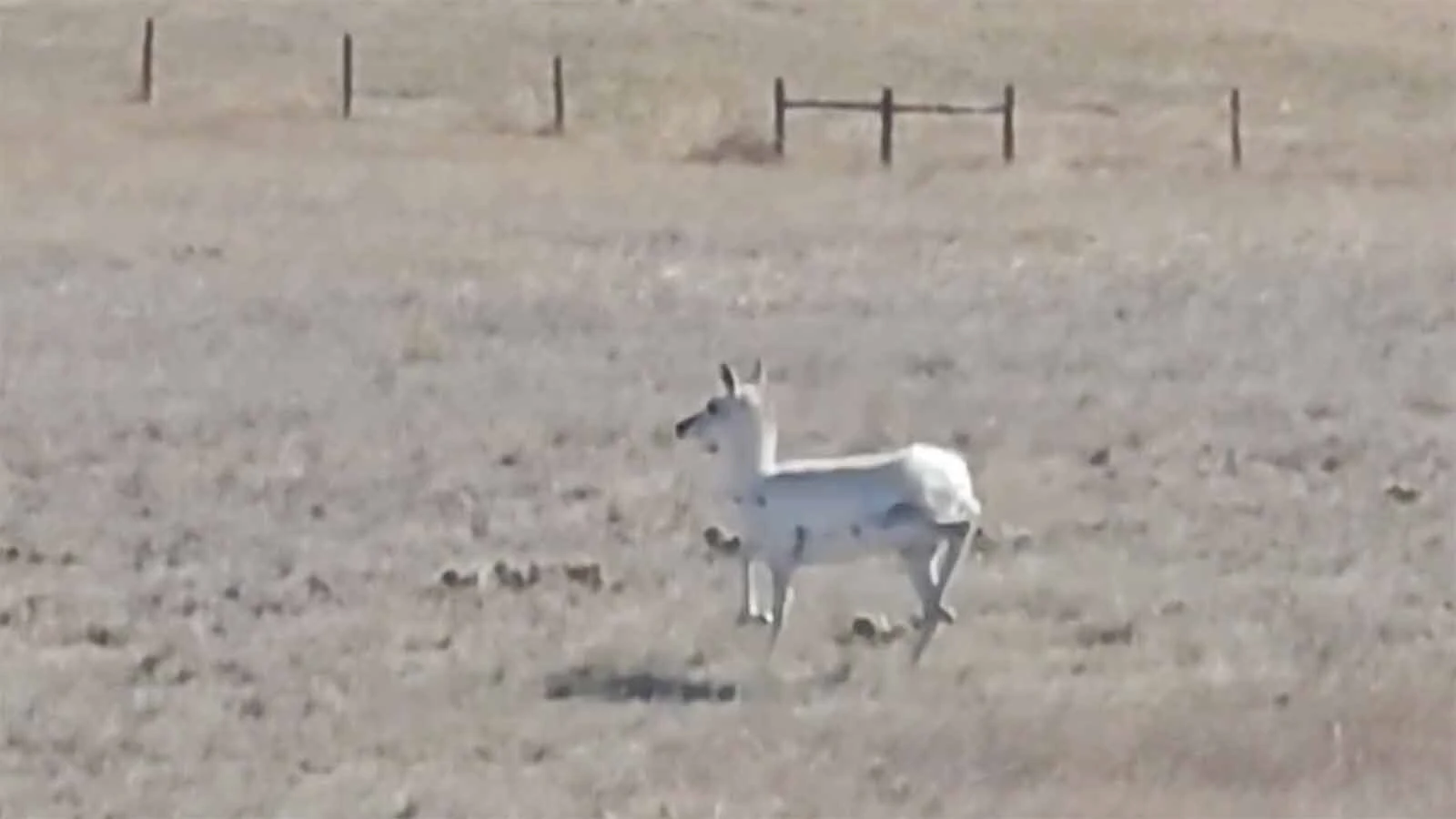
A rare all-white pronghorn made a brief appearance in Goshen County, much to the delight of a couple of local wildlife watcher. But whether the animal is an actual albino remains a mystery.
Matthew Pancake and his wife, Maricela, make a regular habit of taking walks to admire wildlife, including small local herds of pronghorn, commonly called antelope.
“We’re old people, we like to get our exercise by walking,” he quipped during a telephone interview with Cowboy State Daily.
They were out on Memorial Day when they spotted a buck pronghorn with two does, and one of the does was completely white.
“I said, ‘That sucker’s white. Is that an albino?’” he said.
Albinism occurs in humans and numerous animal species. It’s essentially a complete lack of pigmentation, wildlife biologist Rich Guenzel told Cowboy State Daily.
In some animals, including pronghorn, a recessive gene can also cause a few rare individuals to have all-white hair or fur. But they’re not actual albinos, said Guenzel, who worked for the Wyoming Game and Fish Department from 1986-2011 and has a special interest in pronghorn.
It’s most likely that the Goshen County doe has the recessive gene, but isn’t an albino, he said.
Never Seen Before, Or Since
Pancake said the antelope in his area seem to be a bit sparse. He wonders if herds are still trying to recover from an especially harsh winter a few years ago.
The white doe he saw on Memorial Day and the other two antelope with her all looked lively and healthy, Pancake said.
“She looked at us for a little while and then started running,” typical of what antelope do when humans are near, he said.
He’d never seen the white doe before. On Wednesday, he said he hasn’t seen her since.
The Answer Is In The Eyes
True albino animals have strange-looking eyes. In pronghorn, an albino’s eyes will be “reddish-pinkish,” Guenzel said.
Pancake said he "didn’t get close enough to see the eyeballs of that antelope,” so he can’t be sure whether she had that tell-tale feature.
Pronghorn rely heavily upon their vision, and albinism not only makes the eyes strange colors, it can sometimes affect an animal’s vision.
That’s more reason to think that the Goshen County doe is a recessive gene white specimen, he said.
“That’s an adult that’s survived at least one winter,” Pancake said.
He added that he’s seen only “one specimen” of an albino pronghorn, but has never seen such an animal in the wild.
The Air Force Base Buck
Guenzel has seen white, nonalbino pronghorn in a few places in Wyoming, including in the Shirley Basin and the Buffalo area.
“They’re neat to see, they’re a rare animal,” he said.
In the early 2000s, an all-white pronghorn buck that hung out around F.E. Warren Air Force Base near Cheyenne became something of a local wildlife celebrity, Guenzel said.
Sadly, that buck was struck and killed by a vehicle, he said.
The recessive gene that causes all-white fur apparently doesn’t directly manifest from one generation to the next, Guenzel said.
So, if the Goshen County doe ever has fawns, odds are good they’ll have normal-colored fur, white in the belly area, and tannish on the back and flanks, he said.
That pattern has served pronghorn well over the ages, causing them to “blend in” with the landscapes they inhabit.
Evading Predators
An all-white pronghorn might be easier for predators to spot. But since she’s a full-grown doe, good luck catching her, Guenzel said.
Pronghorn fawns might be vulnerable. The adults can run at roughly 55 miles per hour for extended periods. They developed that speediness ages ago, when their ancestors had to evade American cheetahs.
But those lightning-fast cats, which weren’t actually cheetahs, are long since extinct. And nothing else alive today with teeth, claws and a taste for meat can keep up with pronghorn.
And pronghorn also have exceptional vision, said to be about as good as a human looking through a powerful set of binoculars.
Pronghorn are designed to deal with predation. Once they get to be a yearling or above, their survival rate is pretty good, because they can out-run everything and out-see everything, Guenzel said.
All-white bison are also head-turners, and are regarded as sacred by Native Americans.
A white bison calf born in Yellowstone in June 2024 caused a stir as many visitors rushed to catch a glimpse of the rare animal.
Mark Heinz can be reached at mark@cowboystatedaily.com.


