
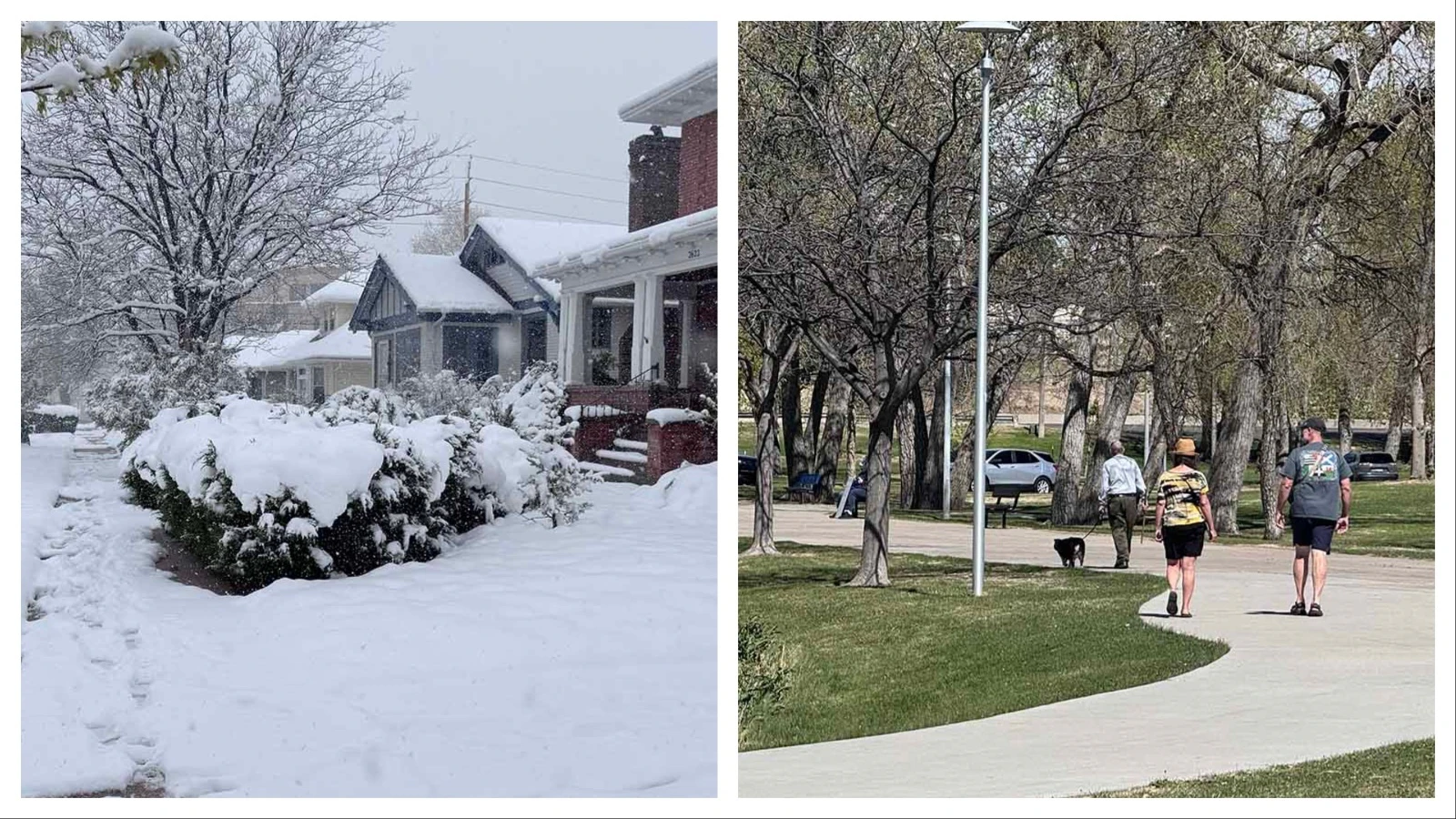
May historically is one of the wettest and most crucial moisture months of the year for Wyoming. This year was a Jekyll-and-Hyde May around the Cowboy state, either exceeding or falling short of expectations.
After the warmest, driest winter on record for areas across Wyoming, experts described the snowpack going into May ranging anywhere from “just OK” to “basically horrible."
While there was plenty of much-needed moisture in southeast Wyoming during May, the rest of the state didn’t do so well. In fact, it was nearly one of the driest Mays on record for many regions.
“You can see the difference driving across the state,” said Cowboy State Daily meteorologist Don Day. “The Red Desert is beautiful, while it looks like it hasn’t rained for years in Thermopolis.
“There was a lot of moisture in May, but we wish that wealth would've spread out a little bit more, that's for sure."
Results May Vary
There were definite winners and losers when it comes to precipitation this May. The clear winners are the communities in southeast Wyoming.
“The southeast and south-central regions did really well,” Day said. “Cheyenne, Laramie, and Rawlins were either at or above average precipitation for the month.”
Southeast Wyoming received more than 2 inches of liquid water from a heavy snowstorm in the first week of May. The region got at least that much, if not more, during the May 21 snowstorm that shut down Interstate 80 for more than 36 hours in some places.
Day categorized the storms as extremely similar but less widespread than many weather watchers had hoped. Their impacts were contained to southeast Wyoming and didn’t extend beyond that.
“It's really hard to find any precipitation patterns that get the whole state one way or another, but there was a really steep gradient,” he said. “Spring precipitation does tend to be more widespread, but we got two nearly identical patterns that gave southeast Wyoming most of that moisture.”
The further north one goes, the bleaker the numbers get.
According to the National Weather Service (NWS) office in Riverton, Buffalo received 0.73 inches of precipitation in May. That’s only 27% of its historical average and the third-driest May on record since 1998.
Rock Springs received 31% of its historical average at just 0.4 inches. Riverton and Greybull didn’t fare much better, with only 32% and 36%, respectively.
Lander and Casper did much better, getting more than 1.5 inches of rain each. That’s over 70% of their historical average precipitation for May, but still significantly below average.
For Day, the trend was clear.
“For the Powder River, Bighorn, and Wind River basins, which really needed to get some moisture, May was disappointing,” Day said. “Sheridan was good, but Buffalo wasn’t.
"Gillette and Sundance weren’t great, and we were still below average in the Casper-Wheatland-Torrington area. If you weren’t in southeast Wyoming, May underperformed.”
Extent Of The Problem
May is one of the wettest months of Wyoming’s year. That makes it one of the most critical periods, setting a precedent going forward.
May continued a troubling trend of below-average monthly precipitation for another consecutive month. Every month since November 2025 has trended toward below-average precipitation with above-average temperatures.
There’s no denying Wyoming’s in the midst of a drought. According to the U.S. Drought Monitor, most of the state is experiencing either extreme or severe drought.
That’s not to say there hasn’t been some improvement. Parts of southeast Wyoming were experiencing exceptional drought at the end of April.
“There was a slight improvement in those southeast and south-central counties with those two big storms, but we didn’t really gain any ground,” Day said. “We lost a bit of ground in northeast Wyoming, which just hasn’t been able to get much of anything.”
Now that May has come and gone, Day said it’s unlikely the statewide drought situation will improve.
“May is such a critical month,” he said. “When precipitation underperforms in May, it's so hard to catch up in the summer and fall. It’s hard to get to better, more moist patterns like we usually get in April, May, and June.”
There isn’t any relief to start off June. Day said the first half of the month is “trending drier,” especially in western and southwest Wyoming.
"There are hints that the second half of June is when our precipitation and opportunities get better, but the first half of June is going to be a bit of a struggle,” he said. “I would say that the better precipitation in June will be later than sooner.”
Monsoon Can’t Come Soon Enough
There are encouraging signs on the horizon.
Meteorologist are anticipating the impact of the El Niño developing in the Pacific Ocean, which many are already saying bears the hallmarks of a “super El Niño.”
Regarding a super El Niño, Day is keeping his expectations and extended forecasts reserved.
“The computer model predictions are for an El Niño to form this summer into fall and maybe linger into early winter,” he said. “While we may feel some impacts of this developing El Niño over the next couple of months, the bigger impacts that happen globally and across the country will happen in the fall, winter, and into spring.
"That’s when those impacts really manifest themselves.”
Day sees more encouraging signs in the short-term.
“We're seeing a lot of humidity building on the U.S./Mexico border,” he said. “Those are the beginning signs of what we call the North American monsoon wanting to form.”
The North American monsoon could produce high-precipitation thunderstorms, like the storms that reached Wheatland and Torrington earlier this week. However, that moisture depends on wind patterns that haven’t materialized yet.
“You need a specific wind pattern to get that moisture transported north, and I don’t see that happening yet,” Day said. “That’s why I’m leaning on the second half of June being better for moisture.”
Regardless, the simultaneous abundance and deficit of moisture in May have already set a precedent for the rest of 2026. As far as the ongoing, statewide drought is concerned, Day sees a drier summer ahead.
“I am certainly concerned about drought conditions worsening in the areas that didn't do well in May,” he said. “Let's just hope that things will get more moist as we get into the second half of June and July.”
Andrew Rossi can be reached at arossi@cowboystatedaily.com.


