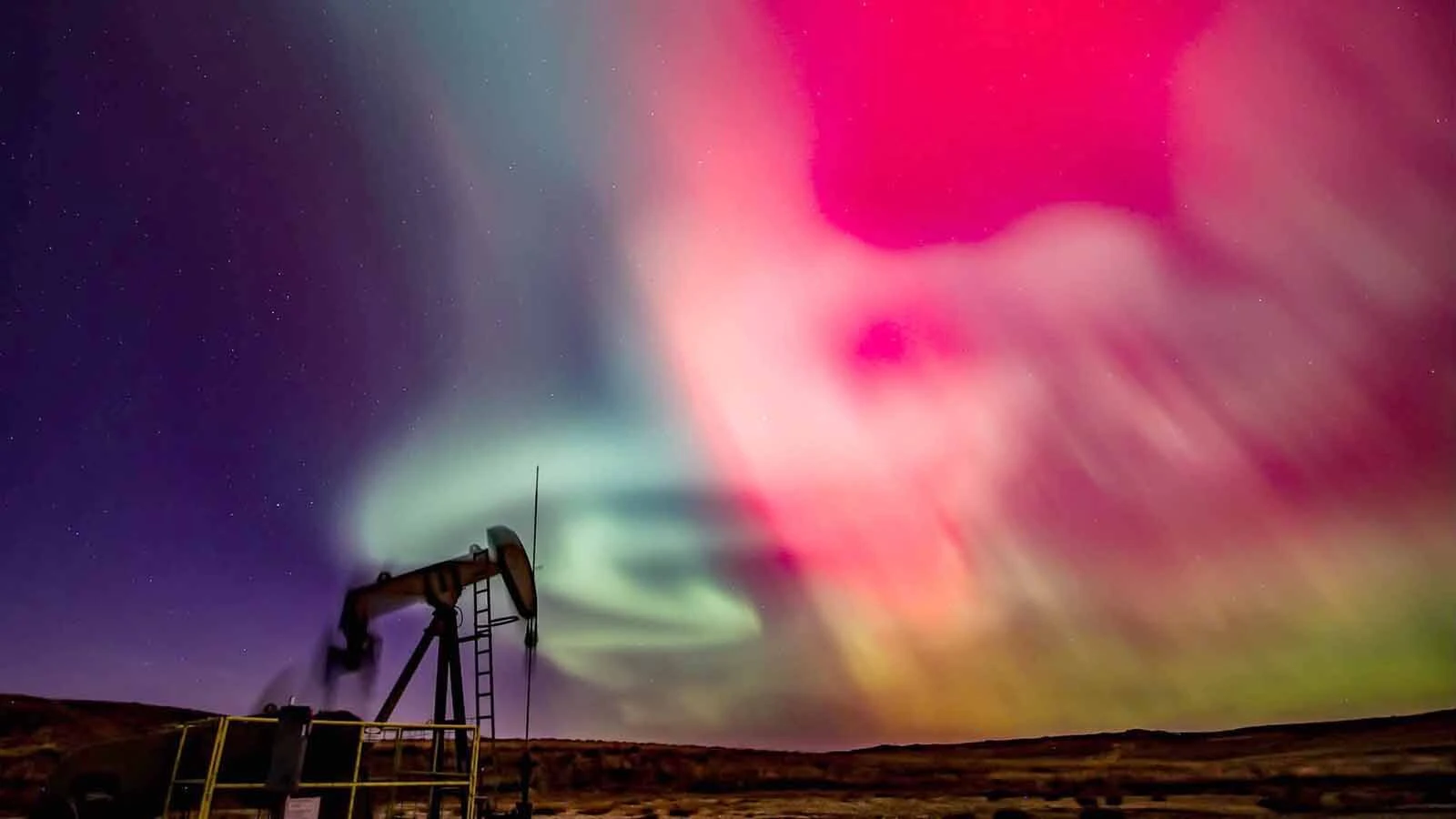
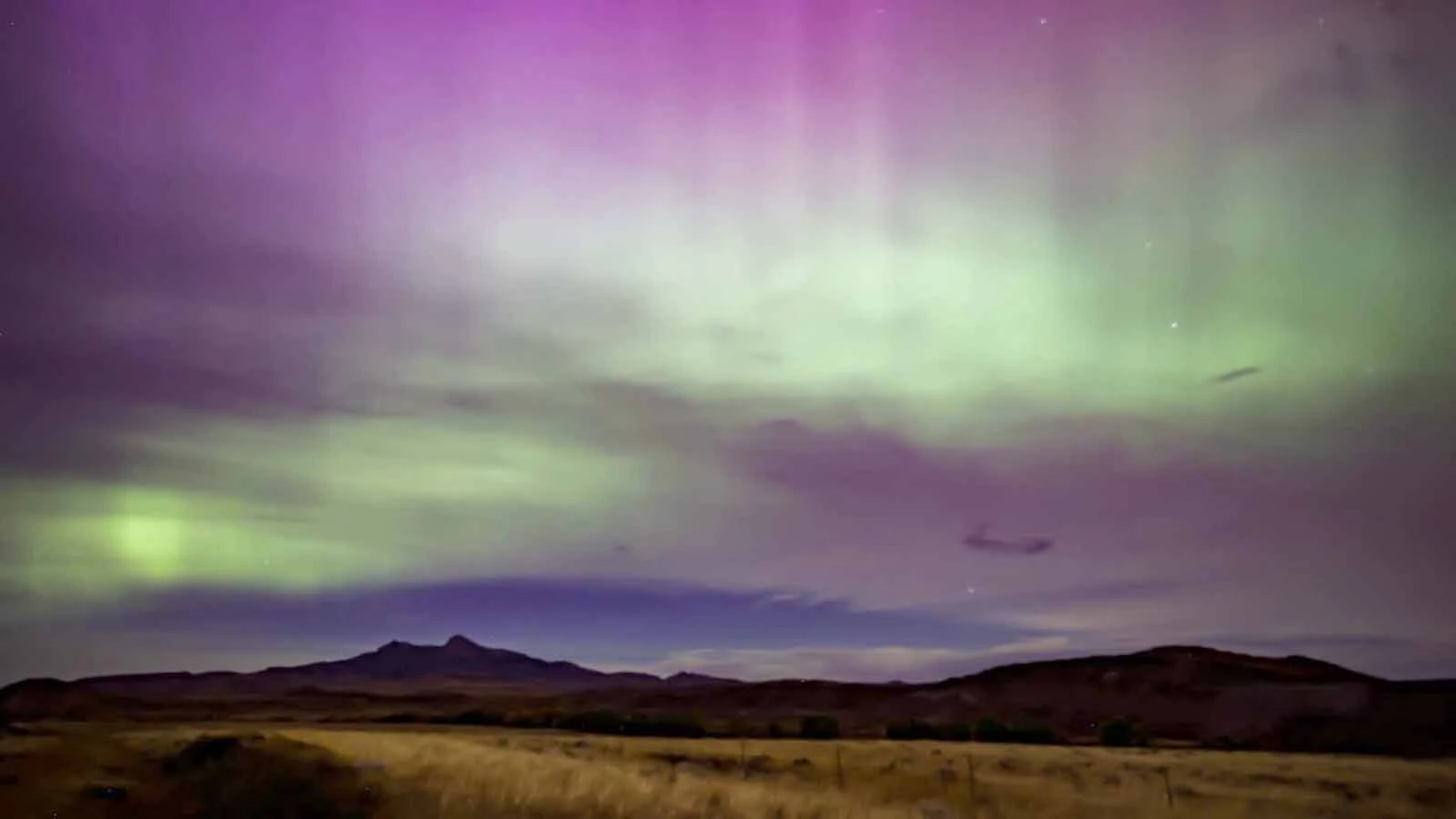
Another aurora is heading for the skies over Wyoming, and it might be the last good natural light show for Cowboy State residents for a long time.
The National Oceanic and Atmospheric Administration’s Space Weather Prediction Center (SWPC) has issued a G3 geomagnetic storm watch through Friday night.
Three coronal mass ejections (CMEs) surged out of the sun on Tuesday and are anticipated to reach Earth’s atmosphere sometime Thursday.
“The current forecast calls for combined CME arrival around mid-afternoon (Thursday), with up to G3 levels possible afterward,” according to the SWPC. “CME passage would likely continue into the evening and possibly overnight hours of (Friday).”
Wyoming aurora enthusiasts are already anticipating a good show, and they’ll be making the most of it.
There might not be another one this good for another 10 years or more.
“I wasn't expecting any more activity after last spring's activity,” said Jan Curtis, a retired meteorologist and former Wyoming state climatologist. “We're definitely at the edge of the envelope for seeing these big displays during this solar cycle.”
A Cannibalistic Event
The intensity of CMEs ranges from G1 to G5. The incoming CME is now a G3, but the SWPC believes it could be G4 by the time it reaches Earth.
Curtis said the intensity of this CME is “a cannibal-type event.” The three CMEs ejected from the sun are intensifying each other as they hurtle through space.
“When one CME catches up to another, it intensifies it,” he said. “It adds a force multiplier to the intensity of the initial eruption.”
That said, there’s no way of knowing how intense the subsequent aurora will be until it gets here. Curtis said there’s “a 50/50 chance” that there will be a super-strong aurora visible in Wyoming, even though it’s almost guaranteed that the CMEs will reach Earth.
“When Earth’s atmosphere is positively charged, they repel other positively charged particles, like a magnet,” he said. “The last time this happened, we were expecting a pretty good display, but the magnetic declination was in the wrong direction.”
Even the SWPC acknowledges there is “a rather complex series of events and circumstances” that will impact the intensity of these latest auroras.
If the CMEs are even more Earth-directed than they already seem to be, they will continue to intensify each other before combining with each other in Earth’s atmosphere.
“The forecasts of aurora are always questionable,” Curtis said. “The SWPC gives you the best estimate they can, but if there are multiple solar wind bursts coming through, that’s usually a good indicator that we will get to see something.”
All-Nighter
Aurora enthusiast and photographer Laura Redmond is already anticipating an “all-nighter” based on the developing forecast.
“They're comparing this storm possibly to the one in May 2024, and that was a very good one,” she said.
The May 2024 auroras were considered some of the best in living memory in Wyoming. They started with a four-combined-CME event between May 10 and 12 of that year, followed by another event later that month.
Redmond isn’t getting her hopes too high, but said the current outlook is “pretty promising.”
“When a CME hits the Earth, it takes several hours for it to push this far south,” she said. “I'm hoping that it'll hit between noon and 3 p.m., because then it should be down by dark down here in Wyoming. From the numbers yesterday, it looks pretty promising.”
Mooning Us
When it comes to CMEs, timing can be tricky. There’s no definite time someone can expect to step outside and see the aurora at its peak.
Redmond had a few suggestions based on her personal experience that have proven results.
“For the people in Wyoming, you just need to be away from city lights,” she said. “You don't have to drive out that far, and you probably will be able to see them with your naked eye.”
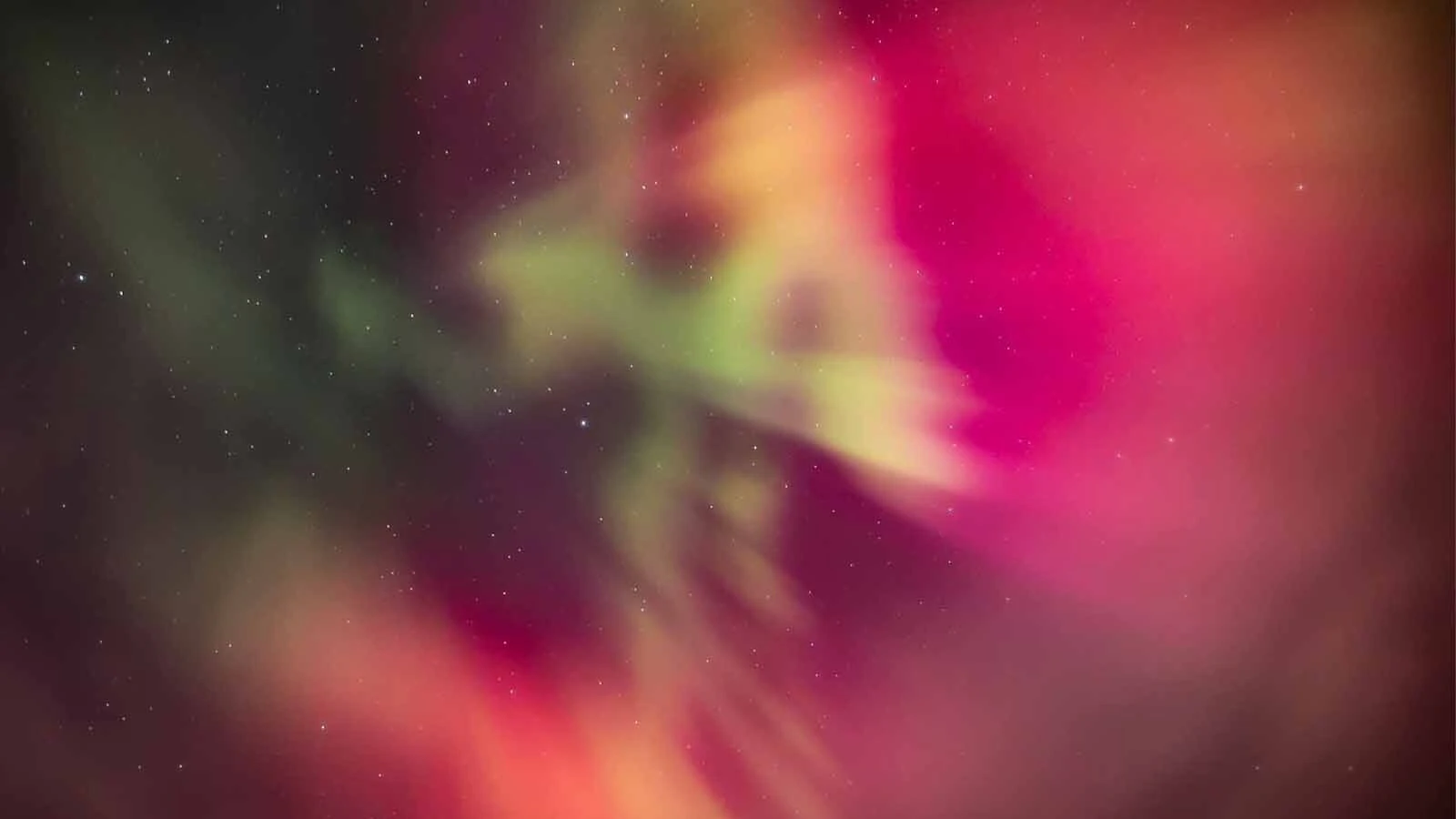
Redmond said people need to look for a “white, wispy, moving cloud” between the constellations Ursa Major, the Big Dipper, and Cassiopeia. That’ll be in the northeastern sky.
“The May 2024 was an all-nighter on the first night, and it lasted about an hour and a half after dark the next night,” she said. “We got two nights out of that one, so it’s possible we could get two nights out of this one, too.”
As for timing, Curtis has a good suggestion of when to step out and look up.
“They're most active around midnight, plus or minus an hour,” he said. “It will probably start off very faint, then burst into a lot of activity. But once it gets dark, certainly start looking.”
There will be a potential problem to contend with. The moon is scheduled to rise around 11 p.m., and it’s an 84% illuminated waning gibbous.
“It’s still a pretty big moon, but if the aurora’s bright enough, there should be no problems seeing it,” Curtis said. “Also, the moon’s going over the southern horizon, and we’ll be looking north, so it won’t interfere as much as it could.”
The Last Hurrah
The sun reached the climax of its solar maximum in October 2024. It’s the point of the 11-year solar cycle when there are more sunspots on the surface of the sun, which means there’s a higher probability of CMEs being generated.
At this point, the sun has nearly cycled out of its solar maximum. It won’t reach its next maximum for another decade, and possibly longer.
As its sunspots decrease, the likelihood of any CME, let alone three colliding CMEs, decreases “exponentially,” according to Curtis.
He added that summer “is not really notorious” for auroras, specifically the northern lights that will potentially reach Wyoming over the next two days. For Wyomingites, this is a “make the most of it” moment for anyone who wants to see an aurora in all its (potential) splendor.
“If we see anything in the next day or so, we should count ourselves lucky,” he said. “We are coming at the end of the two-year buffer after solar maximum, and the frequency of aurora storms diminishes pretty fast at this point.
"This will probably be the last aurora of this particular solar cycle that we’ll see in Wyoming.”
Andrew Rossi can be reached at arossi@cowboystatedaily.com.