
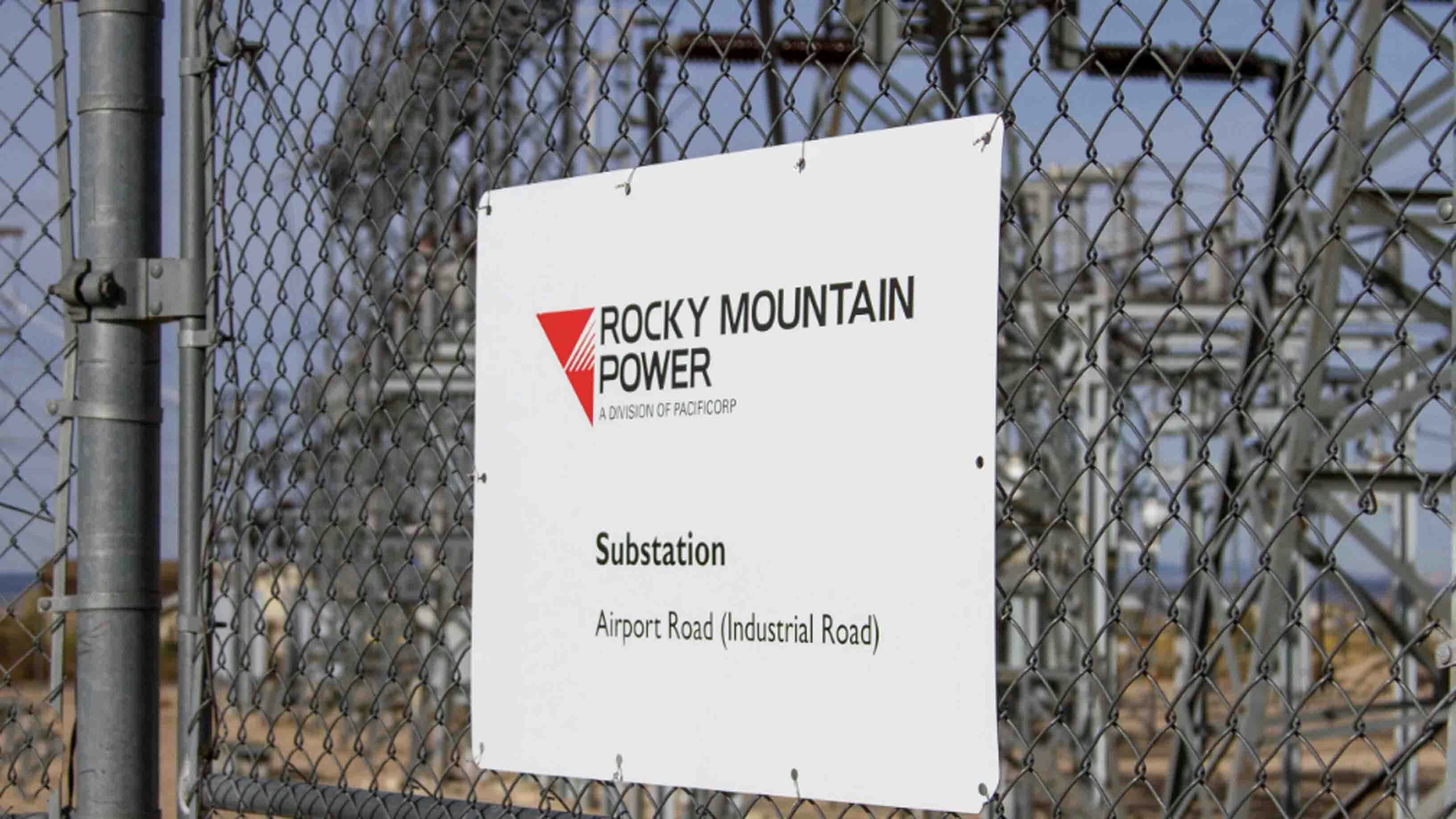
Rocky Mountain Power has proposed significant rate hikes in Wyoming amid what the utility has said are higher-than-expected energy costs.
Now it’s done something that the utility company claims will help save ratepayers a significant amount of money. It joined what’s known as the “Extended Day Ahead Market” for electricity on the Western grid.
That’s a giant online marketplace where utilities may buy and sell electricity up to 24 hours in advance. That lets them lock in cheaper prices before volatility hits the grid, such as during a power crunch.
Wyoming officials are cautiously optimistic about the agreement Rocky Mountain Power announced Friday.
But they also plan to watch the new marketplace for five years to ensure no shifts in grid control leave Wyoming consumers holding the bag.
Years in the making, the move signals a deeper shift in how power is bought and sold across the West.
The old grid system mostly balanced supply and demand in real time, with utilities scrambling to adjust hour by hour.
The look-ahead system lets Western states lock in power deliveries in advance, which should help utilities tamp down on dramatic price volatility that previously led to huge price spikes in spot markets.
That was a contributing factor in high energy costs that had companies like Rocky Mountain Power seeking a whopping 30% rate increase in 2023.
PacifiCorp, which is Rocky Mountain Power’s parent company, plans to act as both buyer and seller on the system, and will onboard roughly 12 gigawatts of generation capacity for its existing six-state territory.
Taming Volatility, Risking Control
Moving into a day-ahead market will allow better planning and will mean less, last-minute jumping around to either obtain or shed power supplies, Sen. Cale Case told Cowboy State Daily.
“It should help us,” Case said. “Potentially, it could lower costs for Wyoming customers — all Wyoming customers. It doesn’t really pick one customer class over another.
"I think it’s a good move. It’s one more step down the road toward more coordination for the grid in the West, and that’s not all bad.”
But the devil is always in the details, Case added.
The change could raise sensitive questions about who is really in control once the grid market goes regional, potentially affecting rates and overall power production.
“Right now, no one says to Rocky Mountain Power, ‘You have to back your plants off, and you have to take this power tomorrow,'” he said. “That doesn’t happen right now. So we’re fully in control, Rocky Mountain Power’s fully in control.”
Coordinating efforts across a regional grid could weaken some of that control, Case suggested.
“If the grid operators realize there’s a shortage of power in certain areas, we may be forced, under the terms of our participation, to provide power to that new area or to back off our plants if there are surpluses in other places,” he said.
“So, it takes the focus from being one regulated utility in the service territory to really considering the needs of the entire region,” he said.
Minding The Store
No one is pretending this market experiment will be simple.
“This topic is really complicated,” Wyoming Energy Authority Director of Energy Markets Development John Jenks told Cowboy State Daily. “We do think this will be a positive for Wyoming and for Wyoming ratepayers. But it’s definitely worth paying attention to this as it continues to evolve.”
To that end, all the parties involved have agreed to mandatory reporting requirements to the Public Service Commission for the next five years, Jenks said.
After that, there will be a hearing to evaluate how things have gone and to quantify the benefits to Wyoming ratepayers.
Jenks will also be watching for any negative effects on legacy energy sources like coal or oil and gas, which still underpin Wyoming’s economy, as well as any unintended impacts from other states’ differing policies or energy goals.
“As with any policy, whether it’s from the federal government or interaction with other states, there’s always a possibility that something could adversarially affect Wyoming energy production,” he said. “The goal is to economically dispatch electricity into the market, but we want to make sure we’re not paying for anybody’s energy goals or policies.”
A Surprise Berkshire Shift
That’s been a bone of contention in the past and is one of the reasons members of the six-state compact under Rocky Mountain Power have been mulling a split.
“We don’t want to be, nor should we be, paying for Washington,” Jenks said. “And quite frankly, Oregon, Washington, and California would be saying the same thing about our energy policies. They don’t want to pay for things they don’t want either.
"So, all of the states are going to be paying attention to it.”
So far, negotiations on the multi-state compact appear to be in a kind of limbo, Case said.
“It’s run out,” he said. “But they’re kind of operating sort of like it’s still in place.”
The biggest thing that’s happened, meanwhile, suggests there is a step-change underway now that Warren Buffett has been succeeded by a new CEO, Greg Abel.
Abel came up through the ranks on the power side, Case said.
“He made a statement about the company’s relationship with Washington state,” he said. “Utilities are a big part of Berkshire Hathaway’s holdings, and he basically said that the utility model wasn’t working in places like Washington state.”
The remarks were followed up with an announcement that PacifiCorp would divest its assets in Washington, selling them to Portland General Electric in a $1.9 billion deal.
During Abel’s first annual shareholders meeting on Saturday, he explained his thinking in more detail.
“When we acquire a utility, we tell the regulators it’s forever,” he said. “But it has to be a relationship that works and, if it’s broken, we’ll find a better path.”
Keeping An Eye On The Bouncing Ball
Washington’s political goals have long been “sideways” with Wyoming, and the majority of Rocky Mountain Power’s states, Case said. Still, the divestiture was a “surprising” development.
It underscores just how strained the relationship has become between utilities and states with aggressive climate goals — the same tensions Wyoming fears could still show up again in this new market dynamic, he said.
“Oregon isn’t exactly on the same page as Idaho, Utah, and Wyoming, either,” Case said. “We’ll kind of have to see what this shot across the bow does there.”
Meanwhile, the opportunity for cost savings is real, Case said.
Better planning for days when weather and renewables don’t cooperate can only help matters, particularly in a region where there are transmission constraints and supply chain issues.
At the same time, Jenks added that no one is taking their eye off the ball.
With a five-year review in place and reporting requirements, alongside an ongoing transmission study, there’s a broader effort under way to ensure Wyoming is not quietly bankrolling some other state’s experiments.
Renée Jean can be reached at renee@cowboystatedaily.com.


