
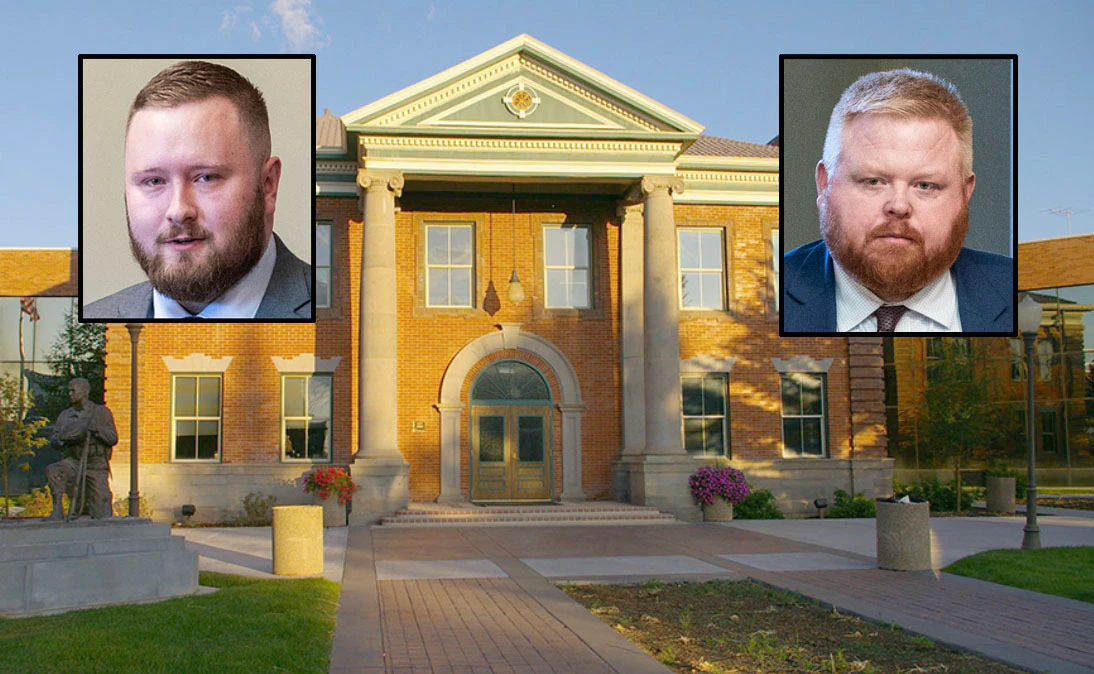
An Evanston-based judge on Thursday dismissed the defamation case of two state legislators against the campaign arm of the Wyoming Freedom Caucus, the WY Freedom PAC.
The WY Freedom PAC in 2024 dispatched mailers attacking state Reps. Cody Wylie and JT Larson, both Republicans of Rock Springs, claiming they had aligned with the radical left and voted to keep President Donald Trump off the ballot.
No vote to keep Trump off the ballot had surfaced in the Wyoming Legislature.
Instead, Wylie and Larson had voted in favor of a budget footnote limiting the Secretary of State’s office from using taxpayers’ money on out-of-state lawsuits in which Wyoming wasn’t a party.
Secretary of State Chuck Gray had been filing amicus briefs in a Colorado case in support of keeping Trump on the ballot in that state.
In the U.S. Supreme Court filing of that case, Gray’s was among about 78 other amicus briefs, on top of the appellant and appellee’s main arguments.
Wylie and Larson sued the WY Freedom PAC for defamation.
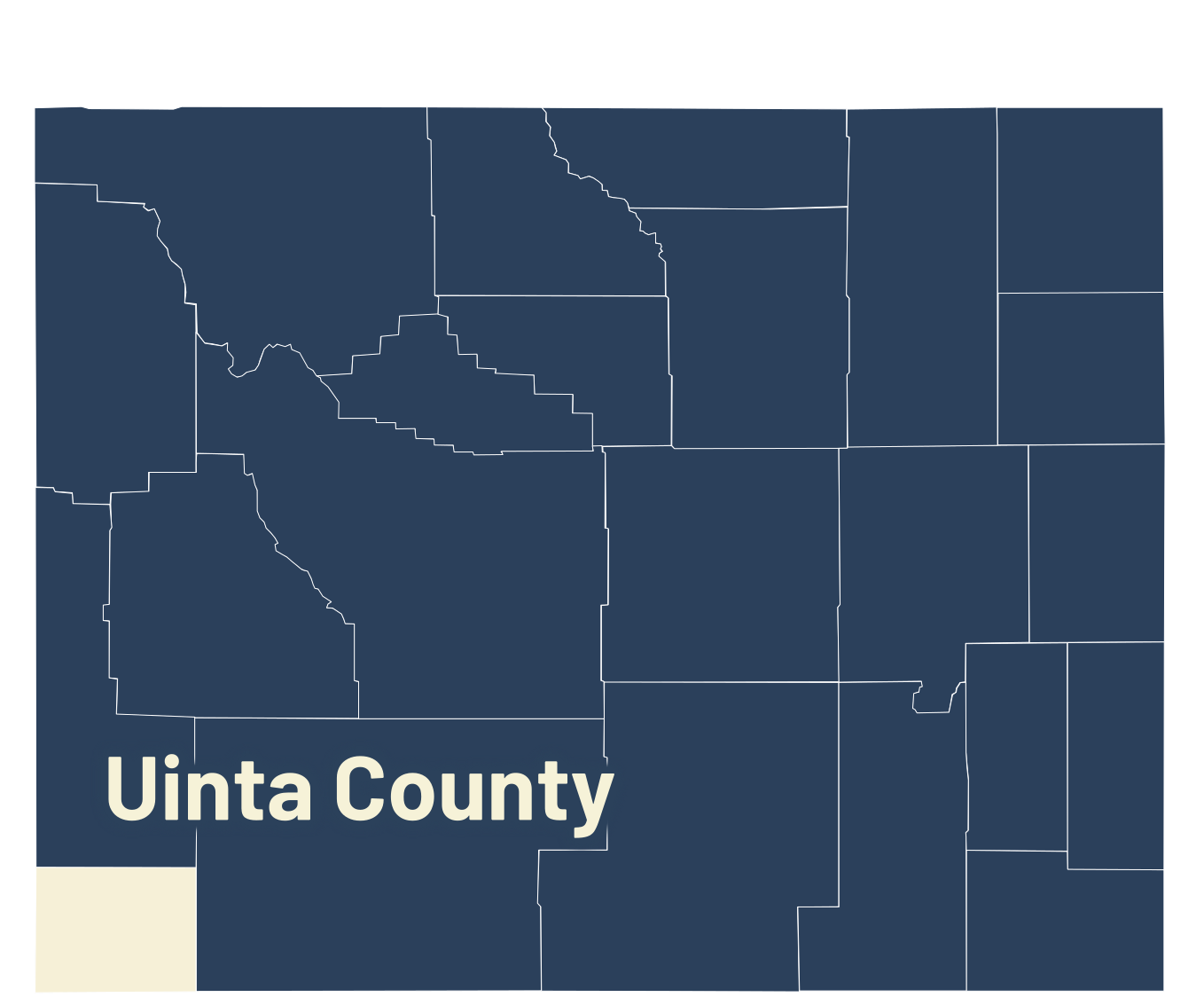
Though using words like “shady,” and “ludicrous” to describe the WY Freedom PAC’s claims about Wylie and Larson, Uinta County District Court Judge James Kaste dismissed the pair’s defamation case on Thursday.
That’s because Wylie and Larson are public figures. To sue someone for defamation, they need to show the people who defamed them either knew they were lying or recklessly disregarded the truth.
‘You Can Say Pretty Ludicrous Stuff'
In this case, two main people crafting the mailers, WY Freedom PAC chair Kari Drost and state Rep. John Bear, R-Gillette, truly believed what they were writing, Kaste concluded from the evidence.
“I think that chain of causation they describe is, um, trying to find the right word for, pretty ludicrous,” said Kaste of the skewed characterization of Wylie and Larson’s votes. “And yet in politics, given our First Amendment, you can say pretty ludicrous stuff.”
The judge gave that speech after hearing oral arguments in which WY Freedom PAC attorney Stephen Klein of Washington, D.C.-based Barr and Klein, urged Kaste to dismiss the case on First Amendment grounds.
Wylie and Larson’s attorney, Joe Hampton of Sweetwater County, had argued to let it go to a trial instead.
Kaste had said earlier in the argument, during a back-and-forth with Klein, that the mailers seemed to be “catastrophizing,” or extrapolating severe and unlikely consequences, from the truth of what actually happened.
And yet, drawing from the evidence, which includes messages by Bear and Drost, as well as their depositions, “I don’t think either of these people harbored any doubt about the truth of their statements,” said Kaste.
Often political catastrophizing is not true, said the judge.
Political operatives “get wrapped around their own axle and drink their own whiskey” and set out to harm their political enemies through a mailer calculated to do the most harm possible.
“And that ain’t actual malice,” Kaste said.
The candidates' remedy is to do what Larson and Wylie did: put out their own advertisements, go to door and shake hands with voters — “and they got reelected,” said Kaste.
He said the United States has and values the First Amendment to the U.S. Constitution for good reason.
“I cannot in good conscience send this to a jury, given the state of the evidence as it relates to actual malice. And I take comfort in the fact that that’s the typical result in these cases,” said Kaste.
Judges often halt defamation cases before sending them to juries because the First Amendment is so protective, “and the remedy for speech you don’t like is more speech,” he said.
Though expressing distaste for “the practice, and the messages that are out there,” Kaste urged against courts interjecting themselves in political speech wars.
The earlier cases on political defamation “wisely tell the court, ‘Butt out,’ more often than not,” he added.
Reacting to the ruling, Bear told Cowboy State Daily on Thursday, "I’m super excited that the First Amendment still exists in Wyoming."
Wylie told Cowboy State Daily in a text message that the case was about accountability and "making sure outside money doesn't distort our elections or mislead Wyoming voters."
"Dark money organizations from outside our state have no business trying to manipulate what happens here," he wrote, adding that the plaintiffs are reviewing the decision and considering their next steps.
He said he would not be distracted by "political games" and would keep standing up for southwest Wyoming, doing real work "and delivering results for the people I serve."
He emphasized that he's never voted to remove Trump from any ballot.
"That narrative was false from the start, pushed by out-of-state groups trying to create chaos here in Wyoming," said Wylie.
Don’t Want To Win That Way
Klein while sparring with Kaste during oral arguments declined to concede that the mailers were false.
When the vote on the budget footnote happened, no one knew how Trump v. Anderson, the ballot case, was going to end, he said.
The U.S. Supreme Court sided with Trump on that case weeks after the Wyoming Legislature’s budget footnote vote.
Sweetwater County District Court Judge Richard Lavery presided over the case before Wyoming’s age-limit restriction for district court judges retired him.
He had ruled that the case was at least viable enough to advance to the evidence-swapping stage in 2025. He concluded at the time that the WY Freedom PAC “fabricated a putative ‘vote’ on an issue that never came before the Legislature.”
Before Kaste sided with Klein on dismissal Thursday, Klein said he and his client respects Lavery’s earlier decision, but that, “We certainly are holding — holding a lot of these things in reserve for appeal if necessary, as far as whether this was provably false in the first place.”
Klein called it “ridiculous” that public officials had brought a lawsuit with what he called little evidence: one witness per plaintiff, among other showings.
He said he would rather win the case on his lack of harm argument than actual malice, but he’d take an actual malice win.
Hampton during his argument had said defamation doesn’t have to hold a person up to hatred, scorn, and a list of other consequences to make it through the court process. The defamatory communication just needs to be of the type that tends to subject its victims to those consequences.
And the WY Freedom PAC made claims that, if true, would have rendered Larson and Wylie incompatible with the offices they sought, argued Hampton.
It’s outright defamation if the defamatory statement would cause people not to vote for the candidate, said Hampton quoting from an earlier case.
As for the actual malice standard, Hampton tried to cast doubt on whether Bear and Drost believed their own statements. The vote at issue was plainly a budget funding vote, said Hampton.
‘Lawfare’
The Wyoming Freedom Caucus celebrated the ruling in a Thursday statement, calling the defamation case “meritless lawfare.”
“For nearly two years, liberal legislators attempted to silence conservatives and shut down free speech through a strategic lawsuit against public participation – often called a SLAPP case,” the statement says. “It didn’t work.”
The statement points to the First Amendment, adding, “politicians don’t get to silence speech that points out their unpopular voting records.”
The statement calls “lawfare” a favorite tactic of the left, and says Wyoming needs strong anti-SLAPP protections.
“We will never stop fighting for Wyoming – America’s last hope,” the statement concludes.
Clair McFarland can be reached at clair@cowboystatedaily.com.


