
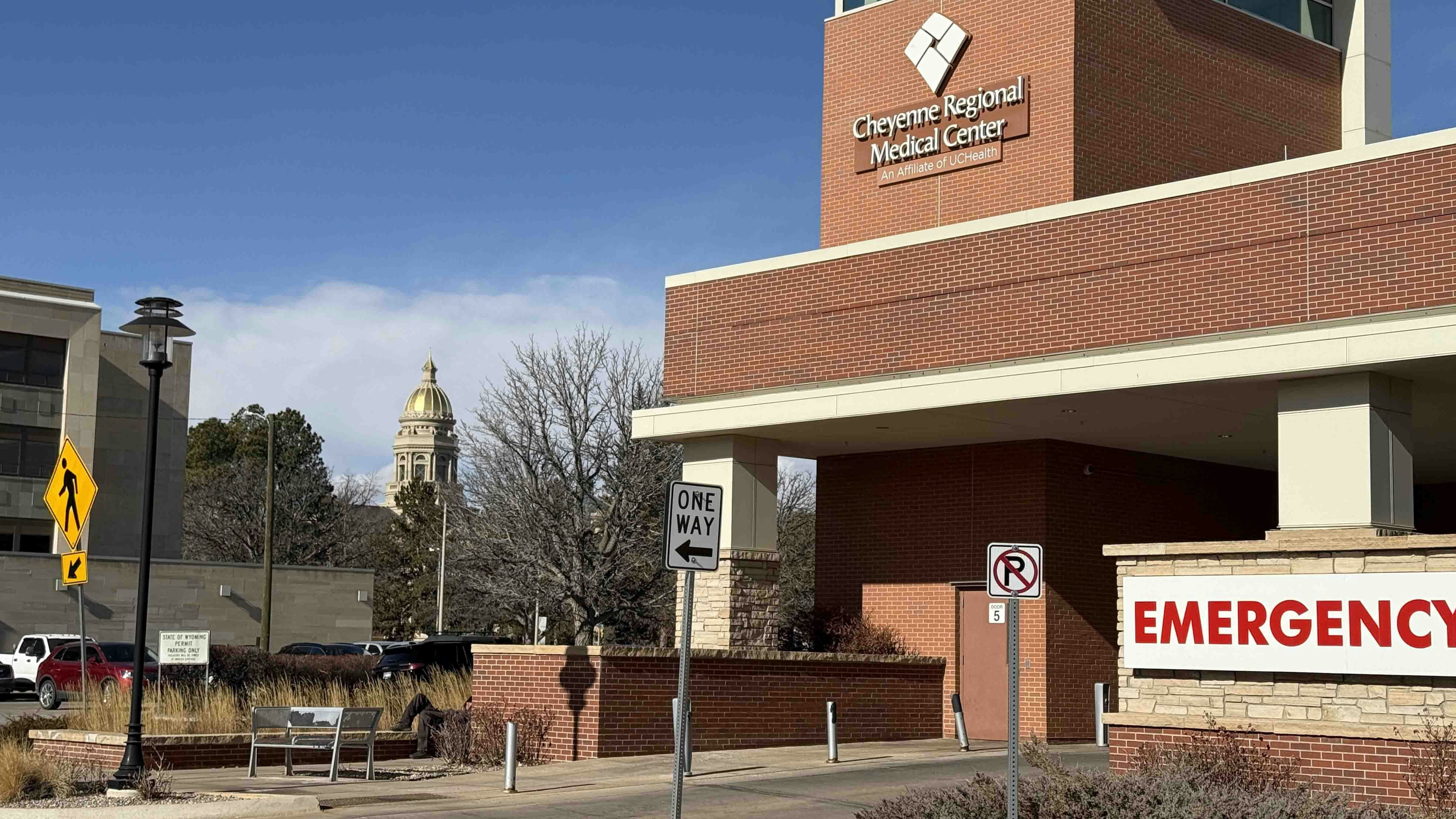
Update - Moments after this story published, Gov. Mark Gordon’s office announced the federal government has approved Wyoming’s revised grant request with the tighter spending window this story contemplates, but not the investment plan Wyoming had crafted.
Wyoming had planned to invest the majority of a roughly $1 billion projected federal grant for rural hospitals, ambulances, baby delivery and other health care so the state could benefit from gains beyond the five-year grant cycle.
The federal government looks likely to reject that plan, Wyoming Department of Health (WDH) Director Stefan Johansson told state lawmakers last week.
In passing the Trump-backed One Big Beautiful Bill Act, Congress marked $50 billion for rural health care across the states. It tasked the Centers for Medicare and Medicaid Services (CMS) with administering the grant program.
Wyoming was slated to receive $205 million for the first year of the five-year program. Its framework for that money says the state would invest 80% of the first-year funding, then 69.5% of each grant figure for the following four years.
“I think if you dig into the details of what’s in our application, you’ll see that in the spirit of … trying to invest this as conservatively as possible, (we hope for) 25, 50 years of benefit change here,” said Johanssen during a Dec. 8 budget talk, “rather than a five-year opportunity to fund pet projects of the Wyoming Department of Health.”
Johansson was still hopeful about getting federal approval for the fund at that time.
He wasn’t on Thursday, when telling members of the legislative Labor, Health, and Social Services Committee that, “because of some esoteric federal regulations, it became clear that CMS may not and ultimately would not approve the perpetuity fund.”
The first year’s grant must be committed to various endeavors by October of this year and spent by October of next year, said Johansson on Thursday.
He urged lawmakers to consider setting up a state-level investment plan for health care in the coming years or to keep the investment idea open in case federal standards change.
State Sen. Charlie Scott, R-Casper, asked if immediate expense hadn’t been the point all along — saying he’d heard health care providers were reporting shortfalls from the federal government failing to keep up with its reimbursement promises in the first place.
“The costs were running up faster than they were approving the reimbursements,” said Scott.
Scott said, “I can see why the perpetuity fund was one step too creative for a big federal bureaucracy like CMS,” but if the agency would resist Wyoming elsewise, “it looks to me like the bureaucracy is trying to defeat some of the intent of Congress in this particular matter.”
The Wyoming Department of Health is now pushing an alternative proposal, Johansson said. It doesn’t contain the perpetuity fund, or a controversial emergency medical incident insurance plan that critics had blasted in December as a government boondoggle, and the department had touted as a mere kick starter for a sustained program.
CMS did not respond by publication to a request for comment.
Do We Let Pharmacists Do More?
Franz Fuchs, WDH deputy director, told the committee that the federal government is hinging some of its grant money on policy changes.
The federal government wants Wyoming to join a multi-state physician assistant licensure compact, expand pharmacists’ scope of practice so they can generate some more treatments on their own, expand dental hygienists’ scope of practice and require doctors to receive continuing education on nutrition.
These are controversial policly questions, Fuchs noted, so the department doesn’t have a stance on them and defers to lawmakers to respond to the federal government’s wish list.
“They essentially give us more money if we do these things, but we are not required to spend more money on them,” said Fuchs.
OK, Feds
Sen. Cale Case, R-Lander, who is not on the Labor/Health Committee but has his Ph.D. in economics, told Cowboy State Daily it’s tough to tell at this stage what the federal agency’s spend-it-quickly mandate could do to Wyoming’s economy.
Johansson in December had called the tight spending window for the grant program a driver off a “fiscal cliff.” He cast the “fiscal cliff” as a familiar phenomenon associated with other federal grant programs. The idea is that Wyoming spends grant money on systems it can’t maintain long-term.
Inflation is already significant, so the fiscal cliff’s inflationary effect might not be that noticeable, particularly if a lot of the money goes toward construction rather than services, Case said in a Thursday interview.
“The whole thing is crazy, OK,” said Case. “The federal government was throwing this money out again. But I just didn’t think we could persuade them to let us bank it and use it as a trust fund. It didn’t fly in my mind.”
When the federal government wants its money to fix something, it usually wants that money deployed right away, Case added.
Case has, so far, hypothetical fears that he said may or may not solidify as Wyoming strikes a deal with CMS.
For example, "Are we buying any real capacity or are we building over-capacity; and then we won’t be able to sustain it?”
Another example, said Case: “If it goes for services … how much will go to Wyoming people and how much will go out of state?”
Many providers contract with traveling nurses to ease a current nurse shortage, noted Case. But traveling nurses tend to cost a lot more compensation-wise, he added.
“So much bad juju about it,” he said. “It’s the federal government.”
Clair McFarland can be reached at clair@cowboystatedaily.com.


