
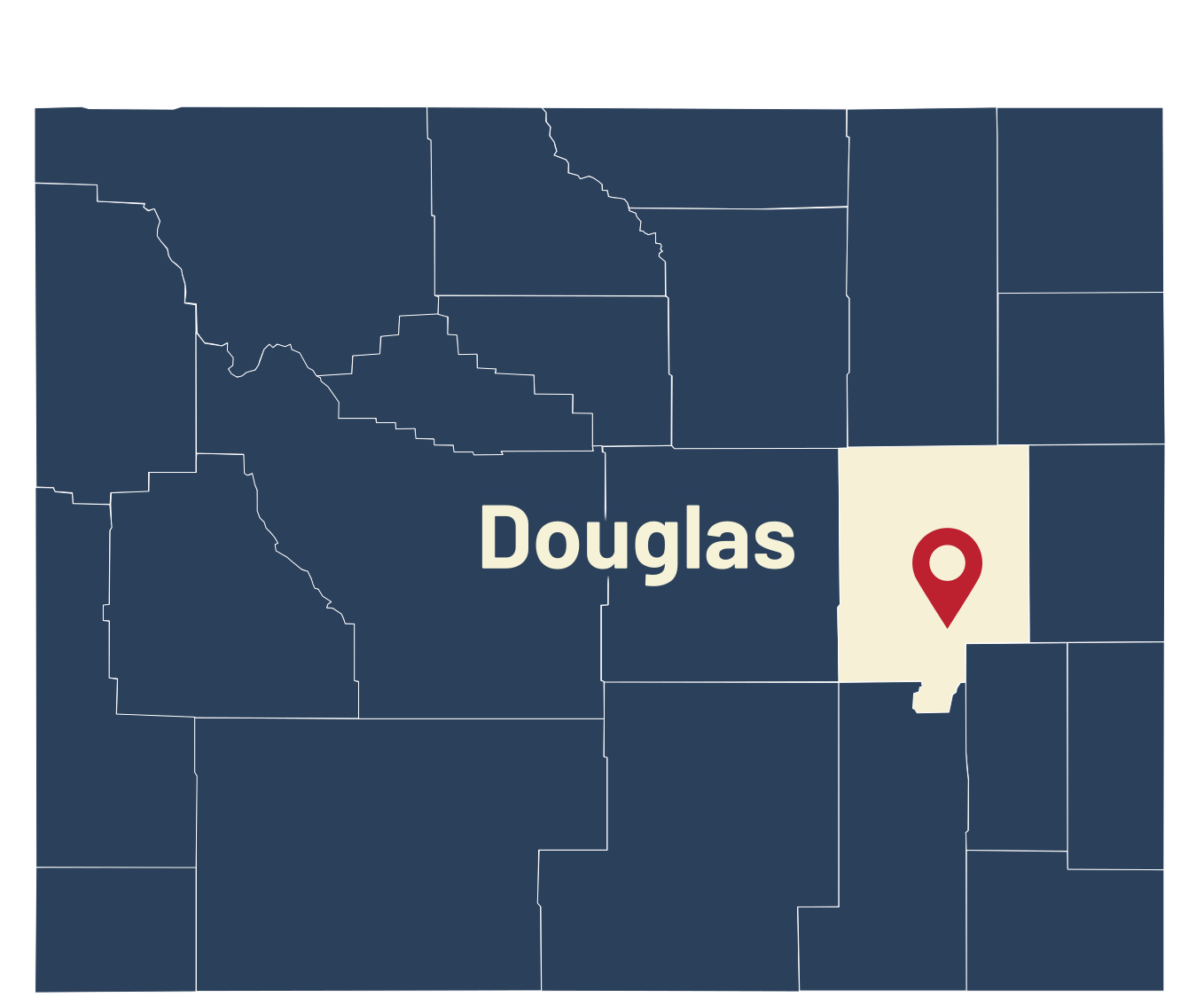
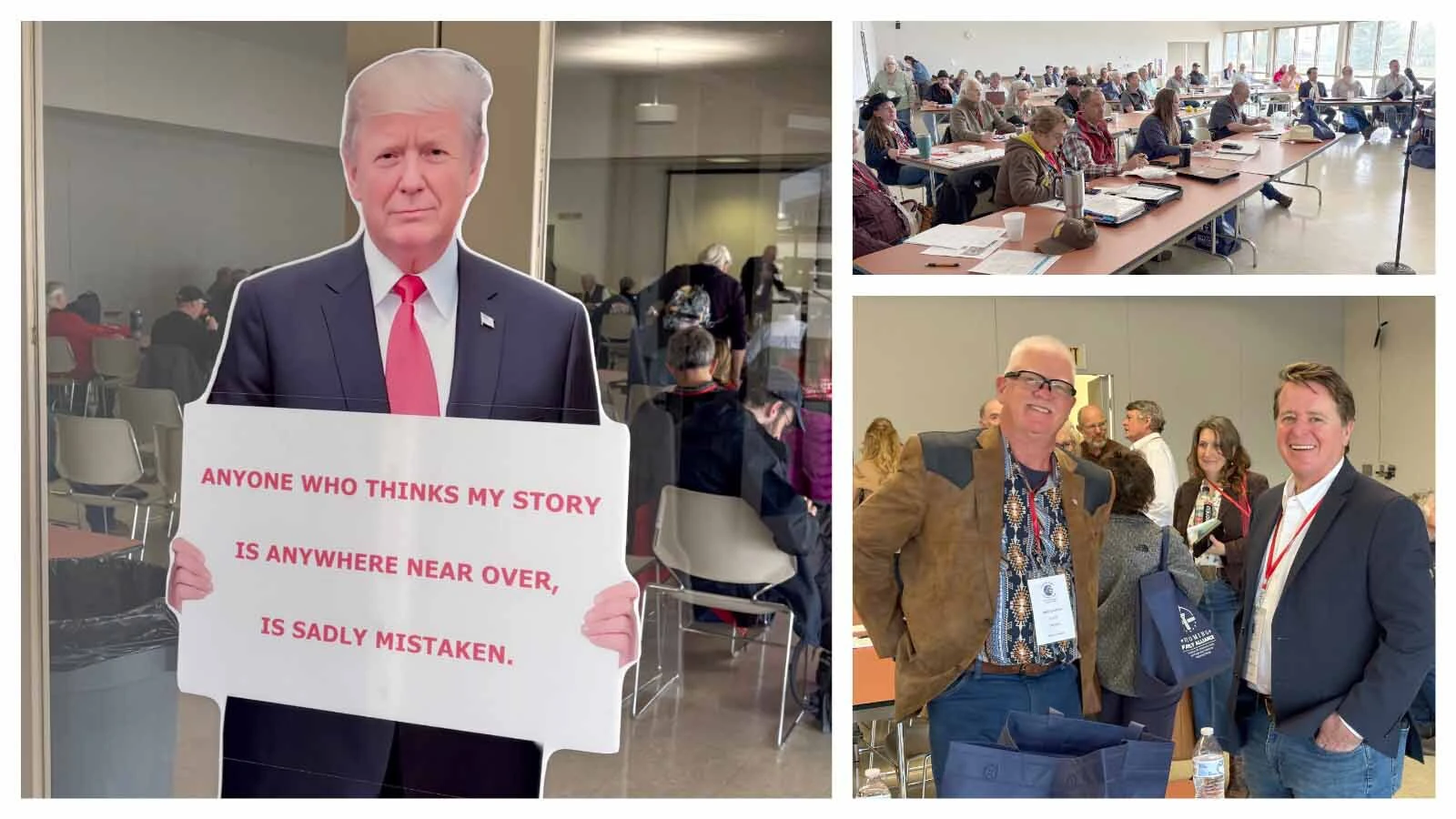
DOUGLAS — “This is going to be a convention to remember.”
Wyoming Republican Party Chair Bryan Miller opened a bylaws committee meeting preceding this year’s state party convention in Douglas with those words Thursday morning.
“What we as a party are moving towards is what people have been asking for decades,” he said.
That includes the Wyoming Republican Party suing to free the GOP from state laws governing political parties.
Miller referenced the 1989 U.S. Supreme Court case of Eu vs. San Francisco County Democratic Central Committee, saying it “talked about what everyone has wanted forever in the state of Wyoming.”
That case overturned California laws governing the major party, saying the state had violated the party’s First and 14th Amendment rights by restricting its endorsement of candidates, and how it determined its membership.
“The state has no right to meddle in the internal affairs of the party,” Miller said. “And they don’t have the right to tell us we have to be in a primary election, and at the same time tell us we can’t participate in that primary election.”
Miller referenced a slate of proposed state GOP bylaws changes from various county Republican parties urging the state party leadership to pronounce as void Wyoming laws that govern it.
Wyoming law says major parties’ county leadership committees consist of elected precinct people, who in turn vote for their state party delegates. The law also bars the major parties from financially backing one candidate over another in the same party, in the primary election.
But on the other hand, state law involves the party in choosing which officials will fill vacancies in legislative, county, and nearly all statewide elected offices.
It’s up to the delegates whether to adopt the party's new stance of autonomy, said Miller.
The chairman asserted, however, that the party’s rights have been violated for nearly four decades. And he said thousands of registered Republicans and Democrats have had their rights violated as a result of the state governing their party leadership.
“Not only do we have the right to do this, we have to do this,” Miller said, addressing a crowd of party delegates and spectators in a meeting room at the Wyoming State Fairgrounds.
Applause sounded.
Then the debates began.
Primary Or Caucus
County party leaders presented proposed bylaw changes reflecting the goal of Miller’s speech: asserting the party’s rights, pronouncing some state laws void, claiming the right to back one Republican candidate against another in the primary election, and claiming that the party — not state law — can determine the party’s membership.
Scott Clem, of the Campbell County Republican Party, demanded context.
He said he didn’t necessarily oppose all the changes, but had questions about how they’d function.
“I don’t see how the primary system, as it exists today, marries what we’re trying to do here,” said Clem.
Clem also said he would support a caucus system whereby the party delegates chose which political candidates to nominate, instead of the publicly-funded, partisan primary election system Wyoming now has.
But, said Clem, the Wyoming Constitution also says that the state can regulate corporations. And trying to throw off state law will spark litigation, which in turn would concern donors.
Clem asked if the party is prepared to fund its own elections, if its newfound autonomy severs it from the state’s governance.
“(If we decide) let’s privatize the whole thing, I’m with you 100%,” said Clem. “But if you want the public in on this via a state election that taxpayers are paying for — if so, you’ve got rules attached. That’s the rub for me.”
Marcia Neumiller, Natrona County Republican Party state committeewoman, also voiced concern, saying she supports the idea of autonomy, but some of the language felt like a “power grab.”
“And I’m not sure this is the right way for us as a party to present ourselves to the public and the rest of the Republicans throughout the state,” she said.
Crook County GOP Chairman Mark Koep, who brought most of the autonomy resolutions on his county party’s behalf, said by giving the party the exclusive authority to govern itself, “it means that we’re no longer a social club. It means the bylaws matter.”
He reiterated the points from the 1989 case. Throughput the debate Koep listed other cases, and other states where parties have more latitude.
Koep said none of the proposed bylaw changes contained language to eliminate the current primary election system.
Clem parried and said he was hearing “conflicting things,” since the Crook County party brought language saying the GOP could govern its nomination procedures and candidate qualification.
Clem raised the specter of litigation repeatedly.
“What is this going to cost?” he asked. “If we don’t have a plan, this is absolutely reckless. I’m assuming there’s a plan.”
Cheryl Aguiar of the Hot Springs County Republican Party, countered: “The cost is our freedom and our liberty. The party against the government. And I’m willing personally to pay. I’m not looking for a little safety. I’m looking for our freedom.”
We Will Not Comply
Miller returned to the meeting room to address what he called “some confusion” and the litigation that was “apparently … getting brought up quite a bit.”
He also announced the plan.
Miller asserted that the Eu vs. San Francisco County Democratic Party case means the state of Wyoming is already violating major parties’ rights, and said it’s the party’s duty to address that immediately, not wait another two years until the next convention.
“We are reasserting, not asking for our rights,” he said, adding that the party intends not to comply with Wyoming’s election laws governing it, and that it will inform the state attorney general of its decision.
“The court case has already been decided,” said Miller. “Wyoming will have to fight this if they want to fight this.”
Miller said he’s talked to Secretary of State Chuck Gray, and the secretary said he didn’t want to deal with it, “because he understands where we’re at.”
In the meantime, to stave off “a bazillion lawsuits,” Miller the state GOP’s executive committee has given Miller the authority to engage Washington, D.C.-based law firm Barr and Klein and file a federal lawsuit on the matter.
“We are filing as a state party, a civil rights case on our First and 14th Amendment rights,” said Miller, adding the attorneys have agreed to take the case “effectively pro bono.”
Clem had floated the question of whether the party tried first going through the Legislature: changing the statutes to conform with its asserted rights.
Miller said party leaders have been trying that for years.
This year, the party sought a change in state law so that members who haven’t been elected by the primary election voters can vote at county party meetings — as long as they were appointed in line with party’s bylaws and registered with the Secretary of State’s Office.
That measure failed, due to what Miller called lawmakers voting “against our First and 14th Amendment rights.”
“We’re never going to get it through, because they don’t want it to go through,” said Miller. “We don’t have to.”
Clem told Miller it’s a “real issue” that Campbell County donors, in particular, don’t want to donate to the party because they don’t want their money going to litigation rather than candidates.
Miller said that people may have also been hesitant to donate because they don’t see the GOP as being of any value to them, since “we’ve not asserted our rights over the years.”
Can We Kick People Out Of The Party?
The bylaws committee advanced multiple resolutions saying state law doesn’t constrain it, and that it possesses autonomy rights.
It voted to advance a bylaws change that would, if finalized, create a candidate vetting committee for reviewing GOP candidates.
The committee advanced other proposed changes, including some to:
• Provide a framework for endorsing candidates.
• Discipline party members who claim to endorse people on the party’s behalf.
• Call for GOP candidates to voice strong support of at least 80% of the state GOP platform.
The committee rejected a change that would have allowed it to remove elected officials from the party and block support to those candidates.
But first, Rebecca George, of Washakie County, asked if the party had the authority to remove people from registering under it. She proposed a change to strike that provision.
Her motion failed.
Clem said that was a shame, and that George’s change would have made the language more palatable to him.
“I don’t know how exactly we could (purge party members) when anybody could run as a Republican,” said Clem, noting that the party can still censure and reprimand members.
Heidi Reed, of the Albany County Republican Party, said she favored the purge clause.
“Whether or not we have something in place at the moment by (which) we can remove Republican insignia from some of these people, we definitely need a mechanism by which we can remove their Republican designation when they do not behave consistently as Republicans,” she said.
“And if nothing else, this does present our intent to have one,” she added.
The full GOP convention will have the chance to approve or reject the proposed bylaws changes on Saturday.
Wyoming is a supermajority Republican state. In most legislative districts, GOP candidates have proven more electable than Democrats and others, which has sparked theories that not all Republicans in the Legislature are real Republicans.
So, websites claiming to assess legislators’ GOP orthodoxy have surfaced.
The Legislature bears a clear divide between lawmakers who have called themselves “traditional” Republicans, and those who hold tightly to the party platform, calling themselves “platform” Republicans.
Meanwhile, the Attorney General
The state GOP is already challenging some of the state laws that govern it, in the case of Martinez vs. Wyoming Republican Party - now ongoing in state court.
In that case, some Hot Springs County GOP members sued the state party last April, claiming they were ousted wrongly from leadership positions.
The state GOP is defending itself by asserting the state can’t dictate how it chooses delegates.
Megan Pope, state Senior Assistant Attorney General, filed a brief last week countering the party and defending party-related laws, and the state’s Uniform Arbitration Act as constitutional.
The arbitration act is involved because the state party used its own arbitration procedure to address the leadership spat.
Pope’s brief acknowledges the 1989 case on which GOP leaders relied Thursday.
It invokes other cases as well, like a 2018 10th Circuit Court of Appeals case, Utah Republican Party v. Cox, in which the court upheld a law requiring parties to let candidates qualify for primary ballots via signature gathering, or party conventions.
Generally when the government infringes someone’s fundamental right, the infringing policy can only survive if the government can show it has a compelling interest, and its restrictions tailor narrowly to that interest.
But in this field, a more tiered system called the Anderson-Burdick test applies, Pope wrote.
“Under that test, if a regulation severely burdens a political party’s associational rights, the state must show it is narrowly tailored to serve a compelling state interest,” says the brief. “When the burden is lesser, the state’s important regulatory interests will usually suffice to justify reasonable, nondiscriminatory restrictions.”
Wyoming's burden on the GOP's rights is "lesser" and fits under the less rigorous test, the brief says.
Pope asserts that Wyoming’s laws dictating the county GOP’s ballot-born membership is “modest,” and “simply identifies who gets to vote for state central committee members who will later perform limited electoral tasks.”
Pope asserts that this law doesn’t dictate the state party’s membership, but determines who the “deciders” of that membership are - so that the party committees reflect the electorate’s will.
The law “ties committee composition to primary election results and assigns the state central committee limited functions such as vacancy filling.”
California had imposed “far more intrusive controls” in the Eu case, wrote Pope.
Here Pope touched on a quasi-governmental function the party retains under state law.
When a county official leaves his post early, his county party chooses three nominees to replace him; from which the county commission appoints one.
For nearly all elected state officials, State Central Committee members do the same, except the governor appoints one person from the three nominees.
Even if the court finds that state law burdens the party’s associational rights, asserted Pope, the laws can still clear the test for overturning fundamental rights.
Clair McFarland can be reached at clair@cowboystatedaily.com.


