
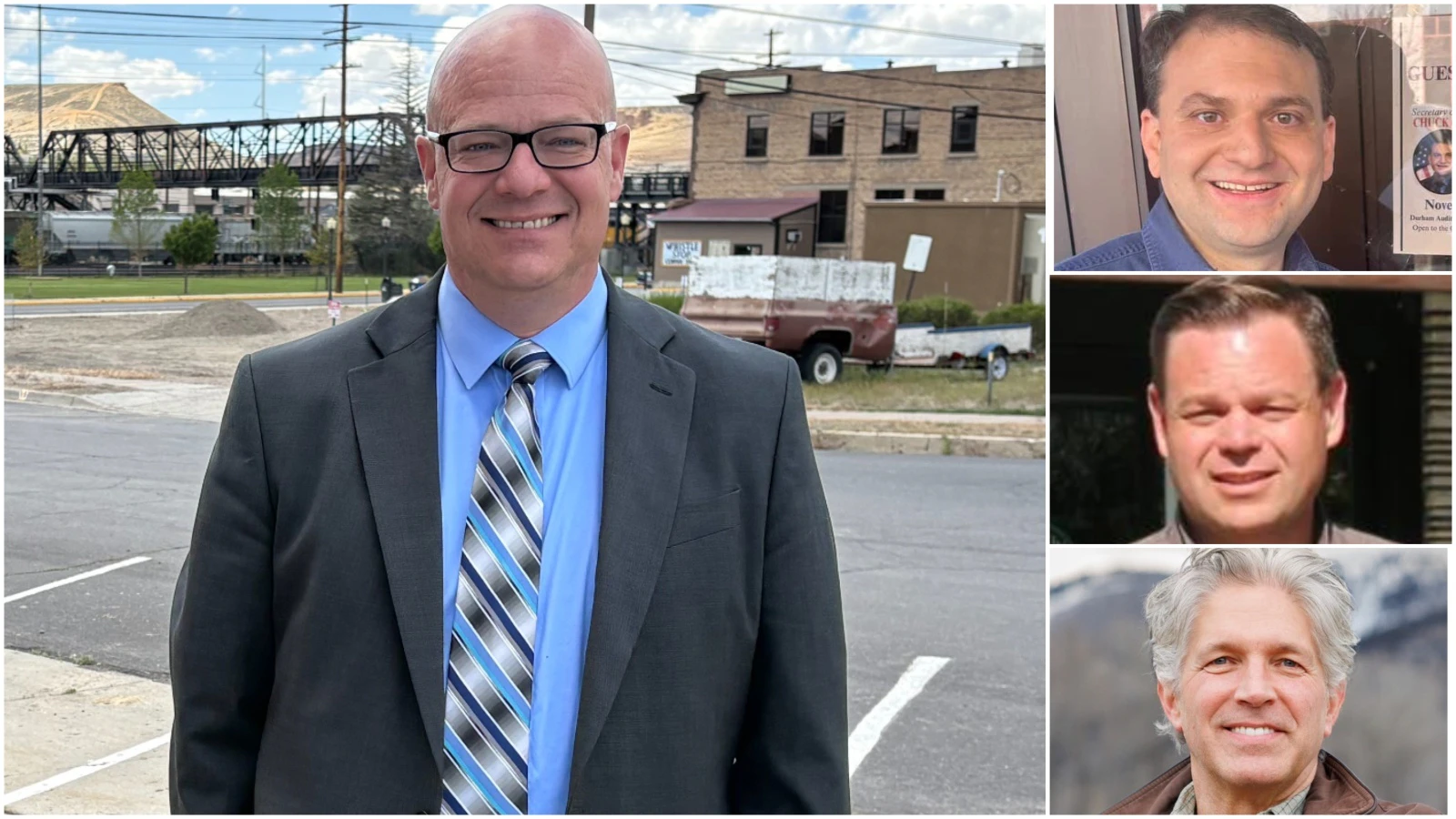
This year's election climate could make the perfect storm for Libertarian candidate Shawn Johnson to win Wyoming's U.S. House seat, politicos say. That is, if he courts conservatives, and if the winner of the crowded GOP primary is hugely unpopular.
Johnson, a Thermopolis-based attorney, two-term Casper City Councilman, and former combat medic earned the Wyoming Libertarian Party’s nomination on Sunday to run for U.S. House, and is slated to appear on the general election ballot Nov. 3.
He’ll face the lone survivor of a hotly contested 10-person GOP primary contest, and the winner of a two-way Democratic primary election. Both major party primary elections are set for Aug. 18.
“Of course it all depends on who comes out of the Republican primary,” said Tim Stubson, who served in the Wyoming House for nine years and ascended to two leadership positions as speaker pro tempore and majority whip.
“But there are some candidates in the Republican primary with substantial negatives that could win. I think it could be a real contest going into the general.”
Stubson also campaigned in a fraught, nine-candidate race for the 2016 Republican nomination for U.S. House, which former Rep. Liz Cheney ultimately won.
This year, the winner of the 10-way GOP primary election could secure the “R” nomination with a mere 10.01 percent of the vote.
Even if that winner secures 21 percent of the primary election vote, however, that leaves 91,967 people willing to vote against him or her, based on the past 10 years’ election averages in Wyoming.
That figure translates to 39.2 percent of the general election turnout – more than enough for a third-party candidate to win a three-way race.
If one assumes, however, that half the Republicans who were willing to vote against primary winner will swallow their disaffection and vote for him or her in the general election, then that gives the GOP nominee a solid 70,431 votes going into the general, and just 45,983 primary-election voters eager to vote against him or her.
But the general election has nearly twice the turnout of the primary.
If one applies the same standard and assumes that half of the Republican-voting Wyomingites who skipped the primary but participated in the general will vote against the GOP nominee, then that buoys the “against” vote by 66,452.
That means a third-party candidate could capture 112,435 votes. The figure represents 47.9 percent of the general election turnout, based on the last decade’s averages.
“And that assumes that all of the Democrats stay home,” said Stubson. “I’m not sure that’s a safe assumption.”
This is especially true, Stubson added, if Secretary of State Chuck Gray wins the primary election.
Gray has immense name recognition, but has also been involved in numerous controversies throughout his tenure.
These include recurring spats with the governor, an about-face on a widely publicized gravel pit project, and a decision to hand Wyoming voters’ identifying information to the federal government.
“I think if you have a legitimate race – even though the Democrats might not agree with Johnson on many of the issues – Chuck Gray’s negatives are so low that if they (Democrats) think there’s a chance to beat him in the general, you could see (Johnson) peeling off votes from all sorts of people you wouldn’t expect,” he said.
The GOP contenders are Gray, state Senate President Bo Biteman, Teton County philanthropist Steve Friess, former Superintendent of Public Instruction Jillian Balow, Casper-based veteran Kevin Christensen, veteran David Giralt, Casper businessman Reid Rasner, former legislator Keith Goodenough, Moran rancher Frank Chapman, and Richard Dodson.
On ‘Wasting’ Votes
Normally, voters hear that they shouldn’t waste their votes on a third-party candidate in the general election.
But the past 10 years’ election data for Wyoming’s general election indicate that, even if a solid half of Republican voters broke ranks to vote for a Libertarian in the U.S. House race, the Democratic candidate is still highly unlikely to win. At least, not without an unprecedented blue shift.
Wyoming voting data in the past decade of U.S. House races has been shifting red, not blue.
The Democratic House candidates from 2016 to 2024 have a maximum vote ceiling of 30.76 percent in the general election – and an average ceiling of 26.6 percent.
Republican House candidates in that same timeframe have won an average 67 percent of the vote and a maximum of 70.6 percent.
That’s more than two thirds, meaning, splitting the vote across two candidates with conservative appeal is unlikely to yield a Democrat win, the data indicate.
That’s even true for the election year of 2016.
The Republican candidate scored 62 percent of the vote that year, which is less than the two-thirds threshold. But the Democratic candidate only won 29.9 percent in that race, so, still not enough to win by unity alone, had a Libertarian split the GOP vote.
Minor-party candidates earned a collective 7.7 percent in that election.
Dark Horse
Gail Symons, an analyst of state voting data and Cowboy State Daily political columnist, said the numbers show a path for Johnson.
“It’s a dark horse. But it’s a possibility,” she added.
The rest depends on how well he courts conservative voters, she said.
“If he starts getting his name out there and is seen as rational Wyoming, like a real Wyoming person – because the Libertarian Party nationally is kinda whacko,” said Symons with a laugh. “But if he presents himself as a Libertarian with conservative leanings, and pulls into the areas that traditional, neighbor-type Republicans have gone for, I think he could pull it.”
The Wyoming Republican Party is fractured, between the more outcome-oriented, socially-conservative Freedom Caucus wing and the more process-oriented conservatives who often voice dislike toward meddling with local governments.
This could make the GOP ripe for third-party capture, both Symons and Stubson said.
The Freedom Caucus-aligned wing of the party is in accord generally with President Donald Trump. Wyoming ventured a higher concentration of Trump votes than any other state in the past two elections. The president is pro-energy, which is a huge draw in the fossil fuels-mining state.
But Wyomingites also resist federal overreach and “really want to not have DC crammed down our throats,” Symons said.
Stubson said Johnson will need to amass monetary backing and name recognition – quickly.
Respect The ‘R’
Rod Miller, longtime political columnist and former congressional candidate, said he doubts Johnson can pull it off.
“All those stats are right,” said Miller. “But that does not mean a third-party candidate, Libertarian or Constitution or Independent, will win the general election.”
It’s not that Republicans are loyal to the “R.” It’s that they’re complacent about it, he said.
If Johnson wants any hope of winning, he’ll have to “really blossom and pop out,” said Miller.
“I don’t think any of these people are capable of doing that. I just don’t,” he added.
Still, said Miller, for Johnson to wage a battle, he’ll have to capitalize on some voters’ disfavor toward the Wyoming Freedom Caucus, he’ll have to show charisma, and courage, and “enough balls” to take a firm stand against the Freedom Caucus wing of the party.
This Time, Says Bru
The Libertarian candidates in those five general elections netted an average 3.35 percent of the vote.
From 2018 to 2024, the Libertarian House candidate was Richard “Bru” Brubaker, of Riverton.
Brubaker told the Libertarian convention on Sunday that he’s not interested in running this year.
He told Cowboy State Daily, “We’ve got a legitimate candidate this time.”
Stubson agrees.
“(Johnson) has held elected office before,” said Stubson. “And he is a legitimate candidate.”
Are Major Parties Going Fringe?
Wyoming Libertarian Party Chair Zachary Padilla theorized that the political scene has reached a point at which the major parties have headed off the rails, and the Libertarian ethic now represents the reasonable approach.
Padilla gave Cowboy State Daily a phone interview Monday on his own behalf, not speaking for the party.
“He has the most sound logic,” said Padilla of Johnson. “The best ability to project the right message, you know, freedom; individual freedom, limited government, fiscal responsibility. He can articulate that in a way that I think will resonate with most Wyomingites.”
On the party’s behalf, Padilla said, “The American political system is rigged against the American people. They are forced to pick between two parties who are two sides of the same coin.
“In the past people haven’t voted Libertarian because the Republican Party lied to them about being fiscally conservative and limited government.”
In his own interview Monday, Johnson said he’s in it to win.
His goal is to vault into public view,” so people know there’s a viable alternative to the Republican, and the Libertarian vote is not a wasted vote. And that I am a viable candidate,” he said.
“I don’t back down from a challenge,” said Johnson. “When I’m fighting for something, I’m going to go until the bloody end.”
Buckle Up: More Numbers
From 2016-2024, the average primary election turnout for the U.S. House race was 131,946 – or 58.5 percent of the general election turnout.
So, the general election is nearly double the size of the primary election.
The year 2022 skews that data. Its primary election tally for that race was 92 percent of the general election total.
That was the year now-U.S. Rep. Harriet Hageman challenged then-Rep. Liz Cheney in the Republican primary and won.
In that same timeframe, Republicans have gained ground, winning a near-steady climb in U.S. House races from 62 percent of the vote in 2016 to 70.6 percent of it in 2024.
Never in that timeframe did the primary election ballot feature 10 Republicans for U.S. House.
But it came close in 2016, when Cheney beat eight contenders for the nomination with 35,043 votes – or 39.7 percent of the total.
In This Simulation
In the five past general elections, the GOP landed an average of 67 percent of the U.S. House vote.
Splitting that average in half between an imaginary Republican and an imaginary Libertarian gives each candidate 33.5 percent - which puts each of them still 3.5 points above the Democratic candidates’ highest tally and 7 points above the Democrats’ average tally.
If the Libertarian candidate in this scenario won that half plus the historic Libertarian average of 3.35 percent, he would win 36.87 percent. Again, well over the one-third threshold for a three-way race victory.
It’s unclear what could happen to the Constitution Party’s average tally of 2.3 percent. That isn’t factored into this simulation.
The Libertarian Party gained a seat in Congress when Rep. Justin Amash changed party in 2020. That same year, the town of Green River sent the Wyoming Legislature its first Libertarian delegate, Marshall Burt.
Burt served one term.
In the central-Wyoming town of Riverton, Libertarian candidate Bethany Baldes came within about 50 and about 30 votes of beating her Republican opponents in 2018 and 2020, respectively.
Who Is Johnson?
Johnson is a Wyoming native, formerly of Casper and now of Thermopolis.
He was an Army combat medic for 21 years and was deployed to Iraq in 2003-2004. He served as a Natrona County Sheriff’s jail deputy for 13 years, and a Casper city councilman for two terms including one year as vice-mayor in 2019.
Then he went to law school and earned his J.D. He’s been a practicing attorney in Wyoming in the areas of family law and criminal defense for two years.
He ran for state House in 2020 and for Natrona County Commission in 2022.
He is married, and has one son and two stepdaughters.
Johnson delivered a speech to the convention Sunday that listed numerous grievances against what he called an authoritarian government, and ended with an appeal to rugged individualism.
“Wyoming doesn’t wait for Washington (DC) to get permission. We didn’t build our destiny on government programs. We built it on grit. On courage. On self-reliance,” he said. “And the people who settled this land did not ask bureaucrats how to live. They weathered blizzards, droughts, isolation and uncertainty.”
He added: “They endured. Because they believed in something more powerful than just comfort. They believed in freedom - and that spirit still lives here.”
Clair McFarland can be reached at clair@cowboystatedaily.com.


