
After the Wyoming Legislature repeatedly rejected a roughly $3 million effort to fund free and reduced school lunches during kids’ summer months away from public school, the governor ordered one of his agencies to find its own way to start the program.
Gordon’s office touted his executive order kickstarting the summer “SUN Bucks” program in a Wednesday statement, as a much-needed gesture of mercy toward Wyoming families as grocery prices rise.
“While the Legislature was unwilling to make sure our young children get food throughout the summer months, we have stepped up to ensure it happens,” Gordon said in the statement. “We have been able to cobble together a one-time-only, bare-bones effort, using current Wyoming Supplemental Nutrition Assistance Program (SNAP) data and Department of Education data, to ensure current eligible children will be fed.”
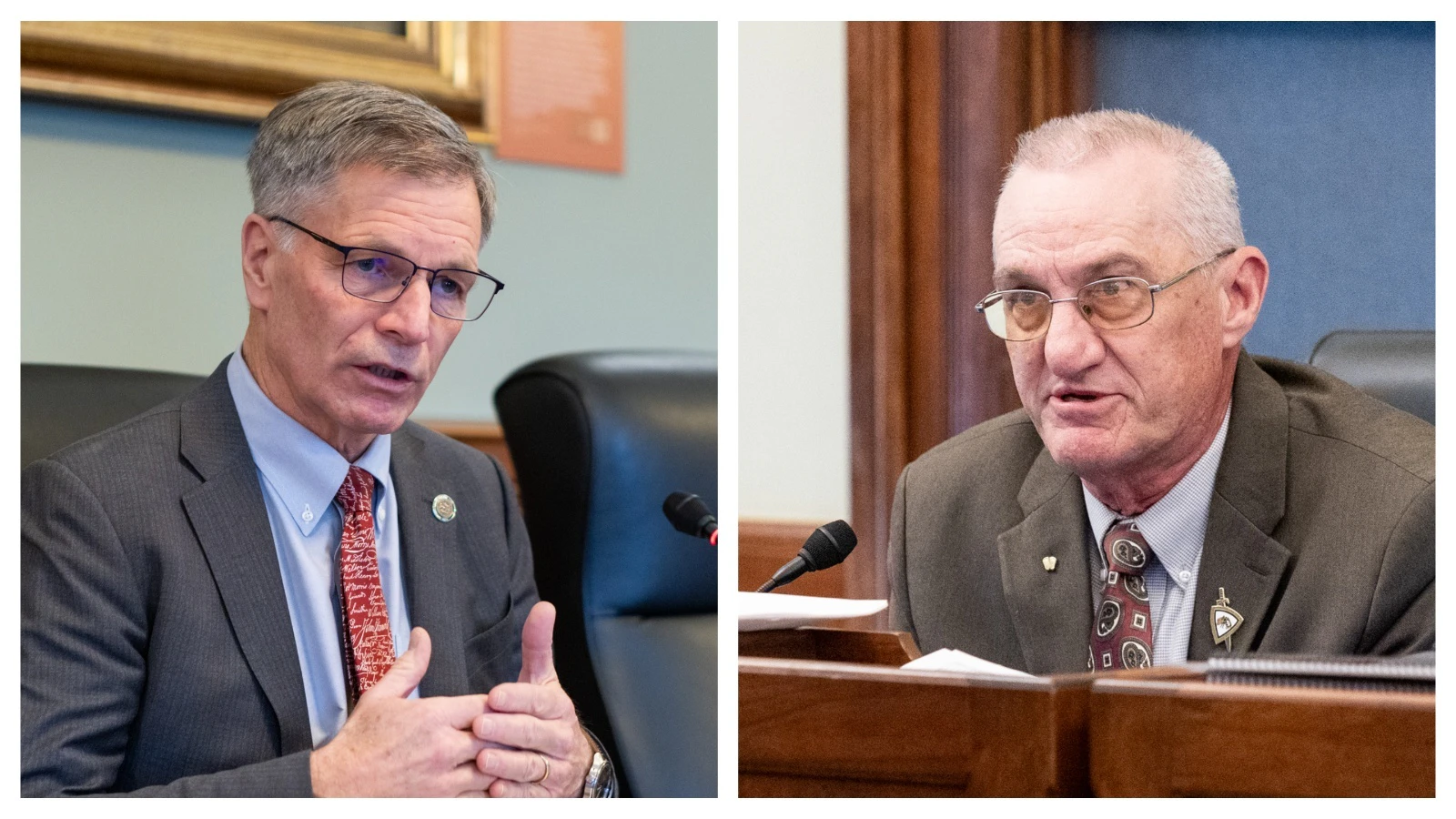
One of the state Legislature’s budget hawks, Rep. Ken Pendergraft, R-Sheridan, questioned Wednesday how the maneuver fits with Gordon’s repeated insistence that the legislative branch should not cross into the executive branch’s lane.
Gordon hinged multiple line-item vetoes in the state’s budget this year on assertions they violated the separation of powers.
“It’s funny how somebody who’s so staunch about, ‘Stay in your lane’ – and when you read his budget vetoes you’re infringing on the right of this branch or that branch… and he sure doesn’t mind going the other direction,” said Pendergraft in a Wednesday phone interview.
Pendergraft is a member of the legislative Joint Appropriations Committee, which attempted in January to trim Gordon’s $10 billion biennial budget request by about $480 million. But after the full Legislature grappled with the budget, it ended $143 million under Gordon’s draft.
Rejection
While the House debated the measure at length, the Legislature ultimately did not budget for the SUN Bucks program.
Gordon voiced displeasure at that repeatedly: he’d urged the Legislature to adopt the program during his Feb. 9 State of the State address; he’d lamented its refusal in a press conference after the budget was finalized.
And he reiterated that Wednesday in his statement.
The executive order says that one in five Wyoming children face food insecurity and endure even more restricted food access in summer months. It directs Schmidt “immediately” to start a planning phase to design the program with a robust outreach strategy across all 23 counties – “with particular attention to rural and remote populations.”
It calls for using the electronic benefits transfer (EBT) structure, and ensuring people can only buy “eligible” foods with those cards.
Gordon late last year applied for a SNAP “waiver” so that Wyoming doesn’t have to fund junk foods with the welfare program.
The Wednesday executive order calls for the state Department of Family Services (DFS) to coordinate with the Department of Education and “other partners to leverage existing infrastructure and programming” to deploy the summer foods. And it says DFS “shall” ensure the program is ready to run by June.
The order is in place “until amended or repealed,” it says.
DFS public information officer Kelly Douglas told Cowboy State Daily in a Thursday email that the agency hopes to keep the program below the $1.8 million in state funds for which it asked lawmakers in December.
The federal government is still expected to match what the state spends, she added.
“We are just beginning to work through the details of the new SUN Bucks program and will share more information as it becomes available,” she said, adding that the program will help children who qualify for SNAP and Temporary Assistance for Needy Families benefits, as well as those who qualify for free and reduced school lunches.
Families would receive a one-time payment of $120 to a prepaid card similar to a SNAP electronics benefits card.
The agency would have to ask for a special funding authorization to make the program work, she said.
Pendergraft said he hadn’t seen a request for a special funding authorization as of Wednesday.
‘So Sad’
To Pendergraft, the real heartache is seeing people become dependent on the services of an ever-changing government, he said.
“Stay in your lane, governor,” said Pendergraft. “You’re creating a problem here, because once you start handing out the money to the people – then what choice has the Legislature?”
He added that all federal programs “come with strings (attached).”
Pendergraft had urged many of the proposed budget reductions and cuts the Appropriations Committee sought in January, alongside House Appropriations Chair John Bear, R-Gillette, and other members.
Bear did not respond by Thursday to a Wednesday voicemail request for comment.
Pendergraft told Cowboy State Daily that as he’s heard budget requests, particularly from tribal leaders in Wyoming who cast their people’s plight as dependent on Medicaid, it saddened him to see government dependency.
“Now, there’s a safety net we’ve put out there that should arguably remain,” said Pendergraft, in reference to the preexisting programs. “But it keeps expanding, and expanding.”
He cast this as a vicious cycle breeding more dependence, and more expense to the public.
“I’m so saddened that these people feel like if they don’t get government money, they’ll die,” he said. “That’s not America.”
Gordon’s spokeswoman Amy Edmonds declined Thursday to respond to Pendergraft’s statements about the separation of powers.
Back Up
The federal government authorized multiple pilot program iterations of the SUN Bucks program starting in 2011.
U.S. Sens. John Boozman, R-Arkansas, and Debbie Stabenow, D-Michigan, championed a provision to make the program permanent in the 2023 Consolidated Appropriations Act, allowing states to provide families an additional $40 per month, per eligible child, for three months of summer, says an informational page by the National Governors Association.
The Biden Administration launched the program in 2024, and Wyoming did not join it that year.
In 2025, Wyoming state Reps. Lloyd Larsen, R-Lander, and Ken Chestek, D-Laramie, cosponsored a bill to implement the program in the Cowboy State.
At that time, it was slated to cost about $2.3 million: $1.14 million from the state’s checking account, called the general fund, and $1.14 million from the federal government.
The state House of Representatives rejected the bill after its first floor debate in a 25-24 vote with three members marked excused from the vote.
Later that year, the governor decided to pitch the program through his November biennial budget proposal, as an allocation for the state Department of Family Services (DFS) which would administer the program.
The price tag had gone up by then, to $1.77 million from the state’s checking account and $1.77 million from the federal government.
DFS’s budget pitch says the Summer Electronics Benefit Transfer program would provide grocery benefits to eligible school-aged children during summer months when school meals are not available, and that $1.6 million of the total figure would be a one-time startup expense, primarily to start the eligibility IT system.
The remaining $1.93 million would fund a full-time program manager, administrative costs, and IT – and that request would be “ongoing” after the new budget’s life expired.
DFS Director Korin Schmidt confirmed in a Dec. 12 meeting with the Joint Appropriations Committee that this program would see “some overlap” with the SNAP program, by which lower-income families already have electronic benefit cards, and with the federally funded Summer Food Service program the Wyoming Department of Education administers.
Schmidt said the Summer Food Service program operates in all of Wyoming’s 23 counties except five - Crook, Weston, Lincoln, Hot Springs, and Johnson — which are among Wyoming’s smaller counties population-wise.
“Did we not subsidize summer lunches in the past?” asked Senate Appropriations Chair Tim Salazar, R-Riverton.
In Riverton, a summer food truck visits various locations during the summer.
Schmidt emphasized that the Department of Education program to which Salazar was referring was a “food site” that children would have to visit personally.
Rep. Trey Sherwood, D-Laramie, said not all families can get their children to those sites at the scheduled times.
Sen. Dan Laursen, R-Powell, said that preexisting food program seems to be “working very well” in his community already.
Rep. Jeremy Haroldson, R-Wheatland, voiced trepidation about the overlaps.
“I don’t want there to be a gap, but I also want to know how those (programs) marry together,” he said.
Schmidt said that while there’s some overlap between SNAP and the free and reduced lunch program, there may be “less stigma attached” to receiving free and reduced lunch.
Both programs involve food voucher cards.
Clair McFarland can be reached at clair@cowboystatedaily.com.


