
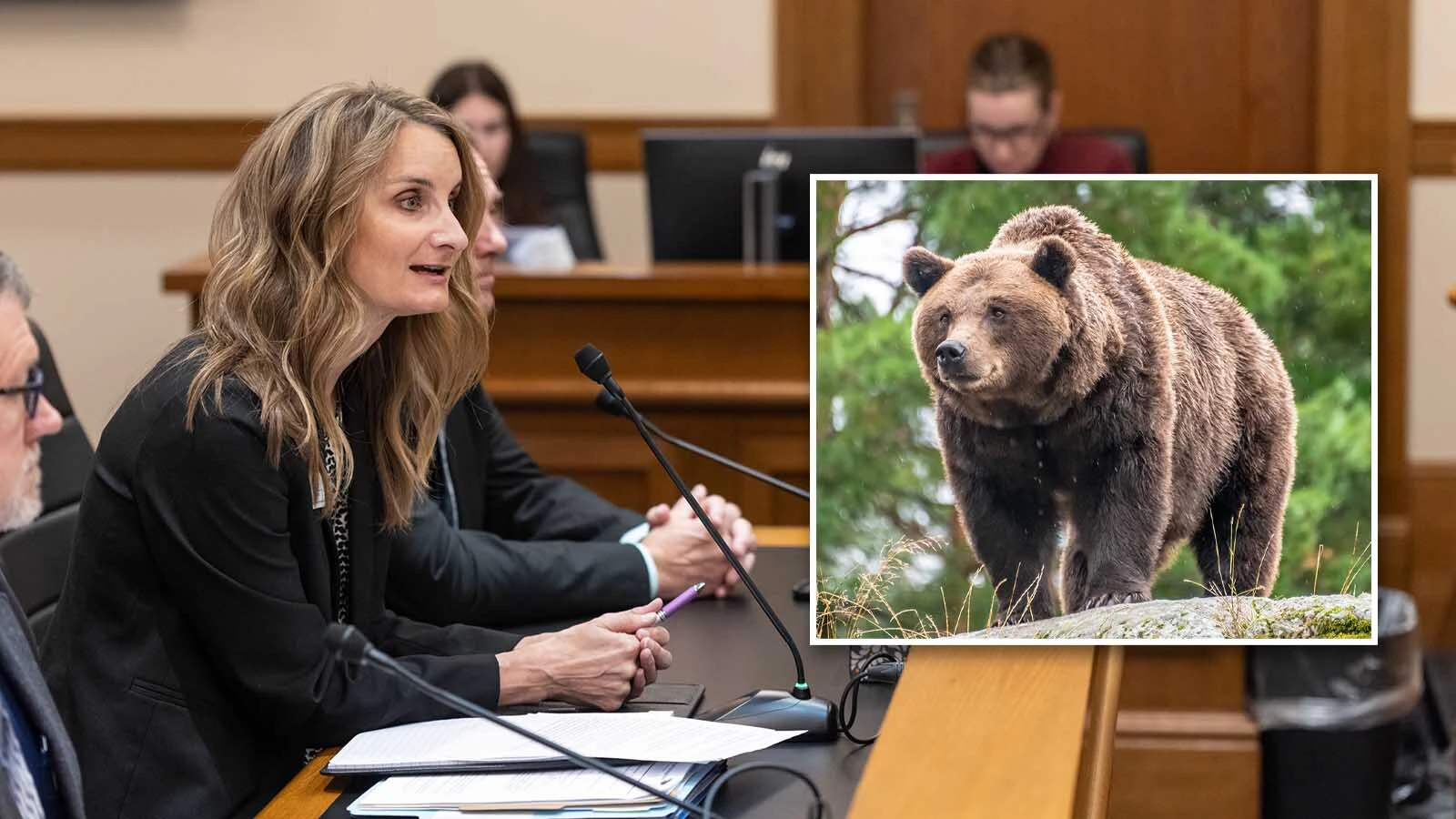
Wildlife agents are killing just as many — if not more — grizzly bears every year because of human-bear conflicts than hunters would if there were grizzly hunting seasons, Wyoming Game and Fish Department Director Angi Bruce told lawmakers.
An average of 21 “conflict” bears are killed in Wyoming every year, whereas 20 grizzly tags might be issued for a “conservative” Wyoming hunting season, Bruce said Wednesday.
She made those remarks before the Legislature’s Joint Travel, Recreation, Wildlife and Cultural Resources Committee, which is meeting in Casper.
Bruce has been an outspoken advocate for delisting grizzlies in the Lower 48 from federal Endangered Species Act (ESA) protection.
So has her predecessor, former Game and Fish Director Brian Nesvik, who is now director of the U.S. Fish and Wildlife Service (FWS).
Bruce told the committee that she regards grizzly hunting as a vital “management tool” that her department is now denied.
That is “allowing these bears to be more comfortable in the ecosystem and spreading outside the ecosystem than they would be if we had a hunting season,” Bruce said.
‘Be Patient’
While giving the committee an update on Game and Fish, Bruce mentioned efforts to delist grizzlies, which started a discussion on the matter.
Grizzly delisting involves federal policy, so the committee took no action.
There’s an ongoing, two-pronged approach to get grizzlies in the Lower 48 delisted, Bruce said. She didn’t mention a time frame for when it might happen.
There are efforts to take an “administrative” approach through FWS, as well as a legislative approach, through bills pending before the U.S. Congress.
Last year, Wyoming Republican Rep. Harriet Hageman introduced H.R. 281, the Grizzly Bear State Management Act, and Republican Sen. Cynthia Lummis introduced a mirror bill.
On the administrative side, Bruce said the goal is to come up with a “durable” delisting plan that will “last through the court system.”
Previous grizzly delistings, most recently in 2017, were overturned by federal judges.
“We are working very closely with our Fish and Wildlife Service partners in the effort to delist the grizzly bear,” Bruce told the committee. "I will tell you and ask you to be patient, because these things take time.
“You won’t see anything publicly-facing on this until later in the year. But just know that it is a continuous work in progress."
Just One Judge
Committee member Sen. Brian Boner, R-Douglas, remarked that “all it takes is one judge to undo all of that effort.”
“How easy is it for a different (presidential) administration to just come in and wipe it away on Day One?” Boner asked Bruce.
Bruce said the goal is to craft a delisting plan that is built “on science,” but noted that an administrative delisting could be overturned.
“That’s why we’re not letting off the gas when it comes to the legislative fix — a congressional action to delist them,” she said.
‘Mother May I?’
Game and Fish is already essentially managing grizzlies in Wyoming, and spending about $2 million a year doing so, Bruce said.
However, with ESA protection still in place for grizzlies, federal authorities have the final say, she said.
“We still have to go to the Fish and Wildlife Service and ask ‘mother may I?’ beforehand,” Bruce said.
Committee member Rep. Robert Wharff, R-Evanston, asked Bruce when Wyoming’s grizzly population reached objective numbers.
“Over 20 years ago,” Bruce responded.
Roadless Protection
If the goal is to kill fewer grizzlies, hunting might be the better option, Wharff said.
“People need to understand that grizzly bears are dying even under federal protection, they are being removed rather than using sportsmen to hunt those bears,” he said.
“The agency is put in a pretty tenuous position. They don’t want to be killing grizzly bears, but that’s one of the realities,” Wharff added.
Richard Garrett, government affairs advisor for the Greater Yellowstone Coalition (GYC), told the committee that the GYC is willing to keep talking about a “durable and sustainable” plan to delist grizzlies.
Meanwhile, GYC is worried about that rescinding the Roadless Rule on national forests could affect grizzlies, he said.
Roadless areas reduce human-bear conflict, Garrett said.
“We’re seeing a lot of human activities on roadways right now,” he said. "Because grizzlies are very active and applications on cellphones are very active too."
Would Hunting Make A Difference?
Calls to delist grizzlies surged again after recent bear attacks in Yellowstone and Glacier national parks, and in Idaho.
In Yellowstone, two brothers were severely hurt when a grizzly mauled them, and a grizzly is thought to have killed a hiker in Glacier.
In Idaho, a black bear hunter shot and killed a grizzly that charged him and his son. Wildlife agents ruled that the shooting was legitimate self-defense.
Grizzlies may be hunted in Alaska and parts of Canada. Those in the Lower 48 haven’t been hunted since they were put under ESA protection in 1975.
Whether hunting grizzlies makes them more fearful of humans and mitigates human-bear conflicts is debated among biologists and bear conservation advocates.
Some claim that it’s effective, others argue that it makes no difference.
Mark Heinz can be reached at mark@cowboystatedaily.com.


