

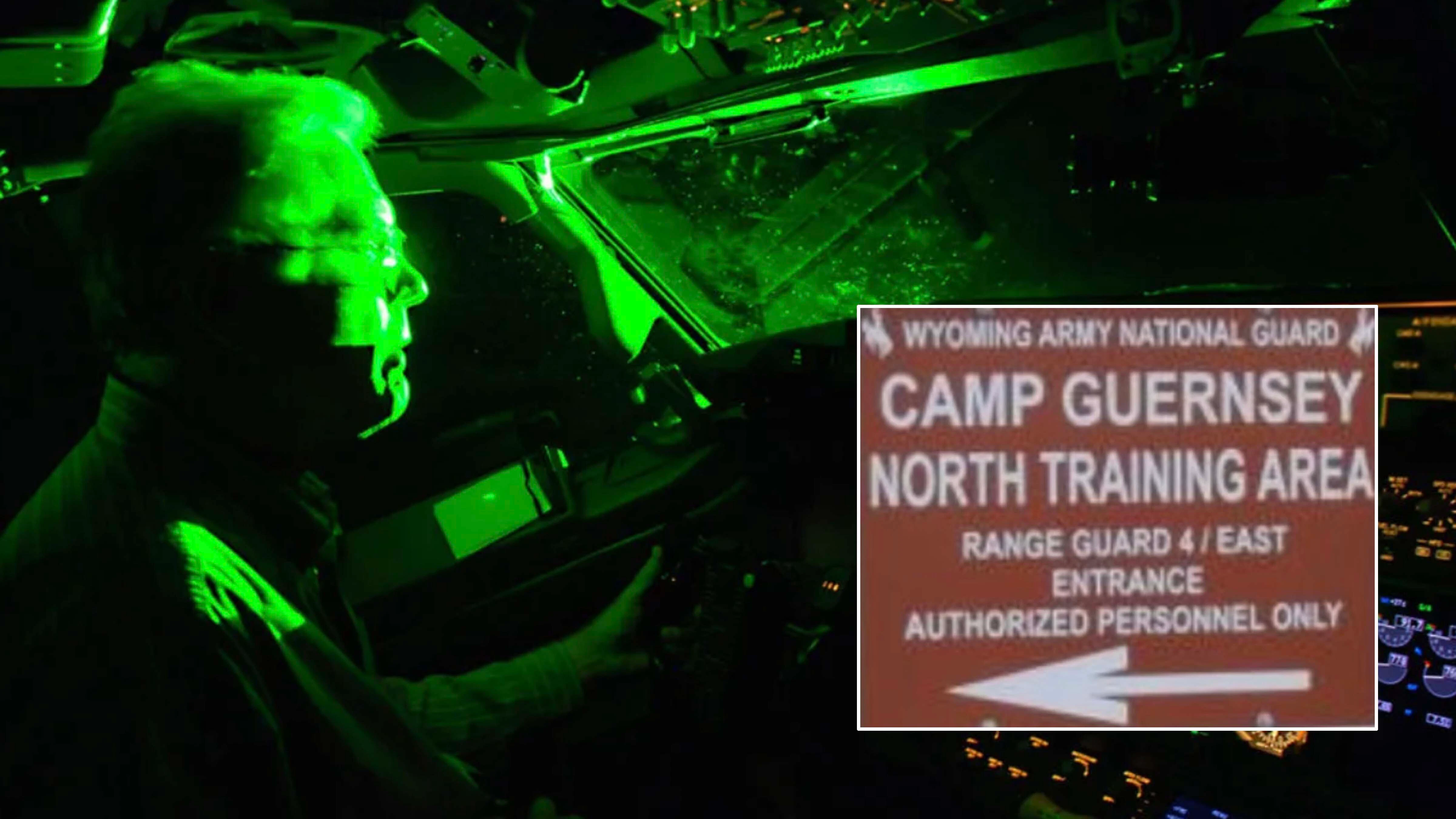
The Wyoming Army National Guard issued a public alert this week after what it described as a recent increase in dangerous laser pointing incidents involving military aircraft operating in the vicinity of Camp Guernsey Training Center.
Two incidents have been reported in the Camp Guernsey area since January, and three since March 2025, according to the Guard.
Each involved someone on the ground "directing high-powered lasers" at aircraft during flight operations.
"The safety of our pilots and the residents of Platte County is our paramount concern," Lt. Col. La'Quendin Counts, Camp Guernsey's base operations manager, said in the alert.
"Pointing a laser at an aircraft is not a harmless prank — it is a reckless, illegal act that creates a severe risk of a catastrophic accident,” he added.
Aiming a laser at an aircraft is a federal offense punishable by up to five years in federal prison, fines up to $250,000, and additional state or local charges, the Guard noted.
The Guernsey cluster is a small slice of a much larger problem.
Pilots have reported nearly 150,000 laser strikes worldwide since record-keeping began in 2004.
The man who has been tracking the issue from the beginning got his start writing software for the kind of laser shows that first put bright beams in the skies above the Vegas Strip.
Good Neighbor
From his office Wednesday in Orlando, Florida, Patrick Murphy told Cowboy State Daily that a cluster of strikes around a single military training facility is unusual.
While laser strikes are common, they aren't "specifically at military training facilities," said Murphy, who runs the website LaserPointerSafety.com.
"I think people are just aiming at aircraft and helicopters in general, and if they happen to be military helicopters, they happen to be military helicopters," he told Cowboy State Daily.
He remembered only one rough parallel.
"I recall a case in England, maybe 10 or 15 years ago, where there was a military facility and somebody was deliberately aiming at the aircraft," Murphy said. "But again, it was more noise.
"It wasn't like, 'I don't like the military,' or 'I'm, you know, a terrorist trying to bring anybody down.'"
His path into the issue started on the entertainment side of the laser business.
"My background is in doing laser light shows," Murphy said. "I'm the executive director of the International Laser Display Association, which is people who do laser light shows like you might have seen during the Paris Olympics, Super Bowl events, concerts, things like that."
The aviation question, Murphy said, came out of Las Vegas in the 1990s when the airport's proximity to the casinos started causing problems.
"There were a few lasers that were close to the airport," Murphy said. "I believe they were from the Luxor, one of the shows or displays."
The displays had cleared the relevant federal reviews at the time, he said, because regulators were focused on whether the beams could damage a pilot's eyesight.
The cockpit-distraction risk hadn't yet registered.
"Nobody was thinking, ‘Hey, these things are really bright,' and it's the last thing that you want in a pilot's eyes as they're coming in on approach to the airport in Las Vegas," Murphy said.
Clark County eventually shut the displays down, and an industry-government working group wrote new outdoor laser rules.
The system held until cheap handheld laser pointers reached the consumer market around 2004, Murphy said.
"People started aiming at aircraft for various reasons," Murphy said. "And so I've been trying to work to tamp that down, with little success, over the succeeding years."
Two Types
In Murphy's experience, the people doing the lasing fall into two camps.
"There's people who are just ordinary persons like you or me, and maybe they get a hold of a laser and they think it's kind of cool," Murphy said. "They don't really know about the hazards and they're not really trying to cause trouble."
The second group is the one that draws prosecutions.
"The other is antisocial people, criminals or just people who have a grudge, and they are deliberately targeting the aircraft for whatever reason, not necessarily to bring it down or anything, but just, you know, like I'm going to stick it to the man," Murphy said.
Those offenders tend to give themselves away, he added.
"When they get caught, it's so easy to catch them, because the laser beam is like a beacon that points right back down to their location, and especially if they're hitting a helicopter, something that can hover," Murphy said.
"Usually they're doing something else illegal, drugs, probation violations and things like that. And they get caught and often go to jail,” he said.
To illustrate the consequences, Murphy read aloud from a letter posted on his website by a California man convicted of a single count of aiming a laser pointer at an aircraft.
The man was sentenced to 24 months in prison and 34 months of supervised release, paid a $10,000 special assessment, and wrote that he lost "my girlfriend, my dog, my home, my vehicle — everything I owned for shining a laser at a helicopter for three seconds."
Catching Culprits
Even with stiff penalties on the books, most offenders never face them.
In 2017, researchers at MIT Lincoln Laboratory — who were developing a ground-based detection system called the Laser Aircraft Strike Suppression Optical System (LASSO) — estimated that less than 1% of laser strike perpetrators are ever caught.
The system uses high-sensitivity cameras to capture light scattered by the beam in midair, then traces the streak back to its point of origin.
Within 30 seconds, LASSOS can deliver GPS coordinates and the nearest address to local law enforcement.
"This technology will significantly increase laser strike origin detection and perpetrator apprehension," reported Brian Saar, principal investigator on the LASSOS team. "As culprits are readily apprehended and prosecuted, the appeal of laser strikes as a crime with low risk of detection will decline."
No Disasters
The Guard's statement about the recent Wyoming incidents warns that laser strikes can temporarily blind or disorient pilots.
"There's practically no possibility of actually harming a pilot's eyes permanently," Murphy said. "What we all are worried about, though, is temporary flash blindness, the same as from a camera flash."
That assessment lines up with a 2015 study in the "Canadian Journal of Ophthalmology," which reviewed 64 laser strikes involving 61 commercial pilots and found no definite cases of ocular damage — only immediate glare, flash blindness and ocular irritation.
Even with nearly 150,000 reported strikes worldwide since 2004, no aircraft has gone down because of one.
"There's never been a case of an accident or a crash or anything like that," Murphy said. "A few aborted landings or go-arounds where they had to come in and then not land, but try it again."
The Federal Aviation Administration logged 12,840 laser strikes in 2024 and 10,993 in 2025, with 2,210 already reported in 2026.
Wyoming does not crack the FAA's top 10, but the state is not exempt: laser strikes were reported in Casper and Cheyenne in 2024.
"I've never seen anything like this," Tim Bradshaw, Cheyenne's director of aviation, told Cowboy State Daily in March 2024. "Blinding a pilot with a laser could cause a crash."
Kalispell Case
A federal case in Kalispell, Montana, last year showed how Murphy's second category of offender ends up in court.
Flight instructor Madisyn Garcia, working for Red Eagle Aviation, had been hit several times by a green laser while training student pilots in a Cessna 172.
On Nov. 25, 2023, she spotted the beam shooting from a white pickup truck and called 911 from the air, guiding deputies to the driver.
Nolan Wayne Hamman, 32, pleaded guilty to knowingly aiming a laser pointer at an aircraft and was sentenced in February 2025 to 2.5 years in federal prison.
Court documents show Hamman told investigators his methamphetamine use made him "paranoid" and that he believed low-flying aircraft were tracking him.
Federal prosecutors wrote that Hamman "engaged in this behavior not out of a benign curiosity, but because he was determined to combat law enforcement's efforts to track him."
His paranoia about being followed by aircraft, in the words of court documents, became a self-fulfilling prophecy when Garcia spotted his pickup from the air and led deputies to his door.
The Guard is working with the Platte County Sheriff's Office and Platte County Commissioners on the Guernsey investigations.
People are asked to report suspected laser activity to the Platte County Sheriff's Office at 307-322-2331 or the Guernsey Police Department at 307-836-2111.
David Madison can be reached at david@cowboystatedaily.com.


