
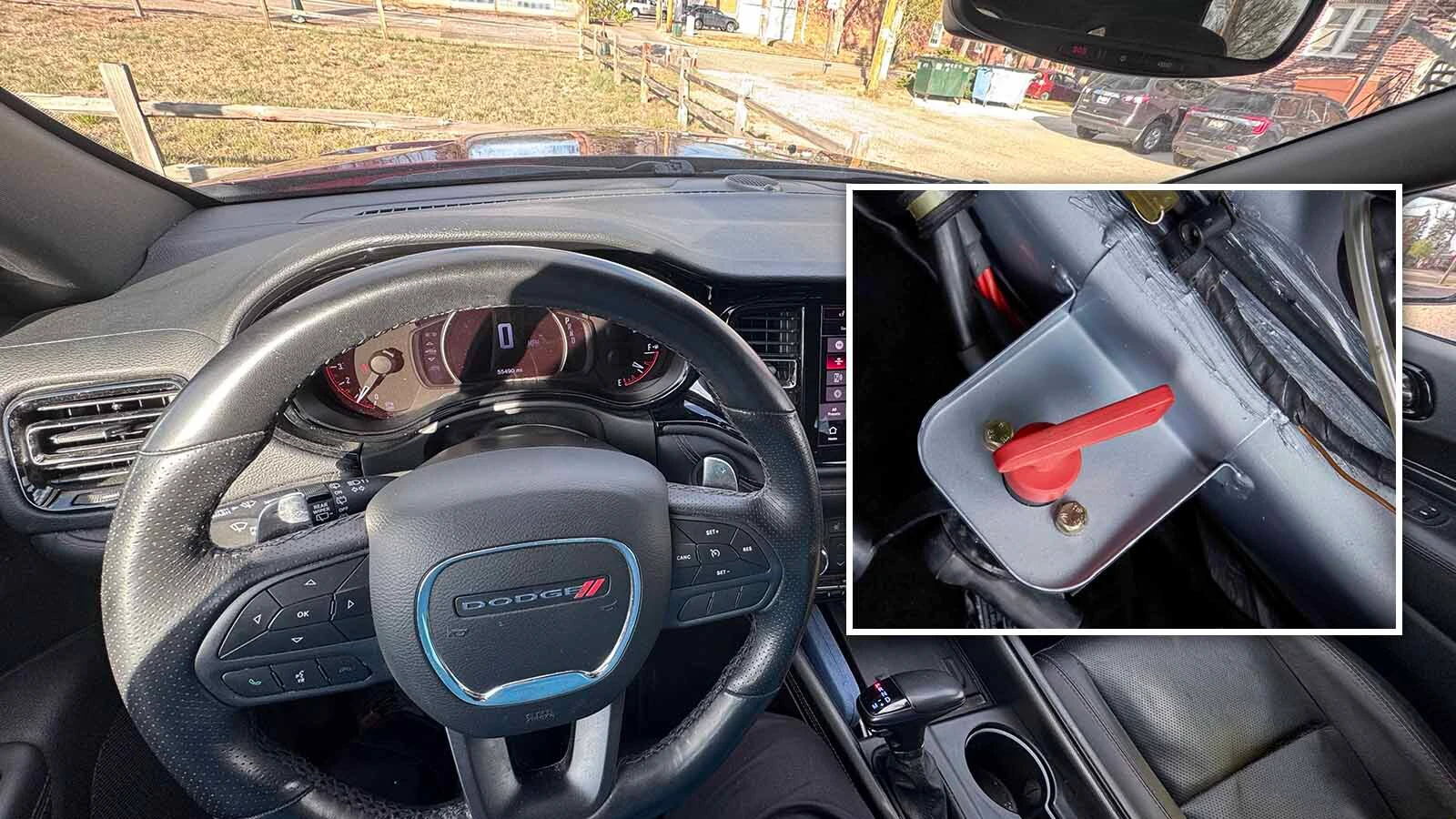
Multiple Wyoming lawmakers and a Cheyenne-based car dealer voiced concern Friday over a federal requirement for new surveillance technology in 2027 model vehicles.
The systems will feature what critics call “kill switch” technology that will monitor driver behavior, detect driver impairment and intervene.
The provision requires the installation of "advanced drunk and impaired driving prevention technology" which can "passively monitor the performance of a driver… to accurately identify whether that driver may be impaired" and "prevent or limit motor vehicle operation if an impairment is detected.”
The requirement passed in the 2021 Infrastructure Investment and Jobs Act, but it’s about to become a reality as 2027 model year vehicles trickle into the market starting this year.
“Big government is getting involved in about everything there is,” said Brian Tyrrell, owner at Tyrrell Chevrolet in Cheyenne. “It’s Big Brother.”
Tyrrell said he believes the mandate will boost used car sales.
Impaired driving is a “terrible thing,” he said, “but having Big Brother oversee and think they can dictate human nature is never going to be a positive thing.”
The 2027-year models haven’t hit his dealership yet, but they will soon, Tyrrell said.
Tyrrell also voiced doubts about how reliable the technology will be.
‘Draconian'
Rep. Daniel Singh, R-Cheyenne, who chairs the Select Committee on Blockchain Financial Technology and Digital Technology, sounded audibly troubled at the mandate, in his Friday interview.
He confirmed that the topic is exploding into headlines now because the new model cars are imminent. He expects a consumer shift toward older cars.
"It will be like having a car with a built-in breathalyzer even though you've never gotten a DUI," said Singh. "Just another example of the government coming up with rules in the name of public safety in order to really implement draconian technology."
He said if there's any hope, it's that members of Congress could somehow work together and reverse this provision. And he hinted that the provision's most vocal critic, Rep. Thomas Massie, R-Kentucky, may suffer losses due to unpopularity on Capitol Hill.
"I would expect it in the state Legislature, I would expect it in Congress: that if there's something important to the people, it shouldn't matter who the main sponsor is," said Singh.
He praised the work of Wyoming's Rep. Harriet Hageman, who has voted with Massie to curb the mandate - at least twice.
"I think people, really, they look at public safety, and public safety is the end," he said, in a sardonic tone. "And whatever we have to do to achieve public safety, they're willing to cross those lines to get it. including crossing the line of respect for private property, individual autonomy. And this is just an example of that."
Always leveraging technology against people plugs the American citizen into a "system" in which he's easily maintained and controlled, said Singh.
'Troubling'
Rep. Landon Brown, R-Cheyenne, who chairs the House Transportation, Highway and Military Affairs Committee, called the mandate "troubling."
He said he can see the upside of it, but notes that self-driving cars and emergency-stop provisions wired to backup cameras still have flaws.
When he backs out of his driveway too quickly his car gives a “jarring” brake because it thinks he’s about to hit the pavement, said Brown.
He voiced concerns that in micromanaging the vehicle to avoid hazards, the systems could create altogether new hazards.
Rep. Mike Yin, D-Jackson, told Cowboy State Daily on Friday that he hadn’t learned much about the provision, but it sounds “a little silly” to make everyone pay potentially more money for technology that only addresses the behavior of a very few people.
Yin serves on the Legislature’s Select Committee on Blockchain, Financial Technology and Digital Innovation Technology.
The mandate also raises privacy and big government concerns, said Yin.
“Moreover, this is the state government’s role and not the federal government’s role (to decide such matters),” said Yin, who has characterized himself as a Democrat with Libertarian roots.
He noted that Republicans control all branches of federal government right now, and said it’s worth asking whether federal delegates plan to reverse this measure.
What She Said
Hageman tried in 2023 to defund the “kill switch” mandate, at the time 210 Democrats and 19 Republicans voted the defunding effort down and to keep the mandate alive.
Hageman reiterated her dislike of the mandate again Friday, calling it an example of government overreach.
“This mandate raises more problems than solutions to the very real and serious issue of roadway tragedies,” said Hageman in a text sent via her communications director, Tristan Justice.
She voiced questions such as how the technology works, whether it could strand vehicle occupants and endanger them more by disabling their vehicle, and what might be the implications of the tech malfunctioning.
“Technology may have the potential to decrease the number of roadway fatalities which are far too high,” she said. “A federally-mandated kill switch that threatens to hijack the vehicles of private citizens is not the answer.”
Hageman in January voted for a Massie-sponsored amendment that sought once again to defund the mandate.
Fifty-seven House Republicans joined with 211 of 215 Democrats to kill the amendment, which ended with a tally of 164 in favor and 268 against.
U.S. Sen. John Barrasso had voted against the Biden-era infrastructure act in which the provision surfaced.
In a Friday statement, his communications director Laura Mengelkamp called the infrastructure bill “full of overreaching, left-wing provisions harmful to Wyoming.”
“The kill switch provision is just one of many concerning policies that were attached to this law,” added Mengelkamp. “No one wants to see impaired drivers on the road. Intrusive government mandates that take away the privacy of lawful Wyoming drivers are not the answer.”
Wyoming’s Republican U.S. Sen. Cynthia Lummis immediately respond to a Friday afternoon request for comment sent to her office via email.
It’s Coming Though
Sen. Stephan Pappas, R-Cheyenne, who chairs the Senate version of the Transportation, Highways and Military Affairs Committee, said he also hadn’t heard much about the provision. Now that it’s gaining traction in the media, he expects pushback from the usually independent-minded people of Wyoming.
State lawmakers in the past tried to put cameras and signs alerting people about the cameras in construction work zones to deter speeders, and the public wouldn’t go for that, said Pappas.
He raised concerns about whether the impairment surveillance technology could interfere with people who have other conditions, which a machine might mistake for impairment.
But Pappas was more resigned to the prospect.
“It’s a technology that, just like everything, there’s a pushback from everybody,” he said. “No one liked seat belts for a long time. … Probably (this) will be a technology that’ll come sooner than later.”
Colby Moore, general sales manager at the Casper outpost of Greiner Ford, was cautiously neutral on the topic.
“Yeah, we don’t have any 2027s yet, so we haven’t seen it yet,” said Moore. “As far as my opinion on it, this is what this business, and our world, is going to.”
He said most people seeking to buy a car prize safety features as a top priority, and the industry is always working to advance in that respect.
“Technology that keeps people in that vehicle more safe, I think is probably a benefit,” said Moore. “Will you get to a point of, ‘Hey, is it too much?' We’ll see. Because we haven’t experienced it yet.”
“Not one person” has come into the shop eager to buy a 2026 because the new mandate will affect 2027s, said Moore.
The industry also has been easing this way for a while, he noted.
Tyrrell had noted that too, referencing “active cruise control” or systems that adjust cruise control settings on their own and detect driver inattention.
Update - this story has been updated to include a comment from Sen. John Barrasso’s communications director which, due to technological reasons, did not reach the outlet by publication.
Clair McFarland can be reached at clair@cowboystatedaily.com.


