
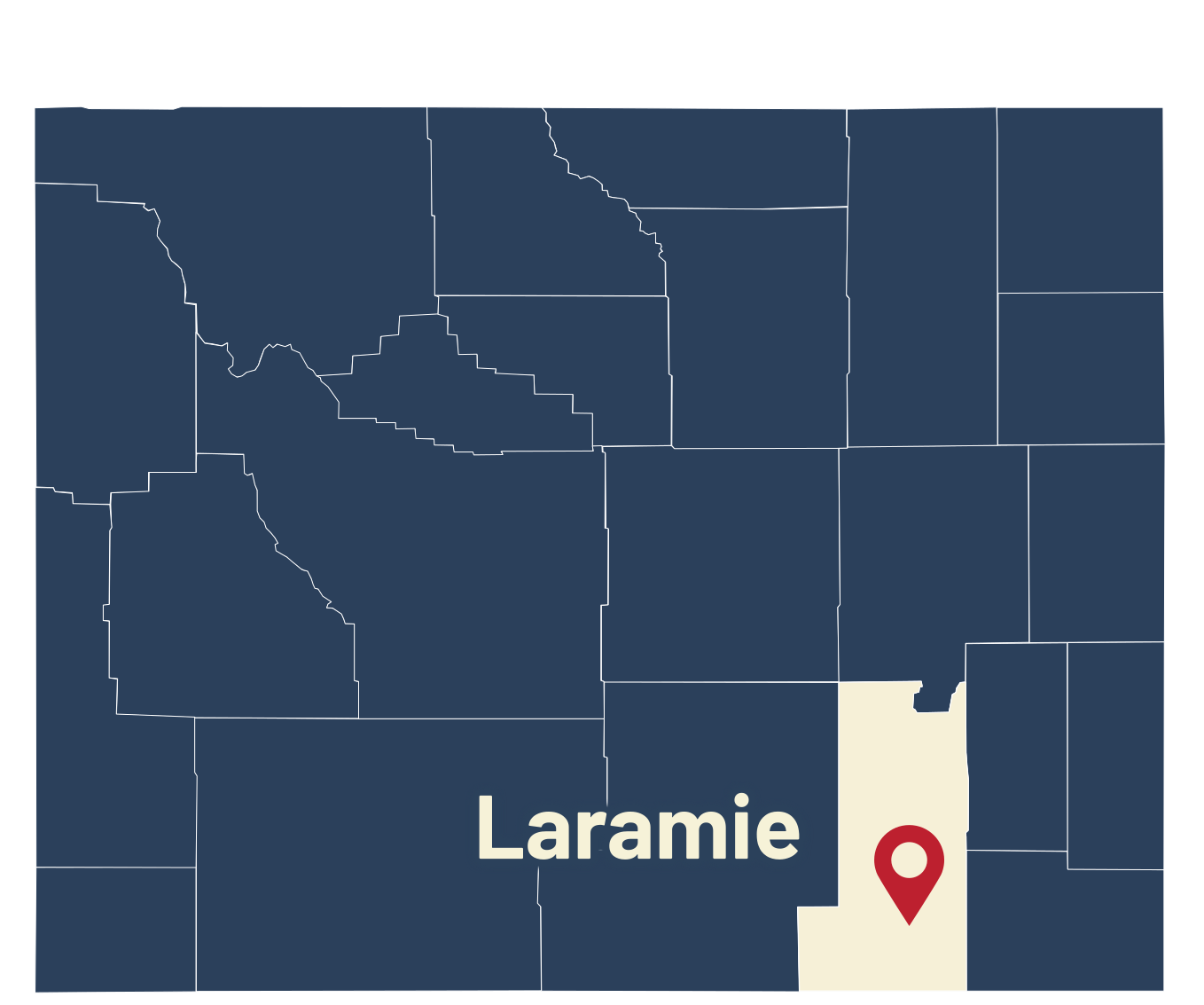

It was the summer of 1998, and a graduate student with a passion for college basketball was spending his days doing two things: playing hoops at Half Acre Gym and haunting the computer lab on the first floor of the engineering building at the University of Wyoming.
His name is Ken Pomeroy, and he'd come to Laramie to study meteorology — drawn, he's said, by the state's wild weather.
But between pickup games and his thesis work, something else was taking shape.
"I just always was interested in sports and math, and so I was always interested in kind of formulating some sort of rating system for various sports," Pomeroy told Cowboy State Daily. "I just had a lot of time on my hands and had free access to a computer lab, which I had really never had before."
The inspiration came from Jeff Sagarin, a prominent ratings guru who ranked all the major sports, but Sagarin already had the big leagues covered.
So, Pomeroy went small — very small.
"I was like, I'm going to test mine on Wyoming high school football because nobody's rating that and I had no preconceived notions about anything," he said.
Pomeroy's Wyoming prep football rankings lived on a website made possible by free university server space.
It was an experiment, a proof of concept.
Nobody knew it would become the foundation for a big-time data revolution of how the world understands college basketball.
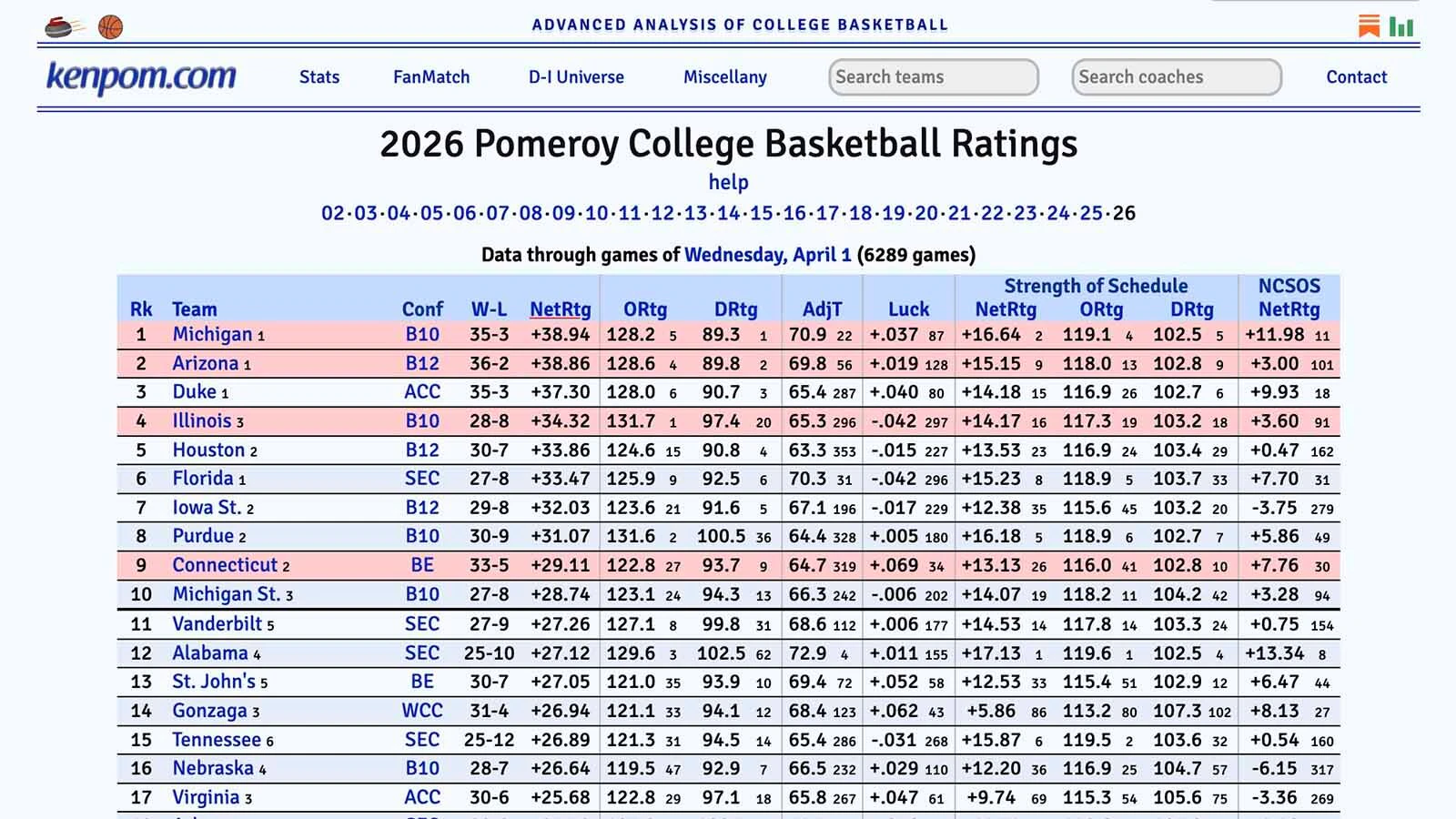
Now the world knows him as the man behind KenPom, considered one of the most accurate and reliable data metrics for ranking the sport.
Weather Training
After finishing his master's degree, Pomeroy went to work as a meteorologist for the National Weather Service, a career he would hold for 12 years.
But the forecasting discipline proved to be more than a day job, it rewired his brain for the work that would eventually make him famous.
"It helped a lot. It really shaped my thinking about making predictions," Pomeroy told former WyoSports reporter Josh Criswell in a 2022 interview. "As a meteorologist, you're constantly making predictions and seeing what happens.
"When you make a prediction about a game, somebody can get hurt or the refs can make a bad call, and you have an excuse for why a prediction didn't go well."
Weather offered no such cover.
"You don't have that excuse in weather. You just make a prediction and it happens, so it got me thinking about probabilities and the chances of things happening, and why unexpected things happen," he told Criswell. "That all helped me think about making sports predictions in a more intelligent way."
Around 2003 and working from his home in Salt Lake City, Pomeroy shifted his focus to men's college basketball. By 2004, he was developing the points-per-possession metrics that would become his signature contribution to the sport.
The insight was deceptively simple: teams that played at a fast pace scored a lot of points and gave up a lot of points, but that didn't mean they had a great offense and a bad defense. It just meant they were playing fast.
"Commentators would fall back on looking at points per game to evaluate teams, but really, points per possession is a better way to look at that," Pomeroy told Cowboy State Daily. "They're not looking at the most useful stats to kind of inform their judgments."

Turning Point
By the late 2000s, the site was generating hundreds of hits a day, and mainstream media had started to take notice. The real turning point came in 2010, during the national championship game between Butler and Duke.
"Brad Stevens was the coach of Butler, and he mentioned during the Final Four that the first thing he does after a game is go to my site to research their next opponent," Pomeroy said. "So it was kind of a big deal. And Coach K was the coach of Duke, and he had me on his radio show earlier in the season."
The New York Times ran a feature on Pomeroy during that Final Four weekend. Appearances on ESPN's SportsCenter followed.
The word-of-mouth snowball that had been rolling since those early days in the UW computer lab had finally become an avalanche.
"People always ask what the turning point was, and there really, it's just mostly word of mouth," he said. "But that was certainly one of the bigger moments in terms of getting my work out there to the public."
By 2012, demand was so intense that Pomeroy walked away from the National Weather Service for good.
The KenPom ratings, tracking all 353 Division I men's basketball programs with advanced statistics, had become his full-time occupation.
His work has since appeared in Sports Illustrated and The Athletic, and he has served as a consultant for the Utah Jazz.
What Pomeroy built is not what most fans think it is.
Unlike the Associated Press Poll, the KenPom system doesn't care about quality wins or team resumes. It cares about one thing: predicting what will happen next.
"My system is purely focused on making predictions," Pomeroy said in that 2022 interview, when the UW men's team faced off with Indiana and lost in the "First Four" round of March Madness. "It doesn't care about how many quality wins you have. It cares about things like scoring margin and things that are important in making predictions going forward."
That distinction drives some fans crazy.

Loyal Customers
Most of his subscribers are fans, regular people willing to pay for a deeper understanding of their team and the sport.
Media members and coaches make up a significant slice, and the gambling world has taken notice too, especially as sports betting has exploded onto mobile phones through platforms like FanDuel.
"In order to make a living at this, I need a lot of fans to help me," Pomeroy said. "I don't know how many of those fans are involved in gambling, but the vast majority are just regular fans who are just kind of interested in a deeper dive into their team or other teams."
Kory Barnett, an assistant coach at West Virginia University, has called Pomeroy a "genius," telling Sports Illustrated that "a lot" of game planning is prepared off KenPom data.
Criswell, the former WyoSports reporter, bought a subscription for about $30 a year while covering UW hoops.
It was actually a college coach at one of his prior reporting stops who first turned him on to the service, he said, because the coach kept referencing statistics that Criswell traced back to KenPom.
When the Cowboys drew Indiana in the 2022 NCAA Tournament, Criswell said the matchup tool became essential.
"For every single matchup, it'll do a compare and contrast with the team," Criswell told Cowboy State Daily. "It'll show where Wyoming's really strong versus where Indiana is really strong, and it kind of shows you how their strengths and weaknesses match up against each other."
That meant a reporter covering a Mountain West team could quickly identify compelling storylines against an unfamiliar Big Ten opponent — whether it was a clash between Indiana's 3-point shooting and Wyoming's perimeter defense, or how each team's bigs matched up inside.
"Once you're in Mountain West play, you're relatively on a fairly equal playing field in terms of the opponents you're playing," Criswell said. "But in non-conference and postseason, the way that they weight those analytics — if you're beating up on really bad teams, it may not really improve your rating as much.
"If you lose by two to a really good team, it really helps you get a feel for where the team you're covering actually stacks up in the big scheme of things."
Coaches, meanwhile, are mining KenPom for transfer portal-era recruiting intelligence.
The site provides advanced analytics on individual players like usage rates, true shooting percentages, offensive and defensive rebounding numbers — metrics that carry more weight than a simple points-per-game line on a stat sheet.
"That's things that a college coach might put more weight into than simply looking at a player's points per game," Criswell said.
It's “Moneyball” for basketball, and for a program like Wyoming operating with limited resources, it can be the difference between a smart pickup and a wasted scholarship.
Wicks Connection
There's a detail from that foundational summer in Laramie that still makes Pomeroy shake his head.
When he started crunching the numbers on Wyoming high school football in the fall of 1998, one name kept emerging from the data — a standout wide receiver from Gillette who was the state's player of the year.
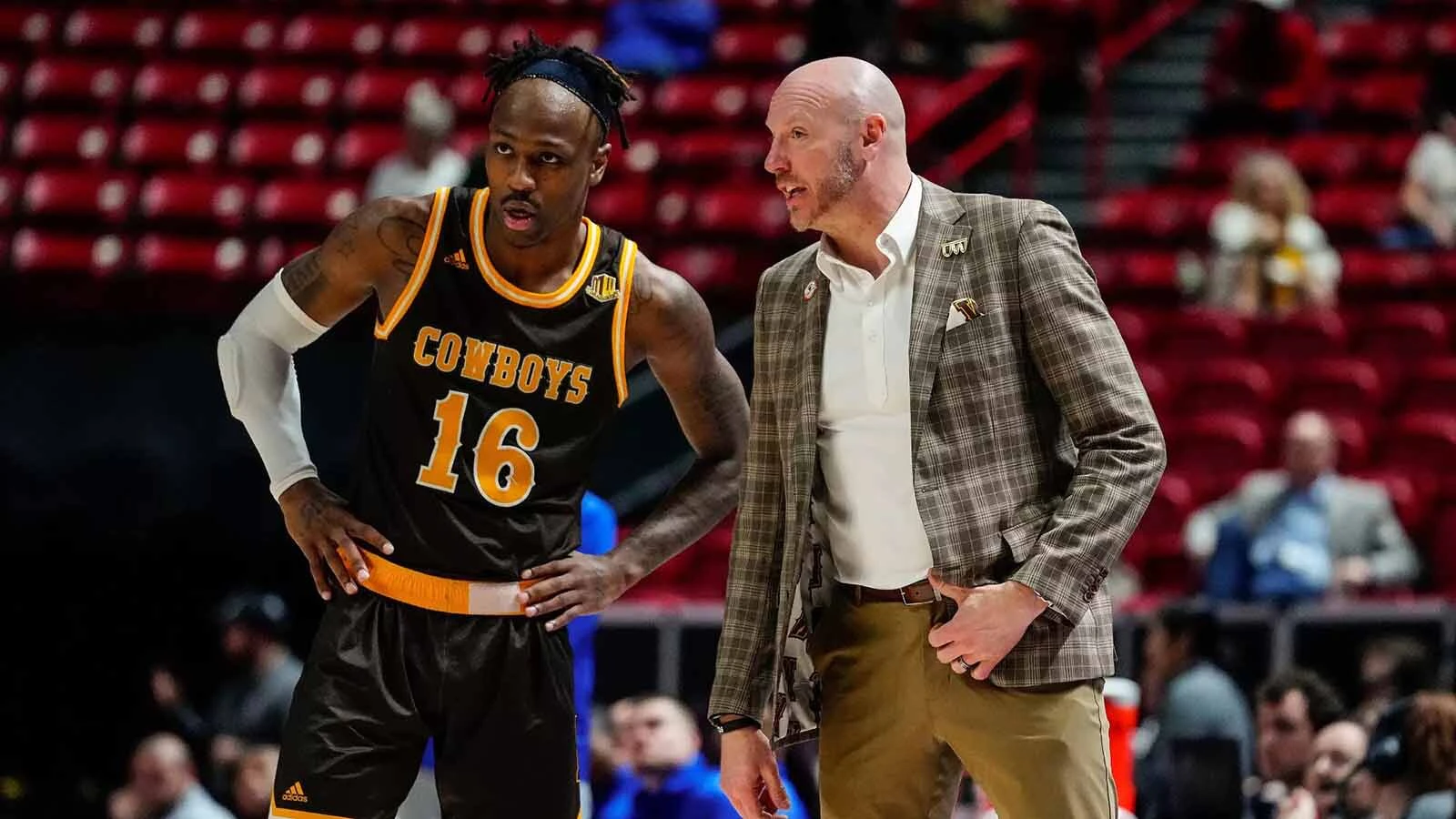
"I'm pretty sure the player of the year was Sundance Wicks," Pomeroy said of the current UW head basketball coach. "Kind of funny how it all comes around full-circle."
Years later, Pomeroy watched that same name rise through the basketball coaching ranks, land an assistant position at Wyoming and eventually take over.
Asked to evaluate Wicks as a coach, Pomeroy pointed to a metric he calls the coaching parameter, a measure of how coaches perform relative to what the algorithm expects based on their roster.
"I believe he was the highest rated second-year head coach going into his third year," Pomeroy said. "The standard doesn't have to be as high at Wyoming as long as you have Sundance Wicks there.
"It certainly seems like he's going to get more out of the talent than the average coach would."
As for the Cowboys' future in a reshuffled Mountain West, Pomeroy offered a measured but encouraging assessment.
"I think heading into the new league, they're gonna be competitive with the top teams in the league, so there certainly should be some excitement there," he said. "Might be a little bit easier to get a tournament bid in the new league."
Friendly Critics
Not everyone embraces the analytics revolution.
Criswell noted that backlash tends to come from fans of mid-major and low-major programs who feel their schools are being disrespected and not realizing the ratings are generated by an algorithm, not a human grudge.
"I did always get a kick out of people kind of getting this notion that KenPom hates your team, when in reality it's probably the computer that doesn't like your team," Criswell said.
Limitations exist as well.
The system doesn't account for injuries, a point critics have noted when a star player goes down and the ratings don't immediately reflect the loss.
And there remains a frontier Pomeroy would love to explore: the economics of the transfer portal era.
"Putting the proper value on players and finding guys who might be undervalued and are maybe worth pursuing — especially for a program like Wyoming that might have limited resources — that would be right up my alley," Pomeroy said. "But getting that data would be the challenge."
Until name, image, and likeness money and revenue share compensation becomes as transparent as NBA salaries, that analysis will remain out of reach.
This time of year as fans are focused on the Final Four — tipoff is Saturday in Indianapolis — many are surprised to learn that Pomeroy doesn't fill out a bracket.
His ratings are his bracket, he said, and even the best data can't tame the mayhem of March.
"There's just so much randomness in the NCAA tournament,” he said. “That's why people watch it."
"Everybody has their biases, and I just came to realize that there was some information missing from the experts' opinions on things," added Pomeroy. "Most of the time the experts are right, but sometimes they get misled about certain things, and it's nice to have a set of information to kind of check that on."
David Madison can be reached at david@cowboystatedaily.com.


