
The bill to revamp the way Wyoming pays its K-12 school districts is headed to one final reading in the state House of Representatives after House members voted Tuesday to keep the “instructional silo” intact.
That’s a provision saying that, while school districts have been able to pull money from instruction to fund other things like support staff or equipment where needed, they’ll no longer be able to do that.
The wages of teachers, paraprofessionals, tutors, paraeducators and instructional aides will be in a “silo” of the state grant.
Crafted last year in the Select Committee on School Finance Recalibration, the silo follows a February 2025 court order in which Laramie County District Court Judge Peter Froelicher said a teacher shortage, linked with salary shortfalls, is one of the defects in the Legislature’s funding model.
Senate File 81, the bill to recalibrate what the state Legislature pays public school districts, left the Senate on Feb. 23 with language that would add about $290 million per biennium to Wyoming’s $3.6 billion two-year school funding plan.
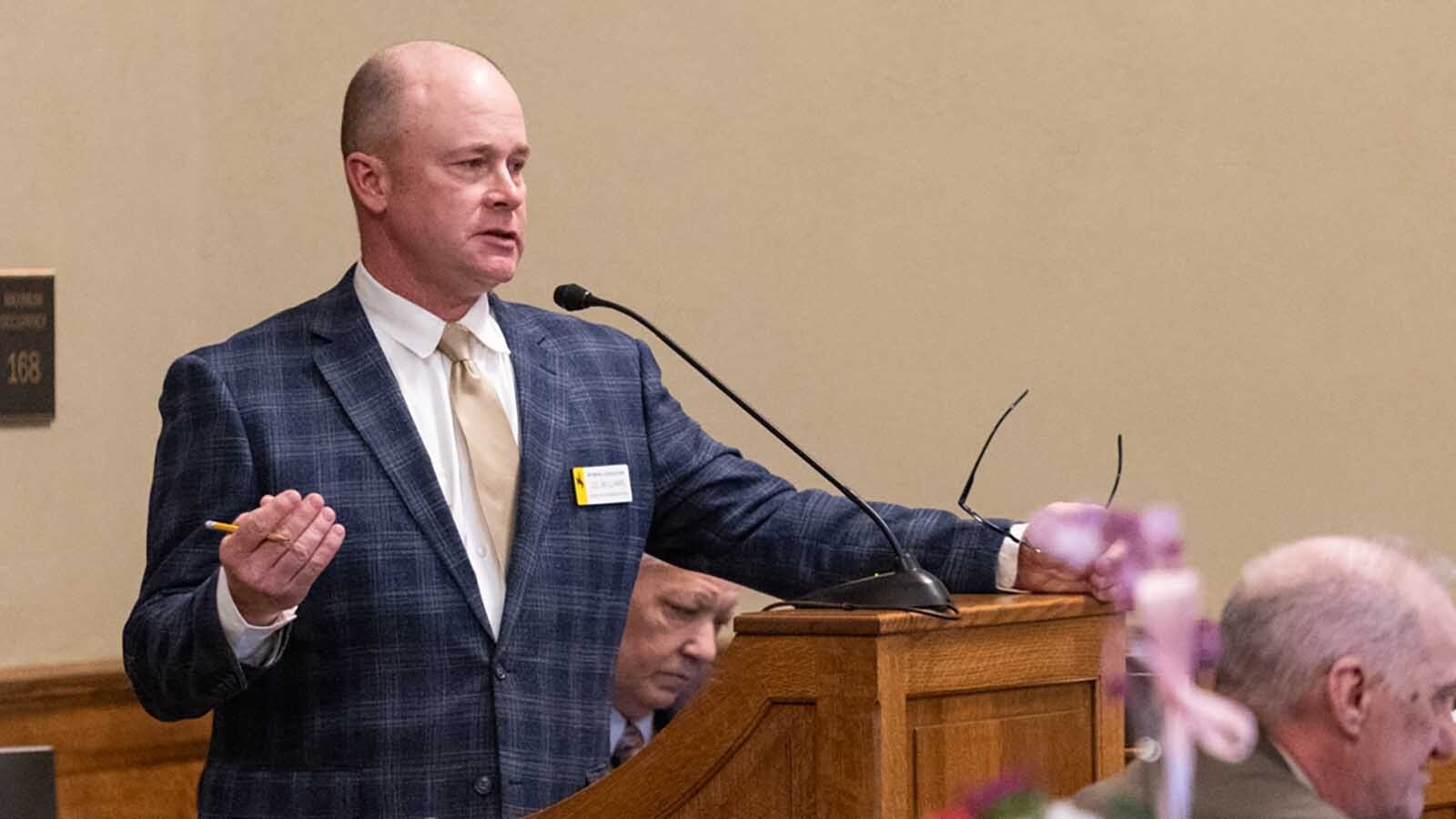
Rep. JD Williams, R-Lusk, urged his fellow House members on Tuesday to let districts access 15% of the instructional silo for other purposes as needed.
His amendment was about flexibility for small school districts like the ones in his area, he said.
“Neighbors, this is an attempt to give my local districts a little bit of latitude,” began Williams. “I don’t think the goal is to cut secretaries, custodians … or extracurricular programs, but these are the hard conversations I’m having with my district.”
Ultimately, the House rejected Williams’ amendment.
The recalibration bill must survive one more reading in the House, an approval of House changes by the Senate, and the governor's desk to become law.
But First, The Debate
House Education Committee Chair Ocean Andrew, R-Laramie, opposed the amendment, saying it “really defeats the entire purpose of the silo.”
House Appropriations Chair John Bear, R-Gillette, likewise opposed Williams’ amendment, pointing to the extensive research and deliberation the recalibration undertook last year in drafting the bill.
Bear indicated that the only reason one would want to erode the silo would be to take money out of it, not put back into it.
That’s because districts have the latitude to add more money to classrooms than the amounts in the silo, but not take it out, he noted.
And he said the new recalibration bill, which contemplates teacher raises and other gains for schools, will ensure those other areas are funded.
Rep. Christopher Knapp, R-Gillette, said he believes in leaving control in the hands of local government.
“But they have to be part of the solution,” said Knapp. “Not continually saying, ‘Not enough, need more.’”
On And For
Rep. Bob Davis, R-Baggs, backed Williams’ effort, saying flexibility is paramount in rural communities.
“I’m listening to my local teachers,” he said. “I’m going to listen to the experts in my area.”
Rep. Steve Harshman, R-Casper, echoed that, calling the silo a uniform, cookie-cutter approach to a complex environment.
Williams said the silo risks shortchanging safety officers, food service workers and costs associated with extracurricular activities.
“Folks at home, they ask me some accountability questions,” said Williams. “If I really believe government closest to the people governs the best, why am I taking away this decision-making authority from my local board? I’ll just pass that along. It’s been good for me to think about.”
Ka-Boom
A clash unfurled when House Majority Floor Leader Scott Heiner, R-Green River, successfully advanced an amendment to subject all school districts to one “regional cost adjustment” model, which the Legislature’s education consultants call the hedonic wage index.
As the bill sat before Heiner’s change, it offered three different tests, depending on the situation. Those included the hedonic wage index and the Wyoming cost-of-living index, and a baseline calculation.
House Minority Floor Leader Mike Yin, D-Jackson, had advocated that second method, saying the hedonic wage index on its own gives too much weight to non-tangible living factors and doesn’t capture the complex housing market in his area.
“So the recalibration bill is a compromise in a bunch of different areas,” said Yin, adding that he’d supported the silo to recognize the compromise effort.
“What this amendment does is, it blows up the compromise,” said Yin.
Yin registered a formal protest after Heiner’s amendment passed, saying the action was unconstitutional.
Heiner had argued the opposite, saying his amendment makes the recalibration bill “defensible” by not “treating one district differently than all the rest.”
Yin also sparred with Bear.
Bear said the cost-of-living compromise Yin favored was, according to “our attorneys,” putting the bill at risk of faltering in court.
“Really frustrating to hear that members are speaking for our attorneys,” parried Yin.
He said he couldn’t speak directly for his local school district, but said the state could expect to see another lawsuit if, conversely, the House passed Heiner’s amendment.
Feeding Frenzy
Heiner successfully advanced another amendment raising a growth cap on teacher raises.
Sen. Chris Rothfuss, D-Laramie, had capped the teacher raises at 5% each year for three years while the bill was on the Senate side, so the substantial new boosts in teacher pay would not drive a frenzy of districts poaching each other’s teachers and artificially driving up wages with bidding wars.
Heiner asked the House to boost that cap to 10%, and it did.
The bill contemplates average teacher salaries at $75,863 per year, a boost from about $67,000.
Rothfuss during the bill’s time in the Senate also removed a controversial provision requiring school districts to use the state’s insurance instead of insurance programs of their choice.
But Rothfuss confined insurance payouts to actual employees, instead of the “ghost” employees the funding model allows but districts haven’t hired.
Clair McFarland can be reached at clair@cowboystatedaily.com.


