
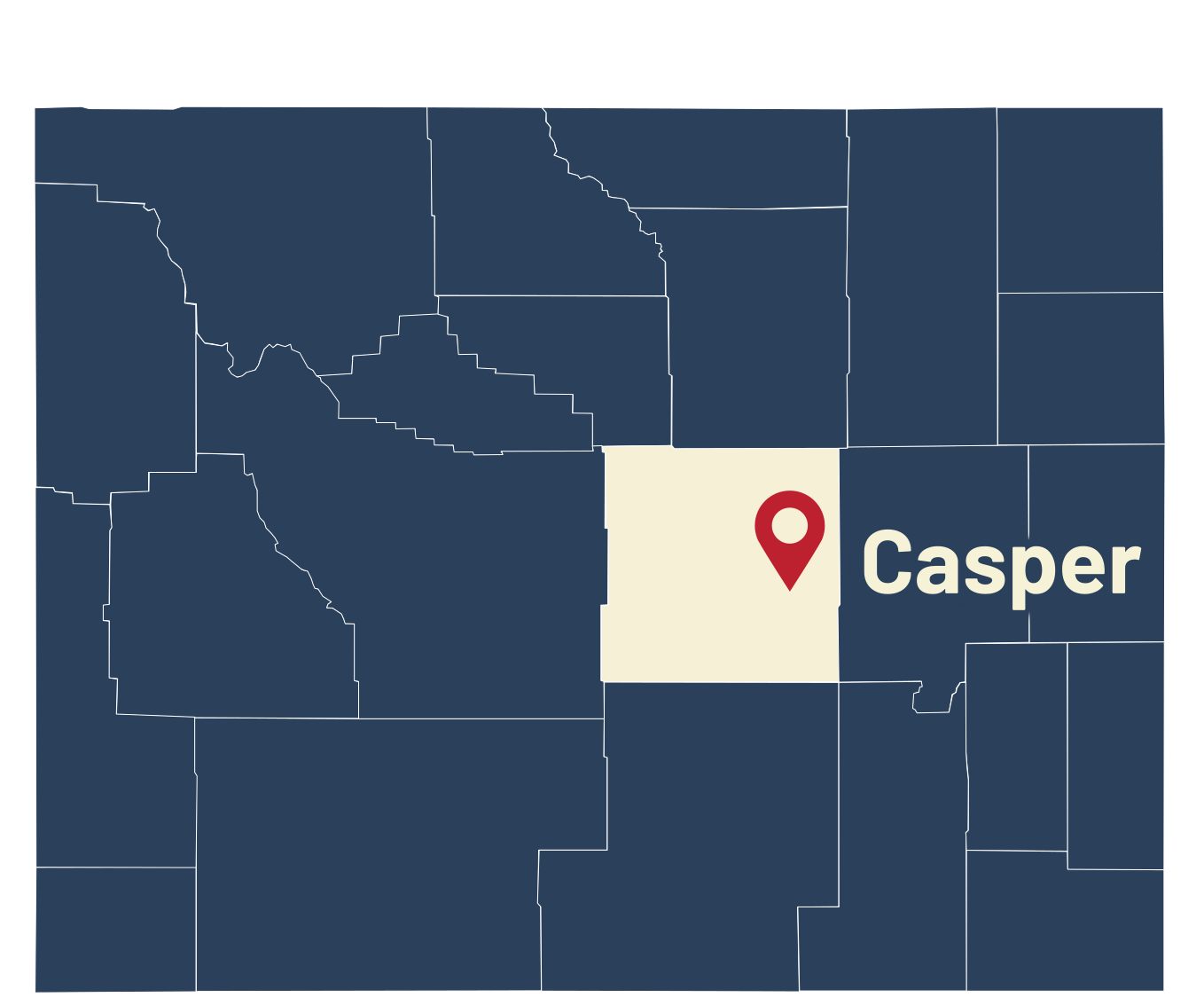

Property owners in a subdivision with $500,000 to $600,000 homes in south-central Casper say they’ve hit a wall in trying to get a literal one repaired, potentially threatening their homes and property values.
They see the issue as bigger than the wall and a lesson for state residents in how limited-liability companies can shield people whose business practices potentially harm others.
Kelly Bonnett and Phillip Rael, two of six property owners — three on the 2100 block of South Nebraska Avenue and three on Eddopf Avenue — said they and the other residents are struggling for a remedy after building and buying homes with a 7-foot-high, 220-foot-long retaining wall between the properties.
That wall is now failing.
They charge that the city of Casper never enforced its ordinance that required the wall to be designed and certified by a Wyoming-registered professional engineer.
“We have been quoted by a reputable landscaping company in Casper that the cost to fix this wall will likely exceed $300,000,” Bonnett said. “This kind of money is beyond the financial capacity of my family and the other five families affected by this wall.”
Rael said the neighbors hired a lawyer for $25,000 to research the issue, and the lawyer told them it should be a “slam dunk” to get the situation remedied. All the city had to do was enforce its agreement with the developer.
The families paid for a consulting engineer to look at the wall, and he determined it was not built to code and did not follow the city’s agreement, which called for a professional to design the wall.
Documents obtained from the city by the neighbors show that City Attorney Eric Nelson wrote developer Dennis Langdon of Beverly Heights Investments LLC on May 23, 2025, that the city had been contacted by landowners about the failing retaining wall in their backyards.

The History
Nelson pointed out that the Beverly Heights Addition property was sold by Scott and Desmond Bennion to Langdon’s Fourth Quadrant Investments LLC on June 6, 2012, after the Bennions requested annexation and a zoning change for the land.
However, Wyoming Secretary of State's Office records show that Fourth Quadrant was administratively dissolved in 2011.
Nelson also noted in the letter to Langdon that the Bennions, one month later in July 2012, executed a second warranty deed to the property, transferring the Beverly Heights Addition property to Beverly Heights, LLC.
“Once transferred, Beverly Heights, LLC, proceeded to complete the annexation, rezoning and platting of the property. You executed these documents as the managing member of the company,” Nelson said. “As it turns out, Beverly Heights, LLC, did not exist as a corporation in Wyoming.”
Nelson wrote that Langdon, a real estate broker in Casper, then recorded an affidavit correcting the name of the company to “Beverly Heights Development, LLC” but never corrected the name with the city of Casper in connection with its annexation of the property.
The annexation agreement made with the company identified as Beverly Heights LLC called for “any retaining walls” constructed in the subdivision to be designed and certified by a Wyoming-registered professional engineer.
That design, according to the agreement signed by Langdon, was to be submitted to the city’s public-services director and community development director for written approval before any building permits would be issued.
“A review of city files reveals there is no record that you, or a contractor on your behalf, submitted the contractually required documents or obtained the necessary written approval prior to constructing the retaining wall in question,” Nelson wrote. “We are requesting that this information be provided no later than June 6, 2025.”

Legal Options
Nelson wrote that the city could pursue legal options if the documents were not provided.
Rael said the wall was completed between the backyards of three of the four houses on each street in 2018. He moved into his home in 2016.
During the spring of 2021, after significant rainfall, the wall started to fail. Then, in 2022, the joint separation, erosion, and movement became even more evident.
Bonnett lives behind him, Rael said. Because the wall and the ground have fallen, the cement anchors to his fence have been exposed.
“The wind is going to blow that fence into my neighbor’s yard because it has subsided so bad,” he said. “The blocks are all over the place. Instead of a nice straight retaining wall, it’s just a complete mess back there.”
Bonnett wrote Casper Mayor Ray Pacheco on Jan. 28 about the situation and received a “thank you.”
He said he was told city staff were reviewing the issue and the city would consult with the city attorney about steps to be taken.
On April 15, Bonnett reached out again and informed Pacheco that the residents had filed a complaint with the Wyoming Attorney General’s Office. He said he has sent at least one other email and has been “ghosted on them.”
Two messages left with Nelson’s office went unreturned by publication. Pacheco also did not respond to a request for comment.
The Wyoming Attorney General’s Office also did not return a request for comment about the issue.
Rael said the Attorney General’s Office was helpful but told the residents that, because Langdon’s firm sold lots to contractors, the only way to legally find a remedy was to sue their contractors, because they did business with Langdon’s firm.
The neighbors did not want to do that.

'No Comment'
Langdon told Cowboy State Daily he was aware of the issue with the wall and would have “no comment.”
“I’ve got a letter from the state Attorney General’s Office and we have sent everything to them,” he said.
Langdon said he sent the material last May and there has been “no communication from the state” about the issue.
Brian Chandler, an engineer at Environmental & Civil Solutions who was consulted by the residents, wrote on Jan. 30, 2026, that the wall used Stone Strong brand retaining wall blocks that are 8 feet long and 3 feet high, about 44 inches wide and weigh 6,000 pounds each.
He wrote that while the wall might be part of a landscaping design, it provides “a critical aspect to the surface water drainage pattern” in the residents’ lots to prevent damage to homes by water runoff.
Chandler wrote that the wall’s height is about 7.5 feet, and though the two walls are terraced they act as one retaining wall. The wall behind the properties has settled from 6 to 18 inches along the wall and caused block joints to separate, he wrote.
The standard for placing the large wall blocks involves using gravel leveling pads underneath and gravel behind the blocks to allow water to drain. He wrote that evidence shows gravel was omitted from the wall’s construction.
“It is our understanding that the retaining wall started to fail after a significant rain event,” he wrote. “While we could not explore the areas behind and below the blocks, we did not observe an indication of a gravel base or drainage gravel in areas behind and below the blocks that were visible.”
He characterized the wall failure as the result of “poor workmanship” or “inexperience” by the contractor.
Chandler wrote that it is “common knowledge or should be” under building codes that retaining walls higher than 4 feet require design by a licensed engineer.
Bonnett said homeowners remain frustrated by Langdon using a limited liability company that did not legally exist. Yet they would have to pay significant attorney fees to try to get a remedy because the city apparently will not enforce its agreement with Langdon.
Rael said he worries that city officials might have decided to characterize the retaining wall as a “landscape wall” so they don’t have to act.
Bonnett said their main worry is that the wall failure will allow water against their foundations at “some point.”
“We get the feeling — they’ve never told us — but we get the feeling that the city just hopes we go away,” he said.
Dale Killingbeck can be reached at dale@cowboystatedaily.com.


