
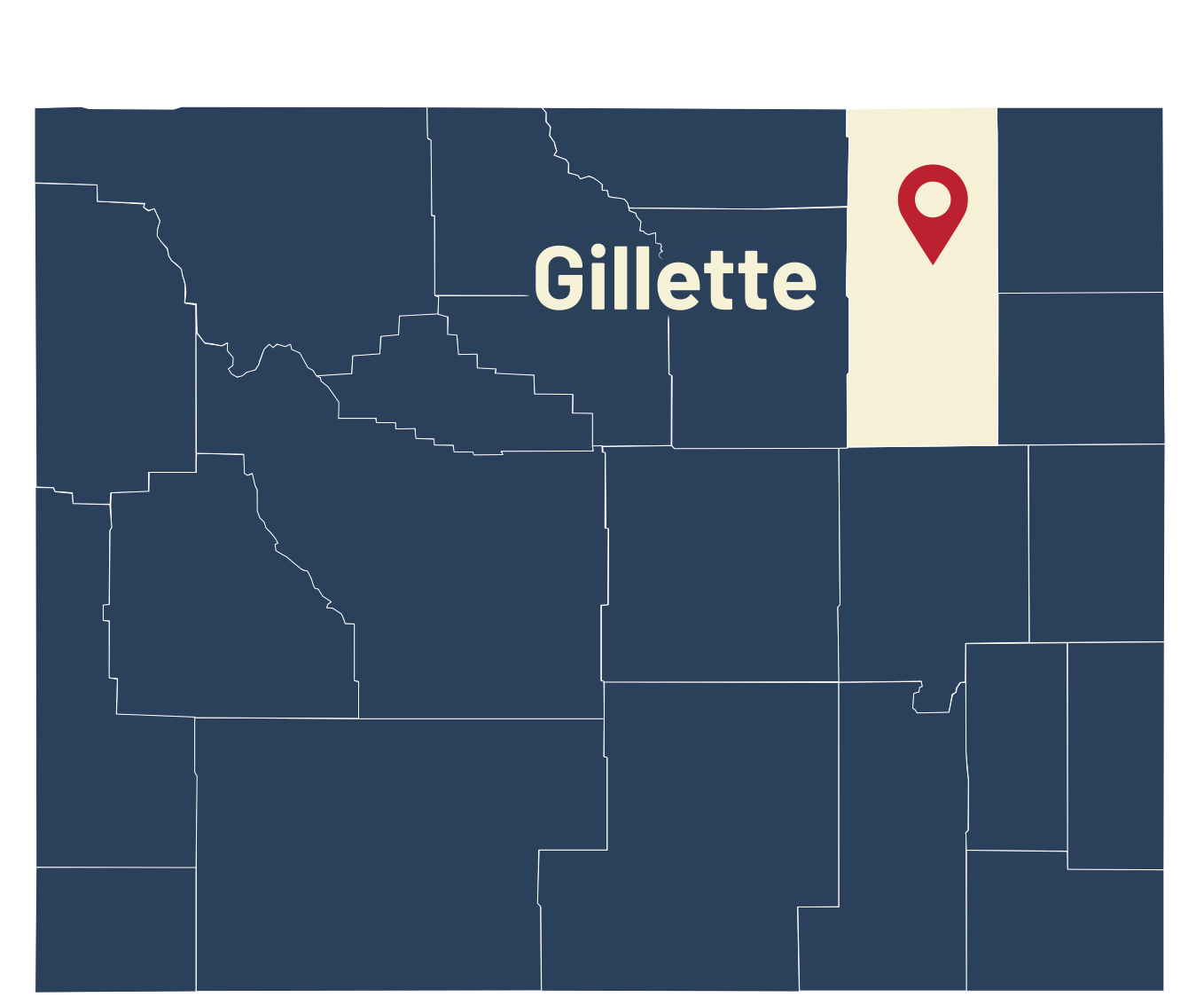

Tashala Luraas was doomscrolling Facebook one day when she came across something that changed her toddler’s life.
The Gillette, Wyoming, mom told Cowboy State Daily that her 15-month-old son Colton was born six weeks early and has spent much of his life in and out of hospitals.
Doctors still can’t say exactly what’s wrong, but they know he can’t keep food down, tires easily and has a hard time moving his tiny body.
"He's very developmentally behind,” Luraas said. “He’s just had a rough go of everything."
Luraas is in several Facebook support groups for parents of children with undiagnosed conditions.
That’s where she saw a post about a child using a 3D-printed mobility trainer: A lightweight, custom-fitted device that helps young children sit upright and wheel themselves around.
With the help of Colton’s physical therapist, several Gillette organizations — and even a few strangers who pitched in — and Colton now has one of his own.
"The people that took the initiative to be part of his journey and step up to help him with this was huge,” Luraas said. “Our community really rallied for this one.”

‘Whirlwind Since Day One’
Even at 15 months old, Colton is smaller than an average 1-year-old and relies on a feeding tube connected directly to his intestine around the clock.
“Anything that goes into Colton's stomach of a high volume, even a bottle over 2 ounces, is going to come right back up the way it went in,” Luraas said.
That’s been the case since Colton came home from the hospital. He spent his first 10 days in the Neonatal Intensive Care Unit. During that time, Luraas said that he already struggled with spitting up after feedings but he was still gaining weight.
That changed when they took him home.
“He was losing weight rapidly,” Luraas said. “We couldn't keep any nutrition in him. He was projectile vomiting, like, across the room, and I couldn't do anything to help him.”
What followed was a revolving door of emergency hospital stays and appointments with five different specialists at Children's Hospital Colorado in Aurora.
"The first diagnosis we got for him was liver cancer,” Luraas said. “They ruled that out, saying that it was more than just his liver that was affected.”
The family continued taking him to specialists as he struggled to get enough nutrition, staying off the growth chart altogether until his one-year checkup.
“It's kind of been a whirlwind since day one,” Luraas said.
Though he remains officially undiagnosed, doctors suspect a genetic mutation or a mitochondrial defect. Luraas said they are taking him to see a team of experts in an undiagnosed disease program in Philadelphia next month and hope to come home with more concrete answers.
Along with his feeding struggles, Colton hasn't started pushing up, pulling to stand or showing any cues that he plans to walk anytime soon.
Luraas isn't sure whether that's a symptom of his medical condition or an effect of his early nutritional delays.
But, even without a diagnosis, doctors have her warned that he will likely deal with lifelong mobility issues.
“They don't think that he'll be able to walk for a normal day, like you and I would,” Luraas said. “They think his time would probably be a lot shorter, like maybe 30 minutes.”

‘Figured It All Out’
Luraas said the only wheelchair Children’s Hospital Colorado could offer was a motorized one made for children the size of an 18-month-old, and Colton was still too small.
After seeing the post about the 3D printed mobility trainer, Luraas messaged the mom who shared it. That’s how she found MakeGood Assistive Design, a New Orleans-based nonprofit with a roster of free, open-source assistive devices that families can request be built by volunteers with local printers.
Jamie Hendryx, the physical therapist at Rehab Solutions Physical Therapy who works with Colton, had already told Luraas that studies show young children’s cognitive development benefits when they’re able to move around.
Luraas said she knew that getting Colton a device would be a proactive step for his growth, so she ran the idea of working with MakeGood by Hendryx.
“She took it and ran with it and thought that she could get it all figured out, and she did,” Luraas said. “So we just sat back from that point and waited for it to get made.”
‘We Could Do That’
Hendryx turned to Area 59, a Gillette College makerspace with 3D printers, laser cutters and a woodworking shop.
Its director, Ellen Peterson, told Cowboy State Daily that MakeGood had already approved the makerspace as one of its vetted 3D printing partners by the time Hendryx reached out about Colton.
“We learned about the program this summer,” Peterson said. “I came across it on a Facebook and I saw it and I went, ‘We could do that.’”
The chair, which was completed and delivered Wednesday, is the first of its kind built by Area 59.
About the size of a small stroller, Peterson said the finished chair is the largest 3D-printed project she has seen in more than 10 years of printing.
“Think of a 3D printer kind of like a hot glue gun on steroids,” Peterson said. “If you’ve ever played with a hot glue gun and let it dry, and then put another layer of glue on top of that, that’s how a 3D printer works. Except the layers are about as thick as a piece of paper.”
It took between 300 and 350 hours of print time to produce all of the chair's individual components on a 10-by-10-inch print bed, Peterson said. After that, members of the Gillette College Diesel Club volunteered to assemble the frame.
“The only pieces that were not 3D printed is actually the hardware, the casters and the bolts that hold the wheels on,” Peterson said. “But everything else on that, including the straps and the connectors, is 3D printed.”

‘A New Avenue’
Colton got to try the chair for the first time at Rehab Solutions Physical Therapy, and the moment was exactly what his mom was hoping for.
"It was huge the way that he lit up,” Luraas said. “Even though he's pretty young and probably doesn't fully know what's going on, he engaged with it right away, which made me feel like it was a good move for him.”
Almost immediately, Colton started reaching for the wheels and trying to push them, with Hendryx guiding his hands. At Luraas’ invitation, Peterson got to see that moment in person.
“My colleague and I got to be there while he was strapped into the chair, figuring out how the straps work,” Peterson said. “We actually got to see him put his hands on the wheels and kind of go, ‘Huh, I don’t know how this works yet.’”
Katie Ford, chief administrative officer for Rehab Solutions Physical Therapy, told Cowboy State Daily that it’s a moment many toddlers with mobility delays never get to have.
Ford said the office has seen many young patients whose insurance won’t cover a mobility device they will inevitably outgrow, and staff have fought with insurance companies, too.
“We always are jumping through hoops with insurance,” Ford said. “Insurance is hard. We get denied on something and the therapist has to come through and tell the insurance, ‘No, this child needs this.’”
Most insurers expect a wheelchair to last between three and five years, and some will only agree to replace one every five years, even though children can outgrow their equipment much faster than that.
Ford said devices like this are a necessity for children, both for their cognitive development and because every child deserves to be able to move around and play.
She was thrilled to see the community come together for Colton and find an alternative to a system where so many families fall through the cracks.
“It’s just cool that we’ve found a new avenue,” Ford said. “I think this is going to become a big thing as more families come forward. I think it’s going to kind of blow up but in the best way.”
‘An Emotional Day’
Peterson said that’s already happening. Before the makerspace even started on Colton’s chair, it had received four or five other requests from families through MakeGood.
“Our decision was to build our first one and work our way through this process,” Peterson said. “Now, we’re like, ‘OK, here’s what we learned. Here’s how we can fix it next time.’”
Just days after delivering Colton’s chair, Area 59 has already started working on the next one for another child in Gillette.
“It’s for a young lady,” Peterson said. “So we’ll get to print it in purples and pinks and things like that.”
But there’s still one piece missing from Colton’s chair.
Luraas said the chair still needs one more strap that runs between Colton’s legs so he can use it without slipping out the bottom. She planned to bring it back to Area 59 on Friday, and she hoped to take Colton on his first outing in the chair to the annual Festival of Trees in Gillette later that night.
Luraas praised the work of Area 59, Colton’s physical therapist and the Gillette College Diesel Club, along with people she’s never met, including a stranger who reached out on social media and volunteered to sew custom covers for the chair.
For a family that has spent much of Colton’s first year searching for answers, Luraas said the chair has become something to celebrate.
"Yesterday I really had an emotional day because it was huge to see everything come together,” Luraas said. “How much people are willing to do for my child was amazing."
Emma Jane Jackson can be reached at emma@cowboystatedaily.com.


