
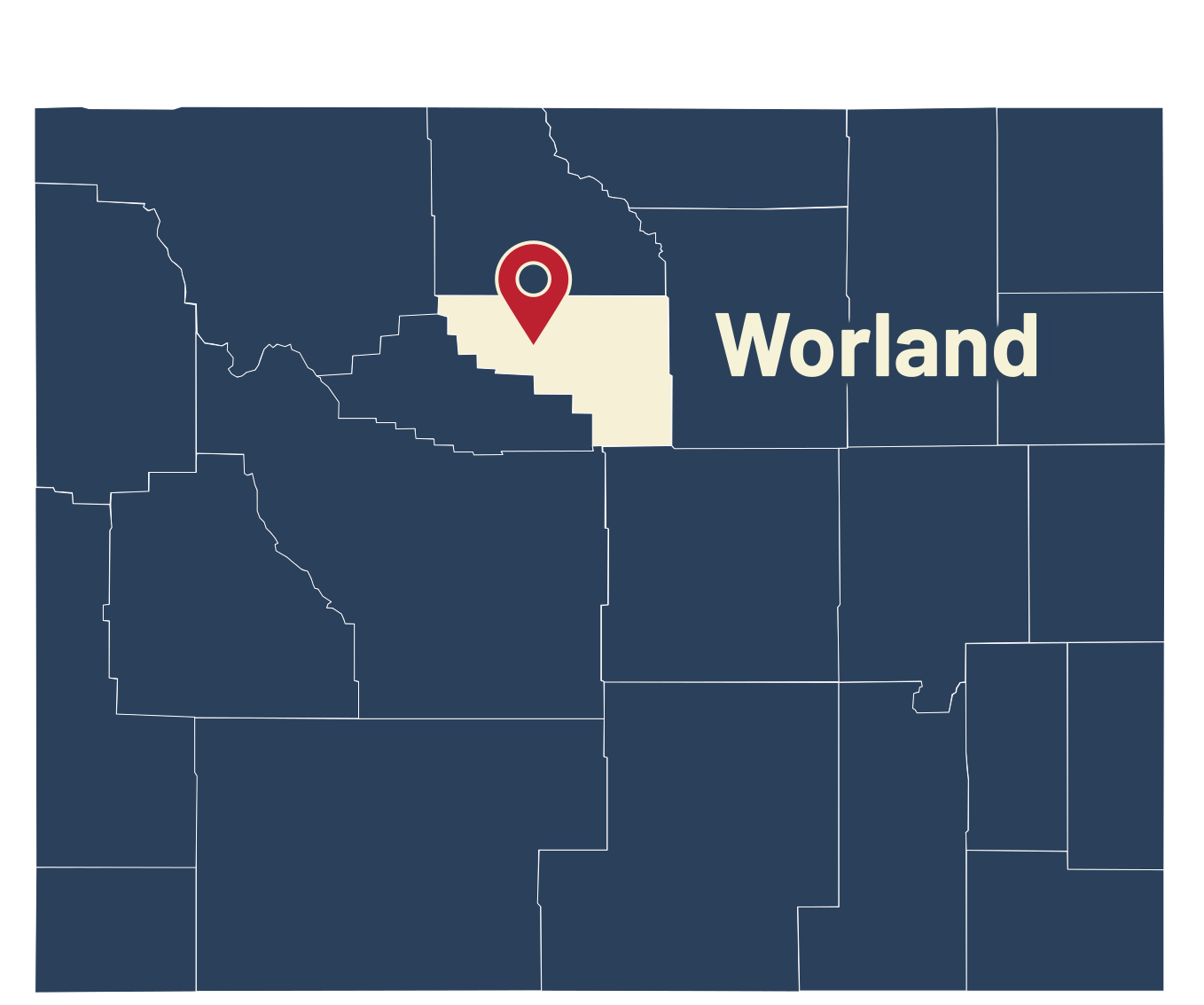

After 92 years, the old Worland Bridge on Culbertson Avenue continues to serve locals crossing the Big Horn River, and it remains a crucial route over the Bighorn River during the local sugar beet harvest.
Since 1975, when the "new" U.S. 20 bridge was installed just over a block to the north, it hasn’t been a necessary option. But for those who love old steel structures and a rumble under the wheels, it still resonates.
Despite being rated in poor condition by the Wyoming Department of Transportation, the two 210-foot truss spans that cross the river serve an important need for residents accessing neighborhoods and for many Wyoming Sugar farmers at harvest time.
Wyoming Department of Transportation spokesman Cody Beers said the overall 426-foot structure once represented the route for the old highway.
“It does provide another way to get across the river in Worland for passenger vehicles,” he said. “And it’s been used by Wyoming Sugar to get trucks into the sugar beet factory.”
Those trucks have been rumbling over the structure and into the Wyoming Sugar plant in recent weeks loaded with sugar beets.
But a load limitation put in place a couple years ago meant an adjustment for farms representing thousands of acres of beets on the west side.
WYDOT records show the bridge’s deck, superstructure, substructure, and overall condition have been rated as “poor” since May 2000.
The bridge was inspected every two years from 2000 to 2022. That inspection rate was moved up to every year beginning in May 2024.
This year’s May inspection notes that the deck has several areas of cracks and spalls that show “near full depth deterioration” as well as superstructure corrosion and substructure cracking throughout the pier and abutments.
Beers said WYDOT has met with Wyoming Sugar to “explore ways” to potentially build a new bridge, but those talks have been set aside due to costs.
“We have ongoing dialogue with Wyoming Sugar,” he said. “We understand that the sugar beet industry is important to Washakie County and the City of Worland, and so we want to facilitate commerce as much as we can.”

A beet truck heads west across the Culbertson Avenue bridge after unloading beets at Wyoming Sugar. (Dale Killingbeck, Cowboy State Daily) 
An empty beet truck heads across the bridge to get another load from a field on the west side of Worland. (Dale Killingbeck, Cowboy State Daily) 
The walkway across the Culbertson Avenue bridge is showing its age. (Dale Killingbeck, Cowboy State Daily) 
The U.S 20 Highway bridge sits just more than a block north of the Culbertson Avenue bridge. (Dale Killingbeck, Cowboy State Daily) 
Rust is an issue with the 1934 bridge on Culbertson Avenue. (Dale Killingbeck, Cowboy State Daily)
Key Location
Wyoming Sugar CEO Michael Greear said having the bridge where it is just above the company’s sugar beet plant helps during harvest with the plant’s setup of inbound and outbound scales. Beet trucks arriving from the west side of the river especially benefit.
“Well over 3,000 acres of beets are delivered across that bridge, so from a traffic flow and pattern standpoint, it is important to us,” he said. “It keeps our trucks off Main Street, so there is a safety component to it.”
Crossing the Big Horn River in Worland has been a foundational need for the community since 1906. And since 1934, the structure has served the community well.
The community’s roots date to Charles H. Worland and his dugout stage stop on the old Bridger Trail. By 1906 it had grown to include a church, school, post office and general store.
Katie Miller, the Washakie Museum and Cultural Center’s curator, said the community then called “Camp Worland” rallied that year when news arrived about the Chicago, Burlington and Quincy Railroad laying tracks through the Big Horn Basin.
Mayor C.F. Robertson asked the railroad to put a depot in the settlement. However, the tracks were planned for the east side of the river, opposite of where “Camp Worland” was established.
“Mayor Robertson said, ‘If we move Camp Worland across the river, will you let us have a train station here in town?” Miller recounted. “They said, ‘Yes.’ A lot of the buildings were dugouts, so they couldn’t move every single building. But they were able to get 11 buildings up on skates essentially and push them across the frozen Big Horn River.”
And crossing the Big Horn River became more important as the divided community grew.
Rust is an issue with the 1934 bridge on Culbertson Avenue. (Dale Killingbeck, Cowboy State Daily) 
The nuts and bolts of the 1934 bridge over the Big Horn River. (Dale Killingbeck, Cowboy State Daily) 
Rust is an issue on the superstructure. (Dale Killingbeck, Cowboy State Daily) 
Cracks in the roadway of the bridge mean it is inspected every year. (Dale Killingbeck, Cowboy State Daily)
Wagon Bridge Needed
On Nov. 15, 1906, the Worland Grit newspaper editorialized that a wagon bridge was needed because there were “several hundred acres of farming land now under cultivation.”
The editor estimated that in 1907, several thousand acres of crops would be put into the ground.
“Every person knows what a dangerous and treacherous stream this river is during the spring and summer months,” the newspaper stated. “The loss of one life is more than the cost of a thousand bridges and the residents of this town should get together and devise a plan by which a good safe bridge may be built.”
Miller said her research showed that a sugar firm constructed a wooden footbridge across the river around 1907 and the community used a river ferry to carry people and horses across the river until the 1920s.
Ice jams put wooden bridges constructed across the waters in danger. In the 1920s, a steel truss bridge was constructed at Winchester.
But Worland needed its own steel bridge, and in 1934 that bridge became a reality.
The state’s highway department sought bids on the bridge in April, awarded a contract, and opened it in late fall.
The Worland Grit reported on Nov. 1 that the community gathered on Saturday, Oct. 27, and had a parade to the new structure featuring the high school band and a public-address system.
“The new bridge is one of the largest and most expensive bridges in Wyoming,” the newspaper reported. “The cost ranging between $105,000 to $106,000 was revealed in the speeches.”
That's equal to $2.6 million in 2026 dollars.
Nine decades later, Wyoming Sugar’s Greear said his company is dealing with the load limitations on the bridge, and operations during the harvest continue to be smooth. If for some reason the 1934 structure gets shut down or closed, it would definitely create issues for the community, he said.
In addition to traffic congestion during the harvest season, it would slow farmers’ ability to get the crop out of their fields due to necessary truck rotations.
“It would be a big inconvenience for sure and something we would have to work around,” he said, noting growers would not be happy. “I think everybody would be pretty worked up about it.”
Contact Dale Killingbeck at dale@cowboystatedaily.com

Dale Killingbeck can be reached at dale@cowboystatedaily.com.


