Every Wyoming county shifted blue by an average of 21.3 points Tuesday compared against the 2024 presidential race, according to federal election percentages.
Republicans still swept the top five state-level seats and the open U.S. Senate and House seats, and kept their roughly 90% supermajority in the Legislature despite losing one seat in the state House.
But the blue shift manifested regardless.
“As the polls closed last night, and the national press did their usual bullshit of calling races in Wyoming for Republicans before a single vote was counted, they held off on the US House seat,” remarked Wyoming Democratic Party Vice-Chair Lindsey Hanlon in a Wednesday Facebook post.
“It took them multiple hours to call that one. I’ve literally never seen that happen. We worked so hard that the people who normally write us off as a ruby red state felt they couldn’t do that.”
The blue wave was a national trend. A huge majority of U.S. counties shifted blue Tuesday.
New Jersey, Utah, West Virginia and Wyoming reported the largest shifts toward Democratic candidates in their U.S. House races, NBC News reported.
The Blue Swing
Republican vote shares in the U.S. Senate and House race dropped an average 14.2 points from Donald Trump’s share of the 2024 election, while the Democratic share jumped roughly seven points from Kamala Harris’ portion, yielding a net swing of 21.3 points.
Sweetwater County posted the biggest shift from red to blue, at 26.4 points, followed by Natrona at 24.7 and Laramie County at 23.4.
When analyzing the House and Senate races separately, Sweetwater County still raised the biggest blue wave in each one analyzed separately: 33.4 points in the House race and 22.5 in the Senate.
In the U.S. House race pitting the ultimate GOP winner, Representative-elect Chuck Gray, against Democrat Lisa Kinney and two other candidates, Natrona County posted the second-biggest defection from red to blue: 30 points.
Weston County defected from the House GOP ticket the most by dropping 25.1 points from its last Trump vote, but when combining that with the Democratic gain of 4.1 points, Weston yielded the third-highest net swing: 29.2 points.
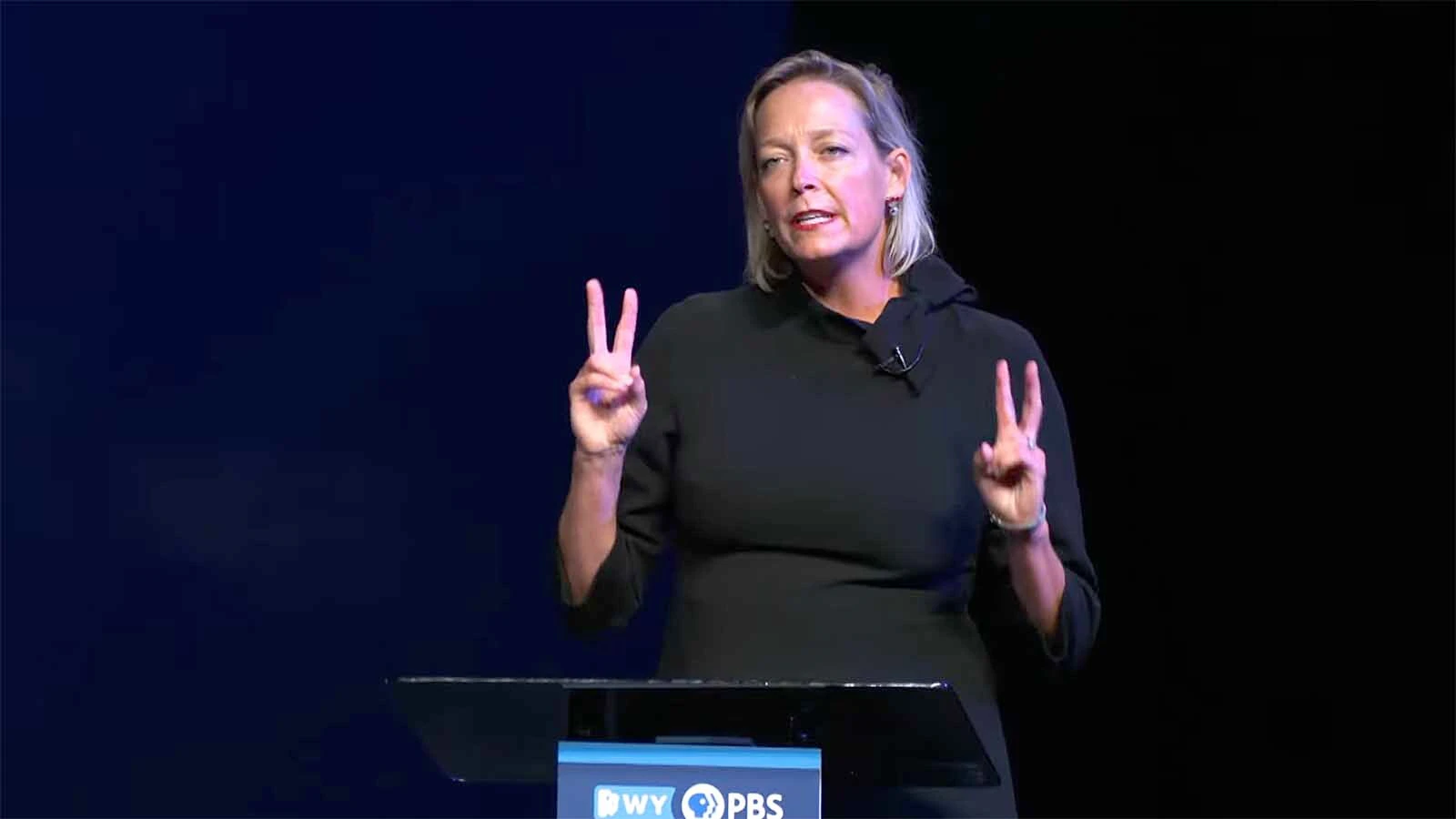
Kinney won 33%, outperforming every Democratic contender for the seat in 18 years.
On the U.S. Senate side, Sweetwater County both defected the hardest from the GOP and posted the biggest gains for the Democratic ticket, yielding a net swing of 22.5 points.
The second- and third-biggest blue swings were Albany County at 19.8 points and Sublette County at 16.6.
That race pitted Senator-elect Harriet Hageman against Democratic nominee James Byrd.
Byrd won 34%, outperforming every Democratic contender for the seat in 30 years.
Still, the House race saw a bigger shift of red to blue than the Senate race, largely because of the low vote share (52%) that Gray won, compared to Hageman (63.7%).
The Senate race’s average blueshift was 16.4 points, while the House’s was 26.2.
Why?
Ryan Williamson, University of Wyoming associate professor of political science, said voting often resembles the axiom, “When you’re holding a hammer everything looks like a nail.”
Local voters respond to national trends and frustrations by voting for one party or the other, all the way down the ballot.
“People are remarkably uniform in their voting, and a lot of people are basing their vote on the sentiment toward the president, whoever he may be,” said Williamson. “Donald Trump is a uniquely polarizing figure – but it’s not exclusive to him.”
President Joe Biden weathered the same repudiation in 2022, as did President Barack Obama in 2010.
Midterm backlash against the president is “a very common phenomenon,” Williamson added.
He pointed to national strain, noting Wyomingites aren’t immune: Fuel and housing prices, war in the Middle East, the “state of politics writ large.”
The lever these forces pull isn’t necessarily mass defection, but different turnout.
The Republican voters of 2024 might have been reluctant to show up and support their nominees this year, while moderates and Democrats may have been more motivated to vote against them, Williamson said.
“I think we saw our own version of this play out in August,” he added, referencing the primary election by which most Wyoming Freedom Caucus-aligned legislative candidates lost their races.
The Freedom Caucus took over the state House of Representatives in 2024, the same year Trump was elected to his second term. Those are separate things, but Trump’s popularity in 2024 combined with similarities across “that particular band of Republican identification” could have helped the Freedom Caucus’ ascent that year, said Williamson.
“And then him not being on the ballot (this year) and people voting, in a way, to punish Trump – that certainly can help explain some Freedom Caucus losses,” he added.
Group Accountability, Also
Voters’ one-party mindset when approaching the ballot instills group accountability in cadres of partisan officeholders, said Williamson. In the case of this year, that mindset forces surviving Republicans to push for improvements among their own.
“There’s at least a very clear signal to Republicans that something has to change in order to be more successful in the future,” he said.
The block ballot approach can elevate less-deserving candidates who are nominated under the popular party’s banner, and punish more-deserving candidates who aren’t, Williamson added.
Look We Worked Hard, Say Dems
Wyoming Democratic Party spokeswoman Mandy Weaver reacted with enthusiasm to news that the GOP vote dropped significantly (before adding Democratic gains for net outcome) in Niobrara and Weston counties.
Those two, along with Lincoln County, have gained new, active county parties in the past two years, where they previously had a Democratic void.
The new party structures have hyped candidates, held events, and talked with people about voting, said Weaver.
As for the big net swings in Sweetwater and Natrona Counties, “it feels to me like it’s the net effect of having really good candidates,” she said.
The Democratic candidates in both those counties “worked their butts off,” said Weaver.
“We know the perception of Democrats in this state,” she said. “We’re not unfamiliar with that.”
But, added Weaver, “I think that having their neighbors active in their community and talking about their values to them is making a huge difference.”
Wyoming GOP Chair Bryan Miller did not return a request for comment by publication.
The Smallest Blue Waves
No county stayed put.
But Teton, Goshen and Crook counties posted the smallest blue waves in a federal-race average, at 10.4, 11.5, and 14.6 points, respectively.
Teton County was already blue. It is Wyoming’s only consistently blue county, though Democratic strongholds exist in Albany County and select neighborhoods of Fremont and Laramie counties.
Clair McFarland can be reached at clair@cowboystatedaily.com.