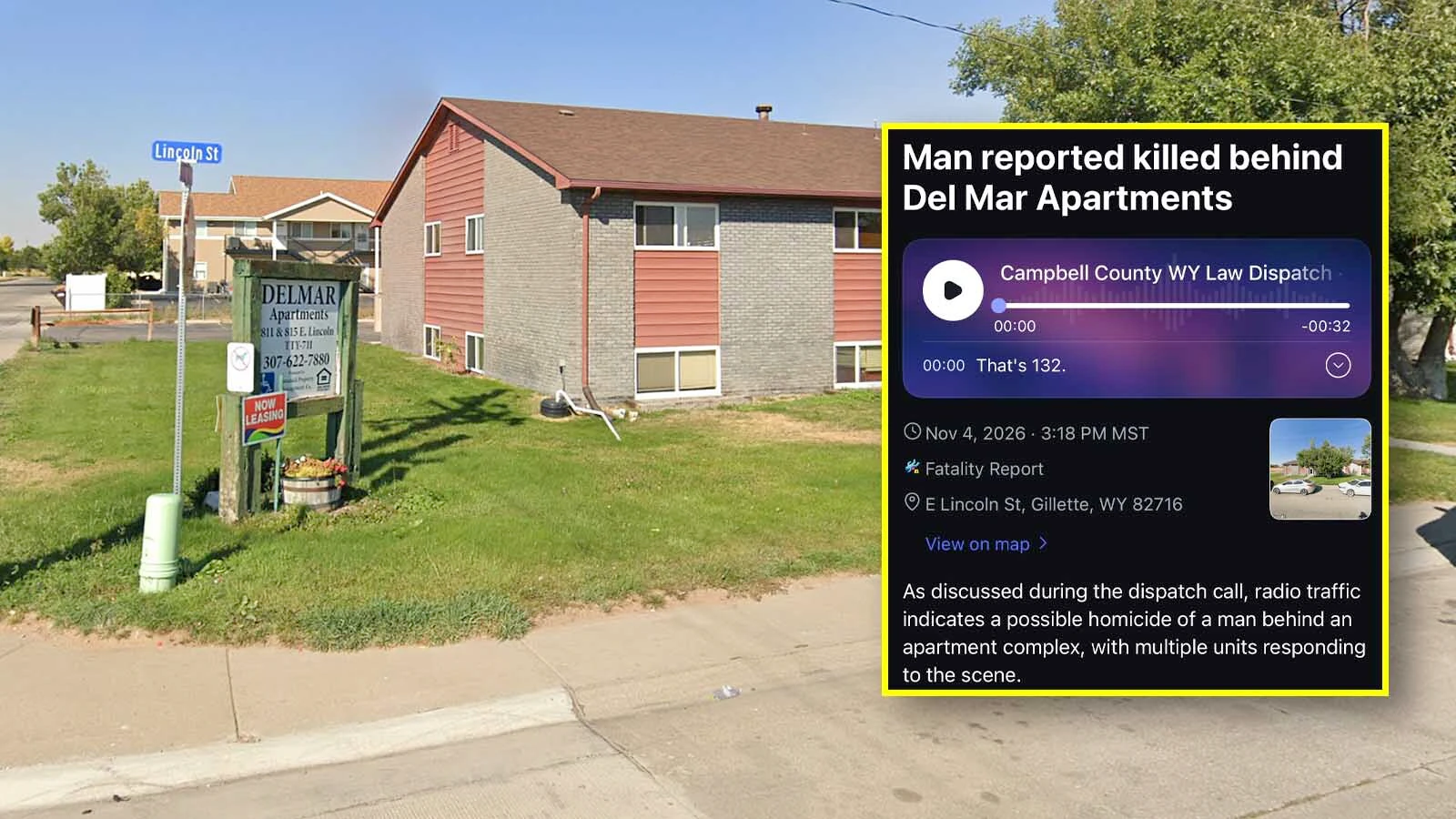
An AI-generated report on CrimeRadar, a popular third-party app that lets the public listen to police radio traffic and read automated summaries of calls, announced Wednesday that a man was killed behind a Gillette apartment complex, but there was just one problem.
Nobody died.
The dispatch report had a location, a 3:18 p.m. MST timestamp and even categorized it as a “Fatality Report.”
It sounded serious:
“As discussed during the dispatch call, radio traffic indicates a possible homicide of a man behind an apartment complex, with multiple units responding to the scene.”
On Thursday, Campbell County Sheriff's Lt. Dan Maul reviewed the actual incident.
“No, not even close," he said.
No dead man. No homicide investigation. No grisly crime scene.
“Yeah, we did have a traffic stop over there at 3:18,” he said. “It looks like we were out with a female in that location.”
What deputies actually encountered Wednesday afternoon was a woman who had an outstanding arrest warrant, and deputies took her into custody.
“I can't, from looking at this, tell what would have possibly come out as homicide,” Maul said.
Somewhere between the crackle of police radio traffic and an artificial intelligence program attempting to make sense of it, that ordinary encounter morphed into a possible murder. One person commented "WOW" beneath the summary.
Welcome to the increasingly strange world of AI-generated police dispatch reports, where the childhood game of telephone has gone digital.
Buried beneath the alarming report was an important disclaimer: "The text was AI-generated, not an official police report, and readers should verify the information with official sources."
Millions Are Listening
CrimeRadar isn't some obscure little corner of the internet, either. The app has racked up an estimated 4.6 million Android downloads and ranked among the most popular free news apps in the country in early November.
Its wide usage shows a growing appetite for instant information about police calls, crashes and other emergencies — even when the technology interpreting those calls can be wildly inaccurate.
Anyone who has ever watched a YouTube video with erroneous automatic captions has seen a milder version of the problem, Maul said.
Ordinary sentences get chewed up by software and come out as if someone tried to piece them together again using snippets from a TV crime drama.
Now add the hiss of a police radio, overlapping transmissions, abbreviations, and unfamiliar names and the possibilities for confusion multiply.
“It's not the best quality audio and a lot of codes and so forth,” he said. “So it's probably worse yet.”
Even a flawless transcription wouldn't necessarily tell listeners the whole story.
Officers sometimes relay information from witnesses who are frightened, confused or simply mistaken. The details can change as deputies reach the scene and investigate.
“Just because we think we hear something on the radio doesn't mean that that's exactly what's happening,” Maul said.
In this case, the problem was more basic: The report described a killing that never happened.
Still, the sheriff's office wasn't fielding a flood of panicked calls.
Maul said he wasn't aware of anyone besides Cowboy State Daily contacting the department about the supposed homicide.
Not 'A Stray-Cat Call'
Byron Oedekoven, a former Campbell County sheriff and longtime leader of the Wyoming Association of Sheriffs and Chiefs of Police, knows a thing or two about what happens when the public tries to decode police radio chatter.
He spent years listening to people describe what they thought they'd heard over scanners.
“If you're listening over the scanner, you may not be used to the traffic, what some of the verbiage actually stands for and means,” Oedekoven said.
Law enforcement officers use shortened phrases and specialized language to communicate quickly without tying up the radio.
For someone unfamiliar with those conventions, even an accurately heard exchange can be easy to misunderstand.
Oedekoven remembers plenty of next-morning conversations with people curious about what had happened in their neighborhoods overnight.
Some would ask about something they'd heard on the scanner. Others occasionally called dispatch to find out what was going on.
But the idea of a computer inventing a homicide from radio traffic struck him as a particularly impressive mistake.
“Oh my gosh!” he said when told about the Gillette report. “When an AI glitch can say homicide, I mean that's number one on the big, big crime side. It's a little different than a stray-cat call.”
Oedekoven isn't opposed to using artificial intelligence. He sees its potential, particularly as public safety agencies explore new ways to communicate and process information, but he draws a firm line between using a machine to gather information and allowing it to make decisions about what's true.
“I think it's important to remember to use AI as a tool,” he said. “It is not a decision-making tool, it's an information tool that you then have to make an educated decision.”
Oedekoven said the technology's eagerness to produce an answer can sometimes be its biggest weakness.
“AI will give you something, even though it would have been better in this particular case to have given nothing,” he said.
AI's Violent Imagination
Researchers have studied the phenomenon known as AI hallucinations, and the findings are clear: Artificial intelligence doesn't just make mistakes. Sometimes it confidently invents information.
In the well-known 2024 study "Careless Whisper: Speech-to-Text Hallucination Harms", Cornell University researcher Allison Koenecke and her colleagues examined more than 13,000 audio clips processed by OpenAI's Whisper transcription system.
About 1% of the transcriptions contained purely invented phrases or sentences. Of the hallucinations researchers identified, 38% included potentially harmful material, such as violent language, false associations or misleading claims of authority.
One particularly unsettling example involved software inventing references to terror, a knife and someone being killed — none of which appeared in the original recording.
“With hallucinations, artificial intelligence is making up something from nothing,” Koenecke explained in her research.
The findings illustrate a broader problem: Software designed to convert speech into text supply information with a straight face, and when the subject is police activity, the difference between a muddled sentence and an invented killing is no small matter.
The CrimeRadar entry did include a warning that its text was AI-generated and needed independent verification.
It also showed that one user edited the entry, leaving unclear whether the headline, description or classification was modified after the initial report was created.
Cowboy State Daily reached out to CrimeRadar on Thursday to ask how the service generates its summaries, what safeguards exist against inaccurate reports and how user corrections are handled. The company had not responded by publication time.
Del Mar Apartments also had not responded to an inquiry about whether the erroneous report had caused any confusion among residents.
Not Just Gillette
The problem is well-documented.
In August, CrimeRadar reported a shooting with multiple victims in Sumrall, Mississippi. Police found no victims, suspects or weapons, but the false alarm prompted calls from concerned residents. A local school even contacted police to ask whether it needed to lock down, a local television outlet reported.
A month earlier, police in Waco, Texas, had to straighten out another false report after third-party crime apps, including CrimeRadar, indicated that an officer had been shot. The supposed shooting was actually part of a police training exercise.
And in Virginia, the Albemarle County Public Schools confirmed Oct. 29 in a public statement, CrimeRadar reported that an 11-year-old boy had overdosed and wasn't breathing at school. Emergency medical crews responded, but there was no overdose, and the student never lost consciousness or stopped breathing.
Concerned community members contacted the district after seeing the false report.
Even CrimeRadar acknowledges the limitations. Its website says the service does not independently verify live dispatch information and encourages users to check original recordings and official sources.
Jason Grant, the Albemarle County district's chief communications officer, said, “These apps are fast, but fast is not the same as accurate.”
For Maul, the lesson is straightforward.
“I would encourage people to be cautious of taking anything AI-generated at face value, without other contexts or evidence to, you know, verify what it's saying,” he said.
Oedekoven offered much the same advice, warning that as artificial intelligence becomes more deeply woven into everyday life, people will have to get better at checking its work.
“We'll need to verify more, be cognizant of glitches and potential errors, and make sure we are checking and double checking,” he said.
Kolby Fedore can be reached at kolby@cowboystatedaily.com.