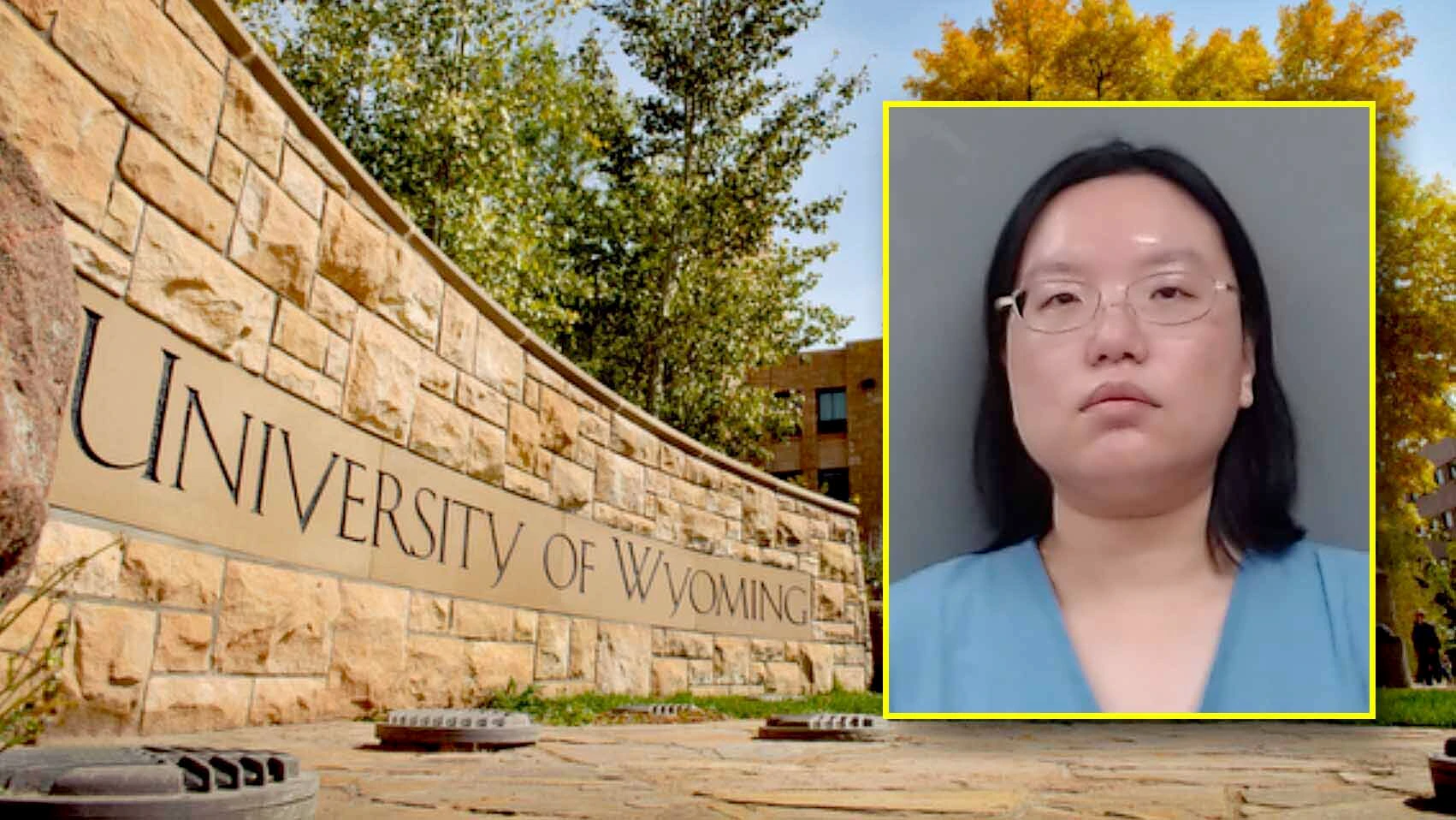
A Laramie-based judge on Tuesday elevated the case of a Chinese national accused of poisoning her University of Wyoming colleague to Albany County’s felony-level court, after finding the prosecutor showed probable cause for second-degree attempted murder and aggravated assault.
Aili Wang, 32, could face between 20 years and life in prison if convicted of the attempted murder charge, and another 10-year maximum if convicted of aggravated assault.
She appeared in Albany County Circuit Court via video link from jail.
Her attorney, Linda DeVine, had asked Judge Robert Sanford to lower Wang’s bond of $1.5 million, saying that’s essentially the same as not having a bond.
Albany County Deputy Attorney Joel Defebaugh protested, saying that when Wang reportedly tried to flee the country to China via the Los Angeles International Airport in early October, she had a gold bar worth $3,000.
Investigators also recovered flash drives and documents before seizing Wang at the airport and ultimately extraditing her back to Wyoming, court documents say.
Sanford declined to lower Wang’s bond.
The Argument
Defebaugh called University of Wyoming Police Chief Joshua Holland as his lone witness.
Holland testified that a female chemist whose initials are PH spoke with UWPD personnel on Sept. 21, to report that her husband, “KT,” had been exposed to acrylamide.
Acrylamide is a neurotoxin that can cause major health issues with prolonged exposure.
The wife provided samples of water sources taken from her husband’s coffee pot in the UW agriculture building, the affidavit says.
UW researchers had boiled the pot’s contents down to dust, tested the dust, and found acrylamide, Holland testified on Tuesday.
The powder was turned over to UWPD as evidence.
Under cross-examination by DeVine, Holland conceded that Wyoming Crime Lab testing is ongoing, and authorities do not yet have an exact quantity on the alleged acrylamide concentration.
UW analysts also took water samples from the ag building’s water, molecular biology professor Mark Gomelsky’s office, distilled water, and KT’s coffee maker.
Only KT’s coffee maker tested positive for acrylamide, the affidavit says.
In the original affidavit, UWPD detective Kiernan A. Quinonez wrote that he took a report that Wang was suspected of poisoning KT.
Holland testified Tuesday that though Wang and KT had different study emphases as graduate students at UW, Wang had worked in KT’s same field for a company prior, when she lived in China.
Defebaugh asked Holland to describe the reported relational dynamic between KT and Wang, who shared an office with one other researcher, “OT.”
“My understanding is there were some accusations of sabotage or tampering with experiments,” said Holland, who didn’t specify who made which accusations. “Some pretty chilled dynamics, for lack of a better term.”
He later clarified under redirect questioning by Defebaugh that video cameras had captured Wang photographing and going through papers on KT’s desk.
The Saga
KT noticed bitterness in the water from his coffee pot on Aug. 10, then again Aug. 17, Holland testified.
“It is my understanding that after those exposures, he began experiencing some symptoms that led him to go to student health,” said the chief, citing nervous system symptoms, numbness, tingling, faltering balance.
UWPD officers interviewed Wang on Oct. 5, said Holland.
She told investigators she hadn’t used acrylamide in years, he recalled.
Holland said Wang handed her cellphone to police voluntarily after the interview.
That day, Holland related from the UW information and technology (IT), department, Wang deleted emails from her UW account. The deleted emails reportedly contained information about eBay orders for acrylamide, placed June 27 and Aug 24, and delivered July 6 and Sept. 8, respectively.
DeVine focused on this point: the alleged second order arrived after KT had already twice experienced symptoms.
Authorities searched Wang’s home and car but didn’t find acrylamide, Holland said.
Video cameras in the shared office coupled with card-key data showed Wang entering the space after hours, including just after midnight, and “manipulating” the coffee maker, coffee tin, and mugs, said Holland.
“I want to ask about that word ‘manipulation,’ which you’ve used a few times,” asked DeVine. “It can mean a whole lot of different things.”
Holland clarified that Wang was shown opening the coffee maker and coffee tin lids and looking inside them. No video captured her putting acrylamide in those reservoirs, Holland confirmed.
Holland had testified that before news of the case broke, he asked generic questions of a toxicologist and former Wyoming Crime Lab worker, “EK,” about acrylamide.
EK told him the dose is the poison, the chief recalled.
Acrylamide occurs naturally in small amounts. But large amounts and prolonged exposure is a health risk.
“She said the dose is the poison, correct?” asked DeVine.
“Correct,” answered Holland.
“So in order to determine if it’s poisonous, we need to know what that dose is – what that quantitative amount is, correct?” asked the defense attorney.
Holland said that’s “correct to an extent.”
Poisoned Coffee
DeVine emphasized that the finding of probable cause had to hinge on current evidence, not future prospects.
She later told the judge that the state’s case comprises “just circumstantial” evidence, “and there’s nothing that directly ties my client to putting acrylamide into the alleged victim’s coffee maker.”
She had questioned during cross-examination whether KT, who was working on his dissertation, may be experiencing stress symptoms.
Holland countered, saying though they hadn’t been able to test for acrylamide in KT’s blood, they had found a high-iron marker of liver damage, which the acrylamide could have caused.
Defebaugh pointed to a variety of evidence.
“This isn’t a PhD student under a lot of stress about a dissertation,” said the prosecutor. “This is liver results, and other things, continued medical evaluations of KT… the purchasing of acrylamide by Ms. Wang, the flight there after the interview.”
Though the chemists researching at UW, rather than the state crime lab, yielded the initial test results for acrylamide, those tests “did show that the powder… was acrylamide,” said Defebaugh.
Sanford bound both counts over without a pause and with little commentary.
Typically in Wyoming, a prosecutor files charges against someone suspected of a felony, based on a police affidavit. But the circuit court judge then weighs the evidence under the probable cause standard – a relatively light level of scrutiny – to determine whether the case should continue in the felony-level district court.
If the judge concludes there’s not probable cause, the felony charges are dismissed.
If he concludes there is, then the case ascends to district court; the defendant gives a plea, and the case proceeds to either settlement or trial.
Clair McFarland can be reached at clair@cowboystatedaily.com.