

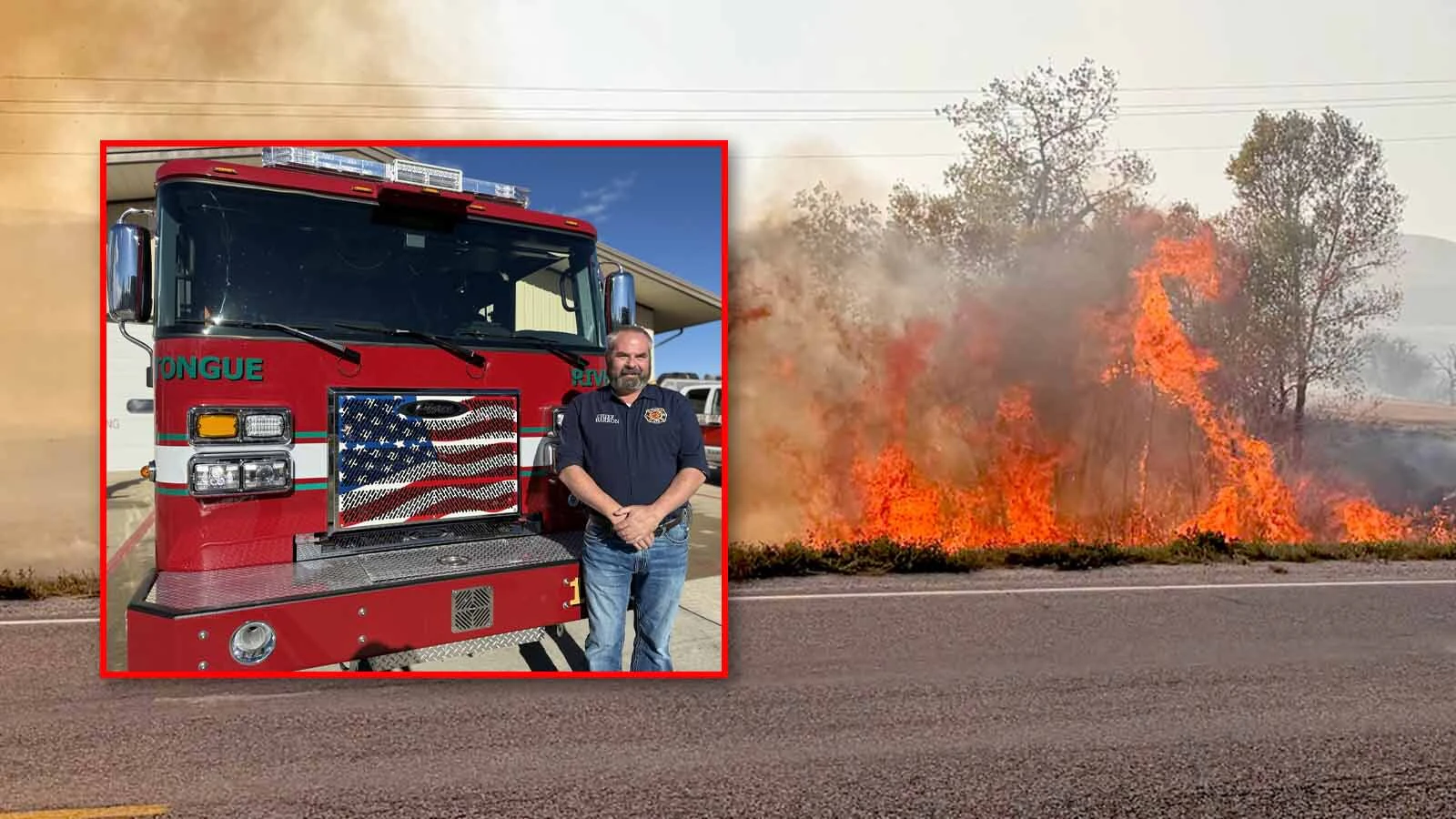
When a vehicle crashes along Interstate 90 just across the Montana border, firefighters from Wyoming's Tongue River Fire Protection District might be the first to arrive.
And according to Fire Chief Jeff Barron, there's a good chance the people they're rescuing are Wyoming residents.
"It's Sheridan folks who are traveling that road," Barron told Cowboy State Daily. "It's our taxpayers."
The volunteer fire district responds to emergencies across the Montana border roughly five or six times a year, most often to vehicle accidents during the winter. It also responds to fires in Montana once or twice a year, although some years it doesn't respond to any.
Barron said the district's proximity to the border puts its volunteers in a position to reach emergencies considerably faster than Montana’s nearest agency.
But the practice has recently come under scrutiny, raising questions about whether Wyoming taxpayers should be footing the bill for emergency services provided in another state.
Barron says the benefits far outweigh the costs.
He responded to criticism of his agency's cross-border work in a letter to the editor published by Cowboy State Daily over the weekend.
"Emergencies do not recognize state boundaries," Barron wrote, "and neither does our responsibility to protect our neighbors and our own communities."
Minutes Matter
The stretch of Interstate 90 between Sheridan County and southern Montana can be treacherous during the winter, when snow, ice and wind make driving difficult.
When accidents happen, Barron said, emergency responders from Wyoming are often closest.
"The only place to keep an ambulance (nearby in Montana) is out of Hardin," Barron said. "We know that. For our traveling public we hold safety as number one."
In his letter, Barron explained that an ambulance responding from Hardin can take 45 minutes to an hour to reach some accidents near the state line.
His volunteers, meanwhile, can reach those same locations in approximately 20 minutes.
The Tongue River district also has vehicle extrication equipment that can be used to free people trapped in wrecked vehicles.
That difference in response time can be critical, Barron said, particularly when someone is seriously injured.
He estimates that more than half the accidents his district responds to along that stretch of highway involve vehicles with Wyoming county license plates.
Others involve commercial trucks carrying goods and providing services through Wyoming.
For Barron, refusing to respond simply because an accident happened on the Montana side of the border makes little sense.
"Are we really prepared to tell a Wyoming family that our firefighters stood down because their accident happened a few miles on the wrong side of an imaginary line?" he wrote.
Who Pays?
Critics have questioned the use of Sheridan County taxpayer dollars to fight fires in Montana and raised concerns about a longstanding practice of providing mutual aid across the border without detailed public accounting of the expenses.
Barron said the expenses are relatively modest.
The Tongue River Fire Protection District is staffed by volunteers who are not paid for emergency responses. Barron estimates that a typical trip across the border costs the district about $200 to $300 in fuel.
"That's the literal expense I have to pay," he said. "It's well within budget dollars."
He said cross-border responses represent a small portion of the district's overall expenses, and those costs are reflected in its fuel expenditures even if they are not separately itemized.
But the distinction between recording expenses and identifying exactly how much is spent responding to emergencies in Montana remains at the center of the accountability debate.
Barron argues that the financial consequences of not responding could be considerably greater.
"To suggest that we should stop at the state line to save a few dollars is akin to tripping over a $100 bill to pick up a penny," he wrote.
Fires Don't Stop At Borders
The issue extends beyond vehicle accidents.
Wildfires can spread across state boundaries, threatening ranches, homes, livestock and other property regardless of where they begin.
Barron said responding to a fire while it is still in Montana can be the most effective way to protect Wyoming.
"We are not going to stand at the state line and watch a fire grow larger simply because it has not yet crossed into Wyoming," he wrote.
That cooperation was evident Oct. 6, when sparks from a BNSF Railway train ignited multiple grassfires along a stretch of railroad between the Parkman area of Wyoming and southern Montana.
The fires prompted a response involving Tongue River, Dayton, Goose Valley, Clearmont and Sheridan fire agencies, along with the U.S. Forest Service, Sheridan County Road and Bridge, the Sheridan County Sheriff's Office and Wyoming Highway Patrol.
Montana responders worked on their side of the border, while private landowners, assisted in fighting the fires.
Barron told Cowboy State Daily he is working to recover costs associated with that incident.
The fires also illustrated how closely connected the region is economically and geographically.
Some ranching operations, including the Padlock Ranch, own or lease land on both sides of the state line, Barron said.
In his letter, Barron pointed to several Wyoming landowners and ranching operations with property interests in Montana, arguing that protecting those properties also benefits Wyoming's agricultural economy.
Another example came in February, when Tongue River firefighters responded to a fire on the Crow Reservation in Montana to assist Bureau of Indian Affairs firefighters with structure protection.
Barron told Cowboy State Daily the BIA responders did not have the equipment needed for that portion of the operation, while the nearest Montana fire unit was approximately 40 minutes away.
The Wyoming volunteers filled that gap.
Mutual-Aid Agreements
Cross-border cooperation is often governed by mutual-aid agreements, which establish expectations for how emergency agencies assist one another and how expenses are handled.
On Sept. 1, Sheridan County commissioners reapproved a mutual-aid agreement with Big Horn County, Montana, formalizing a relationship that had previously operated largely through informal arrangements.
Under the agreement, the responding jurisdiction does not charge the requesting jurisdiction for the first 12 hours of an incident.
After that period, the parties negotiate reimbursement of expenses.
Barron said that arrangement is common.
For a relatively short response, he said, the cost and time involved in preparing an invoice can outweigh the amount the district would recover.
"It functionally works out because if I go up there for two hours, it's not hardly worth the administrative paperwork," he said.
Longer incidents can involve additional expenses, including meals, lodging and other logistical needs, making reimbursement more important.
There is, however, an important distinction between the county's agreement and the arrangements governing independent fire districts.
The Tongue River Fire Protection District operates independently of Sheridan County government and is not automatically covered as a party to the county-to-county agreement, Barron said.
Barron told Cowboy State Daily he is working on a separate agreement that would largely mirror Sheridan County's arrangement with Big Horn County, Montana.
He also hopes to establish a formal agreement with the Crow Tribe in Montana and is working to identify the appropriate officials to begin that process.
Tight Budgets
For small volunteer fire districts, even relatively modest expenses matter.
The Tongue River Fire Protection District is funded through ad valorem taxes and general purpose excise tax revenue. Barron said he supplements that money with grants whenever he can.
Wyoming's previous 25% property tax reduction cost his district approximately $8,000 in revenue, he said. He estimates another 50% reduction could cost the district an additional $9,000.
The district also provides fire protection to the town of Ranchester through an arrangement with the town.
Although the district does not receive property tax revenue from Ranchester residents, Barron said the town provides a building rent-free and pays the utilities.
"They give us a place to be," he said.
Leasing comparable commercial space would consume the entirety of the district's budget, Barron said.
The town has also provided additional financial support for equipment, including approving a $5,000 request from Barron.
Those investments benefit Ranchester residents through improved fire protection.
Barron said the district's work to maintain training and equipment has helped improve the town's fire protection insurance classification from a 6 to a 5, a change that can lower insurance rates for property owners.
Across Wyoming's Borders
Sheridan County is not the only part of Wyoming where emergency responders occasionally cross state lines.
In northeastern Wyoming, Weston County Fire Warden Daniel Tysdal told Cowboy State Daily that his agency has an agreement involving the Black Hills and occasionally assists with wildfire calls across the South Dakota border.
Tysdal said the Newcastle Volunteer Fire Department also occasionally responds to vehicle accidents across the state line.
Newcastle Fire Chief Chris Kenney did not return Cowboy State Daily's request for comment.
The Crook County Volunteer Fire Department also did not respond to a request for comment about cross-border emergency services.
The arrangements underscore a reality familiar to rural emergency responders: The closest available help is not always located in the same state as the emergency.
For smaller communities with limited equipment, volunteers and long distances between emergency stations, cooperation between agencies can mean getting help to an accident or wildfire sooner.
"Our volunteers leave their families, jobs, and personal obligations when the call comes," he wrote. "They do not ask whether the person trapped in a vehicle pays taxes in Wyoming or Montana."
They ask where the emergency is and how quickly they can get there.
Kate Meadows can be reached at kate@cowboystatedaily.com.


