

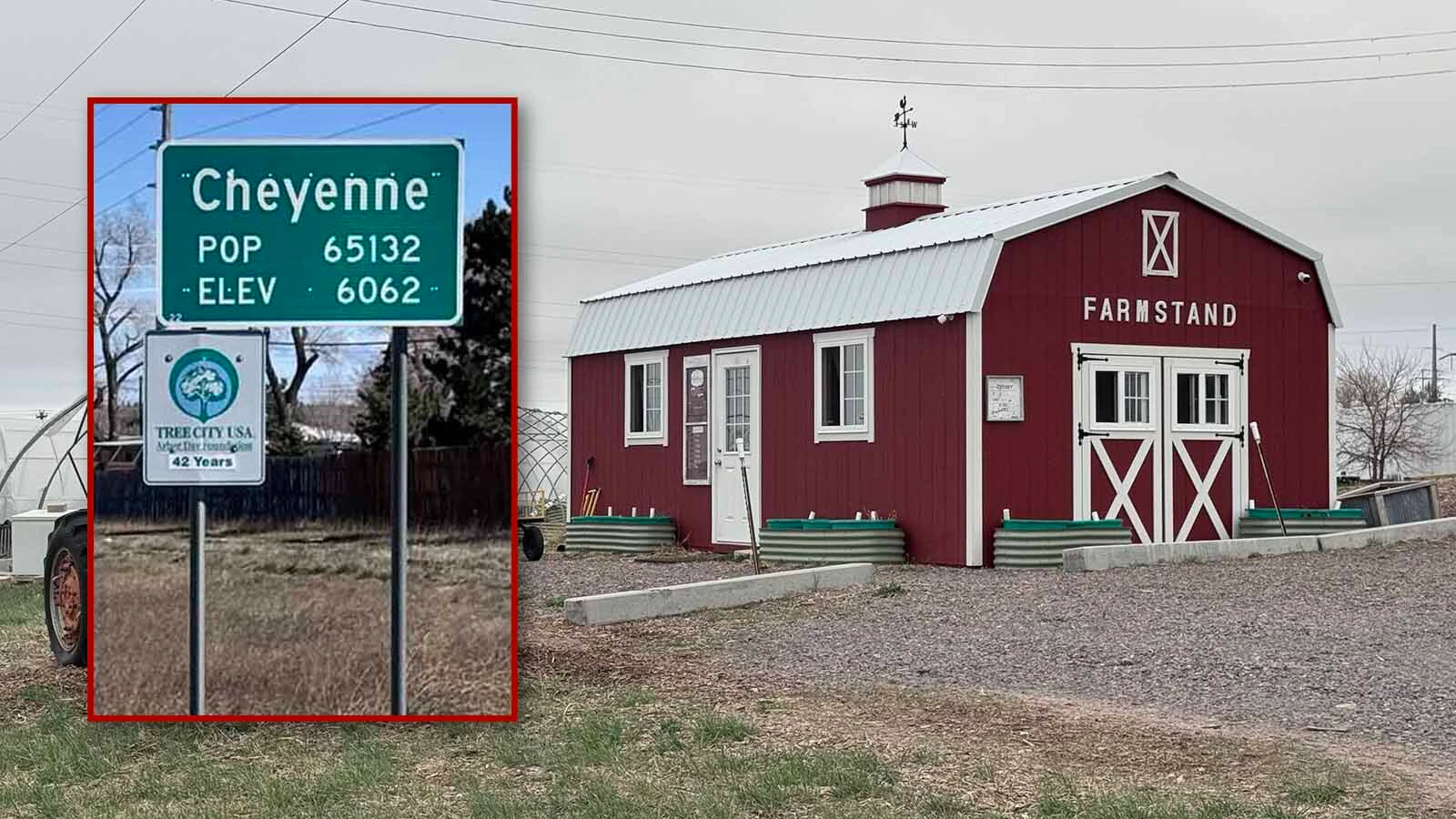
A small Laramie County farm that has spent months fighting to stay out of Cheyenne city limits is one step closer to being forcibly annexed, despite changes to city ordinances intended to accommodate agricultural operations.
The Cheyenne Public Services Committee on Monday recommended moving forward with several ordinances aimed at making urban farming easier within city limits, as well as annexing a handful of county properties completely surrounded by the city.
Among those properties is WY Fresh Farm, a working farm and farmstand owned by David and Tommie Kniseley, who say the proposed changes still don't do enough to protect their livelihood.
The Cheyenne City Council will consider the annexation on its third and final reading Nov. 9, eight months after postponing the matter to give city officials time to address concerns about how agricultural operations within the city would be regulated.
For the Kniseleys, that time has done little to ease their fears.
David Kniseley told Cowboy State Daily in a text message Monday that he is exhausted and "grieving the loss of our way of life."
"This will put us out of business. Mark my words, it absolutely will put us out of business," he told the committee on Monday.
City officials maintain that the changes are intended to allow farms like WY Fresh to continue operating while bringing their properties into compliance with municipal regulations.
Cheyenne City Planner Connor White told the committee that the city has conducted 333 annexations as part of its efforts to eliminate pockets of county land within city boundaries.
While multiple businesses have been affected by the changes, he said that none to his knowledge have gone out of business.
Eight Months Of Negotiations
The Kniseleys have operated WY Fresh Farm for about 20 years, growing food and selling agricultural products from their own property and dozens of other local producers.
Their farm sits in a county pocket in south Cheyenne, surrounded by city territory but outside city jurisdiction.
Cheyenne officials have argued that annexing such pockets would simplify municipal boundaries and eliminate confusion over city and county services.
But the Kniseleys have maintained that being brought into the city against their wishes would subject their longstanding agricultural operation to regulations that weren't written with working farms in mind.
In March, following hours of public testimony and pleas from the Kniseleys and their supporters, the City Council unanimously postponed its final annexation vote until Nov. 9.
The delay was intended, in part, to allow the city to develop regulations that would better accommodate farming and agricultural enterprises within city limits.
On Monday, the Public Services Committee took up several of those proposed changes.
The amendments would clarify rules for keeping livestock, allow electric fencing for certain agricultural uses and provide exemptions from some development requirements that don't make sense for working farms.
Other changes would establish definitions for agricultural activities including agritourism and farmers markets, while addressing issues such as gravel parking lots and the number of animals allowed on a property.
The city also proposes assigning agricultural, medium-density residential, community business and light industrial zoning to different portions of the annexation area, reflecting existing land uses and surrounding neighborhoods.
If approved, the changes would establish a more comprehensive framework for urban agriculture in Cheyenne, the committee said.
But the Kniseleys say the regulations still leave important questions unanswered.
'The Things We Asked For ... Are Still Not In Place'
Tommie Kniseley thanked committee members Monday for considering changes to the city's agricultural ordinances since the annexation was postponed in March.
But she said the city still hasn't addressed the issues most important to her family.
"The things we asked for just to continue operation are still not in place," she said.
Among her concerns are protections for the family's right to farm and repairs to fencing she says the city damaged.
David Kniseley told Cowboy State Daily that the city has neglected their road grading since taking over the street from the county and that erosion has destroyed his fence.
The Kniseleys have also raised concerns about livestock working animals, fencing standards and how city regulations would affect the farm's day-to-day operations.
Tommie Kniseley told the committee that she and her husband had tried repeatedly to participate in discussions about the ordinances, but their opportunities had been limited.
An Aug. 21 meeting allowed no public comment, she said. A Sept. 5 meeting was postponed, and a Sept. 21 meeting was canceled.
"I stand before you, Nov. 2, seven days before our farm is about to be a part of the city," she said.
Committee Chairwoman Dr. Michelle Aldrich interrupted Kniseley when she reached the three-minute limit for public comment.
Aldrich explained that because the committee was considering multiple agenda items related to agricultural regulations, both Tommie and David Kniseley could speak for three minutes on each item.
David Kniseley then approached the podium.
"We had asked for these things on March 9," he told committee members. "You all were eloquent in the hope that we could work with the city."
But he said the cooperative spirit that appeared to exist when the council postponed the annexation quickly disappeared.
Kniseley said he was told by the mayor's chief of staff that the mayor would not meet with the family and that all communication would have to be in writing.
"The warmth evaporated," he said.
"We're at a loss," he added, accusing the city administration of stonewalling the family despite the council's stated intention to work with them.
Electric Fences And Other Rules
Among the ordinances considered Monday was an amendment to Cheyenne's municipal code allowing electric fencing for certain agricultural and livestock uses.
The committee recommended approval of the measure on third reading.
Committee members asked Cheyenne Planning and Development Director Charles Bloom whether WY Fresh would be grandfathered in under the new rules.
Bloom said the farm would be grandfathered in if it already had electric fencing.
David Kniseley pushed back.
"We're not going to hurry to build an electric fence not knowing what the standards are going to be," he said.
He again accused the city of refusing to repair fencing he said was damaged by municipal work.
"The city makes it an adversarial matter and refuses to be a good neighbor," Kniseley said.
Other amendments considered Monday addressed the number of livestock permitted within city limits and exemptions for certain agricultural activities.
Councilmember Dr. Mark Rinne questioned why nurseries were not included under the proposed agricultural use provisions.
White explained that nurseries already fall under a separate land-use classification.
Rinne also questioned how the city would determine whether gardens and homemade food operations exceeded the proposed $10,000 annual sales threshold.
White said enforcement would be complaint-driven rather than based on routine monitoring.
"We wouldn't monitor unless we received a complaint," he said.
If a property appeared to be operating within the rules and nobody complained, the city generally would not investigate, he said.
A Question Of Property Rights
The fight over WY Fresh Farm has extended well beyond the question of whether Cheyenne should annex a county pocket.
For the Kniseleys, it has become a dispute over private property rights and whether a city should be able to impose new regulations on a working farm that existed long before the surrounding area was incorporated into municipal boundaries.
The family has previously raised concerns that violations of city ordinances could expose them to misdemeanor charges, fines of up to $750 and as much as six months in jail.
They have also questioned whether the city would recognize protections under Wyoming's Right to Farm and Ranch Act.
In September, Tyler Lindholm, author of Wyoming's Food Freedom Act, told Cowboy State Daily that the proposed regulations could prevent other agricultural enterprises from starting similar operations.
City officials, meanwhile, have maintained that the regulations are intended to accommodate agricultural activity without exempting farms from requirements that apply to other properties.
Senior planner Seth Lloyd previously told Cowboy State Daily that the city's Unified Development Code, adopted in 2012, was largely designed around residential, commercial and industrial development.
Because Cheyenne has relatively little agricultural land, some conflicts between the code and ordinary farming practices did not become apparent until the city began annexing county pockets.
Lloyd acknowledged that the changes would not satisfy every request made by agricultural property owners, but said the city had to consider how its rules would apply throughout Cheyenne, not just to one farm.
'On Both Sides ... I See Failure'
The committee voted in favor of the annexation ordinance Monday, although councilmember Pete Laybourn voted against it.
Laybourn said he was dissatisfied with how both the Kniseleys and the city had handled the dispute.
"On both sides of this issue I see failure,” he said. “I see a failure of the WY Fresh farm to be able to articulate and work with the city. I especially see a failure of the city to reasonably and responsibly respond to their concerns.”
His comments underscored the frustration surrounding a process that began months ago with the stated goal of finding a way for the Kniseleys to continue farming while bringing their property into city limits.
Now, with the final annexation vote scheduled for Nov. 9, the two sides remain far apart.
Kate Meadows can be reached at kate@cowboystatedaily.com.


