
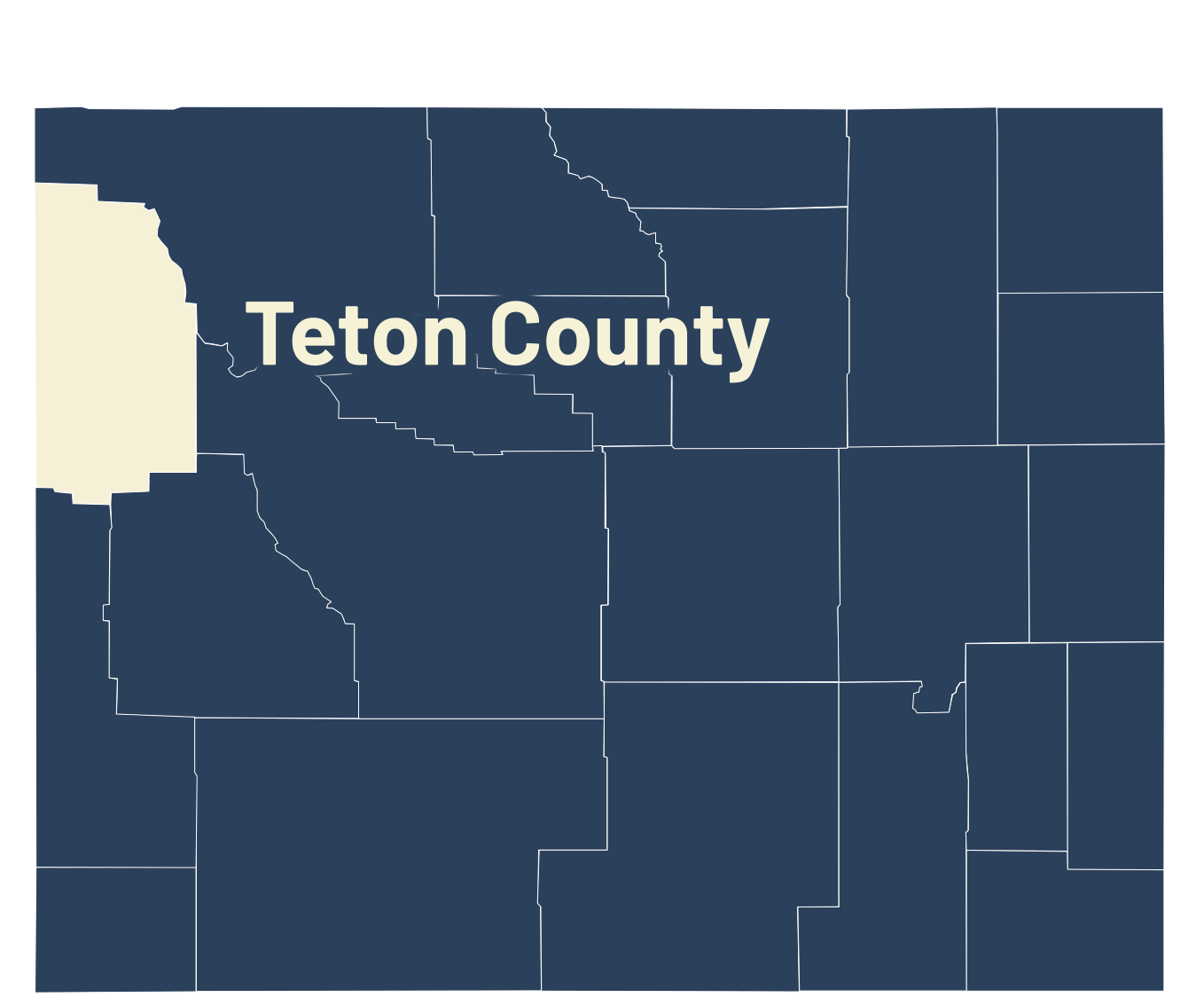
This is an account of the web of dark money that has infected even my own party, the Democratic, and even the most local races in Wyoming.
I was born and raised a blue-collar Democrat, by working-class parents who prized civic, grassroots-style involvement. I served on the Jackson Town Council; and as a National Committeewoman to the DNC, where we tried to get rid of "superdelegates" and ban dark money.
For most of my life I've been politically active and making "good trouble" even if it means calling out my fellow Dems.
So here goes.
On Aug. 26 the Jackson Hole News&Guide reported that Rep. Liz Storer (D) formed a political action committee 12 days before the primary to back three Teton County Commission candidates, one of them her husband, Luther Propst. The committee, Keep Jackson Whole, raised $12,500 and Storer said that is not dark money, not "like some out-of-state PACs that can't be traced back to one person or group." She's right.
Keep Jackson Whole was the smallest and most transparent money in the race. The largest came from Way Back PAC, a federal committee that files from a Sheridan mailing address. It reported spending $6,430,160.86; $43,000 of it stayed in Wyoming. Its biggest donor is a Sheridan nonprofit that never has to say who funds it. By Storer's own standard, that money is dark.
Ryan Lance signs every Way Back PAC filing as treasurer. He is also a trustee of the George B. Storer Foundation alongside Storer and Propst. Storer ran the foundation, which was worth $89.7 million at the end of 2024 and gives away about $3.3 million a year, most of it to civic organizations outside Teton County. The paper's story did not mention it.
Two Channels, One Slate
Two kinds of money reached this race. No tax filing connects them; they meet anyway: on the same three candidates, through the same people and, by Storer's and Shelter JH's own account, in money that took the long way around. This will get confusing, which is how dark money works.
Dark money is money whose original source voters cannot see before they vote. It goes dark by passing through legal containers. A 501(c)(3) charity may educate voters but never back a candidate; a 501(c)(4) "social welfare" group may work on elections as long as that isn't its main purpose.
Neither has to name its donors.
A political action committee (PAC) names both ends of every transaction, but those names can be other organizations.
A donor-advised fund is an account inside a charity. The donor takes the tax deduction up front and keeps the right to recommend where the money goes; the charity reports each grant under its own name.
Donor-advised funds are the fastest-growing piece of this: Americans put $90.6 billion into them in 2024, up 38.6 percent in a single year, according to the DAF Research Collaborative.
Their tax advantages are largest for people with the most to give. They have grown in step with the biggest fortunes. From 2020 to 2024 the funds' assets nearly doubled to $327.9 billion, while the combined wealth of the Forbes 400 rose 69 percent to $5.4 trillion.
On paper, the two kinds of money are walled off.
In practice, the law lets them work side by side, even with a little overlap. A charity may give a 501(c)(4) a named grant restricted to charitable work.
In 2024, the charitable New Venture Fund sent $1.8 million to Western Futures Fund, the Sheridan 501(c)(4) at the center of this story. The two may also share offices, staff and data if they split the costs. Every charitable dollar that covers a 501(c)(4)'s research leaves its other dollars free for politics.
The first kind of money is charitable and by law can never touch a ballot.
The Storer Foundation gave away $13.3 million over four years and paid Storer $196,000 in its most recent reporting year. Better Wyoming in Laramie, on whose board Storer sits, took just over $1 million. The Wyoming Civic Engagement Network in Cheyenne took $1.09 million, part of it routed through a New York fiscal sponsor.
Another $1 million took a shorter route. The foundation granted it to Schwab Charitable, a national charity that holds donor-advised funds, for one account there: the Riverbend Fund.
The foundation told the IRS that one of its own insiders advises that fund. The only public record naming its advisers is a 2015 trails-group donor list. It reads "The Riverbend Fund/Liz Storer and Luther Propst."
A private foundation must give away at least 5% of its assets every year. A grant to a donor-advised fund counts, even one the foundation's own board members advise. So the Storer Foundation met its IRS requirement by moving $1 million into an account that by that record the same two people still direct. There is no deadline to give it out.
On paper the money was given away. In practice the same people kept the say over where it goes. That is the loophole, and it is legal.
Here is what that move buys. Inside the foundation the money's investment income is taxed, a share of it must be given out every year and every grant is listed by name on a public return. Once it moves to the fund its earnings grow tax-free and there is no deadline to give it out. Each grant goes out under Schwab's name, with nothing public showing which account it came from. The same two people keep deciding where it goes.
The law calls that charity. It is a legal racket.
The second kind of money can touch a ballot. Western Futures Fund, the 501(c)(4) at a Sheridan mailing address that funded Way Back PAC, took in $8.7 million in 2024 and gave out $6.8 million without naming a single donor. Its own money comes largely from two national pass-throughs, the New Venture Fund and the Sixteen Thirty Fund, which report their grants but not their donors. It has given $1.3 million to Way Back PAC, $70,000 to Shelter JH, a Teton County housing advocacy 501(c)(4), and $75,000 to the Wyoming Donor Alliance. Way Back PAC then gave $5,500 to the three Democratic Teton County Commission candidates who won: Karyn Chin, Luther Propst and Ali Dunford. Shelter JH endorsed two of them and recommended the third.
Storer's committee promoted all three.
Upstream
Western Futures' $1.2 million in payments to Way Back PAC since April 2025 show up so far only on federal filings. The $125,000 it sent in 2025 should appear on the Sheridan group's 2025 return, due around November; the $1.075 million it sent in 2026 will not appear on its own return until late 2027.
A $1 million payment arrived Jan. 13, 2026; the next day Way Back PAC named Western Futures its connected organization in its federal registration. In plain terms: one Sheridan social welfare nonprofit funded both the organization that told voters whom to back and the committee that wrote those candidates checks.
Very little of this money stays here.
Way Back PAC's August report to the Wyoming Secretary of State puts 99.4% of its spending, $5.75 million, on one line: "NON-WY EXPENDITURES." Its federal filings show the biggest checks went to PACs in Montana, Nebraska and Idaho. Of Western Futures' $6.77 million in 2024 grants, about $205,000 went to groups working in Wyoming. Wyoming supplies the return address: 30 N. Gould St. in Sheridan, a known shell: that registered-agent building houses more than 200,000 companies.
Follow Western Futures' money one step further east: $1.8 million from the New Venture Fund in 2024 and several million since 2021 from the Sixteen Thirty Fund. The Sixteen Thirty Fund itself took $31 million in 2020 and $35 million in 2022 from the Berger Action Fund, which is associated with Hansjörg Wyss, the Swiss billionaire who lives in Wilson.
No document shows Wyss money or Storer money reaching Sheridan.
The pass-throughs pool many donors, and the record ties none of them to any grant. What the record does show is closer to home.
Propst founded the Sonoran Institute and ran it from 1991 to 2012. The Wyss Foundation gave it about $2 million from 2008 to 2012, years when Storer's own federal contribution filings list Sonoran as her employer too. Between 2018 and 2024 the Wyss Foundation put $11.2 million into Teton County, nearly all of it to human services.
The Housing Group In The Middle
Full disclosure: I was an early member of Shelter JH when it was a dues-paying membership group. It endorsed me in 2018 and 2020 and my opponent for mayor in 2024.
I'm on the Nov. 3 ballot for Jackson Town Council, and Shelter JH did not endorse me this year.
Shelter JH is a membership organization of more than 600 people. On its 2023 tax form it reported about $24,000 in dues and $135,000 in contributions with no donor named. What can be traced comes from the other end: Western Futures itemized its $70,000. The Community Foundation of Jackson Hole sent $93,673 over two years to Shelter JH's fiscal sponsor, Jackson Hole United, for Shelter JH programs. That money appears on no Shelter JH filing.
The largest check came from Texas. In 2025 Action Now, the 501(c)(4) of John and Laura Arnold's Arnold Ventures, gave Shelter JH $250,000 "to expand grantee's capacity to support pro-housing policies in Wyoming." It was one of 11 housing grants Action Now made in 10 states that year. It went to a Jackson group just as the group was launching a statewide network. That is money for state policy, and Action Now never has to say who funds it.
On Oct. 21 the News&Guide reported a link the tax filings do not show. A donor-advised fund controlled by the Storer Foundation's board gave Shelter JH's fiscal sponsor Jackson Hole United three $5,000 grants. According to Storer and Shelter JH executive director Clare Stumpf, two of them totaling $10,000 went to Shelter JH.
Stumpf said the group received foundation grants in 2022 and 2026 and that the money is restricted to education. That restriction is real, and it is also how the system works: every dollar a funder covers for education is a dollar the group no longer has to raise for its political work.
Shelter JH has since endorsed Storer for re-election with a disclaimer that her family's foundation supports the group.
The money moved from a foundation, to a donor-advised fund, to a fiscal sponsor, to a social welfare group that endorses candidates.
The public knows only because the people involved disclosed it, and the law did not require them to.
One person sat in both channels.
The Storer Foundation’s 2022 tax return lists a contractor: “Nicole Kaufman, Victor, Idaho — programmatic consultant, $67,087.” In 2023 and 2024 Nicole Kaufman also ran the Wyoming Donor Alliance, a Western Futures grantee. She was Shelter JH’s vice chair in 2022, the year Stumpf says the group got a Storer foundation grant, and its chair in 2024. Her LinkedIn profile lists Propst, Natalia Macker and Arne Jorgensen among her campaign clients. Shelter JH’s October 2024 endorsement letter was issued while she chaired the board. It backed Macker and Jorgensen and says, “We did not consider political party affiliation, personal connections, or personal support for any candidate.”
No published record shows whether she took part in those votes.
Another consultant links them, too. Skye Schell co-founded Shelter JH and ran the Jackson Hole Conservation Alliance, a Storer grantee, until 2022. He then founded Yellow Tree Strategy and in 2023 co-founded Mountain Movement Strategies with Chin. All three 2026 winners paid Mountain Movement a combined $17,064; Way Back PAC's checks to the candidates covered about a third.
Western Futures also supplied seven-eighths of the money behind a second committee, Wyoming Way PAC.
In 2022 it paid Yellow Tree $29,500 to help a moderate Republican against Chuck Gray in the GOP primary for secretary of state.
In 2024 it paid Mountain Movement $47,805. One funder, one consultant, both parties' primaries. Wyoming Way pays the consultant directly on a state filing. Way Back pays the candidates, who pay the consultant on county forms the state posts only as scanned images. Western Futures sits behind every stage, and it has never had to say who sits behind Western Futures.
On The Ground In Teton County
Picture a Democratic primary voter in Jackson this summer. Six candidates are running for three County Commission seats, and she has until Aug. 18 to sort them out. Here is what she could see and what sat behind each piece.
The Endorsement
Shelter JH endorsed Karyn Chin and Ali Dunford and "recommended" Luther Propst, a lower tier it created in 2022, after backing him fully in 2018 and 2022. It passed over two incumbents it had backed in 2022, Wes Gardner and Mark Newcomb, for two challengers with no commission voting record.
Before the primary, Propst was the lone no on the huge northern South Park housing project three times: on the Gill family's plan in March 2024, which he called "perhaps the worst land use decision in the history of Teton County"; on its next stage in May 2025, 506 to 600 homes, most of them affordable homes price-capped for local workers; and on a road easement for the project in February 2026. Gardner and Newcomb voted yes each time. Propst said he worried the deed-restricted homes would not keep pace with the market-rate ones. In a More Perfect Union video on Teton County housing released July 17, a month before the primary, he said it outright: "I oppose Northern South Park." Then he voted for the project's development plan in October, after the primary.
What Voters Didn't See
Behind the endorsing group: $70,000 from Western Futures, $250,000 from Action Now in Texas and, by Storer's and Stumpf's account, $10,000 from a donor-advised fund run by the board of the foundation where Propst is a trustee. The primary endorsement page mentioned none of it, nor the rubric Shelter JH says it scores candidates with. A one-line Storer Foundation disclaimer appeared only in the general election, under Storer's own race. The ratings carry weight: Shelter JH has more than 600 members, and 19 of 24 candidates it has backed in town and county races since 2020 have won, the News&Guide reported Aug. 26.
Propst, Chin and Dunford ran together with door hangers and materials carrying all three names and faces. Keep Jackson Whole, Storer's committee, promoted all three. It raised $12,500 from three named donors and reported them to the county late. It is the one piece of this race a voter could trace to its source, granted after the fact.
Each winner's clerk report lists Way Back PAC at a Sheridan address, $5,500 among the three. Behind that name is a $6.4 million federal committee. Its treasurer, Ryan Lance, is a Storer Foundation trustee. Its sponsor and biggest donor is Western Futures, which is funded in turn by national pass-throughs whose donors are reported nowhere.
The same reports list $17,064 in all to Mountain Movement Strategies, the firm Chin co-founded with Shelter JH's co-founder.
Each of those pieces is legal, and each is public somewhere. Seeing them as one picture takes the county clerk's paper reports, the Secretary of State's PAC filings, the Federal Election Commission, IRS returns from at least seven organizations, a foundation's website and a newspaper interview.
The federal returns covering most of the 2025 and 2026 money will post in late 2027. The voter in Jackson saw a slate, a few ads and some checks. Seeing the whole entangled picture beforehand might have changed minds, votes and outcomes.
Same Game, Other Side
If this reads as a Jackson Democrat problem, look at Cheyenne.
Gore-Tex heiress Susan Gore built the same machine from the right: a charity called the Wyoming Liberty Group and Republic Free Choice, a 501(c)(4) whose donors were never reported. The two shared staff and offices. In Citizens United the Liberty Group's attorney filed a brief urging the Supreme Court to overturn its own earlier rulings limiting corporate election spending. In January 2010 the Court did, freeing corporations, unions and nonprofits to spend unlimited sums on elections as long as they don't coordinate with candidates.
Gore and one donor who has never been publicly identified supplied more than 75% of the Liberty Group's $4.3 million in its early years. Wyoming money helped build the legal framework that made all of this possible.
In 2026 Make Liberty Win, a Virginia-based federal PAC, spent $549,000 in Wyoming's legislative races, largely backing Freedom Caucus candidates, Cowboy State Daily reported. Its Wyoming report lists four contributions, all from itself. The WY Freedom PAC took $165,000 of its $296,500 from the State Freedom Caucus Network in Washington, D.C. The network is the Wyoming caucus's national partner. It describes itself only as "a privately funded organization" and names no donors.
All sides are playing the same game by the same rules, and the rest of us are losing.
Too Late To Matter
Campaign finance reports arrive in weeks; tax returns arrive in years. Western Futures Fund's return covering the 2026 primary is due in late 2027 and Better Wyoming's in May 2028, when the commissioners elected this year will be halfway through their terms. To see all of this before Aug. 18, a voter would have had to work through more than 20 entities in at least five states and six filing systems that don't index to each other.
Only the political committees ever have to name a donor. This is how money goes dark.
Some Things Aren't For Sale
The Code of the West is featured in Wyoming law, adopted in 2010 at W.S. 8-3-123. Two of its ten principles fit here: "Ride for the brand" and "Remember that some things are not for sale." The brand is Wyoming.
This is not Liz Storer against the Freedom Caucus, and it is not one party against the other. The money in this story backs Democrats and moderate Republicans.
The Freedom Caucus and its allies run the same play.
It's time for both sides to own it.
Citizens United was the worst decision the Supreme Court has made for our democracy. Twenty-five states, half the country, have now asked Congress for an amendment that would let them set their own limits on election spending again. Idaho, Utah and Oklahoma are among them.
In Wyoming that effort is led by Sen. Ed Cooper, a Republican from Ten Sleep. His resolution passed the Senate 17–13 in 2025 and died when the House never brought it to the floor.
On Oct. 15 he brought a new version to a legislative committee, and its Freedom Caucus-aligned members voted down a motion to give it a hearing. The same day the committee voted to sponsor eight election bills, including a ban on ballot drop boxes. Cooper told them Wyoming's election integrity problem "comes down to money."
A caucus whose candidates were carried by $549,000 from a Virginia PAC and whose national partner names no donors owes Wyoming that hearing.
An amendment is the long road, and Wyoming does not have to wait for it. In 2022 Arizona voters passed a law that makes any group spending more than $25,000 on a local race or $50,000 statewide name everyone who gave it $5,000 or more, traced back through every pass-through to the original source. A federal appeals court upheld it on Sept. 30. Wyoming could pass its own in January. The charity side belongs to Congress and the IRS: require 501(c)(4) groups to report their donors to the IRS again, as they did until 2018, get the returns of groups that spend on elections out before the votes are cast, and make donor-advised funds record who advised each grant.
That leaves it to us, and it means no more finger-pointing. I'm a Democrat asking you to call your state senator and representative before January and ask them to back a Republican's resolution and a Wyoming disclosure law, and to tell our congressional delegation the IRS rules need fixing too. Get rid of all of it, on both sides.
Every dollar, entity and filing in this piece is mapped and sourced at wydarkmoney.org.


