Two economics Ph.D.s and a certified public accountant who have all served in the Wyoming Legislature say passing Proposition 1 could easily lead to a state income tax.
That’s because the 50% residential property tax cut on qualifying home structures that Prop 1 offers favors Wyoming’s richest county, Teton. Projections show Teton County residents will glean 24.7% of the cut’s benefit though they comprise just 4% of the state population.
But applying an income tax to the wealthy could reverse that disproportionate benefit, because the Wyoming Constitution says people can credit their sales, use, and property taxes against any income tax imposed.
Sen. Cale Case, R-Lander, read aloud from the state Constitution’s unique “credit” clause during a Tuesday phone interview.
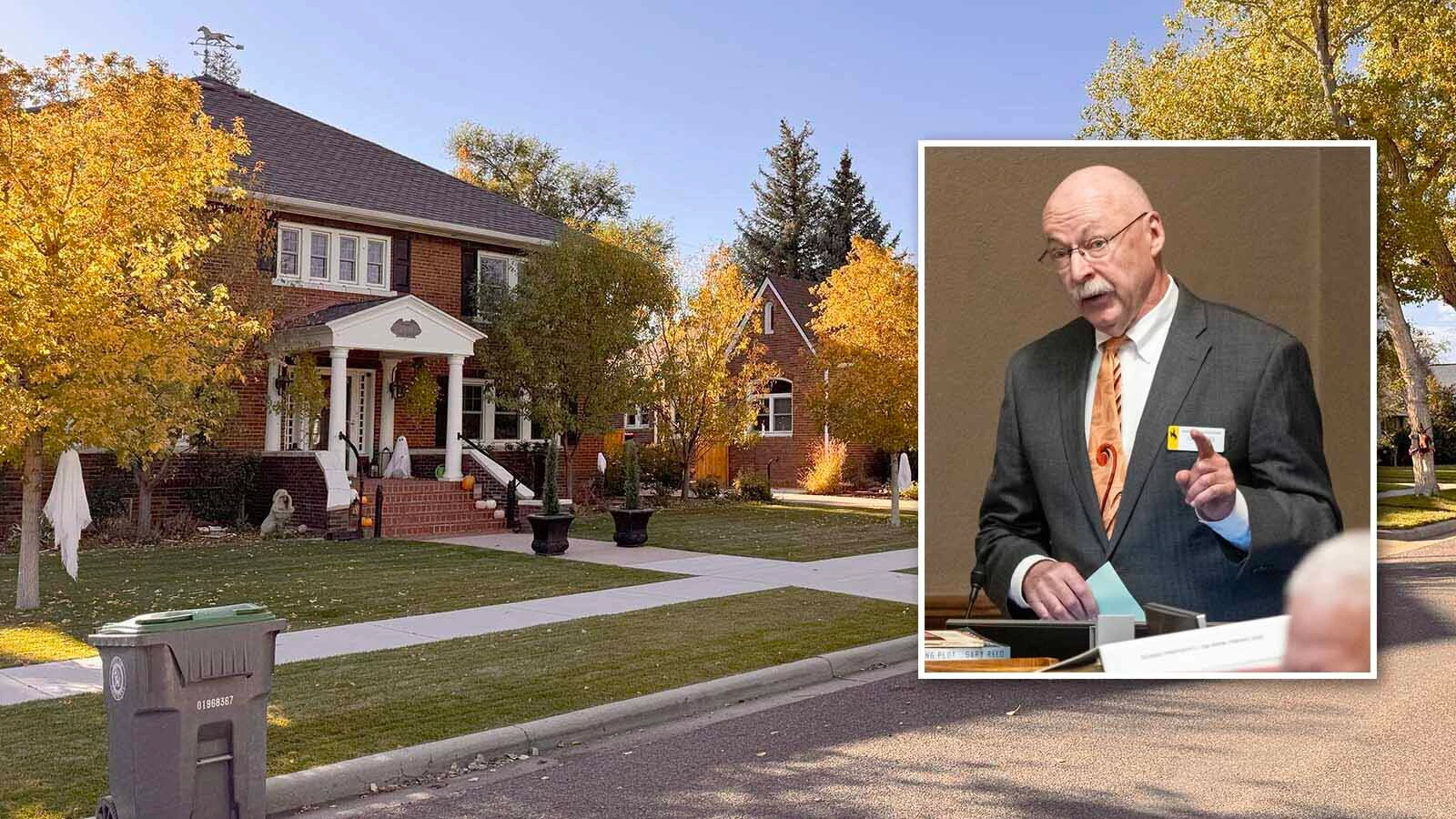
“This is a key point,” said Case, who holds a Ph.D. in economics. “There is nothing that prevents Wyoming from putting in an income tax except our own will, and the fact that an income tax doesn’t raise much money.”
But slashing property taxes would also slash one of the biggest credits a person — especially a wealthy person — could leverage against his income tax, if Wyoming adopted one. So it makes an income tax look more worthwhile, said Case.
'It's Real ... It's Not A Threat'
Lawmakers would be drawn toward taxing the highest incomes rather than lower ones anyway, said Case, because the latter won’t generate much revenue.
“Right now, we face our Constitution: (rich people) own property, and they would have big credits from their property taxes,” said Case. “But here’s the deal. Prop 1 gets rid of that. Now we can look at the possibility of an income tax just for the ultra-rich, for example. Or just people with $1 million or more (annual) income.”
Case didn’t say he’s pushing for an income tax, but said it’s worth considering in light of the credit system, if Prop 1 passes.
“It’s real. It’s not phony. It’s not a threat. It just makes income tax more logical,” he said.
Wyoming doesn’t have personal or corporate income taxation.
It’s been politically unpopular idea historically.
The Legislature advanced the income tax credit clause in 1973 and the voters ratified it the following year.
Former Rep. Mike Madden, R-Buffalo, is an economics Ph.D. who was so instrumental in developing the state’s monetary distribution formula for local governments, the Legislature named it after him.
Madden told Cowboy State Daily on Tuesday that Case’s theory that Prop 1 could tilt legislators toward an income tax “makes logical sense to me.”
Former Rep. Jerry Obermueller, R-Casper, told Cowboy State Daily that Case’s theory is “correct.”
The Revenue Committee examined the possibility of imposing income taxes in about 2017.
“It didn’t really work because the property tax and sales taxes are a credit against the calculated income tax,” he said. “If you cut property tax in half, all of a sudden the picture looks much more attractive to have an income tax at the highest level of income.”
Obermueller, who was a CPA before his six years in the Legislature, opposes Prop 1. So do Case and Madden.
If it becomes law, the cut would apply to primary home structures of people who have lived in Wyoming for at least a year, and in that home for at least six months of the prior year.
The Skeptic
A fourth economics buff, former Gov. Dave Freudenthal, wasn’t as sure about Prop 1 rendering income taxes feasible.
“As a matter of theory, it’s possible,” said Freudenthal, who earned a bachelor’s degree in economics before securing his juris doctorate from the University of Wyoming College of Law. “But I think the mechanics of it will defeat the idea.”
For example, an income tax would leave individuals with the burden of tallying all their sales taxes, to glean the credit.
“I think it’s a theoretical possibility, and maybe a mechanical impossibility,” said Freudenthal.
Like Case, Madden, and Obermueller, Freudenthal opposes Prop 1.
Freudenthal said during a Monday interview on Cowboy State Daily’s Morning Show With Jake that his opposition isn’t an ideological stance, but a pragmatic one. The former governor said he believes the Legislature should have adjusted its tax rate for funding schools downward during the COVID-era tax spikes, rather than leave the people to codify a permanent or semi-permanent solution via ballot initiative.
But as to Case’s theory, the Legislature can study it if it hopes to find a way.
“Cale’s smart enough, he can figure it out,” said Freudenthal.
Nuts And Bolts
Wyoming assesses residential property taxes at 9.5% of home value, then multiplies that by the number of mills the state’s schools, local governments, and special districts impose. Each mill represents the fraction 1/1000th.
Taxpayers.net ranked Wyoming 38th for residential property tax rates, and USpropertystats.com ranked it 41st.
But home values spiked during COVID, and residential property taxes followed.
Wyoming’s residential assessed values nearly doubled from 2019 to 2024 – from a collective $5.86 billion to $10.15 billion. New homes, not just inflated value, likely drove some of that gain.
The numbers fell starting in 2025, down that year to $8.275 billion.
The Legislature acted, passing a 25% cut on taxes billed on the first $1 million in home value, an exemption for long-term residents over 65, and a 4% cap on annual property tax growth. Lawmakers also expanded the state’s refund program.
Meanwhile, 30,251 people signed a petition to put an alternate 50% cut for qualifying home structures on the 2026 general election ballot.
Election Day is Nov. 3.
Despite the temporary spike, property taxes’ overall trajectory has kept pace with inflation, Obermueller noted.
For example, Wyoming’s mill levy income for funding K-12 schools sat at $280 million in 2019 and at $353.7 million in 2025, meaning that account jumped by 26.1%.
That’s a near-exact match to the U.S. dollar inflation documented over that same timeframe.
“There’s this argument out there that these – property taxes – have been this big windfall and the government doesn’t need all that extra money,” said Obermueller.
He noted that residential property taxes might have been irregular in that equation, which also includes other kinds of property taxes.
But, he added, “The overall impact is, there is no windfall.”
The Legislative Service Office projects Prop 1, if it passes, to cut $109.4 million initially, or $55.4 million than if voters didn’t adopt it but used the 25% exemption.
About two-thirds of property taxes fund schools. The rest goes to local governments, special districts and community colleges.
Firefighters, county and special district leaders have been among the most vocal in their opposition to Prop 1.
‘Unrealized Gain’
Proponents, however, say residential property taxes are like renting from the government.
Wyoming GOP Chair Bryan Miller, who’s leading the party’s official advocacy of Prop 1, told Cowboy State Daily residential property taxes penalize an “unrealized gain” – increased home values that people don’t enjoy as they continue to live in their homes.
Residential property taxes make up about 29% of all property taxes in Wyoming, the Department of Revenue told lawmakers in 2024.
That’s the highest share, followed by oil production (22.5%), natural gas production (18.4%), coal (7.8%), industrial (6.9%), commercial (6.6%), railroads (1.9%) and other lesser sources.
“It does anger me that we have public officials and we have fire chiefs out there trying to tell everybody the sky is falling when they know darn well it’s not,” said Miller.
The Laramie County Fire Authority made headlines last week for announcing that declining revenues, including from prior property tax decreases, made it cancel its trunk-or-treat Halloween event.
Detractors called the announcement “propaganda” to dampen Prop 1, and suggested the department focus more on essential services.
Get Creative Now
Wyomingites can’t dedicate revenues or direct appropriations with their ballot initiatives, the state Constitution says.
That leaves the state Legislature to decide if the state should compensate local governments, schools and special districts for their lost revenues, if Prop 1 passes.
It also saddles lawmakers with the question of how they’d do that.
Obermuller doubts they will.
“What would their interest be in fixing something that the citizens themselves voted for, which is a cut in services?” he asked. “That’s not a good assumption, that the Legislature would automatically want to do that.”
Prop 1 proponents say Wyoming should pull from its investment or rainy day funds.
The investment funds are largely driven by mineral taxation, and minerals are an irreplaceable asset, opponents have countered.
“Every one of those funds has a purpose,” said Case. “The permanent mineral trust fund, especially, doesn’t belong to us. It belongs to Wyoming’s future.”
Clair McFarland can be reached at clair@cowboystatedaily.com.