

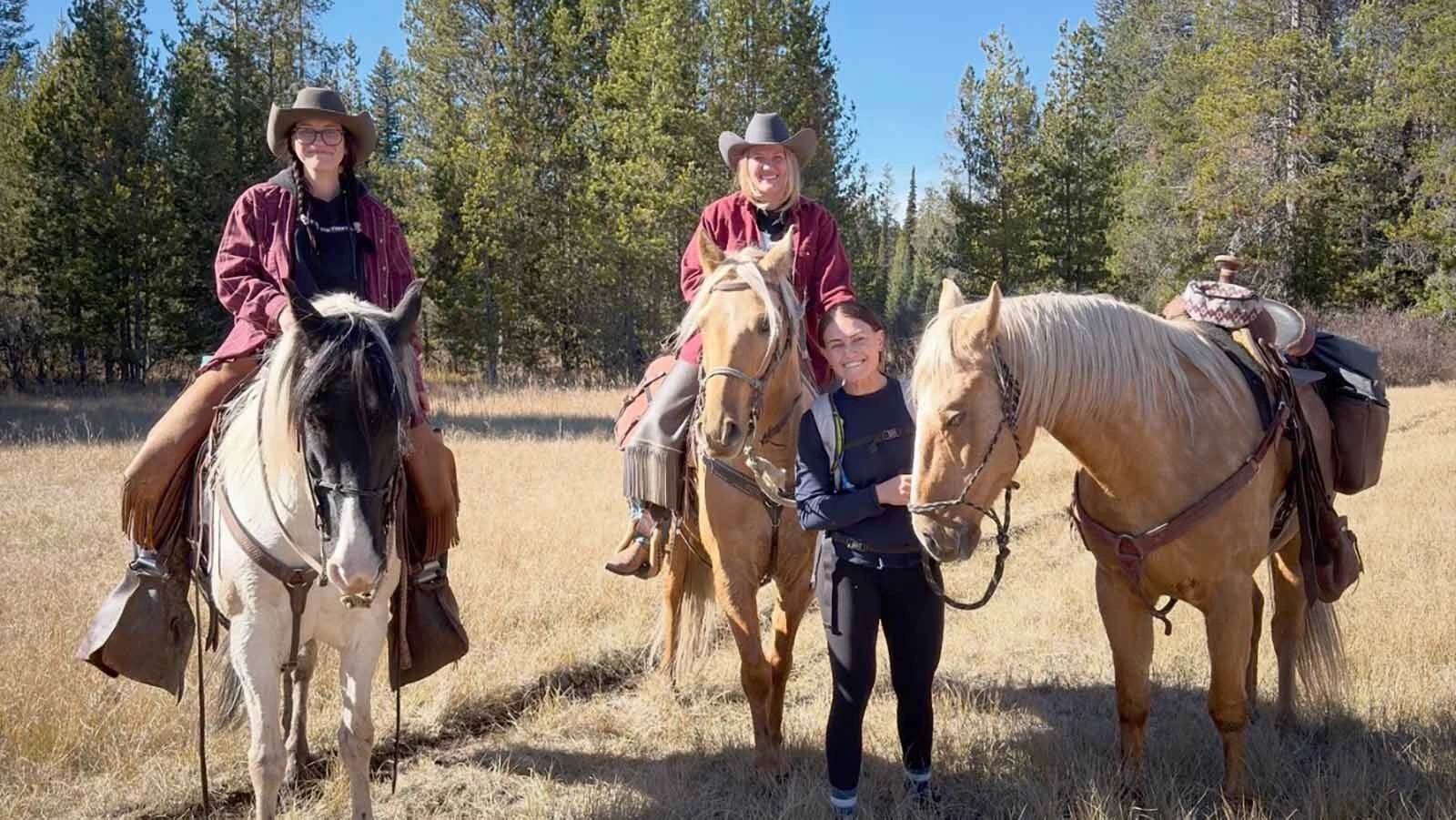
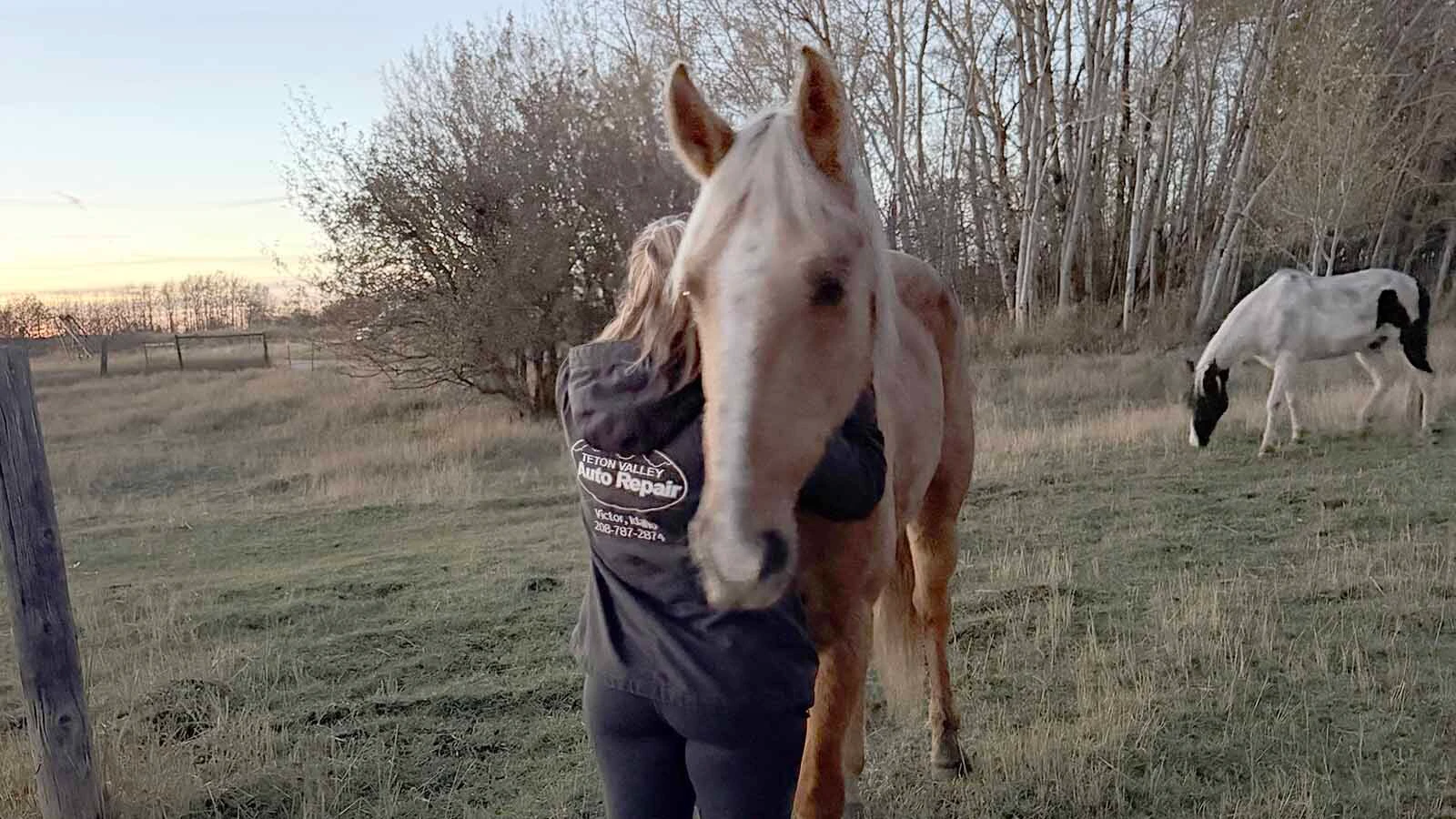
When Sue the horse disappeared into the Yellowstone backcountry, he wasn't entirely off the technological grid.
Tucked into the 15-year-old palomino's saddle was owner Paige Chavez's iPhone.
That seemed like it ought to make finding a 1,000-pound animal in the wilderness considerably easier. Chavez's family tried Apple's Find My feature and contacted Verizon, hoping the cellphone company could simply ping the phone and tell them where Sue was.
It didn't happen.
“Verizon will not ping it,” Chavez's sister Morgan D'Ambra told Cowboy State Daily while the search was underway. “They're standing their ground on that.”
Sue was found alive and well after a week in Yellowstone, remarkably just half a mile from Dunanda Falls, where he'd disappeared.
The phone wasn't with him anymore.
“The only things lost were my bridle, my phone, and a little weight on Sue,” Chavez said after the reunion. “Even though my phone wasn't on my saddle in the end, I still hate Verizon.”
The episode raises a question that matters beyond one wayward horse: If a cellphone disappears with someone in Wyoming's backcountry, can't the carrier just ping it?
The answer is more complicated than it sounds.
Verizon Can Help … Sometimes
Verizon did not respond Monday to Cowboy State Daily's questions about Sue's case, including what information the company had from Chavez's phone, whether it could have provided a last known location, or whether the outcome might have been different had law enforcement made the request.
Verizon's own published policies, however, show that cellphone information is regularly provided in genuine emergencies — and search-and-rescue operations are specifically among them.
In its transparency reports, Verizon says it receives emergency requests from law enforcement involving threats of death or serious physical injury.
Those aren't rare requests.
In the second half of 2024 alone, Verizon reported receiving 36,564 emergency requests from law enforcement involving danger of death or serious physical injury, plus 6,982 requests from 911 centers connected to particular emergency calls.
Verizon says many of those emergency requests arise in search-and-rescue operations or efforts to locate missing children and elderly people.
So the idea of using Verizon data to find somebody lost in the wilderness isn't hypothetical.
It happens.
The important distinction in Sue's case is who was missing — and who was asking.
A Horse Isn't A Missing Person
Federal law generally restricts cellphone providers from simply handing customer communications and records to anyone who asks.
There is an emergency exception.
A provider may disclose certain customer information to a government entity if the company believes in good faith that an emergency involving danger of death or serious physical injury to a person requires disclosure without delay.
That's a potentially significant distinction in Sue's case.
Nobody was missing with the phone.
A horse was.
Chavez had made it safely out of the backcountry after Sue slipped and fell near Dunanda Falls, briefly trapping her beneath him. Chavez lost her glasses in the fall, and Sue got back to his feet and disappeared before she could see where he'd gone.
The family then spent a week searching.
That doesn't mean Verizon definitely could not have provided information, or that no other legal avenue was available.
But federal law's emergency provision is written around the threat of death or serious physical injury to a person, not the loss of property or an animal — and Verizon's own descriptions of emergency requests center on requests coming from law enforcement and 911 centers.
In other words, calling your cellphone provider and asking it to locate a missing device isn't necessarily the same thing as law enforcement requesting information in a life-threatening search-and-rescue operation.
Can They 'Ping' It?
There's another wrinkle.
“Ping the phone” makes the technology sound a lot simpler than it is.
Verizon says its Enhanced 911 system can automatically provide emergency call takers with a cellphone number, the cell site and sector handling a call and, when available, an estimated latitude and longitude.
For GPS-capable phones, Verizon says its network can work with the phone's GPS technology to estimate its location during a 911 voice call.
But Verizon makes an important point in its own explanation of the technology: A cellphone isn't a standalone tracking beacon that the carrier can simply switch on from afar.
According to Verizon, its E911 location capability becomes functional after a 911 call prompts the network to determine the phone's location.
Even then, it isn't perfect.
Verizon warns that terrain, weather, buildings and other conditions can affect the accuracy of a location estimate.
That's particularly relevant in a place like the Bechler region of Yellowstone, the isolated southwest corner of the park where Sue disappeared about 8 miles from the Bechler Ranger Station.
By the time D'Ambra spoke with Cowboy State Daily during the search, the family believed Chavez's phone had died.
What Verizon knew about the phone before it died — including whether it had recently communicated with the company's network and whether Verizon possessed useful historical location information — remains unknown.
Verizon did not answer those questions.
Yellowstone Doesn't Say
Cowboy State Daily asked Yellowstone National Park whether its rangers or dispatchers contacted Verizon or submitted an emergency request seeking location information from Chavez's phone.
The park was also asked whether such a request had been considered and whether Yellowstone has a protocol for requesting cellphone information from carriers during backcountry search-and-rescue operations.
Yellowstone Public Affairs did not answer those specific questions.
“The horse that was loose in the Bechler area has been recovered,” Yellowstone spokeswoman Linda Veress responded.
Cowboy State Daily followed up, noting that Sue's recovery was already known and asking again whether Yellowstone had contacted Verizon during the search and whether the park has a procedure for seeking cellphone location data.
They said they did not have any additional information.
Horse Found, Phone Lost
Ultimately, none of the technology found Sue.
Chavez and relatives returned to the area Friday and were crossing water on foot when she came up a bank and saw Sue looking back at her.
He was about a half-mile from where he'd vanished a week earlier.
The outcome was about as good as Chavez's family could have hoped for, but it also exposed the limits of something many people carry into the Wyoming wilderness assuming it amounts to a tracking device.
A cellphone can provide rescuers extraordinarily useful information under the right circumstances. Verizon's own records show carriers routinely work with authorities in life-threatening searches — but carrying a cellphone doesn't mean a worried family member can call the carrier and ask for a dot on a map.
Kolby Fedore can be reached at kolby@cowboystatedaily.com.


