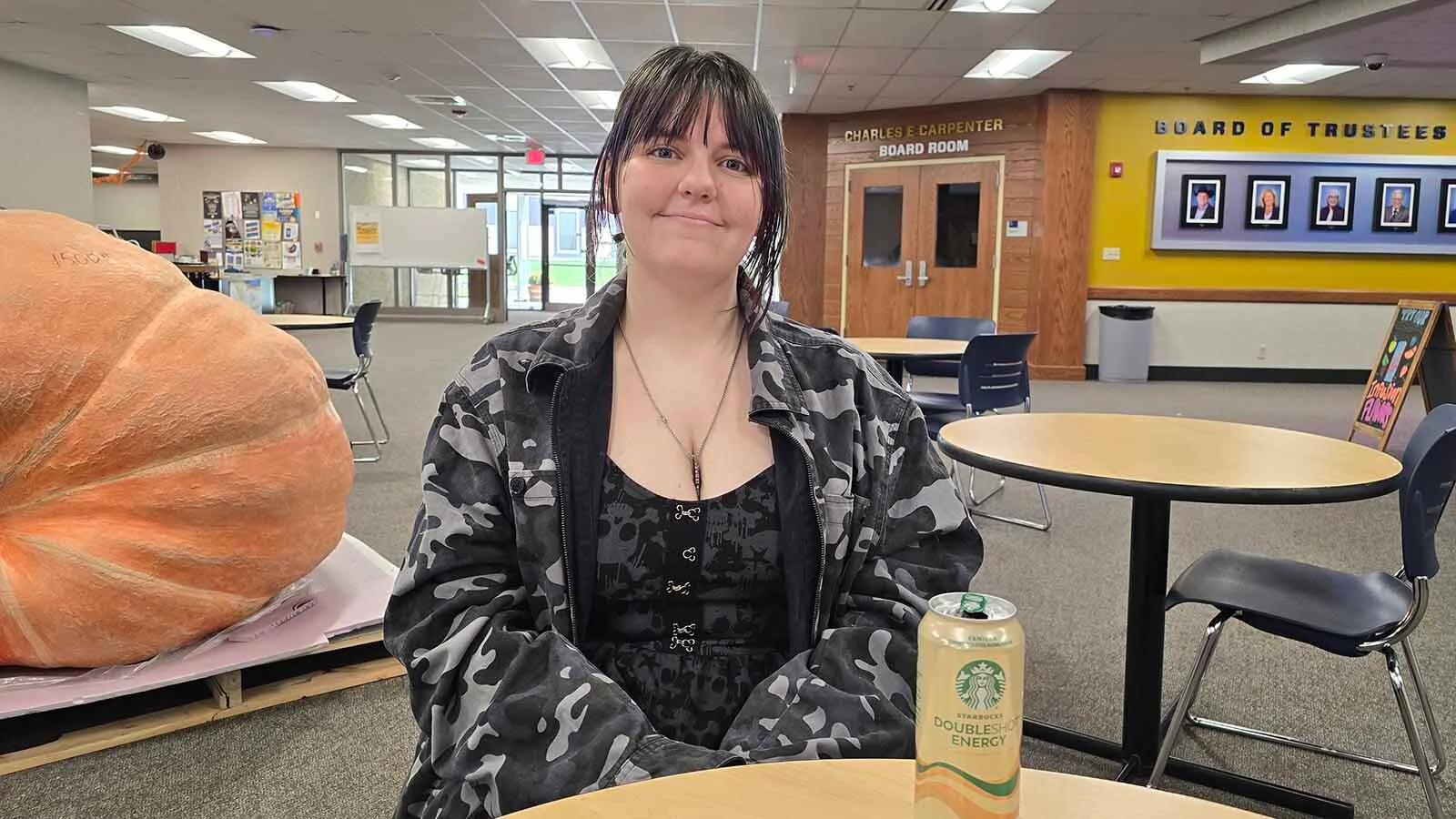
Abigail Campbell was quick to open doors for others as she headed to meet with her professor at Laramie County Community College, a Starbucks Doubleshot Energy drink in hand.
Campbell has never brought coffee to a job interview, she told Cowboy State Daily. But she has carried in her own water bottle — and sees little difference.
“If we’re supposed to be waiting in a room for our interview and they offer us coffee, what would be so wrong about bringing our own?” she asked. “It just means we’re prepared. So sorry we came prepared to be alert and active during our interview.”
Campbell did not know about the viral TikTok debate touched off after corporate recruiter Caitlin Wehniainen scolded a Gen Z job applicant for bringing an iced latte to an interview, saying it gave the impression the interview was just another errand.
Career commenters were divided about whether bringing one’s own coffee to a job interview was a dealo-breaker.
Some saw the beverage as a needless distraction and a risk, while others said rejecting a candidate over it reveals more about an employer’s culture than the candidate’s professionalism.
The debate over whether an applicant can carry coffee into an interview might seem trivial on the surface.
But conversations with Wyoming workers, hiring managers, and human-resources professionals suggest it reflects larger shifts in what professionalism means today — from dress codes to pay, schedules and how much employers should expect work to shape an employee’s life.
Campbell, 22, has been in the job market since she was 16. She said the coffee question is probably situational.
“I notice a lot of boomer-age people, who are going to retire soon, have a completely different aspect of what a job should be,” she said. “Like, they want me to dress professionally, use professional things, have no face piercings, no dyed hair, none of that.”
She’s noticed that most Gen X bosses care much less about such things.
“We can have CEOs who have dyed hair and piercings and tattoos,” she said. “So I think it’s definitely what market you’re going into.”
For Employers, Context Matters
The hiring managers Cowboy State Daily talked with gave answers ranging from “not impressive” to “wouldn’t bother me at all.”
One even suggested it might be seen as a plus.
Blossom Ko Lumley is co-founder of Airloom Energy and director of Startup Wyoming, a statewide initiative to support high-growth potential companies.
“Since I work with startup founders and people interested in becoming startup founders, the vibe is looser and less traditionally corporate than it would be in other industries,” she told Cowboy State Daily. “Since startups are, by definition, disruptive rule breakers, that vibe would extend to the folks I’d be looking to hire as well. So bringing coffee to an interview wouldn’t bother me at all.”
Lumley added that because her workplace is remote, many interviews would likely happen at a coffee shop anyway.
“I think Gen Zers would just need to do their homework on the type of company they’re interviewing with,” she said. “And err on the side of caution as far as how they present themselves.”
Nicole Romeo is senior director of human resources and culture at the Sheridan County YMCA and president of the Wyoming Society for Human Resource Management.
To her, the bigger issue isn’t whether the applicant brought coffee. It’s whether the applicant is on time.
“I’m a Gen Xer, so I’m pretty casual as well,” she said. “But if they came in and said, ‘I brought my own coffee and I’m late because I was in the coffee line,’ I’d be like, ‘Ooh, not impressive. Sorry.’”
That said, Romeo herself has never brought coffee to a job interview. Mainly, though, she sees it as situational.
“Being a senior director in HR, my last couple of job interviews were extremely high-level professional positions,” she said. “So I wouldn’t have even brought a bottle of water with me. Although that’s perfectly acceptable for most places, I just feel like it’s kind of one of those things where you just wait to see if they offer you a beverage or not.”
Changing Work Expectations
Cam-Plex Executive Director Aaron Lyles told Cowboy State Daily he’s seen plenty of candidates arrive with water bottles.
“I can’t recall anyone who brought coffee for the interview or walked in with their personal cup,” he said. “But we are seeing an increase in people not dressing traditionally for interviews. Also a very high rate of no-shows as people apply for jobs to keep their unemployment requirements met.”
Lyles said the larger change is that prospective employees are more direct about the schedules they’re willing to work. That includes “lots of no overtime wanted, no outside or second/third shift hours, etc.”
The sentiment seems to have become “I need work to support my other interests/life goals,” Lyles added, rather than “I need to have purpose in my work.”
“That isn’t a specifically generational sentiment,” he said. “But we are hearing a lot more of it than we used to.”
Salary Questions Come Up Earlier
Romeo said young applicants are raising pay and benefits much earlier, and more directly, than they once did.
“They’re very interested in the things we were always raised to not talk about,” Romeo said. “So salary, leave, benefits, and how we address work-life balance. I hate to say ‘back in the day,’ but back in the day, you never asked about those things in an interview, because it would be seen as you just wanting the job for perks. But they’re more interested in how the job can fit into their life, versus how they can tailor their life around a job.”
Campbell, who is working toward her CPA, said she has asked about salary at every job interview and didn’t realize it was taboo.
“I’m the one paying for my housing,” she said. “I’m the one paying for my food. If you’re not even close, I can’t accept this job.”
She would prefer to know up front if the job she’s interviewing for is even in the right ballpark. That way, no one on either side of the desk is wasting their time.
She also said she believes it might be time for employers to adapt. The world is changing, and the balance of power in the job market is shifting.
“We know the job market needs people,” she said. “We know that we’re going to need a lot of people in entry-level positions in the next five years because we’re losing an entire generation.”
What Happens To The Cup?
For Wyomingite Stacie McDonald, vice president of strategic communications for Harry Marketing in New York, the relevant question isn’t whether a candidate brings coffee. It’s what the candidate does with the cup afterward.
“We watch to see what a candidate does with — usually our — coffee or water cup at the end of the interview,” she told Cowboy State Daily. “Do they attempt to clear the cup themselves or throw it away, or do they leave it on the conference room table for us to handle? That’s often telling.”
McDonald also asked her younger co-workers if they would bring coffee with them to a job interview and most said they wouldn’t.
“They said that probably their parents would have told them at some point, ‘No, you wouldn’t bring anything,’” McDonald said. “You could bring a notebook, but you wouldn’t bring your beverage or water bottle or anything.’”
Campbell, hearing about the beverage test, was shocked anyone would dare leave a coffee cup behind for someone else to clean up.
“If I just left this in my classroom, I’d run back. I’d feel so bad,” she said, gesturing toward her energy drink. “Everyone says, ‘I am your teacher, I am your manager. I’m not your mother. I will not clean up after you.’”
Just Be Up Front
McDonald agreed that workplace norms are changing.
“The people who are hiring are typically a little older, but that is starting to shift,” McDonald said. “So can you wear jeans now and can you bring your coffee cup? Does it depend on the kind of interview it is?”
To Campbell, workplace expectations have become fragmented and tough to parse from one employer to the next. The coffee debate makes that clear with so many different opinions about it surfacing.
To some it’s a dealbreaker. To others, it might signal a plus. And to still others, it’s about what happens to the cup itself once the coffee is gone.
“No one is going to know how an interview should go unless you tell them,” Campbell said. “I never knew it would be bad to take coffee to an interview. I never did it, but I wouldn’t have thought anything wrong about it.”
Her generation, she added, was raised by millennials — the people who “make jokes out of the workplace” and are making offices “all colorful and everyone gets a yoga ball for a chair.”
That, she said, is a different workplace than what Boomers are used to.
“So if you want a certain code of conduct, state that,” she said. “State your company’s values in a job listing … Instead of doing a whole bunch of interviews that you’re not really gonna hire, be more upfront.”
Her generation is “down to listen,” she added, pointing to her nearby cell phone.
“That’s all we do,” she said. “Our entire life is listening. You’ve just got to tell us.”
Renée Jean can be reached at renee@cowboystatedaily.com.