
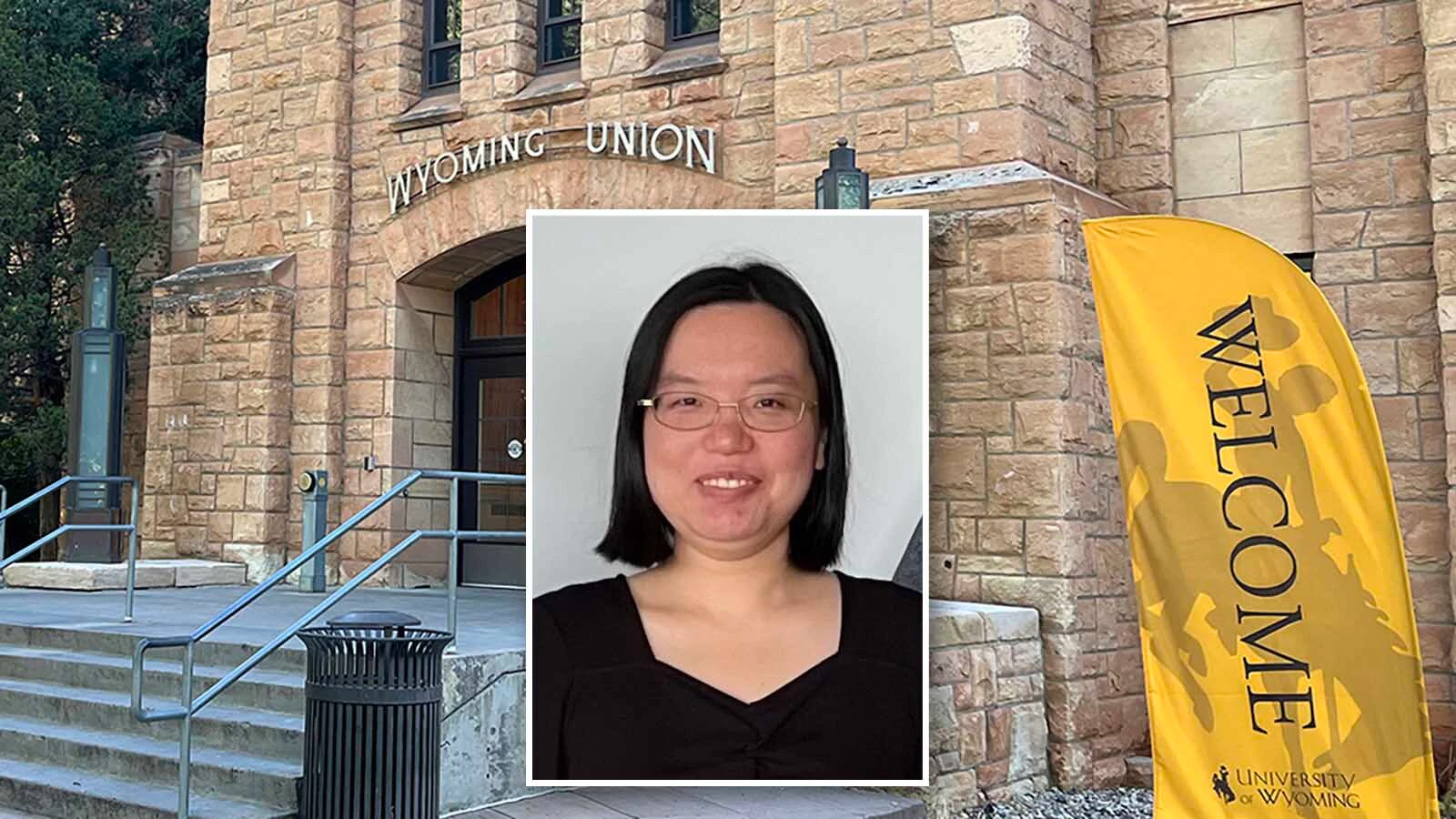
A Chinese national accused of poisoning a microbiology researcher colleague at the University of Wyoming was arrested last week when trying to flee the country through the Los Angeles airport, prosecutors say.
Aili Wang, 32, is charged in Laramie Circuit Court with one count of aggravated assault, which is punishable by up to 10 years in prison and $10,000 in fines.
The evidentiary affidavit by University of Wyoming Police Department detective Kiernan A. Quinonez says a researcher with pending patents, who had been working on new technology to address cancer, neurological and genetic disease treatments, started experiencing strange symptoms in August.
The man, identified as “KT,” reported tingling and numbness in his fingertips, restless leg sensations, and weakness in his legs starting Aug. 10, the affidavit says.
That numbness later spread through his left arm and all his fingertips. KT went to the UW student health clinic, then underwent evaluation and blood testing, with checkups continuing to date, the document adds.
It was reported, wrote Quinonez, “the two parties have not gotten along and Wang does not like KT.”
Before coming to the United States on a temporary visa, Wang was working in the field KT now occupies. But their fields don’t match now, the affidavit says.
The Wife
On Sept. 21, Quinonez spoke with a woman the affidavit calls “PH,” who is KT’s wife.
The wife provided samples of water sources taken from the UW agricultural building, showing water data taken from KT’s coffee maker. The samples contained elevated amounts of acrylamide, a neurotoxin that can cause major health issues with prolonged exposure, Quinonez wrote.
The analysts in the agriculture building, whom the affidavit doesn’t identify by name, conducted an evaporation test on 100 milliliters of boiled water form the coffee maker, which left behind 63 milligrams of white powder that tested positive for acrylamide, reportedly.
That powder was turned over to UWPD as evidence.
Takashi Suyama, the assistant professor of bioorganic chemistry, explained the analysis to Quinonez, the document says.
Analysts also took water samples from the ag building’s water, molecular biology professor Mark Gomelsky’s office, distilled water, and KT’s coffee maker.
Only KT’s coffee maker tested positive for acrylamide, the affidavit says.
Quinonez wrote that he took a report that Wang was suspected of poisoning KT. The affidavit doesn’t say who identified Wang as the suspect.
Cameras
Quinonez received a surveillance camera that had been placed in Ag room 6003 – which contained KT and Wang’s shared office space.
The detective reviewed the footage and could see Gomelsky installing the camera, a janitor vacuuming, and the office lights turning on, he wrote.
UWPD then bought its own camera and ran its own surveillance operation.
Quinonez noted that Wang had a card-swipe-documented entry into the area three minutes after midnight Sept. 18. He checked the surveillance system Sept. 28.
The detective saw that Wang accessed the building at 8:26 p.m. Sept. 27.
At some point, KT set up his own surveillance camera as well, the document says.
A camera – the affidavit doesn’t say which – showed Wang entering the room one night, going through KT’s desk, picking up his coffee tin and inspecting its contents, Quinonez wrote.
The detective wrote that Wang walked back and forth, sat on a desk, and used her phone.
Quinonez turned over the hidden camera to a UWPD sergeant on Sept. 29, then reinstalled the surveillance kit. On Oct. 1, KT reported new video footage.
Quinonez checked the card-swipe entry data and noticed Wang entered the building eight minutes after midnight Oct. 1.
The video showed Wang inside the office, rinsing out KT’s coffee mug with liquid from her coffee mug, taking photos and “manipulating notebooks” on KT’s desk, says the affidavit.
The camera also reportedly showed Wang looking into KT’s coffee maker.
KT told Quinonez that his research was in a patent pending process. Wang was reportedly working on similar research in China before coming to the U.S., the document says.
Gomelsky, who oversaw KT at UW, confirmed KT’s research was federally funded, tied to a company and had pending patents. The professor also confirmed to Quinonez that Wang had no reason to access KT’s research notes.
From eBay
UWPD Chief Joshua Holland received university email data from UW’s IT team, the affidavit says.
Wang’s uwyo.edu account was used to buy acrylamide from eBay, the document adds.
It says the email placed an order for acrylamide June 27, and it was delivered July 6. The affidavit says that account placed a second order Aug. 24, and it was delivered Sept. 8.
On Oct. 5 – one day before Wang was charged – the account asked eBay to delete its order history and account, the affidavit says.
Police interviewed Wang on Oct. 5, reportedly.
“She informed (me) she had not used acrylamide in years,” said Quinonez in the affidavit.
$15 Million, Cash
Albany County Deputy Attorney Jennifer Curran charged Wang with the felony Oct. 6.
Laramie Circuit Court Judge Robert Sanford initially issued a warrant for her arrest with a $200,000 bond attached to it.
On Oct. 8, another deputy prosecutor Joel Defebaugh asked Sanford to hike that bond to $15 million, cash only, with tight restrictions to keep Wang in Albany County.
Wang had fled Wyoming and was trying to flee the country to return to China, but was stopped at Los Angeles International Airport over “this matter,” wrote Defebaugh.
“If defendant is able to return to the People’s Republic of China, the U.S. does not maintain a bilateral agreement for extradition and there is no reliable mechanism to secure defendant’s return,” wrote Defebaugh.
She’s a foreign national on a temporary visa, but no longer has work in Wyoming, nor does she have meaningful ties to anchor her to the area, the prosecutor added.
When airport authorities arrested her, they found multiple laptops, portable external digital storage devices, physical records, and written materials in her possession.
The Los Angeles Police Department has those, the prosecutor said.
Sanford granted Defebaugh’s request to hold Wang on the $15 million bond once she’s returned to Albany County. The judge also stipulated that anyone wishing to bond her out at that sum would be reviewed to ensure the money came from “legitimate verifiable sources.”
Wang will have to surrender all passports and travel documents, and if she’s bonded out, she’ll be on electric monitoring with geofencing, and ordered to avoid victims and witnesses in the case, Sanford’s order says.
This case is pending.
UW said in a Tuesday statement that it continues to assess the situation.
“The university takes matters involving the health and safety of the campus community seriously and remains committed to providing a safe and secure environment for students, faculty, staff and visitors,” UW President Shane Reeves said in the statement.
Clair McFarland can be reached at clair@cowboystatedaily.com.


